
Baptism Into Christ
WHAT BLESSINGS DOES A PERSON RECEIVE WHEN HE IS BAPTIZED BIBLICALLY?
Lesson 1
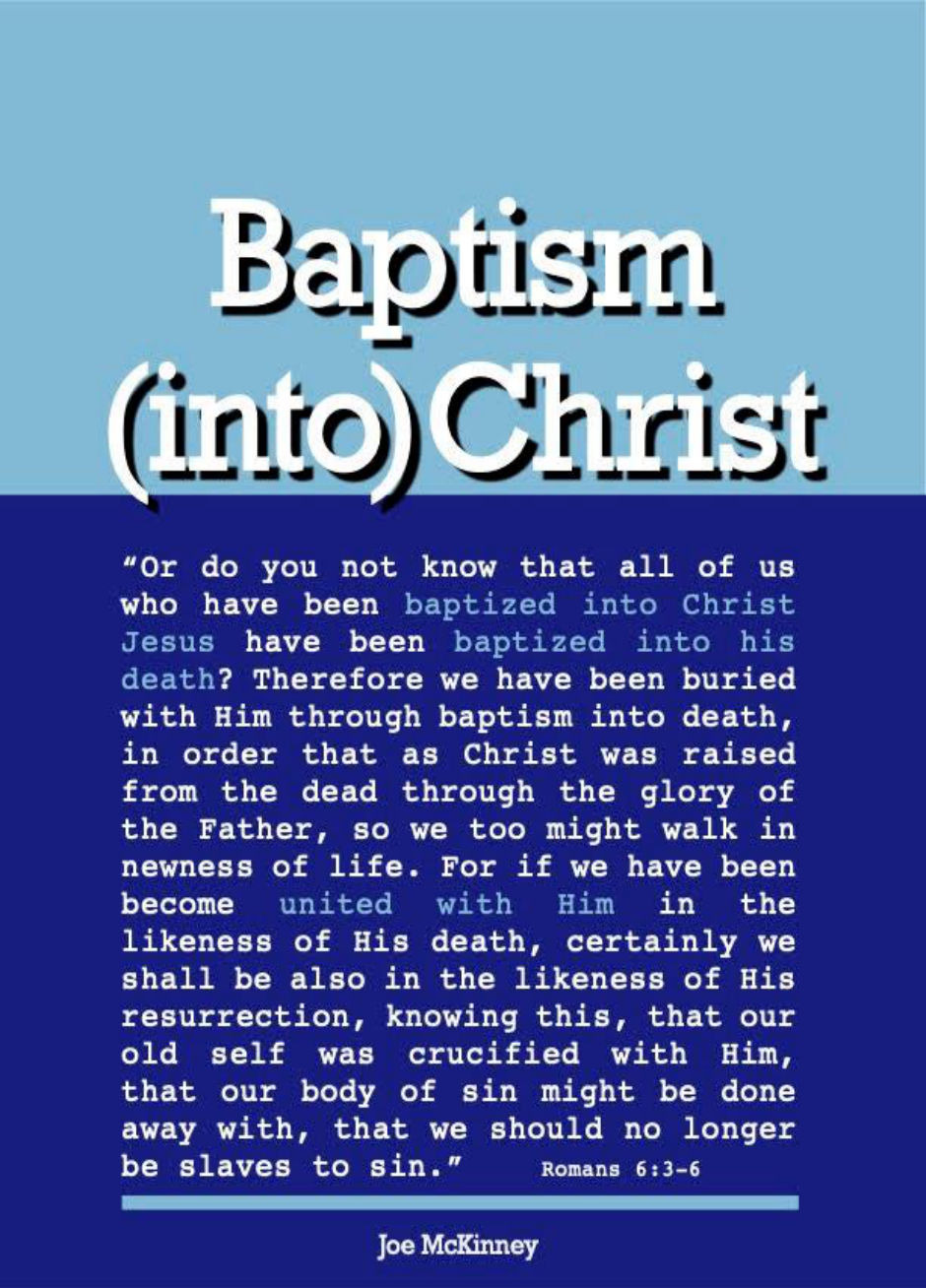
A person is saved when he is scripturally baptized. There are several aspects or ways of expressing this gift of salvation in the New Testament:
- Salvation — Mark 16:15-16
“And He said to them, “Go into all the world and preach the gospel to all creation. He who has believed and has been baptized shall be saved; but he who has disbelieved shall be condemned.”
- Forgiveness of sins — Acts 2:38
“And Peter said to them, “Repent, and let each of you be baptized in the name of Jesus Christ for the forgiveness of your sins; and you shall receive the gift of the Holy Spirit.”
- Receive the gift of the Holy Spirit — Acts 2:38 above
- Sins washed away — Acts 22:16
“And now why do you delay? Arise and be baptized, and wash away your sins, calling on His name.”
- Cleansing – Eph. 5:25-27
“... Christ also loved the church and gave Himself for her, that He might sanctify her, having cleansed her by the washing of water with the word, that He might present to Himself the church in all her glory, having no spot or wrinkle or any such thing; but that she should be holy and blameless.”
- Sanctification — Eph. 5:26 above
- A good conscience — 1 Peter 3:21
“And corresponding to that, baptism now saves you—not the removal of dirt from the flesh, but an appeal to God for a good conscience—through the resurrection of Jesus Christ.”
- Puts off the body of sin — Col. 2:11, 12
“In Him you were also circumcised with a circumcision made without hands, in the removal of the body of the flesh by the circumcision of Christ; having been buried with Him in baptism in which you were also raised up with Him through faith in the working of God, who raised Him from the dead.”
- Raised with Christ — Col. 2:12 above
- Born again — John 3:3-5
“Jesus answered and said to him, ‘Truly, truly, I say to you, unless one is born again, he cannot see the kingdom of God.’ Nicodemus said to Him, ‘How can a man be born when he is old? He cannot enter a second time into his mother’s womb and be born, can he?’ Jesus answered, ‘Truly, truly, I say to you, unless one is born of water and the Spirit, he cannot enter into the kingdom of God.’”
- Baptized into the death of Christ - Romans 6:3-6
“Or do you not know that all of us who have been baptized into Christ Jesus have been baptized into his death? Therefore, we have been buried with Him through baptism into
death, in order that as Christ was raised from the dead through the glory of the Father, so we too might walk in newness of life. For if we have been become united with Him in the likeness of His death, certainly we shall be also in the likeness of His resurrection, knowing this, that our old self was crucified with Him, that our body of sin might be done away with, that we should no longer be slaves to sin.”
- Become a child of God — Gal. 3:26, 27
“For you are all sons of God through faith in Christ Jesus. For all of you who were baptized
into Christ have clothed yourselves with Christ.”
- Be clothed with Christ — Gal. 3:27 above
- Enter into Christ — Gal. 3:27 and Romans 6:3 above
NOTE 1 - The phrase “in Christ” or “into Christ” is very significant! When we enter into Christ, we then are found “in Christ” and it is “in Christ” that all spiritual blessings are given to us (Eph. 1:3, “Blessed be the God and Father of our Lord Jesus Christ, who has blessed us with every spiritual blessing in the heavenly places in Christ”).
- 3:24 — “being justified as a gift by His grace through the redemption which is in Christ
Jesus.”
- 6:11— “Even so consider yourselves to be dead to sin, but alive to God in Christ Jesus.”
- 6:23 — “For the wages of sin is death, but the free gift of God is eternal life in Christ Jesus our Lord.”
- 8:1 — “There is therefore now no condemnation for those who are in Christ Jesus.”
- 12:5 — “So we, who are many, are one body in Christ, and individually members one of one another.”
2 Cor. 5:17 — “...Therefore if any man is in Christ, he is a new creature; the old things passed away; behold, new things have come.”
2 Cor. 5:21 — “He made Him who knew no sin to be sin on our behalf, that we might become the righteousness of God in Him.”
- 3:28 — “There is neither Jew nor Greek, there is neither slave nor free man, there is neither male nor female; for you are all one in Christ Jesus.”
- 1:7 — “In Him we have redemption through His blood, the forgiveness of our trespasses, according to the riches of His grace.”
- 1:11 — “In Him also we have obtained an inheritance.”
- 2:6 — “and raised us up with Him, and seated us with Him in the heavenly places in Christ
Jesus.”
- 2:7 — “in order that in the ages to come He might show the surpassing riches of His grace in kindness toward us in Christ Jesus.”
- 2:13 — “but now in Christ Jesus you who formerly were far off have been brought near by the blood of Christ.”
- 3:6 — “that the Gentiles are fellow heirs and fellow members of the body, and fellow partakers of the promise in Christ Jesus through the gospel.”
- 3:12 — “in whom we have boldness and confident access through faith in Him.”
Phil. 3:9 — “and may be found in Him, not having a righteousness of my own derived from the Law, but that which is through faith in Christ, the righteousness which comes from God on the basis of faith.”
- 2:10 — “and in Him you have been made complete, and He is the head over all rule and authority.”
1 Thess. 4:16 — “...For the Lord Himself will descend from heaven with a shout, with the voice of an archangel, and with the trumpet of God; and the dead in Christ will rise first.”
2 Tim. 1:1 — “Paul, an apostle of Jesus Christ by the will of God, according to the promise of life
in Christ Jesus.”
2 Tim 1:9 — “who has saved us and called us with a holy calling, not according to our works, but according to His own purpose and grace which was given us in Christ Jesus from all eternity.”
2 Tim 2:10 — “For this reason I endure all things for the sake of those who are chosen, that they also may obtain the salvation which is in Christ Jesus and with-it eternal glory.”
1 John 3:5 — “And you know that He appeared in order to take away sins; and in Him there is no sin.” 1 John 5:11 — “And the witness is this, that God has given us eternal life, and this life is in His
Son.”
NOTE 2. These questions are often asked: “Do I have to be baptized in order to be saved?” It might be easier to reply if we asked: “Do I have to be born of the water and the Spirit in order to be saved?” “Do I have to have my sins washed away in order to be saved?” “Do I have to be a child of God in order to be saved?” “Do I have to be ‘in Christ’ to be saved?”
The answer to all these questions is the same – (“yes!”) - Since it is in Christ that all these blessings are bestowed and we are “baptized into Christ”; that is, we come into Christ in the act of being baptized. Baptism is obviously necessary for a sinner to be saved! It is good to remember that the act of baptism is not a work man does whereby he earns salvation. Instead, it is, as we will see in the next section of this study, “an appeal to God for a good conscience – through the resurrection of Jesus Christ.” Questions
- Who are those that will be condemned?
- ____ No one as Jesus saves everybody
- ____ Those who disbelieve, do not obey, the Gospel
- Who will not see the Kingdom of God?
- ____ Jews
- ____ Blind
- ____ Those who are not born again
- The penitent believer who is baptized into Christ Jesus has been baptized into His death.
True ____ False ____
- All in Christ have been blessed with all spiritual blessings
True ____ False ____
- What does one have to do to be saved
- ____ be baptized into Christ death
- ____ be born of the water and the Spirit
- ____ have their sins washed away
- ____ be a child of God
- ____ be in Christ
- ____ all the above
- ____ b, c, d and e
SHOULD A PERSON UNDERSTAND THAT HIS SINS ARE BEING FORGIVEN WHEN HE IS BAPTIZED? I believe the answer is yes, he does. These are the reasons why:
Lesson 2
- In Baptism A Sinner Cries Out To God To Save Him
- Acts 22: 16 — “And now why do you delay? Arise and be baptized, and wash away your sins, calling on His name.” This passage shows that we are baptized to have our sins washed away and in that action of being baptized, we are calling on the name of the Lord. To call on the name of the Lord means to invoke Him to action. (See Call on the Name of the Lord page13.)
Question: In baptism, what are we calling on the Lord to do? Answer: To save us! To wash away our sins!
But what if we don’t feel the need to be saved, because we don’t think Jesus saves or we don’t think we are lost or we don’t really know what we’re doing, or because we think we are already saved?
In this case, how could we be calling on the Lord to save us in baptism? If we didn’t feel the need to be saved, we couldn’t be calling on the Lord to save us! True, scriptural, baptism is an act in which we are asking the Lord to save us from our sins!
This is not to say that for a person’s baptism to be valid, he must say aloud words like: “Lord save me from my sins”. Rather, it means that we are being baptized for that purpose.
- 1 Peter 3: 21 — “Corresponding to that (eight souls saved by water in Noah’s ark), baptism now saves you — not the removal of dirt from the flesh, but an appeal to god for a good conscience — through the resurrection of Jesus Christ.”
Baptism, according to Peter, is not an outer cleansing of dirt from the physical body. Rather, the baptism that saves us is an “appeal to God for a good conscience.” It is a prayer (an appeal, a petition, a request) to God for Him to cleanse our guilty soul of the guilt of sin. This is the very same thought expressed in Acts 22:16 above. Notice how various translators render this phrase in 1 Peter 3:21:
“Baptism is...
- an appeal to God for a good conscience” – NASB
- an appeal to God for a good conscience” – RSV, NRSV
- an appeal to God for a good conscience” – ESV
- making you free from the sense of sin before God” – Basic English
- the prayer for a clean conscience before God” – Moffatt (1935)
- an appeal to God from [or for] a clean conscience” – New Living Translation
- [the] demand as before God of a good conscience” – Darby
- the craving of a good conscience after God” – Weymouth
- the asking of a good conscience in God” – Wycliffe New Testament
- the question of a good conscience in regard to God” – Young’s Literal
- the interrogation of a good conscience toward God” – ASV
- [providing you with] the answer of a good and clear conscience (inward cleanness and peace) before God” – Amplified Bible
- asking God for a pure heart” – Easy To Read Version
- making you free from the sense of sin before God” – Bible in Basic English
- the request unto God for a good conscience” – Rotherham (1897)
- the prayer for a good conscience toward God” – Montgomery (1924)
- the craving for a conscience right with God” – Goodspeed (1935)
Some other translations or paraphrases render this phrase differently:
- the answer of a good conscience toward God. NKJV, KJV
- the pledge (or response) of a good conscience toward God. NIV
- It means turning to God with a clear conscience. Contemporary
English Version
- It means we are saved from the punishment of sin and go to God in prayer with a heart that says we are right. New Life Version
In the New International Version, it is “the pledge of a good conscience toward God,” as if it were because we are already saved and have a good conscience, instead of being “for” or “unto” remission of sins in order to have a good conscience.
But it is rendered by most other translations as an appeal to God for “cleansing” in order to “have ... no more consciousness of sins” (Hebrews 10:2), in accord with Acts 2:38, which speaks of it as “for the remission of sins.” This would make baptism an overt prayer for pardon, without which surely baptism itself would be of no avail.
This seems to not be the easiest phrase to translate. Beasley-Murray makes this comment: “...the disputed phrase can be rendered either as a ‘prayer to God for a good conscience’ or a ‘pledge to God to maintain a good conscience.
On the first interpretation, baptism is declared to be an appeal to God on the part of the baptized, which appeal is answered through the saving act of the risen Christ; this personal dealing between the believer and His Lord makes [baptism] what it is.”
Theological Dictionary of the New Testament (edited by Kittel in Germany, 1935; translated by Bromily in America, 1964): “Prayer to God for a good conscience” (Vol. II, p.688), with the following comment: “In view of v.21, we should expect alla to be followed by a cleansing in the spiritual sense. Thus, the request for a good conscience is to be construed as a prayer for the remission of sins. ... Remission of sins is closely related to baptism from the very outset (Mk.1:4 and par.; Acts 2:38.) This makes a number of other passages fall beautifully into place. For one thing, a “good conscience” (Acts 23:1) is a “conscience void of offence toward God and men” Acts 24:16). For another thing, it harmonizes with what Ananias, sent by the Lord to the believing and penitent Saul of Tarsus, told him yet to do: “arise, and be baptized, and wash away thy sins, calling on the name of the Lord” (Acts 22:16, King James Version; or “calling on his name,” American Standard Version).” It is said: “For there is no distinction between the Jew and the Greek: for the same Lord is Lord of all, and is rich unto all that call upon him: for, whosoever shall call upon the name of the Lord shall be saved” (Romans 10:12-13). “Calling upon the name of the Lord” or
“calling upon him” or praying to him as Stephen did while being stoned, was “calling upon the Lord, saying, “Lord Jesus, receive my spirit” (Acts 7:59). Saul of Tarsus was to “be baptized,” “calling upon the name of the Lord,” in order to have his “sins washed away” and thus have a “good conscience toward God.” His baptism itself, being “for” or “unto the remission of sins,” was an overt request for pardon in order to have a “good conscience.”
The Greek word under consideration in 1 Peter 3:21 is the noun eperotema, the verb form of which is eperotao, meaning to ask; also, according to Thayer, “by a usage foreign to the Greeks, to address one with a request or demand; to ask of or demand of one”, citing Matthew 16:1. Arndt & Gingrich likewise cite Matthew 16:1 as an example of meaning to ask someone for something.” Kittel-Bromily trace the change of the word’s meaning to include (in koine Greek of New Testament times) the last mentioned sense, which was taking place at the time of the LXX (about 250 B.C.) Accordingly, Arndt & Gingrich define eperotema as: “1. question; 2. request, appeal, and cite as an example ‘an appeal to God for a clear conscience 1 Peter 2:21’, in harmony with the goodly number of versions cited above, and Kittel.” Even many scholars who do not wish to concede baptism as being “for,” or “unto remission of sins,” acknowledge that “answer” is not a satisfactory rendering of the Greek verb. But, if not, then the above must be its most likely meaning. It is to me the most satisfactory from every significant angle.
The word “appeal” as used by the NASB, RSV, and others seems to make more sense, meaning that we ask God for a good conscience in the act of baptism. This appears obvious when we read “baptism now saves us.” There is no way for sinners to have a good conscience before being saved. That is what it really means to be saved – to be forgiven of our sins. We are not saved when we “pledge to God to maintain a good conscience.” That would more closely define repentance. On the other hand, when we, in baptism, appeal to God to cleanse our conscience, he does just that - He saves us!
It is not the sinner saying “I promise to never sin again!” that saves him. Rather it is the sinner crying out in the act of baptism “Lord, please, save me!” that saves him. That is the meaning of baptism.
That “appeal” is the better translation and is reinforced by comparing Hebrews 9:13, 14; Romans 6:3-6; Acts 22:16, and 1 Peter 3:21.
Hebrews 9:13, 14 “For if the blood of goats and bulls and the ashes of a heifer sprinkling those who have been defiled, sanctify for the cleansing of the flesh, how much more will the blood of Christ, who through the eternal Spirit offered Himself without blemish to God, cleanse your conscience from dead works to serve the living God?”
Romans 6:3 “Or do you not know that all of us who have been baptized into Christ Jesus have been baptized into his death?”
Acts 22:16 “Arise and be baptized, and wash away your sins, calling on His name.”
1 Peter 3: 21 “… baptism now saves you — not the removal of dirt from the flesh, but an appeal to God for a good conscience — through the resurrection of Jesus Christ.”
From these we see that our conscience is cleansed by the blood of Christ, in baptism we contact his blood (death) and in baptism, we call on the Lord to save us. These three statements fit together perfectly. Salvation is given to us in baptism because it is in baptism that we are appealing (imploring, asking) God to cleanse our conscience by the blood of Christ.
If the person being baptized is unaware of or unbelieving in the truth that God is forgiving his sins (washing away his sins, remitting his sins, cleansing his conscience) in his baptism, then certainly he could not be asking for or appealing for the forgiveness of his sins. Such lack of understanding makes his baptism, not the baptism referred to in 1 Peter 3:21, which baptism “saves” him.
The conclusion is: Salvation (forgiveness of sins), which comes from being united with God in Christ, is given when our trusting hearts appeal to God for a good conscience. We do this when we are baptized. Baptism is faith crying out to God to save, based on the death of Christ on the cross. Baptism is the biblical “sinner’s prayer”, not necessarily spoken but understood and acted out.
- Colossians 2:12 — “buried with Him in baptism, in which you were also raised up with Him through faith in the working of God, who raised Him from the dead.”
The raising to a new life happens in, through or by means of (Greek dia) our faith in God’s operation or working. We, in effect, are trusting in God to save us in that act of baptism.
Note that in baptism it is faith in God’s working. Baptism is God’s work, not ours.
When we are baptized, we believe (trust) that God is working. It is through our faith in His working that He works! For our baptism to be effective we must believe that God is working to raise us to a new life (save us). Again, that’s what baptism is: crying out to God to save us and trusting that He will, based on the cleansing power of Christ’s blood.
Call On The Name Of The Lord
Word study To call on the name of the lord means to invoke Him to action. Read each verse in its own context and you will notice how calling on the name of the Lord means to call out to God to save, help, bless, protect, act, etc.
1 Kings 18:24 — “Then you call on the name of your gods, and I will call on the name of the LORD; and the God who answers by fire, He is God.” And all the people answered and said, “That is a good idea.”
2 Kings 5:11 But Naaman went away angry and said, “I thought that he would surely come out to me and stand and call on the name of the LORD his God, wave his hand over the spot and cure me of my leprosy.
Psalm 105:1 — “Oh, give thanks to the LORD! Call upon His name; Make known His deeds among the peoples.”
Psalm 116:3-4 — “The cords of death entangled me, the anguish of the grave came over me; I was overcome by distress and sorrow. Then I called upon the name of the LORD: ‘O LORD, I beseech Thee, save my life!”
Psalm 116:13 — (NKJV) “I will take up the cup of salvation, And call upon the name of the LORD.”
Psalm 116:17 — (NKJV) “I will offer to You the sacrifice of thanksgiving, And will call upon the name of the LORD.”
Isaiah 12:4 — “And in that day you will say, ‘give thanks to the Lord, call on His name. Make known His deeds among the peoples; Make them remember that His name is exalted.”
Isaiah 64:7 — “And there is no one who calls on Thy name, who arouses himself to take hold of Thee; for thou hast hidden Thy face from us, and hast delivered us into the power of our iniquities.”
Lamentations 3:55 — “I called on Thy name, O Lord, out of the lowest pit.”
Joel 2:32 — “And it will come about that whoever calls on the name of the LORD will be delivered; For on Mount Zion and in Jerusalem there will be those who escape.”
Zephaniah 3:9 — “For then I will give to the peoples purified lips, that all of them may call on the name of the LORD, to serve Him shoulder to shoulder.”
Zechariah 13:9 — “And I will bring the third part through the fire, refine them as silver is refined, and test them as gold is tested. They will call on My name, and I will answer them. I will say, ‘They are My people,’ And they will say, 'The LORD is my God.'”
Acts 2:21 — “And it shall come to pass that whoever calls on the name of the LORD shall be saved.”
Acts 9:14 — “And here he has authority from the chief priests to bind all who call on Thy name.”
Acts 9:21 — “...Is this not he who in Jerusalem destroyed those who called on this name, and who had come here for the purpose of bringing them bound before the chief priests?”
Acts 22:16 — “And now why do you delay? Arise, and be baptized, and wash away your sins, calling on His name.”
Romans 10:13 — “for, Everyone who calls on the name of the Lord will be saved.”
1 Corinthians 1:2 — “to the church of God which is at Corinth, to those who have been sanctified in Christ Jesus, saints by calling, with all who in every place call upon the name of our Lord Jesus Christ, their Lord and ours.” Questions
- Through the act of baptism, one realizes he is a sinful man, recognizes Jesus is Lord and
Savior, and pleads to God to wash away his sin by the blood of Christ. True ____ False ____
- Baptism only washes away the dirt from the body
True ____ False ____
- Baptism is just a tradition as one is saved when they believe Jesus is the Christ
True ____ False ____
- One’s conscience is cleansed when God answers their appeal for forgiveness through their act of baptism.
True ____ False ____
- Salvation comes from being united with God in Christ.
True ____ False ____
- To call on the name of the Lord means to invoke Him to some type of action.
True ____ False ____
DOCTRINE OF JUSTIFICATION
Lesson 3 The doctrine of justification by faith demands that a person understand and believe that his sins are being forgiven when he is baptized. It is important, therefore, for us to know what justification means.
To help us understand this word, think about the super-religious, do-gooder, self-righteous hypocrite, pillar of the church, and the dirty, rotten, no-good, traitorous, wicked, extortioner, sinner at his side. “And He also told this parable to certain ones who trusted in themselves that they were righteous, and viewed others with contempt: ‘Two men went up into the temple to pray, one a Pharisee, and the other a tax-gatherer. The Pharisee stood and was praying thus to himself, “God, I thank Thee that I am not like other people; swindlers, unjust, adulterers, or even like this tax- gatherer. I fast twice a week; I pay tithes of all that I get.” But the tax-gatherer, standing some distance away, was even unwilling to lift up his eyes to heaven, but was beating his breast, saying, “God, be merciful to me, the sinner!” ‘I tell you, this man went down to his house justified rather than the other; for everyone who exalts himself shall be humbled, but he who humbles himself shall be exalted.’” (Luke 18:9-14)
- What does it mean to be justified? What is justification?
Justification is a legal term. Justification, defined in Young's Analytical Concordance, means “A judicial sentence, declaration of right, to make or declare right.” Vine's Dictionary of New Testament Words says that justify “denotes the act of pronouncing righteous, justification, acquittal.”
The person who is justified is declared or pronounced to be righteous. (The same Greek word translated “just” 33 times in the New Testament is translated “righteous” 41 times). Declaring a person justified is the same thing as pronouncing a man righteous.
Perhaps knowing that “just” and “righteous” are two ways to translate the very same Greek word will help us understand that to be justified does not mean to be made “just-as-if-I” had never sinned. Just having no sin does not make us acceptable in God’s eyes. We must have our sins “subtracted” and also Christ’s righteousness “added”. Justification is when the criminal is not only declared innocent of the crimes, he committed but also declared to be a righteous person.
There is a difference between “being righteous” and “being declared righteous”. We are declared to be righteous the moment we are saved. We spend our lives becoming righteous as we grow spiritually into the image of Christ. Justification is exclusively a work of God in which He imputes to us the righteousness of Christ.
There are two kinds of righteousness: imputed (attributed, ascribed or reckoned) righteousness and earned righteousness. Consider Philippians 3:3-9: “for we are the true circumcision, who worship in the Spirit of God and glory in Christ Jesus and put no confidence in the flesh, although I myself might have confidence even in the flesh. If anyone else has a mind to put confidence in the flesh, I far more: circumcised the eighth day, of the nation of Israel, of the tribe of Benjamin, a Hebrew of Hebrews; as to the Law, a Pharisee; as to zeal, a persecutor of the church; as to the righteousness which is in the Law, found blameless. But whatever things were gain to me, those things I have counted as loss for the sake of Christ.
More than that, I count all things to be loss in view of the surpassing value of knowing Christ Jesus my Lord, for whom I have suffered the loss of all things, and count them but rubbish so that I may gain Christ, and may be found in Him, not having a righteousness of my own derived from the Law, but that which is through faith in Christ, the righteousness which comes from God on the basis of faith, (This is imputed righteousness).”
- We are justified (saved, counted as righteous) by faith.
“For we maintain that a man is justified by faith apart from works of the Law.” (Romans 3:28)
“knowing that a man is not justified by the works of Law but through faith in Christ Jesus, even we have believed in Christ Jesus, that we may be justified by faith in Christ, and not by the works of the Law; since by the works of the Law shall no flesh be justified.” (Galatians 2:16)
“Now that no one is justified by the Law before God is evident for, ‘The Righteous Man Shall Live By Faith.’” (Galatians 3:11)
“For we also once were foolish ourselves, disobedient, deceived, enslaved to various lusts and pleasures, spending our life in malice and envy, hateful, hating one another. But when the kindness of God our Savior and His love for mankind appeared, He saved us, not on the basis of deeds which we have done in righteousness, but according to His mercy, by the washing of regeneration and renewing by the Holy Spirit, whom He poured out upon us richly through Jesus Christ our Savior, that being justified by His grace we might be made heirs according to the hope of eternal life.” (Titus 3:3-7)
“But God, being rich in mercy, because of His great love with which He loved us, even when we were dead in our transgressions, made us alive together with Christ (by grace you have been saved), and raised us up with Him, and seated us with Him in the heavenly places, in Christ Jesus, in order that in the ages to come He might show the surpassing riches of His grace in kindness toward us in Christ Jesus. For by grace you have been saved through faith; and that not of yourselves, it is the gift of God; not as a result of works, that no one should boast. For we are His workmanship, created in Christ Jesus for good works, which God prepared beforehand, that we should walk in them.” (Ephesians 2:4-10)
- Some conclusions based on these passages:
- God’s motive for saving us is His mercy, kindness, love and grace
- Our actions did not move God to grace. God’s grace moved us to take a step toward Him.
- God saves sinners who do not deserve to be saved. Grace is unmerited and unearned favor.
- We are saved by grace through faith.
- Salvation is by Christ’s meritorious work, not ours.
- Wrath was owed but grace was bestowed.
- We do not save ourselves from our sins, rather God saves us.
- Salvation is a gift from God.
- Salvation is through faith.
- Living (obedient) faith is the means by which we receive God’s grace.
- Human response is required for salvation. To be saved we must trust in Jesus as our sin sacrifice.
- All our righteous deeds are excluded as the means to salvation.
- Christ's perfect obedience merited the salvation that is given to us.
- We are not saved because we are good enough but on the merits of Christ’s work.
- Saving faith trusts in and depends upon God’s saving work in Christ.
Baptism, which now saves us (1 Peter 3:21), to be effective, must be classified as faith. It must be an expression of our faith in Christ as our sin - sacrifice! Otherwise, being saved by baptism would mean that we are justified by works of law and not by faith.
Questions
Answer each question, then submit your work to your instructor for grading.
Text and illustrations reproduced from the study “Baptism Into Christ”. The original PDF is the reference copy.