
Christ — God's Mystery
Christ - The Mystery of God
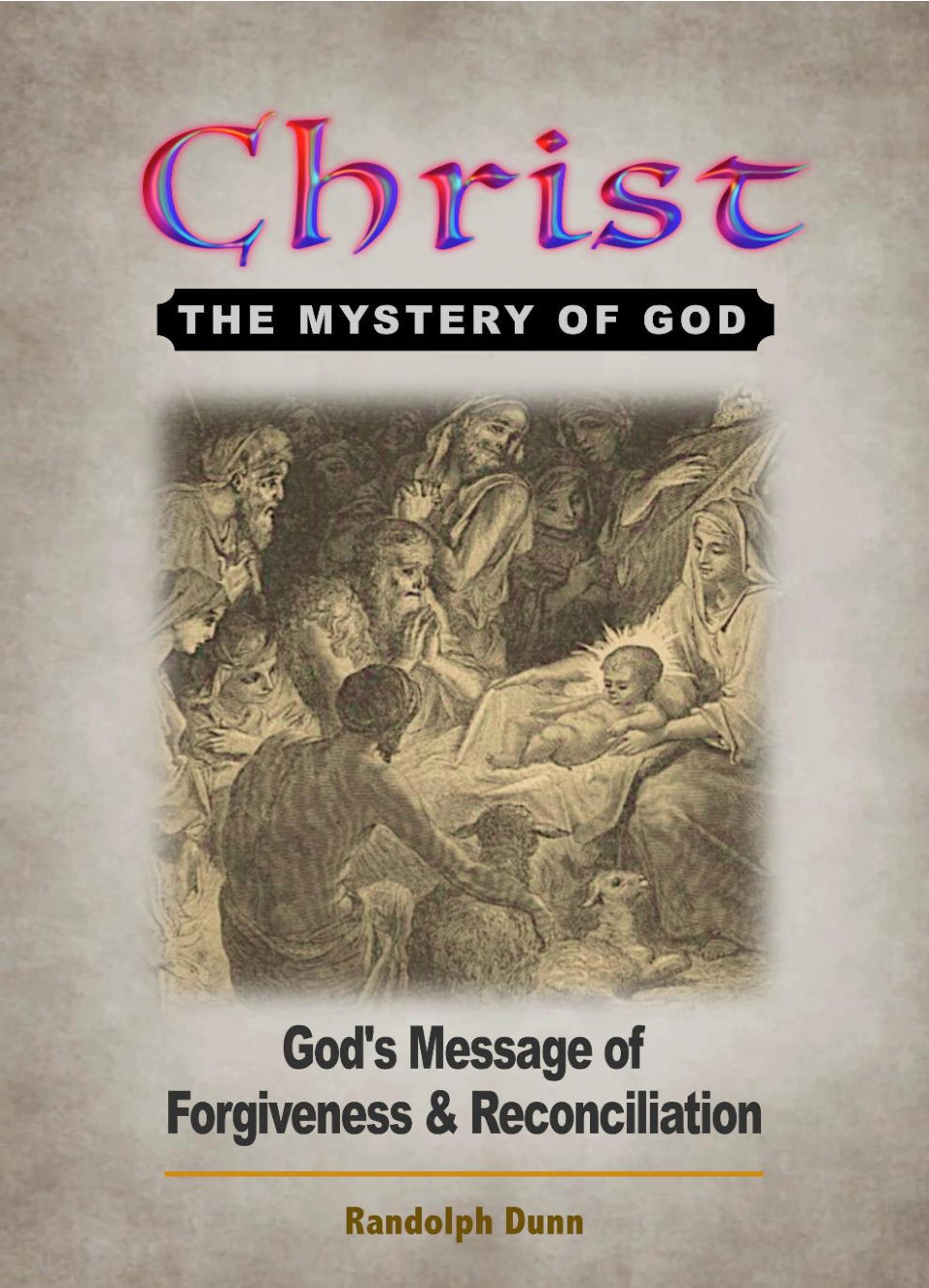
By Randolph Dunn
Chapter 1.
The last day of creation as recorded in Genesis 1:26-27 is “Then God said, ‘Let us make man in our image, in our likeness, and let them rule over the fish of the sea and the birds of the air, over the livestock, over all the earth, and over all the creatures that move along the ground.’ So, God created man in his own image, in the image of God he created him; male and female he created them.”
Compiler’s Comment: This creation was different from all His other creations as man was made in God's likeness, in His image. Man is not an exact copy of God. Man was created flesh and blood while God is spirit. End Comment.
God put Adam and Eve in the midst of the rest of His creation to rule over and have dominion over it. He told Adam to work and take care of it. “And the LORD God commanded the man, ‘You are free to eat from any tree in the garden; but you must not eat from the tree of the knowledge of good and evil, for when you eat of it you will surely die.’” (Genesis 2:16-17).
Comment: God gave man the ability to choose.
The Devil took on the form of a serpent to tempt Eve. “When the woman saw that the fruit of the tree was good for food and pleasing to the eye, and also desirable for gaining wisdom, she took some and ate it. She also gave some to her husband, who was with her, and he ate it.” (Genesis 3:6).
The man listened to Satan’s lie choosing desire over obedience thus ceasing to be a righteous person and breaking the intimate relationship he enjoyed with God, his creator.
But disobedience has consequences and, in some situations, sin may not be found out until the judgment when one faces God. In this case, the consequence was immediate. They were removed from paradise to a land of toil and pain. God said to the serpent “‘Because you have done this, cursed are you above all the livestock and all the wild animals! You will crawl on your belly and you will eat dust all the days of your life. And I will put enmity between you and the woman, and between your offspring and hers; he will crush your head, and you will strike his heel.’
But God had a plan to restore man to the original state and relationship with HIM.
Comment: With this sin, both Adam and Eve were separated from God and in need of being reunited with Him. This reconciliation would require a perfect sacrifice for their sin of disobedience. That perfect sacrifice apparently is a reference to God becoming human to be the atoning sacrifice for their sin and all others to come.
Noah “By faith Noah, when warned about things not yet seen, in holy fear built an ark to save his family. By his faith he condemned the world and became heir of the righteousness that comes by faith.” (Hebrews 11:7).
God told Noah what he must do to save the righteous people from perishing in the impending flood. No doubt these instructions appeared to be unusual but they very explicit. Noah may have even questioned how a boat made only from one kind of wood exactly so long, wide and high with only one window and door could possibly save him and his family. However, he began building immediately warning others of the consequences of their rebellious and sinful lifestyle. After the ark was completed Noah and his family entered the ark and God caused the animals that breathed air to come into the ark. After God closed the door, He opened the fountains of the deep and the windows of heaven to flood the earth. After days and months, the waters abated. Then Noah, his family, and the animals came out of the ark.
Noah immediately built an altar, offered a sacrifice, and worshipped God.
Compiler’s Comment: In only six chapters of the first book of the Bible we have seen three situations where people disobeyed God's commandments, substituting them for their own desires; one disobeyed because it was pleasing to the eye and something to be desired to make them wise, one disobeyed by presenting an offering, an act of worship, that was not pleasing to God and one group disobeyed as the thoughts and intent of their mind was evil continually. God was displeased in every case, judging their actions against His standard, against His Word. A righteous God, their creator, established the consequences He considered appropriate for their action. End Comment.
Questions
- Sin occurs when one yields to their evil desires?
True ___ False ___
- God’s statement to Cain “if you do what is right” leaves no doubt Cain knew what God the type(s) of offering God desired.
True ___ False ___
- Noah’s faith in God was displayed by his actions.
True ___ False ___
- God allowed people who do not retain the knowledge of Him to
- ___ Have a depraved mind
- ___ Be filled with wickedness
- ___ Be slanderers, insolent, and arrogant
- ___ Become faithless, heartless, and ruthless
- ___ All of the above
- All the people of Noah’s time made a choice to continue living wickedly.
True ___ False ___
Chapter 2.
God’s Promise.
Terah became the father of Abram. After Abraham became an adult, God made a promise to Abram. “The LORD had said to Abram, 'Leave your country, your people, and your father's household and go to the land I will show you. I will make you into a great nation and I will bless you; I will make your name great, and you will be a blessing. I will bless those who bless you, and whoever curses you I will curse; all peoples on earth will be blessed through you.’” (Genesis 12:1-
- God changed Abram's name to Abraham when He established His covenant with him. So,
Abraham left his home and went to Canaan.
Compiler’s Comment: “By faith he made his home in the promised land like a stranger in a foreign country; he lived in tents, as did Isaac and Jacob, who were heirs with him of the same promise. For he was looking forward to the city with foundations, whose architect and builder is God.” (Hebrews 11:9-10) It should be clear that God's promise to Abraham was to all mankind rather than to one nation since it would be more than 400 years before Israel became a nation. End Comment.
Later, when Isaac was older, God commanded Abraham to offer Isaac as a burnt offering sacrifice. This was a test of Abraham's faith. Abraham reasoned that since God gave him Isaac when it was physically impossible for him and Sarah to have a son then He could bring Isaac back from the dead in order to fulfill his promise.
What is so significant about this relationship between God and Abraham? First and foremost, God requires faithful obedience. Through Abraham's faith God’s promise to provide a way for man to be reconciled to Him was initiated, a hint of God’s mystery. It would not be realized until years later when Jesus of Nazareth, through complete obedient faithfulness, would offer himself as the atoning sacrifice for man's sins. It was through Isaac, the son of promise, not Ishmael his first born, that the covenant would be continued as Jesus was a descendant of Isaac through David.
It was God’s promise that through Abraham all peoples of the earth would be blessed. Therefore, there is no way mankind can earn reconciliation. It is a promise and matter of attitude, faith, and
obedience to Jesus, the Christ, His Word, the Message of Reconciliation. It should not be so amazing that God blesses the faithful and obedient and disinherits the rebellious disobedient.
Because of problems between the herdsmen of Abraham and Lot, his nephew, Abraham allowed Lot to choose his land and Abraham would take another area. Lot chose the better area near the city of Sodom. “And the LORD said, 'Because the outcry against Sodom and Gomorrah is great, and because their sin is very grave, I will go down now and see whether they have done altogether according to the outcry against it that has come to Me; and if not, I will know.’” (Genesis 18:20- 21).
Before God sent angels to destroy Sodom, He revealed His plans to Abraham who pleaded with God to save Sodom because of righteous people living there. But there were so few. So, God's angels in the form of men appeared at evening entering the city of Sodom. When Lot saw these visitors, he insisted they enter his house under his protection.
God called Abraham while he was living in Ur of the Chaldees to go to a far country. He had no place to call home; only a promise that his descendants would one day have a home. Abraham's descendants would ultimately become enslaved by the Egyptians. God delivered the Children of Israel from slavery through Moses to go to the land of their inheritance, the land where Abraham had wandered.
The Children of Israel’s journey into that far country, Egypt, began with a cowardly act by Jacob's sons against a younger brother, Joseph, when they sold him to a band of Ishmaelites, descendants of Abraham's first-born son Ishmael. They sold him as a common slave and then deceived Jacob into believing Joseph had been killed by a wild animal. Joseph remained faithful to God and God used him in his plan to create a mighty nation from Abraham's descendants. This nation would occur after years of slavery in a nation that worshipped man-made gods rather than Almighty God.
Compiler’s Comment: Do people professing to be God’s people allow Him to use them as Joseph did? End Comment.
After some four hundred years in Egypt Moses was born. Pharaoh ordered all Hebrew children to be killed. “By faith Moses' parents hid him for three months after he was born, because they saw he was no ordinary child, and they were not afraid of the king's edict.” (Hebrews 11:23).
Moses was found by Pharaoh's daughter who had compassion on him. Moses’ sister summoned her mother and “Pharaoh's daughter said to her, 'Take this baby and nurse him for me, and I will pay you.' So, the woman took the baby and nursed him. When the child grew older, she took him to Pharaoh's daughter and he became her son. She named him Moses, saying, 'I drew him out of the water.’” (Exodus 2:9-10).
At the appropriate time, Moses’ mother took Moses to Pharaoh's daughter. “Moses was educated in all the wisdom of the Egyptians and was powerful in speech and action. When Moses was forty years old, he decided to visit his fellow Israelites. He saw one of them being mistreated by an Egyptian, so he went to his defense and avenged him by killing the Egyptian. Moses thought that his own people would realize that God was using him to rescue them, but they did not.” (Acts 7:22- 25).
“By faith Moses, when he had grown up, refused to be known as the son of Pharaoh's daughter. He chose to be mistreated along with the people of God rather than to enjoy the pleasures of sin for a short time. He regarded disgrace for the sake of Christ as of greater value than the treasures of Egypt, because he was looking ahead to his reward. By faith he left Egypt, not fearing the king's anger; he persevered because he saw him who is invisible.” (Hebrews 11:24-27).
Compiler’s Comment: After being trained in all the ways of the Egyptians for forty years, God trained Moses for another forty years as a herdsman before calling him to lead Abraham's descendants from the bondage of slavery to the land promised long ago to Abraham, Isaac, and Jacob. End Comment.
Because of these former slaves' lack of faith and obedience, it took forty years before they were ready to obey and claim their promised land. Even though this land was given to them by God’s grace they had to fight God's enemies to inhabit it.
Compiler’s Comment: Today mankind is under the bondage of sin. By God’s grace (the gift of His Son) we can be freed from the bondage of sin by the blood of Christ. It takes continued obedience and faithfulness for us to reach Heaven, our promised land, while always fighting the enemies of God. End Comment.
Compiler’s Comment: “I thought” can cause a heap of trouble. Instead of allowing God to guide our paths. End Comment.
Moses, in fear resulting from his rash action, fled from Pharaoh, going to the land of Midian. He humbled himself as a shepherd for forty years, after which God was ready for him to deliver the descendants of Abraham, Isaac, and Jacob from the bondage of physical slavery, a symbol of our slavery to sin. God gave Pharaoh and the Egyptians ten opportunities to choose obedience over destruction. Pharaoh appeared to recognize God's power but with each passing opportunity, it was easier for him to refuse. After the death of his firstborn, he told the Israelites to leave. But he changed his mind and pursued them to bring them back to slavery.
It was at the Red Sea, that the Israelites had to make a choice to obey God or return to slavery. It was also there that Pharaoh and his army were buried in the waters of the sea. A new nation, freed from slavery, arose on the other side.
Compiler’s Comment: At the Red Sea Pharaoh thought he could lead his army through the sea like Moses did. This is also like our flight from sin. At the cross of Christ, we must make a decision if we want to bury our sinful master in the waters of baptism in order to arise as a new creation. Paul stated in Romans 6:3-7 “Or don't you know that all of us who were baptized into Christ Jesus were baptized into his death? We were therefore buried with him through baptism into death in order that, just as Christ was raised from the dead through the glory of the Father, we too may live a new life. If we have been united with him like this in his death, we will certainly also be united with him in his resurrection. For we know that our old self was crucified with him so that the body of sin might be done away with, that we should no longer be slaves to sin- because anyone who has died has been freed from sin.” End Comment.
The Israelites did not enter into Canaan, their promised land, immediately as their faith was weak. They rejected the report of Joshua and Caleb who trusted in God. Consequently, the Israelites wandered in the wilderness, near their promised land, for forty years, never entering the Promised Land. It wasn't until all males over twenty died (except Joshua and Caleb) that they would be allowed to enter the Promised Land. God forbade Moses to enter or lead Israel into Canaan. Instead, it was Joshua, Moses' faithful aide who was chosen to lead them. Once they put their faith in God and obeyed him, they were allowed to enter their Promised Land.
Compiler’s Comment: While we wander here on earth, we must also be faithfully obedient to God in order to be reconciled and able to enter our Heavenly Promised Land. How many like Pharaoh thought they could continue on their journey without God? End Comment.
God performed many miracles of blessing upon the Israelites, the most prominent being, the leading thousands of slaves toward a land promised years before to Abraham.
Three months after they departed Egypt and around four hundred years after God's promise to Abraham the Israelites camped at Sinai. Here God appeared and delivered to Moses His commandments. “The Lord said to Moses, ‘Come up to me on the mountain and stay here, and I will give you the tablets of stone, with the law and commands I have written for their instruction.’” (Exodus 24:12). We refer to them as the Ten Commandments and they are listed below.
- “You shall have no other gods before me.
- “You shall not make for yourself an idol in the form of anything in heaven above or on the earth beneath or in the waters below. You shall not bow down to them or worship them; for I, the Lord your God, am a jealous God, punishing the children for the sin of the fathers to the third and fourth generation of those who hate me, but showing love to a thousand generations of those who love me and keep my commandments.:
- “You shall not misuse the name of the Lord your God, for the Lord will not hold anyone guiltless who misuses his name.
- “Remember the Sabbath day by keeping it holy. Six days you shall labor and do all your work, but the seventh day is a Sabbath to the Lord your God. On it you shall not do any work, neither you, nor your son or daughter, nor your manservant or maidservant, nor your animals, nor the alien within your gates. For in six days the LORD made the heavens and the earth, the sea, and all that is in them, but he rested on the seventh day.
Therefore, the LORD blessed the Sabbath day and made it holy.
- “Honor your father and your mother, so that you may live long in the land the LORD your
God is giving you.
- “You shall not murder.
- “You shall not commit adultery.
- “You shall not steal.
- “You shall not give false testimony against your neighbor.
- “You shall not covet your neighbor's house. You shall not covet your neighbor's wife, or his manservant or maidservant, his ox or donkey, or anything that belongs to your neighbor.” (Exodus 20:3-17).
Compiler’s Comment: on the “Covenant”:
Read the commandments again and notice that they are laws, rules, regulations, things to do, and things not to do. Did you find any statement of forgiveness or faith? NO! This covenant was designed to bring man to Christ and make them aware of sin. It was to be replaced by a new covenant that forgives wickedness.
But God found fault with the people and said: “The time is coming, declares the Lord, when I will make a new covenant with the house of Israel and with the house of Judah. It will not be like the covenant I made with their forefathers when I took them by the hand to lead them out of Egypt, because they did not remain faithful to my covenant, and I turned away from them, declares the Lord. 'This is the covenant I will make with the house of Israel after that time, declares the Lord. I will put my laws in their minds and write them on their hearts. I will be their God, and they will be my people. No longer will a man teach his neighbor, or a man his brother, saying, 'Know the Lord,' because they will all know me, from the least of them to the greatest. For I will forgive their wickedness and will remember their sins no more'." "By calling this covenant 'new,' he has made the first one obsolete; and what is obsolete and aging will soon disappear.” (Hebrews 8:8-13).
When Jesus came, he preached a message of repentance, a message of God's grace and of faith, love, and reconciliation. His mission was “to do the will of him who sent me and to finish his work.” (John 4:34).
Jesus opened the way to obtain forgiveness of sin by willingly giving his life as the only atoning sacrifice for OUR sins, to all who believe in Him and who “wholeheartedly obeyed the form of teaching to which you were entrusted.” (Romans 6:17).
“But the Scripture declares that the whole world is a prisoner of sin, so that what was promised, being given through faith in Jesus Christ, might be given to those who believe. Before this faith came, we were held prisoners by the law, locked up until faith should be revealed. So, the law was put in charge to lead us to Christ that we might be justified by faith. Now that faith has come, we are no longer under the supervision of the law.” (Galatians 3:22-25).
“And you, being dead in your trespasses and the uncircumcision of your flesh, He has made alive together with Him, having forgiven you all trespasses, having wiped out the handwriting of requirements that was against us, which was contrary to us. And He has taken it out of the way, having nailed it to the cross.” (Colossians 2:13-14).
God's love and mercy provided the perfect blood sacrifice in His Son. Christ's death established the “new covenant”, providing for forgiveness of sins and freedom from sin to all who obey the call to repentance and obedience. (Read Hebrews 9:16-28).
“If you really keep the royal law found in Scripture, ‘Love your neighbor as yourself,’ you are doing right. But if you show favoritism, you sin and are convicted by the law as lawbreakers. For whoever keeps the whole law and yet stumbles at just one point is guilty of breaking all of
- For he who said, ‘Do not commit adultery,’ also said, ‘Do not murder.’ If you do not commit adultery but do commit murder, you have become a lawbreaker. Speak and act as those who are going to be judged by the law that gives freedom, because judgment without mercy will be shown to anyone who has not been merciful. Mercy triumphs over judgment!” (James 2:8-13).
End of comments on the “Covenant”
After being delivered from Egyptian slavery and receiving a land flowing with milk and honey, Israel was governed by judges that God selected. But the Israelites wanted to be like all the nations around them. They rejected God and wanted a king. So, God gave them a king; Saul. He ruled by what the people wanted – rule by opinion – rather than as an obedient servant of God. Therefore, Samuel, at God's direction, anointed David as king, one who would obey him. Many times, David had to flee from Saul because Saul was hunting him down like a common criminal desiring to kill him. Yet, in spite of this David refused to do anything against God's anointed.
After Saul's death, David became king. God said of David: “‘I have found David son of Jesse a man after my own heart; he will do everything I want him to do.’ From this man's descendants God has brought to Israel the Savior Jesus, as he promised.” (Acts 13:22-23).
On one occasion David's men were among the flocks of a very wealthy man named Nabal, and while there, they dealt honorably with him protecting him, not mistreating his herdsmen or taking anything that belonged to him. Later David was nearby, his men were hungry and in need of food so David requested assistance, but Nabal, a surly man known for his mean dealings, refused David's request in a harsh and disrespectful manner. David became very angry, intending to kill him, but he repented, allowing God to exercise his judgment.
But not everything was godly in David's life. Instead of going to battle with his army, he remained at home. There, he saw a lovely woman, lusted for her, and sent for her to satisfy his sexual pleasure, breaking her marriage covenant - adultery. Learning she was pregnant by him; David ordered the murder of her husband to cover up his sin. Terrible? Yes! Pleasing to God? No! David desired fleshly satisfaction and yielded to the temptation. He suffered much for this sin. But when confronted by Nathan, the messenger from God, he admitted his wickedness, repented and pleaded for forgiveness. Although forgiven, he still suffered the consequences of his sinful actions.
Compiler’s Comment: No doubt David’s heartfelt attitude, his remorse, and the desire for forgiveness in order to be reconciled to God is why God would say “I have found David the son of Jesse, a man after My own heart, who will do all My will.” (Acts 13:22). End Comment.
Compiler’s Comment: This is everyone's situation today. We have all sinned, and need the proper attitude toward our sin to be reconciled to God. End Comment
God promised David that one of his descendants would sit on his throne forever, referring to Jesus, the Christ, whose kingdom will have no end. It was Christ who; without sin, totally obeyed God, and willingly gave his life as the atoning sacrifice for us, thus fulfilling God's promise to David and Abraham.
God spoke directly to Adam, Noah, Abraham, Isaac, and Jacob during the era many refer to as the “Patriarchal Age.” During the establishment of the nation of Israel, God spoke to Moses, Joshua, and then their judges. While Samuel was the judge, the people rebelled against God’s leadership by demanding a king. During the reign of the kings, God delivered His message through men we refer to as “prophets.” All prophets delivered God’s message to the Children of Israel but not all delivered prophecies about the coming Messiah. Over hundreds of years, more than 50 prophecies are recorded, by many different prophets, all of which were fulfilled in Jesus.
A few prophesies and their New Testament fulfillment are listed below.
Malachi 3:1 “Watch out! I'm sending my messenger, and he will prepare the way before me. Then suddenly the LORD you are looking for will come to his Temple. He is the messenger of the covenant whom you desire. Watch out! He is coming!” says the LORD of the Heavenly Armies.”
Matthew 2:1-2 “After Jesus had been born in Bethlehem of Judea in the days of King Herod, wise men from the east arrived in Jerusalem and asked, "Where is the one who was born king of the Jews? We saw his star in the east and have come to worship him.”
Genesis 49:10 “The scepter shall not depart from Judah, nor the ruler's staff from between his feet, until tribute comes to him; and to him shall be the obedience of the peoples.” Luke 3:23 - 38 The genealogy of Jesus is tracing His lineage back through David all the way to Adam.
Jeremiah 23:5 “Behold, the days are coming, declares the LORD, when I will raise up for David a righteous Branch, and he shall reign as king and deal wisely, and shall execute justice and righteousness in the land.” Matthew 1:1 This is a record of the life of Jesus the Messiah, the son of David, the son of Abraham.
Isaiah 7:13-14 “And he said, "Hear then, O house of David! Is it too little for you to weary men, that you weary my God also? Therefore, the Lord himself will give you a sign. Behold, the virgin shall conceive and bear a son, and shall call his name Immanuel (meaning God with us).”
Matthew 1:18 Now the birth of Jesus the Messiah happened in this way. When his mother Mary was engaged to Joseph, before they lived together, she was discovered to be pregnant by the Holy Spirit.
Luke 1:31-33 Hundreds of years later the angel Gabriel told the virgin Mary she would have a son and “shall call his name Jesus. He will be great and will be called the Son of the Most-High. And the Lord God will give to him the throne of his father David, and he will reign over the house of Jacob forever, and of his kingdom there will be no end.”
Micah 5:2 “But you, O Bethlehem Ephrathah, who are too little to be among the clans of Judah, from you shall come forth for me one who is to be ruler in Israel, whose coming forth is from of old, from ancient days.”
Mathew 2:1-6 “After Jesus was born in Bethlehem in Judea, during the time of King Herod… King Herod …called together all the people’s chief priests and teachers of the law, he asked them where the Messiah was to be born. “In Bethlehem in Judea,” they replied.’’
Zechariah 9:9 “Rejoice greatly, O daughter of Zion! Shout aloud, O daughter of Jerusalem! Behold, your king is coming to you; righteous and having salvation is he, humble and mounted on a donkey, on a colt, the foal of a donkey.”
Matthew 21:6-7 “And the disciples went, and did even as Jesus appointed them, and brought the ass, and the colt, and put on them their garments; and he sat thereon.”
Isaiah 53:5 “But he was wounded for our transgressions, he was bruised for our iniquities; the chastisement of our peace was upon him; and with his stripes we are healed.”
Matthew 27:26 “Then released he unto them Barabbas; but Jesus he scourged and delivered to be crucified.”
Isaiah 53:7 “He was oppressed, and he was afflicted, yet he opened not his mouth; like a lamb that is led to the slaughter, and like a sheep that before its shearers is silent, so he opened not his mouth.”
Matthew 27:12-14 “While Jesus was being accused by the high priests and elders, he made no reply. Then Pilate asked him, "Don't you hear how many charges they're bringing against you?" But Jesus did not reply at all, so that the governor was very surprised.”
Isaiah 53:9 “And they made his grave with the wicked and with a rich man in his death, although he had done no violence, and there was no deceit in his mouth.”
Matthew 27:57-60 “Later that evening, a rich man arrived from Arimathea. His name was Joseph, and he had become a disciple of Jesus. He went to Pilate and asked for the body of Jesus, and Pilate ordered it to be done. So, Joseph took the body and wrapped it in a clean linen cloth. Then he placed it in his own new tomb, which he had cut out of the rock. After rolling a large stone across the door of the tomb, he left.”
- God promised Abram that all people on earth would be blessed through him.
True ___ False ___
- Because of wickedness, God
- ___ removed Adam and Eve from their paradise
- ___ destroyed all people except Noah and his family by water
- ___ Destroyed by fire Sodom
- ___ it was not wickedness
- Action based on I thought rather than truth causes a heap of trouble.
True ___ False ___
- The covenant given by God through Moses provided for the forgiveness of sins
True ___ False ___
- Prophecies about the Messiah were never fulfilled.
True ___ False ___
Chapter 3. Christ – The Promise of God.
Ever since Adam and Eve sinned, which resulted in their fall from a perfect relationship with God, man has needed to be reconciled to God. He needed to have his sins washed away and his guilt removed. At just the perfect time and by the action of the Holy Spirit, God became flesh to dwell among men. The Holy Spirit performed a miracle allowing Mary to become pregnant without sexual relations with man. The angel Gabriel announced to Mary and later an angel announced to Joseph how God would be using them to bring the Messiah, God's anointed one, to earth to save mankind from their sins. Both were willing to become servants of God regardless of how people would treat them and their son Jesus or what they would say about them. They only wanted to obey and be used by God.
“In the beginning was the Word, and the Word was with God, and the Word was God. He was with God in the beginning. Through him all things were made; without him nothing was made that has been made. In him was life, and that life was the light of men. The light shines in the darkness, but the darkness has not understood it. There came a man who was sent from God; his name was John. He came as a witness to testify concerning that light, so that through him all men might believe. He himself was not the light; he came only as a witness to the light. The true light that gives light to every man was coming into the world. He was in the world, and though the world was made through him, the world did not recognize him. … The Word became flesh and made his dwelling among us. We have seen his glory, the glory of the One and Only, who came from the Father, full of grace and truth.” (John 1:1-10, 14)
John preached a baptism for repentance and it was said all Judah came to John to be baptized. (baptizo, a Greek word meaning immersion). “Now some Pharisees who had been sent questioned him asking, ‘Why then do you baptize if you are not the Christ, nor Elijah, nor the Prophet?’ ‘I baptize with water,’ John replied, 'but among you stands one you do not know. He is the one who comes after me, the thongs of whose sandals I am not worthy to untie.’”
“Jesus came from Galilee to the Jordan to be baptized by John. But John tried to deter him, saying, 'I need to be baptized by you, and do you come to me?' Jesus replied, 'Let it be so now; it is proper for us to do this to fulfill all righteousness.' Then John consented." And when Jesus was baptized, he went up immediately from the water, and behold, the heavens were opened and he saw the Spirit of God descending like a dove, and alighting on him; and lo, a voice from heaven, saying, 'This is my beloved Son, with whom I am well pleased.’” (Matthew 3:13-17).
Comment: This confirmed what John had said prior to Jesus coming to be baptism “Look, the Lamb of God, who takes away the sin of the world!”
Following His baptism “Jesus, full of the Holy Spirit, was led by the Spirit into the desert and where for forty days he was tempted by the devil. He ate nothing during those days, and at the end of them he was hungry.” (Luke 4:1-2) Then the Devil tempted Him in all things like we are tempted:
- Desire for food – the lust of the flesh,
- Desire for power – the pride of life,
- Desire for things – the lust of the eye.
Jesus faced each challenge and temptation without yielding stating “it is written.” The devil then left for a more opportune time.
Jesus left the area where He was tempted and “returned to Galilee in the power of the Spirit, and news about him spread through the whole countryside. He taught in their synagogues, and everyone praised him. He went to Nazareth, where he had been brought up, and on the Sabbath day he went into the synagogue, as was his custom. And he stood up to read. The scroll of the prophet Isaiah was handed to him. Unrolling it, he found the place where it is written:
‘The Spirit of the Lord is on me, because he has anointed me to preach good news to the poor. He has sent me to proclaim freedom for the prisoners and recovery of sight for the blind, to release the oppressed, to proclaim the year of the Lord's favor.’
‘Then he rolled up the scroll, gave it back to the attendant and sat down. The eyes of everyone in the synagogue were fastened on him, and he began by saying to them, ‘Today this scripture is fulfilled in your hearing.’ All spoke well of him and were amazed at the gracious words that came from his lips. ‘Isn't this Joseph's son?’ they asked. … (He continued speaking to them and) all the people in the synagogue were furious when they heard this. They got up, drove him out of the town, and took him to the brow of the hill on which the town was built, in order to throw him down the cliff. But he walked right through the crowd and went on his way.” (Luke 4:14-22, 29- 30).
After a short conversation with the Samaritan woman who came to draw water at Jacob’s well, the woman said to Jesus “I know that Messiah” (called Christ) “is coming. When he comes, he will explain everything to us." Then Jesus declared, "I who speak to you am he.” (John 4:7-26).
At the appropriate time, Jesus would begin proving to all that He was God who had come to earth to live among men becoming the perfect sacrifice for man's sins. He did this by the perfect life He lived, and the miracles He performed openly before great crowds.
Jesus did not receive any formal training in rabbinical schools. However, people recognized that he spoke with authority, not like other religious leaders; the rabbis, priests, Pharisees, and Scribes. To these “learned men” Jesus was very pointed in His remarks calling them hypocrites,
and blind guides as their hearts, minds, and attitudes, were so prideful, arrogant, haughty, jealous, and willing to stop at nothing to maintain their place in society. They even attributed His many miracles to the Devil rather than giving glory to God.
Once He stopped a funeral procession to bring back to life an only child of a widow. He healed people who had been blind or crippled all their lives, which everyone in the town knew. Lastly, he went to a cemetery, opened the grave, and brought back to life a body that was already decaying. All these statements and miracles proved to the honest and sincere people that Jesus was the Son of God. They believed.
“That which was from the beginning, Christ, which we have heard, which we have seen with our eyes, which we have looked at and our hands have touched-this we proclaim concerning the Word of life. The life appeared; we have seen it and testify to it, and we proclaim to you the eternal life, which was with the Father and has appeared to us.” (1 John 1:1-2).
It is in Christ that we are reconciled to God for “Jesus answered, ‘I am the way and the truth and the life. No one comes to the Father except through me.’” (John 14:6).
Therefore, Christ must be the Good News.
Before the “Good News” message could become available, an atonement for sins was necessary. Jesus, who lived a sinless life, would freely give his life as the “blood sacrifice” required. Therefore, Jesus’ Good News offers man a choice to accept or reject God’s offer of forgiveness and salvation.
“When he had finished praying, Jesus left with his disciples and crossed the Kidron Valley. On the other side there was an olive grove, and he and his disciples went into it. Now Judas, who betrayed him, knew the place, because Jesus had often met there with his disciples. So, Judas came to the grove, guiding a detachment of soldiers and some officials from the chief priests and Pharisees. They were carrying torches, lanterns and weapons. Jesus, knowing all that was going to happen to him, went out and asked them, ‘Who is it you want?’ ‘Jesus of Nazareth,’ they replied. ’I am he’ Jesus said. … Then the detachment of soldiers with its commander and the Jewish officials arrested Jesus. They bound him and brought him first to Annas, who was the father-in-law of Caiaphas, the high priest that year. … Meanwhile, the high priest questioned Jesus about his disciples and his teaching. ‘I have spoken openly to the world,’ Jesus replied. ‘I always taught in synagogues or at the temple, where all the Jews come together. I said nothing in secret. Why question me? Ask those who heard me. Surely they know what I said.’ When Jesus said this, one of the officials nearby struck him in the face. ‘Is this the way you answer the high priest?’ he demanded. ‘If I said something wrong,’ Jesus replied, ‘testify as to what is wrong. But if I spoke the truth, why did you strike me?’ Then Annas sent him, still bound, to Caiaphas the high priest. … Then the Jews led Jesus from Caiaphas to the palace of the Roman governor. … Pilate then went back inside the
palace, summoned Jesus and asked him, ‘Are you the king of the Jews?’ … ‘Is that your own idea’ Jesus asked, ‘or did others talk to you about me?’ ‘Am I a Jew?’ Pilate replied. ‘It was your people and your chief priests who handed you over to me. What is it you have done?’ Jesus said, ‘My kingdom is not of this world. If it were, my servants would fight to prevent my arrest by the Jews. But now my kingdom is from another place.’ ‘You are a king, then!’ said Pilate. Jesus answered, ‘You are right in saying I am a king. In fact, for this reason, I was born, and for this I came into the world, to testify to the truth. Everyone on the side of truth listens to me.’” (John 18:1-5, 12-13, 19- 24, 28, 33-37).
Pilate went out again to the Jews and said, “I find no basis for a charge against him. … Do you want me to release 'the king of the Jews'? They shouted back, ‘No, not him!’ … Then Pilate took Jesus and had him flogged. The soldiers twisted together a crown of thorns and put it on his head.” (John 18:38-19:2).
Compiler’s Comment: Preparations for the scourging (flogging) were carried out when the Prisoner was stripped of His clothing and His hands tied to a post above His head. It is doubtful the Romans would have made any attempt to follow the Jewish law in this matter, but the Jews had an ancient law prohibiting more than forty lashes. End Comment.
“Finally, Pilate handed him over to them to be crucified. So, the soldiers took charge of Jesus. Carrying his own cross, he went out to the place of the Skull (which in Aramaic is called Golgotha). Here they crucified him, and with him two others — one on each side and Jesus in the middle. Pilate had a notice prepared and fastened to the cross. It read: JESUS OF NAZARETH, THE KING OF THE JEWS. Many of the Jews read this sign, for the place where Jesus was crucified was near the city, and the sign was written in Aramaic, Latin, and Greek. The chief priests of the Jews protested to Pilate, ‘Do not write ‘The King of the Jews,' but that this man claimed to be king of the Jews.’ Pilate answered, ‘What I have written, I have written.’” (John 19:16-22).
“From the sixth hour until the ninth hour darkness came over all the land. About the ninth hour Jesus cried out in a loud voice, ‘Eloi, Eloi, lama sabachthani?’ - which means, ‘My God, my God, why have you forsaken me?’ … When Jesus had cried out again in a loud voice, he gave up his spirit. At that moment the curtain of the temple was torn in two from top to bottom. The earth shook and the rocks split. The tombs broke open and the bodies of many holy people who had died were raised to life. They came out of the tombs, and after Jesus' resurrection they went into the holy city and appeared to many people. When the centurion and those with him who were guarding Jesus saw the earthquake and all that had happened, they were terrified, and exclaimed, ‘Surely he was the Son of God!’” (Matthew 27:45-46, 50-54).
Compiler’s Comment: John adds “Later, knowing that all was now completed, and so that the Scripture would be fulfilled, Jesus said, ‘I am thirsty.’ A jar of wine vinegar was there, so they soaked a sponge in it, put the sponge on a stalk of the hyssop plant, and lifted it to Jesus' lips.
When he had received the drink, Jesus said, ‘It is finished.’ With that, he bowed his head and gave up his spirit.” (John 19:28-30). End Comment.
Compiler’s Comment: The curtain separating the Holy Place from the Most Holy --where God’s presence was before the Babylon captivity-- was torn from top to bottom allowing every Jew to see and have access to the Holy of Holies. It is significant that the curtain was torn from the top indicating not done by man. End Comment.
. Compiler’s Comment: “But now in Christ Jesus you, all non-Jews, who once were far away have been brought near through the blood of Christ. For he himself is our peace, who has made the two one and has destroyed the barrier, the dividing wall of hostility, by abolishing in his flesh the law with its commandments and regulations.” (Ephesians 2:13-15). End Comment
“Because the Jews did not want the bodies left on the crosses during the Sabbath, they asked Pilate to have the legs broken and the bodies taken down. The soldiers therefore came and broke the legs of the first man who had been crucified with Jesus, and then those of the other. But when they came to Jesus and found that he was already dead, they did not break his legs. Instead, one of the soldiers pierced Jesus' side with a spear, bringing a sudden flow of blood and water. The man who saw it has given testimony, and his testimony is true. He knows that he tells the truth, and he testifies so that you also may believe. These things happened so that the scripture would be fulfilled: ‘Not one of his bones will be broken,’ and, as another scripture says, ‘They will look on the one they have pierced.’” (John 19:31-37).
“Later, Joseph of Arimathea asked Pilate for the body of Jesus. Now Joseph was a disciple of Jesus, but secretly because he feared the Jews. With Pilate's permission, he came and took the body away. He was accompanied by Nicodemus, the man who earlier had visited Jesus at night. Nicodemus brought a mixture of myrrh and aloes, about seventy-five pounds. Taking Jesus' body, the two of them wrapped it, with the spices, in strips of linen. This was in accordance with Jewish burial customs. At the place where Jesus was crucified, there was a garden, and in the garden a new tomb, in which no one had ever been laid. … He rolled a big stone in front of the entrance to the tomb and went away.” (John 19:38-42; Matthew 27:60).
“When the Sabbath was over, Mary Magdalene, Mary the mother of James, and Salome bought spices so that they might go to anoint Jesus' body. Very early on the first day of the week, just after sunrise, they were on their way to the tomb and they asked each other, ‘Who will roll the stone away from the entrance of the tomb?’ But when they looked up, they saw that the stone, which was very large, had been rolled away. As they entered the tomb, they saw a young man dressed in a white robe sitting on the right side, and they were alarmed. ’Don't be alarmed,’ he said. ‘You are looking for Jesus the Nazarene, who was crucified. He has risen! He is not here. See the place where they laid him. But go, tell his disciples and Peter, ‘He is going ahead of you into Galilee. There you will see him, just as he told you.' Trembling and bewildered, the women went
out and fled from the tomb. They said nothing to anyone, because they were afraid.” (Mark 16:1- 8)
Compiler’s Comment: Matthew stated there was a violent earthquake, for an angel of the Lord came down from heaven and, going to the tomb, rolled back the stone and sat on it. (Matthew 28:3). End Comment.
“But Mary stood outside the tomb crying. As she wept, she bent over to look into the tomb and saw two angels in white, seated where Jesus' body had been, one at the head and the other at the foot. They asked her, ‘Woman, why are you crying?’ ‘They have taken my Lord away,’ she said, ‘and I don't know where they have put him.’ At this, she turned around and saw Jesus standing there, but she did not realize that it was Jesus. ‘Woman,’ he said, ‘why are you crying? Who is it you are looking for?’ Thinking he was the gardener, she said, ‘Sir, if you have carried him away, tell me where you have put him, and I will get him.’ Jesus said to her, ‘Mary.’ She turned toward him and cried out in Aramaic, ‘Rabboni!’ meaning Teacher). Jesus said, ‘Do not hold on to me, for I have not yet returned to the Father. Go instead to my brothers (brethren) and tell them, 'I am returning to my Father and your Father, to my God and your God.' Mary Magdalene went to the disciples with the news: ‘I have seen the Lord!’ And she told them that he had said these things to her.” (John 20:11-18).
“On the evening of that first day of the week, when the disciples were together, with the doors locked for fear of the Jews, Jesus came and stood among them and said, ‘Peace be with you!’ After he said this, he showed them his hands and side. The disciples were overjoyed when they saw the Lord. Again, Jesus said, ‘Peace be with you! As the Father has sent me, I am sending you.’ And with that he breathed on them and said, ‘Receive the Holy Spirit. If you forgive anyone his sins, they are forgiven; if you do not forgive them, they are not forgiven.’” (John 20:19-23).
Christ, “The Son of the Living God” (Matthew 16:15, 16) said to His disciples that He would create a group of “called out people” (church) that God would put into a Kingdom which would come with power during the lifetime of some present.
He was more specific about the time His Kingdom would come when “he said to them, ‘I tell you the truth, some who are standing here will not taste death before they see the kingdom of God come with power.’” (Mark 9:1).
Compiler’s Comment: Therefore, we see Christ would be establishing his church during the lifetime of some of his hearers. End Comment.
Shortly after Jesus told Judas that he would betray Him, He said, “‘You are those who have stood by me in my trials. And I confer on you a kingdom, just as my Father conferred one on me, so that you may eat and drink at my table in my kingdom and sit on thrones, judging the twelve tribes of Israel.’” (Luke 22:28-30).
Compiler’s Comment: Some believe the apostles were put into Christ’s church at this time as He appointed to them His Kingdom.
As He was ready to return to God, the Father, "Jesus came to them and said, 'All authority in heaven and on earth has been given to me. Therefore, go and make disciples of all nations, baptizing them in the name of the Father and of the Son and of the Holy Spirit, and teaching them to obey everything I have commanded you. Surely, I am with you always, to the very end of the age.’” (Matthew 28:18-20).
“He said to them, ‘Go into all the world and preach the good news to all creation. Whoever believes and is baptized will be saved, but whoever does not believe will be condemned.’” (Mark 16:15-17).
“In my former book, Theophilus, I wrote about all that Jesus began to do and to teach until the day he was taken up to heaven, after giving instructions through the Holy Spirit to the apostles he had chosen. After his suffering, he showed himself to these men and gave many convincing proofs that he was alive. He appeared to them over a period of forty days and spoke about the kingdom of God. On one occasion, while he was eating with them, he gave them this command: ‘Do not leave Jerusalem but wait for the gift my Father promised, which you have heard me speak about. For John baptized with water, but in a few days, you will be baptized with the Holy Spirit.’ So, when they met together, they asked him, ‘Lord, are you at this time going to restore the kingdom to Israel?’”
“He said to them: ‘It is not for you to know the times or dates the Father has set by his own authority. But you will receive power when the Holy Spirit comes on you; and you will be my witnesses in Jerusalem, and in all Judea and Samaria, and to the ends of the earth.’ After he said this, he was taken up before their very eyes, and a cloud hid him from their sight.”
“They were looking intently up into the sky as he was going, when suddenly two men dressed in white stood beside them. ‘Men of Galilee,’ they said, ‘why do you stand here looking into the sky? This same Jesus, who has been taken from you into heaven, will come back in the same way you have seen him go into heaven.’ Then they returned to Jerusalem from the hill called the Mount of Olives, a Sabbath day's walk from the city. When they arrived, they went upstairs to the room where they were staying. Those present were Peter, John, James and Andrew; Philip and Thomas, Bartholomew and Matthew; James son of Alphaeus and Simon the Zealot, and Judas son of James. They all joined together constantly in prayer, along with the women and Mary the mother of Jesus, and with his brothers.” (Acts 1:1-14).
Compiler’s Comment: For the first time following the sin of Adam and Eve, man would soon have a way opened for them to be reconciled to God. End Comment.
Even though it is in the Bible that Jesus is revealed, there is considerable evidence outside the Bible confirming that Jesus is a historical person, just as the Bible presents him. These external writings by ancient historians corroborate what the Bible tells about him and are from Edward C. Wharton in his book “Christianity: A Clear Case of History.”
Thallus, a Samaritan-born historian who lived and worked in Rome about A.D. 52, was quoted by Julius Africanus, a Christian chronographer of the late second century. "Thallus, in the third book of his histories, explains away this darkness as an eclipse of the sun. " Africanus stated his objection to the report arguing that an eclipse of the sun cannot occur during the full moon, as was the case when Jesus died at Passover time. The force of the reference to Thallus is that the circumstances of Jesus' death were known and discussed in the Imperial City as early as the middle of the first century. The fact of Jesus' crucifixion must have been fairly well known by that time, to the extent that unbelievers like Thallus thought it necessary to explain the matter of the darkness as a natural phenomenon. ... Ironically, Thallus' efforts have been turned into the mainstream of historical proof for Jesus and for the reliability of Mark's account of the darkness at his death which states “At the sixth-hour darkness came over the whole land until the ninth hour.” (Mark 15:33).
Mara bar-Serapion
A manuscript in the British Museum preserves the text of a letter sent to his son by a Syrian named Mara Bar-Serapion, in which he, speaking of Jesus stated, nor did the wise King die for good; he lived on in the teaching which He had given.
Cornelius Tacitus
A Roman historian living from about AD 50 to AD 100 wrote regarding Nero's fire. "Consequently, to get rid of the report, Nero fastened the guilt and inflicted the most exquisite tortures on a class hated for their abominations, called Christians by the populace. Christus, from whom the name had its origin, suffered the extreme penalty during the reign of Tiberius at the hands of one of our procurators, Pontius Pilatus."
Plinius Secundus
A Roman governor in AD 112 wrote Emperor Trajan "They (Christians) were in the habit of meeting on a certain fixed day before it was light, when they sang an anthem to Christ as God and bound themselves by a solemn oath not to commit any wicked deed ... after which it was their custom to separate, and then meet again to partake of food, but food of an ordinary kind."
Seutonius An analyst and court official of the Imperial House during the reign of Hadrian wrote about AD
120 in the Life of Claudius. “As the Jews were making constant disturbances at the instigation of Chrestus, Claudius expelled them from Rome
Josephus was a first-century Romano-Jewish historian who was born in Jerusalem—then part of Roman Judea— in AD 33. Josephus has an interesting observation. "And there arose about this time Jesus, a wise man, if indeed we should call him a man; for he was a doer of marvelous deeds, a teacher of men who receive the truth with pleasure. He won over many Jews and also many Greeks. This man was the Messiah. And when Pilate had condemned him to the cross at the instigation of our own leaders, those who had loved him from the first did not cease. For he appeared to them on the third day alive again, as the prophets had predicted and said many other wonderful things about him. And even now the race of Christians, so named after him, has not yet died out.
The following quote from F. F. Bruce summarizes this very clearly. "Whatever else may be thought of the evidence from early Jewish and Gentile writers...it does at least establish, for those who refuse the witness of Christian writings, the historical character of Jesus himself. Some writers may toy with the fancy of a 'Christ-myth,' but they do not do so on the grounds of historical evidence. The historicity of Christ is as axiomatic (self-evident) for an unbiased historian as the historicity of Julius Caesar. It is not historians who propagate the 'Christ-myth' theories."
Conclusion
Jesus of Nazareth was God’s Mystery. Following Jesus’ temptations by Satan, that rebellious angel, Jesus began proclaiming His message of forgiveness and salvation. After Jesus’ atoning sacrifice (crucifixion), His resurrection, and ascension, His message of reconciliation began to be proclaimed and offered to all men. Everyone who puts their faith, trust, and obedience in Him is reconciled to their Creator and put in Christ's Body, His church.
- When Jesus was baptized (immersed) by John
- ___ The heavens were opened.
- ___ The Spirit of God descended on Him.
- ___ A voice said, “this is my beloved Son, with whom I am well pleased.”
- ___ All the above
- ___ Nothing happened, He only got wet
- The Devil tempted Jesus by His desire for
- ___ Food
- ___ Power
- ___ Material things
- Jesus told the Samaritan woman that He was the Messiah
True ___ False ___
- It is through Christ man is reconciled to God.
True ___ False ___
- What occurred during Jesus’ arrest and trial?
- ___ questioned about His teachings
- ___ struck in the face
- ___ delivered to Pilate for trial
- ___ found not guilty
- ___ flogged
- ___ had a crown of thorns placed on His head
- ___ proclaimed by Pilate “King if the Jews”
- ___ All the above
Text and illustrations reproduced from the study “Christ — God's Mystery”. The original PDF is the reference copy.