
Introduction
IS ONE RELIGION AS GOOD AS ANOTHER?
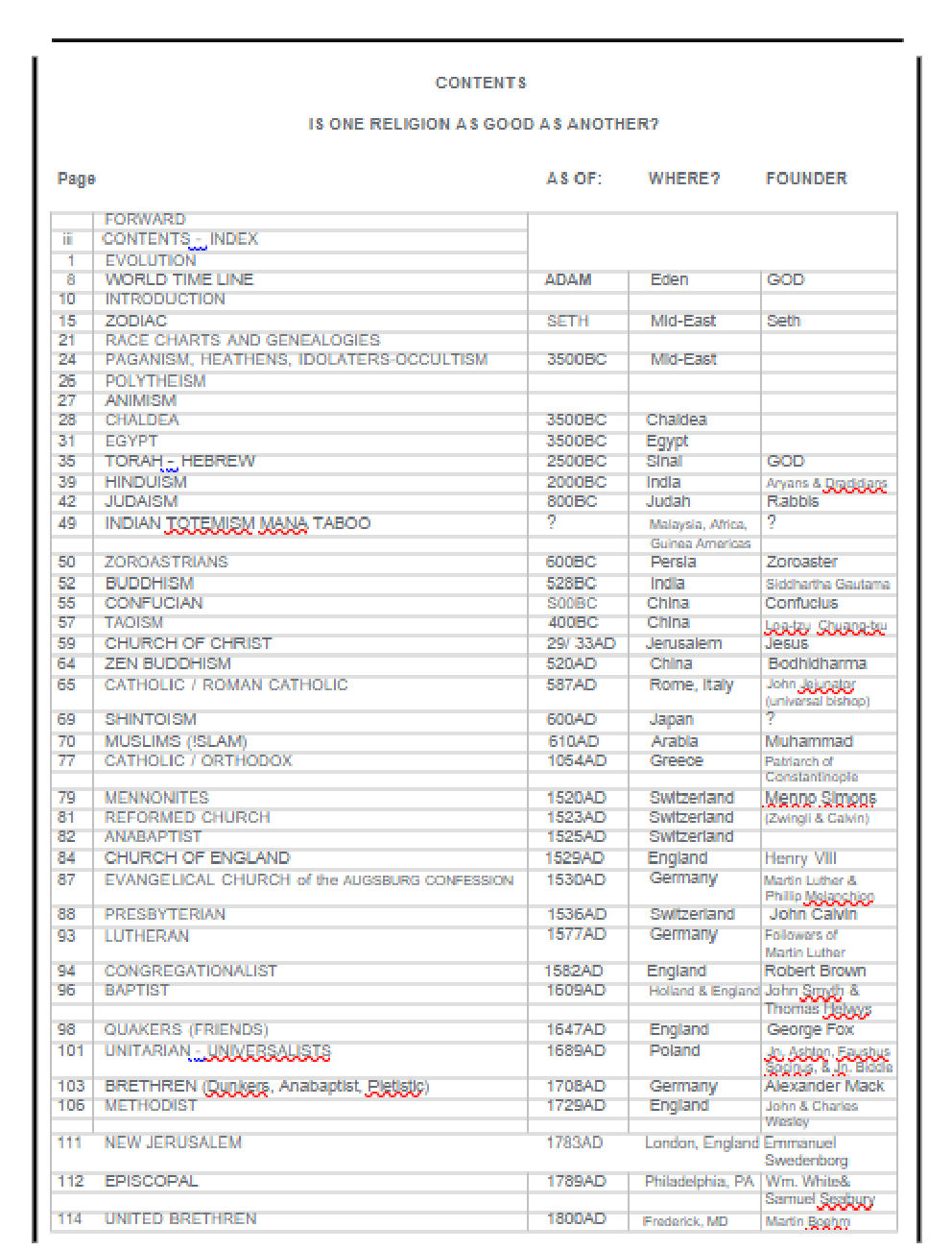
A time line of religions from the 'beginning' until the present.
Compiled as a study by Jake Van Dyke Printed by Lambert Book House Copyright @ 2008
ISBN 978-0-89315-429-5
All rights reserved. No part of this publication may be reproduced, stored in a retrieval system, or transmitted in any form or by any means-electronic, mechanical, photocopy, recording, or any other- except for brief quotations in printed reviews, without the prior permission of the publisher.
FORWARD
While paging through a magazine published by one of our well-known universities, I began to read 'Mailbag'. In the 'Mailbag' was a letter written by a Professor of Social Ethics Emeritus of this universities' School of Religion. I will quote from this letter while keeping its author anonymous. Who he is does not matter. What he said does need to be reviewed because there are so many in the world that think and teach as he does. He does not directly invite comment, but does say that those of Jewish, Christian, or Muslim 'traditions' "expose and denounce" the "moral dangers of theocracy", "where misguided fanatics pursue Holy War" through "savage tactics".
There are other significant comments which stimulate thought. The ideas presented in this letter will be repeated here, and a personal commentary will be added in reply.
- "Awareness of religious diversity is doubtless a good thing, especially if it is supplemented by a scholarly study of religion in the university curriculum."
Comment: Awareness of religious diversity is a good thing if the origins of this diversity are made known. This is not normally the course or direction of these "scholarly studies".
- "College is just the place to learn how to avoid supernatural nonsense while coming to appreciate the mythopoeic (pertaining to the making of myths) profundity (profound or deep matters) of religion." Comment: Religion is based on things 'supernatural' but there has been an accumulation of supernatural nonsense added to religions over the course of the existence of mankind. There are also many religions based on myths and stories distorted from the original source of religion. There is a natural desire of man to create his own religions that fill his needs.
There is therefore, a need to go beyond these sources in a 'scholarly' way to learn what religion is and should be.
- "Knowledge of how a so-called sacred text like the Bible or the Koran is created can provide an antidote to unintelligent notions of "the Word of God", and knowledge of how ecclesiastical doctrines and institutions have developed can prevent a too-submissive reverence for priestly elites."
Comment: There are some very good books available as a study of how we got the Bible, and how various books survived the ages and how some books were not selected as part of 'sacred text'. The Bible speaks for itself in stating that all scriptures are God breathed, and are profitable for doctrine, for reproof, and for instruction in righteousness. A study of the Muslim Religion will reveal that the Koran is a collection of passages revealed to Mohammed during the years 610 to 632 AD. It is good to have knowledge of the development of doctrines and institutions to prevent a submissive reverence for any man who takes on the role of a leader in any religion.
- "In addition to awareness and knowledge, students must also cultivate the powers of discernment that will enable them to evaluate faith traditions in terms of whether they support or endanger human well-being." Comment: This is an excellent statement, and a valuable asset for any person, to cultivate powers of discernment, and evaluate faith based traditions, especially where human life may be endangered because of religion. Powers of discernment and religion can also be used to determine 'moral issues' and the effect on human well being; issues such as abortion, homosexuality, faithfulness in marriage, concern for the disadvantaged, financial responsibility, war, and the focus on wealth and ownership, caring for the creation, and matters of social justice.
- "Above all, they must come to recognize Enlightenment principles of religious tolerance and freedom of conscience as one of the greatest achievements of European civilization.
Comment: Religious tolerance is important to peace among men, but should never be expected to the point where people of religious faith lower their defenses so that others who are intolerant can easily conquer, murder, or harass them, as has happened so often in history. Enlightenment as in the Reformation in the sixteenth century
and then again in the Restoration Movement of the nineteenth century were very important in providing the direction of progress toward peace in religion.
- "This will lead to a lively comprehension of the evils of theocratic fundamentalism as a pernicious brand of religion that differ from other forms of religious faith in it's insistence that what it calls the will of God should be imposed on everyone, everywhere. Impassioned believers who see themselves as 'defenders of God' are a menace, for they mistakenly think that God's honor will be stained unless all humankind is forced to conform to their notion of His law."
Comment: There has been a real misuse of religion in the Christian era. The Bible records God directing His people and other nations and Kings to war with one other for the purpose of preserving the line of the 'seed of the woman' who was to be the Savior. This was no longer necessary after the savior arrived. But history shows many times when religions in the name of God did try to impose their will on others by their use of force or political coercion.
Examples easily recognized are the Crusades and the Inquisitions by the Catholic Religion, Jihad or Holy Wars and battles of the Muslims begun by Mohammed, and subjugation of entire nations by Communists.
- "A university religious program has an obligation to insure that all of its participants realize one cardinal truth: All believers are worthy of respect, but not every kind of belief is."
Comment: This is true: it is not the purpose of a university to teach religion, but only to teach about religion. It is the responsibility of the church to teach religion. It is also true that not every religion has earned a place of respect and some should be feared as potential dangers to other religions. It will be the purpose of this book to sort out origins, the history, and the purpose of religions.
- "The moral dangers of theocracy must be exposed and denounced, hopefully by those of the same tradition - Jewish, Christian, or Muslim - where misguided fanatics pursue Holy War objective through savage tactics." Comment: There are those in every religion who, even with the best intentions, will hurt others. Some cases are obvious as when killing the body occurs. Some cases are not so obvious but can be even more deadly, when the spirit, when the soul is wounded and people are driven away from God, and there are eternal consequences and eternal separation from God.
- "Religious belief is an option for those who derive comfort or inspiration from it. But it is merely a possibility or a hope, not something we can know for sure."
Comment: Religion, or even the lack of religion, is based on faith; everyone has a belief system of one kind or another. An atheist has the faith that there is no God. Those who believe the Bible as the Word of God are told that "Faith comes by hearing the Word of God" and their faith is based on that, and they derive comfort and inspiration from it. An atheist has no basis for morality, no knowledge of where he came from, why he exists and no motive for kindness to others. There is no basis for spiritual values or hope beyond the grave. No hope of heaven, and no fear of hell.
- "Philosophical and political pluralism, on the other hand, are part of a moral worldview whose benefits we know and need, and religious liberty trumps mere belief. It is the responsibility of higher education to protect and promote pluralism, and - no matter how subtly or politely to oppose any manifestation of religion that imperils it."
Comment: Philosophical and political pluralism has benefits we need, but religious pluralism, on the other hand, has been the major source of the world's problems. There is only one God, who created the world. He has never appreciated those who worshipped in ways which He had not directed. There is the 'supernatural' and it is directed by a force in opposition to God. sometimes called Satan, or the devil, a fallen angel. God has given man His commandments to follow in the course of time, and when those are understood, no pluralism will result. We will proceed with a timeline of God's dealings with man through the ages, to understand where we came from, why we are here, and where we are going; and we will look at the various origins of man-made religions as well in the pages to follow.
There are many questions which we need to answer in life. Does God exist? Who or what made the world we live in? How did it get here? How did I get here? What is life? What is my place in it? What choices should I make? How did this earth come to be arranged in such perfect order? Is there life after death? What is true, what is not? These are just some of the questions which we can investigate in a journey through the ages. The answers to these questions are addressed by many people in various ways in the religions that have been established. Our main question we are addressing is "Is one religion as good as another?" Which religions can answer the important questions of life?
About the Author
Is One Religion as Good as Another? Where did all these religions come from? What are the sources of religion? Why are there variations within religions? What should religion be? Who determines what is
acceptable to God?
This book follows a time line of God's dealings with man from Adam to present. The time line shows that God has made covenants with man over time, and also shows the various religions men have created along side of those religions God has authorized. This book observes four distinct time periods:
• The period before the deluge and the saving of Noah.
• The age of God's dealings, promises, and covenants with the Patriarchs.
• The Law established with Moses and Israel.
• The Christian Age.
In each time period, we see what God expected of His people, and we see what man chose to do in establishing his own ideas of what religion should be. The theme is sin, man's rejection of the requirements of God in every age, and God's plan to redeem mankind for Himself through the 'seed of the woman' as He promised and prophesied in each age. During each time period, there were people faithful to the requirements God established. This is still true in our current day and time as some have not yet been deceived by that third-party who tricked Adam and Eve and who still leads people from God's ways. God established only one way. Follow the religions of time, and see if you can find the path God directed and the path that pleases Him.
Jake Van Dyke was reared in the Christian Reformed tradition and attended Christian (protestant) grammar and high schools. He and his wife Millie attended the Reformed Church, Presbyterian Church, Pentecostal Church, and the Salvation Army. They were married in a Methodist Church. Jake and Millie have 4 children and 6 grandchildren. Jake and Millie currently live in Florence, Alabama and attend the Jackson Heights Church of Christ.
On learning of the Church of Christ while in the army, Jake and Millie began to study religion. Jake has served as a deacon for 12 years, an elder for 12 years, and preached in a start-up congregation for a few years. He has taught Bible classes and has participated in home religion studies for 37 years. Jake is a retired Industrial/Manufacturing Engineer.
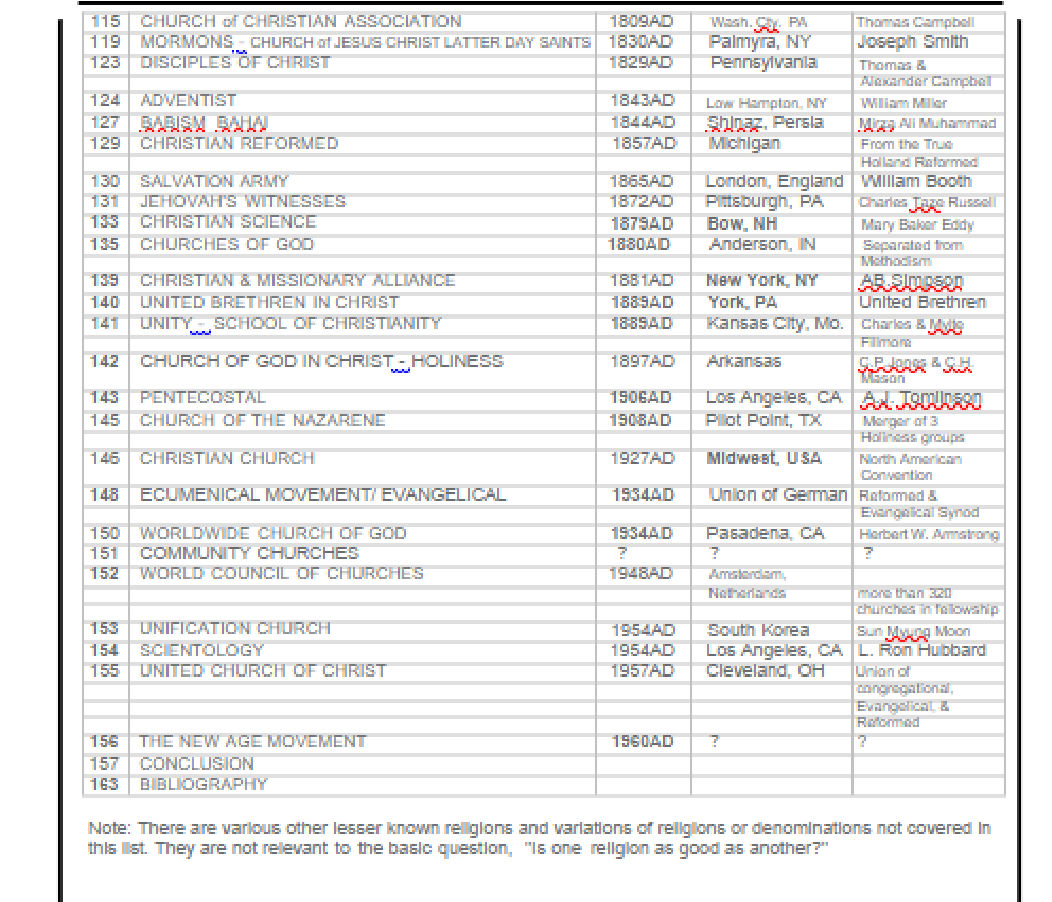
Text and illustrations reproduced from the study “Introduction”. The original PDF is the reference copy.