
protestantism
SHINTOISM
Shinto is A Japanese religion, and has been important in that nation since early times of history. It has aspects of origin along the same lines as Hinduism and Buddhism, and even the Chaldeans in that its worship is centered on a large number of spirits or divinities. This 'pantheon' of divinities represents various aspects of the natural world, such as the heavenly bodies, the earth, and the weather.
The practices include prayers of thanksgiving and offering of personal items, such as armor or cloth seeking purification from evil deeds, crimes, and defilements.
The people of Japan knew of God and had a need for a god, but did not "retain God in their knowledge" as we observed in Romans one. They also "changed the glory of the incorruptible God into an image made like to corruptible man" and "changed the truth of God into a lie, and worshipped and served the creature more than the creator."
During the early years there was no name for this religion, but in the late sixth century the name Shinto was given to it to distinguish it from Confucianism and Buddhism, which now had been introduced from China. Buddhism and Shinto soon began as one religion and Buddhist priests administered the Shinto shrines and introduced their own ways and ornaments. The original gods were generally regarded as manifestations of Buddha in a previous state of existence. Other elements of this religion were adopted from Confucianism.
In the 18th century Shinto was revived as a national religion. It took a form of reverence for Japanese antiquity and teaching of notable scholars. It also developed ideas and practices of hatred for practice of a foreign origin. Buddhism became less a part and Shinto was adopted a state religion. In 1887, the Emperor became head of state, and the Shogunate was overthrown. The Emperor, according to Shinto doctrine was now established as sovereign and divine through his reputed descent from the sun goddess. The sun goddess was considered the founder of the Japanese nation. It is called "The Land of the Rising Sun." Other doctrines developed to the idea that the Japanese were superior to other peoples because of the descent from the gods. The Emperor was believed to be worthy of ruling the entire world. These beliefs were important in the support of their military during World War Two.
After World War Two, Shinto was separated from the state, and the Emperor renounced claims to divinity. There are many variations to Shinto now, some retain the ancient traditions of Shinto, some adhere to Confucian ethics, and some practice faith healing. There are those who worsh1p the mountains and the other things of the world, and there are some use it for purification rites.
Does this religion have the elements of that dangerous theocracy where war is possible and hatred of other races can exist within its doctrines and teachings?
This religion is difficult to separate from others from which it has originated and merged with over time. Is this religion as good any other?
MENNONITES
During the time that Martin Luther was studying the scriptures and concluding that the Catholic church was in apostasy, and stirred up by the sale of indulgences, other men were also studying and reading the Word and drawing similar conclusions. These men were influenced and encouraged by Martin Luther's action and in the years closely following began reforms and church organizations. Men like Uldreich Zwingli, John Calvin, and Menno Simons began to publish their view of what Christianity should be, and gathered followers.
Mennonites
There were two sources of Mennonites.
The first emerged in Switzerland in the 1520's. (shortly after Martin Luther made his 95 theses known in Germany.)
The first Mennonite congregation was organized in Zurich, Switzerland in 1525 of Swiss Brethen who disagreed with Uldreich Zwingli in his consent to a union of church and state. They also denied the scriptural validity of infant baptism and re-baptized those formerly baptized as infants. Because of this they were labeled Anabaptist or re-baptizers. Anabaptist congregations were organized in Holland by Obbe Phillips as early as 1534. Phillips had baptized Menno Simons, who was a converted Roman Catholic priest. Menno organized more Anabaptist congregations in Holland and his contemporaries gave his name to the movement.
Mennonite faith is based on a confession of faith signed at Dortrecht, Holland, in 1632. In 18 articles these doctrines were documented. Some are listed here:
- Faith in God as creator;
- Man's fall and restoration at the coming of Christ;
- Christ as Son of God, redeeming men on the cross;
- Obedience to Christ's law in the gospel;
- The necessity of repentance and conversion for salvation;
- Baptism as a public testimony of faith;
- The Lord's Supper as an expression of common union and fellowship (served twice a year);
- Matrimony only to those 'spiritual kindred;'
- Obedience and respect to civil government, except in the use of armed forces;
- Exclusion from the church those who sin willfully with social ostracism for the protection of others in the church;
- Future rewards for the faithful and punishment for the wicked.
Most observe "foot washing" in connection with the Lord's Supper and salute each other with the 'kiss of peace' (sexes separated in these 2 ceremonies). Most Mennonites refuse to take an oath before magistrates, oppose secret societies, and follow strictly teaching from the New Testament, trying to live after the Sermon on the Mount. Church officers are bishops, (elders), ministers, and deacons.
The Amish movements take the name from Jacob Amman, a Swiss Mennonite bishop of the late 17th century who insisted on a strict conformation to the confession of faith, especially in the ban, or expulsion of members. This brought about a separation in Switzerland about 1693.
For various reasons others separated and now there are many Mennonite groups such as: Beachy Amish Mennonite churches
Church of God in Christ (Mennonite) Conservative
Mennonite Conference Evangelical Mennonite Brethren
Evangelical Mennonite Church
General Conference Mennonite Church
Hutterian Brethren
Mennonite Brethren Church of North
America Mennonite Church
Old Older Mennonite Church
Amish Mennonite Church
Old Order (Wisler) Mennonite Church
Reformed Mennonite Church
There are also some Unaffiliated Mennonites.
Is one Mennonite church as good as another?
REFORMED
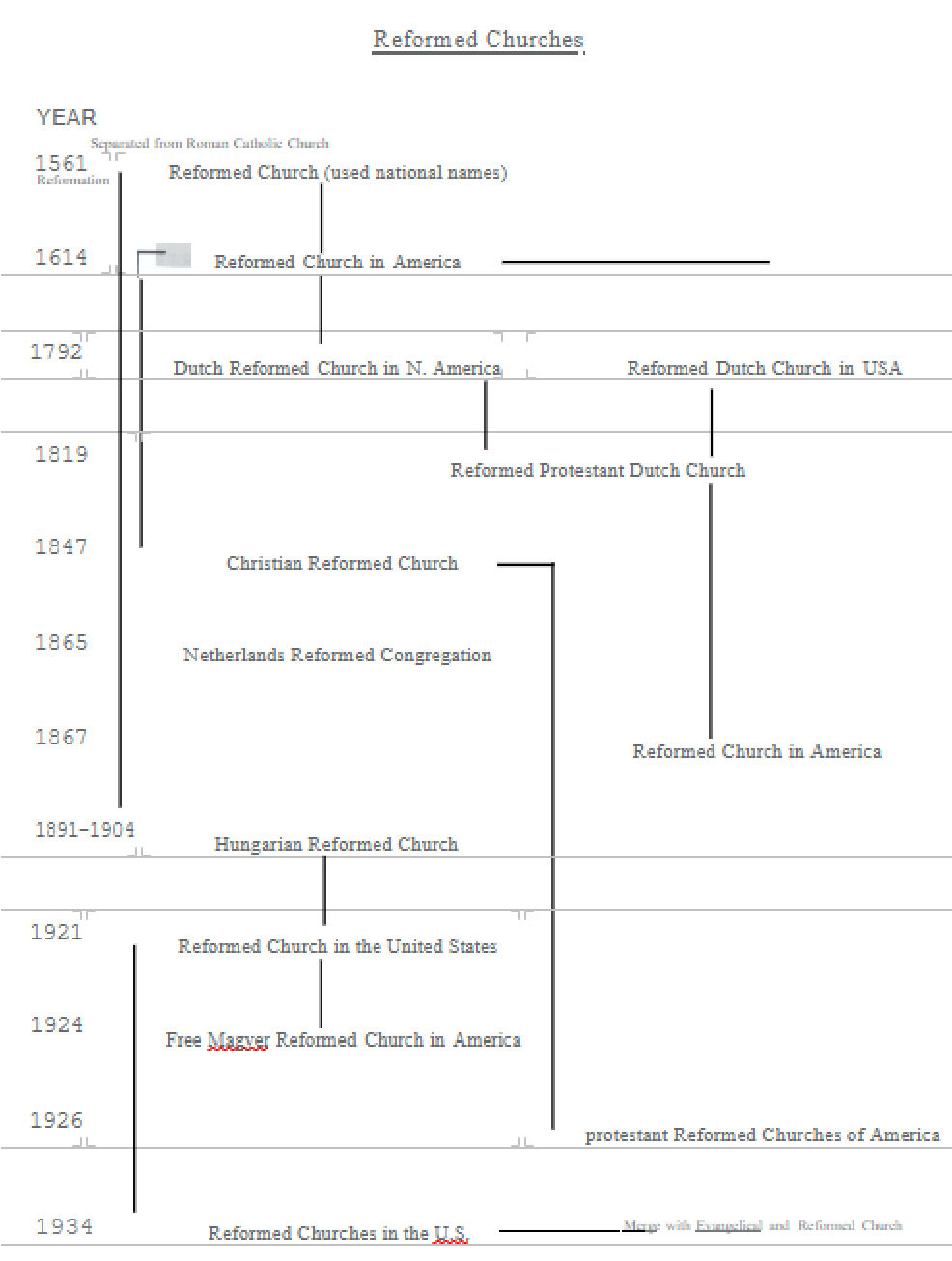
Reformed Churches
When the Belgic Confession was written in 1561 it became the creed of the Re formed Churches in Belgium and Holland. The Reformation was spreading from Switzerland into Holland at a time when the Dutch were in a struggle with Catholic Spain. The churches called Reformed as distinguished from Lutheran, originated in Swit- zerland under Zwingli, Calvin, and Melancthon. They were reformed in Switzerland, Holland, and Germany; they were Presbyterian in England and Scotland, and Huguenot in France.
Others in Bohemia and Hungary used National names.
When the Reformed churches moved to America they formed the Reformed Church in America, and the Christian Reformed from the Dutch peoples, Reformed Church in America from the German people, and a group coming from Hungary became the Magyer Reformed Church in America. All of them are Calvinistic and conservative, basing their doctrine upon the Heidelberg Catechism, The Belgic Confession, and the Canons of Dort (of the Synod of Dortrecht) using a Presbyterian form of government.
We now have:
Reformed Church in America
Christian Reformed Church
Hungarian Reformed Church in America
Netherlands Reformed Congregations
Protestant Reformed Churches of America
Reformed Church in the United States
CHART
Is one Reformed Church as good as another?
ANABAPTISTS
During the years of the Reformation, and beginning in 1520 and 1525, some religious groups organized that preached against certain church and social practices in Switzerland, Germany, The Netherlands, and in Austria. These groups were considered to be on the radical fringes of the Reformation of the 1500s.They believed that the church was a gathering of people united by faith, repentance, obedience to the Bible, and discipline. Because of this stand for obedience to the Bible they limited baptism to those who were believers and old enough to choose membership.
Originally known as the Brethren, or Swiss Brethren, they believed that the Bible negated the practice of infant baptism and the celebration of the Mass. Instead they insisted on believer's baptism and a memorial Lord's Supper. Other people called them Anabaptists or rebaptizers because they baptized adults who had been baptized in infancy. These 'Anabaptists' condemned government involvement in religion, which eventually led to the idea of the separation of church and state. Because other more prominent leaders of the Reformation were involved with leadership in government the Anabaptists were persecuted in both Protestant and Roman Catholic countries. Other reformers such as Huldeich Zwingli of Zurich and Martin Luther, and their followers often used the name Ana Baptist as an expression of contempt for any radial or unorthodox Protestant group. It has always been true that any group that attempts to follow the line of obedience to God's word as the Bible teaches will suffer persecution from the 'established' religions of the day. Jesus told His followers that, in the world you will have trouble.
There were similarities in belief between Anabaptist and Lutherans and Calvinists. All believed in a personal faith in God, as opposed to the ritualism that had been the practice of the established churches. They believed in the right of independent personal judgment, but the Anabaptist differed by being nonviolent and opposing state churches. The state church was organized by geographical areas called parishes and all those born in the area and resident were considered members and babies were baptized and included in the membership. Some Anabaptist did desire to establish Christian communities where all men would be equal and share with one another. These groups were opposed to participation in civil government and the taking of oaths. In this way they were radicals. Some of these groups that formed about 1534 were the Hutterian Brethren, founded by Jakob Hutter, New Zion founded by Jan Beuckelzoon, and the Mennonites led by Menno Simons. Anabaptist groups continued to form under different names, but they did not except or continue the use of the name given to them by others, Anabaptist. The Anabaptist's beliefs survive today in Mennonite and Hutterite religious communities.
CHURCH OF ENGLAND
The Church of England or Anglican church was established by acts of Parliament in England between 1529 and 1536. King Henry the 8th was angered by the refusal of Pope Clement 7 to annul his marriage to Catherine of Aragon. He induced Parliament to enact a series of statutes denying the Pope any power or jurisdiction over the church in his domain. Henry received support for this by a great majority of the English people. Mainly they supported the change because there was no drastic change from the catholic practices to which they had become accustomed.
The Christian church had existed in England since Christianity was introduced into the country. Evidence of its existence is found in writings of Tertullian and Origen in the early years of the 3rd century. English bishops are known to have attended the Councils of Aries in 314 AD, the council of Sardica in 347 and in Ariminun in 360. There are references to the church in what was Roman Britain found in writings of 4th century church fathers. After the arrival of Saint Augustine and his missionary companions from Rome in 597, the Roman influences found their way into the liturgy and practices in the Roman West. During the next four centuries the church in
Saxon England had the same lines of growth, development, and apostasy from the original church established as recorded in the New Testament. It followed the same changes as made in churches everywhere in the middle-ages when the Bible was not freely available to the people. After the Norman conquest in 1066 AD the influence from the continent of Europe strengthened the connection between the English church and the Roman papacy.
The assertion of power made by Popes from Gregory 7 to Innocent 3 between the late 11th and the 13th centuries was also felt in England, as elsewhere. Clerical influence and privilege were widely extended into secular affairs. Several times during the medieval period, English kings tried to limit the power of the Catholic church, and claimed independent canon law, but without success until Henry the 8th.
In 1382 John Wycliffe completed a translation of the scriptures from Latin to English. In 1528 William Tyndale by his unrelenting efforts put the Bible into the hands of the people. Working with a New Testament printed in Greek by the monk-scholar Erasmas, Tyndale set out to trans late it to English. Tyndale had to leave England, after finding, as he said, "there was no place to do it (translate the New Testament) in all of England." He completed the translation in Hamburg and tried to print it in Cologne, Germany. He had to flee from Cologne with sheets of his partially printed work to Worms. Here he had the printing completed. The first copies were smuggled into England and bought with enthusiasm. Officials of the church spoke out to condemn the translation; copies were obtained and burned in public ceremony; money was subscribed to buy up incoming copies. But, all the opposition could not stop a movement which was happening around the world. It was not difficult for a Pope or a sovereign to control the religion of the people when the people were denied access to the truth, but as copies of the New Testament, and then the entire Bible became available, it was very difficult to control the church.
After Henry the 8th died, the influences of religious reform became stronger in England. ln1549 the first Anglican Book of Common Prayer was published and it was required by an Act of Uniformity. A second prayer book issued in 1552 reflected the influence of Protestantism from the continent, and was followed shortly by the Forty-two Articles, also Protestant influenced. Both were put aside upon the accession, in 1553 of Mary 1, who returned to England and to formal obedience to the Roman Papacy that lasted until her death in 1558.
When Elizabeth 1 succeeded Mary as Queen of England in 1558 most of the ecclesiastical laws of Henry the 8th were revived. An Act of Supremacy defined more cautiously the authority of the Crown in the church, and another Act of Uniformity established the use of a Book of Common Prayer that avoided the Protestant influences of the second prayer book. The visible churches in the middle-ages were controlled by the Pope or by a monarch, not by the King of Kings, or the Word of God given in the New Testament. The churches recorded in history were churches controlled by doctrines of men and these doctrines and practices could be changed at the whim of a sovereign or a government. But there was also an element seeking the truth and attempting to follow the Word of God. In this period of time that Word was not readily available to the common man as it was controlled and kept by the powers of the churches in control. The Puritans meanwhile were increasing in numbers and in power and became more insistent in their demands for further reform in the church of England. Many people were tortured or burned at the stake for beliefs contrary to the established church and government. Just being known to disbelieve the doctrine of Transubstantiation would be cause for being publicly burned tied to a stake, and many people observed these atrocities. The people wanted changes in the direction of the Protestantism of Geneva and other cities on the continent. After James 1 became monarch in England in 1603 this agitation for religious change also became a struggle in Parliament. By 1645 the Parliament party was strong enough to outlaw the use of the prayer book.
In 1649, Charles 1 was executed, and the monarchy was temporarily overthrown, but in 1662 under Charles 2, the use of the prayer book revised to its present form, was required by an Act of Uniformity. An attack on the
Anglican church was attempted when King James 2 tried to reintroduce Roman Catholicism in England, but James lost his throne to William 3 and Mary 2 in the revolution of 1688. The church was in the power of the government, and corrupted in one direction or another. It has been said that power corrupts and that absolute power corrupts absolutely. It is easy to see this in the control and power struggles of the church in England.
The doctrine of the Church of England is found primarily in the Book of Common Prayer, which contain the ancient creeds, and in the Thirty-Nine Articles, which are interpreted in accordance with the prayer book. The four General Councils of the Christian Church, as well as the Holy Scriptures, as interpreted by the Catholic fathers and ancient bishops, is also considered. The Church of England differs from the Catholic church in denying the Roman papacy. The Church of England does allow women to become priests while the Catholic Church does not.
Throughout the 17th and 18th centuries there have been movements away from and back toward the beliefs and practices of the Roman Catholic Church. Some felt the pull of the work of John Wesley and his followers, many of whom left the Church of England to become Methodists. The foundation of an independent Episcopal church in the United States dates from the American Revolution, when members of the Anglican Church could no longer give allegiance to the mother church in England. Soon an establishment from a number of other churches, centering upon the Church of England was established as the Anglican Communion.
The Church of England now has Anglican churches in many countries of the world because of missions and educational facilities.
We ask:
- Is the Church of England as good as the Catholic Church?
- Is the Church of England any different really from the Catholic church?
- Is a church that follows a common prayer book as good as a church that adheres only to the New
Testament as the Word of God?
- Is a church that tries to keep the Bible from people managing the church according to the Apostle's doctrine which had been published in the 1st century?
- Is one church as good as another?
- Who is the king of the church?
EVANGELICAL CHURCH of the AUGSBURG CONFESSION
The Augsberg Confession was a short summary of the religious teaching of Martin Luther. It was written by Phillip Melanchthon, Luther's associate in leading the Protestant Reformation. The Confession was written in 1530. It was designed to refute the accusation that the Protestants were reviving old heresies, and was prepared for Charles V, the 'Holy Roman Emperor.' It was named for the city of Augsberg, Germany, the scene of a meeting (called a diet) called by Charles V to end religious divisions within the Empire.
Melanchthon wrote the confession to prove that the followers of Martin Luther supported the historic tradition of the established church. He tried to compromise on some controversial is sues, hoping for a reunification of people of the Christian persuasion. He did not try to restore the Lord's church to the original found in the New Testament, but sought to reform the existing church. Luther admired the confession for 'treading lightly' over disputed issues. He also insisted that no further concessions be made. It was entirely too Protestant in tone
and the Emperor rejected it. While Malanchthon made some change to it over the years, it was the original version that became the basic statement of faith of what was to become the Lutheran Church.
The Catholic Church had developed an elaborate doctrine of 'merit', earned by works and dispensed by the priesthood. Luther concluded that people are not justified by works after he had extensively studied the Bible. Because he had been a monk he had easy access to a Bible which all people of his day did not have. He saw that many church imposed rites and the sale of indulgences had no foundation in the Bible. He came to understand that "the just shall live by faith" and that salvation and eternal life come only by faith in Jesus Christ. He believed that the Bible and not the church officials is the final authority in religion. (Indulgences allowed a person to pay for forgiveness of sins they had committed or were going to commit.)
Over the course of sixty years the enemies of Luther compelled him and his successors to defend their faith in the face of severe persecution. The Augsberg Confession consisted of a number of articles and began by showing similarities and differences between the Catholics and the Protestant positions with emphasis on justification by faith... Then it listed Catholic abuses for which a remedy was demanded. When the Catholics responded refuting much of the Confession, the Protestants answered with an "Apology' that further explained their beliefs. Later other articles were written by Luther that detailed Protestant theology and attacked Catholic teaching concerning such things as the Mass, the Pope, pilgrimages, monastic life, baptism, and justification by works.
The church established by Luther was originally called the Evangelical Church of the Augsberg Confession, or simply the Evangelical Church. Luther did not approve of having his name as a part of this church, but soon it became known only as the Lutheran Church.
PRESBYTERIAN
Presbyterianism began in the theology of John Calvin, the leader of the Protestant Reformation in Geneva, Switzerland. John Calvin established a church government based on the New Testament office of Elder, but did not insist on Presbyterianism as the only form of church government sanctioned by the Bible. This allowed variations of church government, but still following the Calvinistic theology. Some Congregational or Baptist churches have Calvinistic theology, but do not have a Presbyterian form of government. John Calvin did not found Presbyterianism, but he laid the foundations for it in Switzerland, Holland, France, England, Scotland, and Ireland. He inspired those in France who became Huguenots, he influenced the Dutchmen who formed the Dutch Reformed Church in Holand, and he gave courage to British Presbyterians in their struggle against Bloody Mary, and taught John Knox who went home to Scotland. Knox and the Covenanters set Scotland afire and made it Protestant and Presbyterian.
Presbyterianism is a form of church government and a theological tradition found in Presbyterian and Reformed churches. The Protestant Reformation of the 16th century constituted four major groups, which were the Lutheran, Anabaptist, Anglican, and Presbyterian and Reformed. As these traditions spread in various countries, when Calvinist formed organized churches in Europe, they called them Reformed, in the British Isles and North America these churches were known as Presbyterian.
The term Presbyterian is from the Greek 'presbyteros' or elder. The New Testament provided for the establishment of a plurality of Elders in all of the churches. The qualifications for these offices are found in combining verses from the Book of Acts, 1 Timothy 3, and 1 Peter 5. These were to be the rulers of the local congregations. Additions to the Bible structure of church government were made by the Presbyterian church in the form of ascending church bodies and courts. Each congregation is governed by a ruling body called a
session or consistory composed of the pastor and the elders, who are elected by the congregation. (the Bible makes no distinction between the titles, pastor, elder, bishop, overseer, or shepherd, referring interchangeably within the same passages to these titles.) Then each congregation belongs to a presbytery, or classis, which coordinates and governs the activities of congregations within a particular geographic area. The members of the presbytery include all the pastors and elected representatives of the elders from each congregation. Here the Reformation followed the ascending offices of the Catholic churches from whom they had broken away. Presbyteries belong to synods, which are larger geographical units of the church, and a general assembly, or general synod unites the entire church. At each level the church is governed by elected representatives of the people. The churches of the Presbyterian tradition have usually organized according to national boundaries. Within each country they have often had divisions. They are associated in the World Alliance of Reformed Churches, the World Council of Churches, in the U.S.A. the National Council of Churches, and the Consultation on Church Union.
The theology of Presbyterianism has diversity today, but Calvin's theology is still the central source. Calvin's book, Institutes of the Christian Religion, of 1536 and revised in 1559 has been widely used. Like the religious reformer in Germany, Martin Luther, Calvin emphasized the two central doctrines of the Protestant Reformation; the authority of the scriptures and justification by grace through faith. Also like Luther, Calvin reduced the Christian sacraments to two - baptism of both infants and adults, and the Lord's Supper. (The Bible authorizes only the baptism of believers.)
John Calvin differed from other Protestant reformers in his understanding of the nature of the Lord's Supper, church government, and the role of law in Christian life. The Lord's Supper was served only occasionally. Worship allowed some flexibility but the sermon was central. Liturgy mostly absent. Currently with the renewal of Reformed influence the sermon is still important but a greater use of liturgy and more regular celebration of the Lord's Supper can be found in many congregations.
John Calvin believed and taught God's sovereignty; the sovereignty of God ruling His universe, Christ in salvation, the scriptures in faith and conduct, and the sovereignty of each individual in the interpretation of the will and the Word of God. These were points that needed to be stressed to people who had known the rule of the Roman Catholic system. Calvin's system has been summarized in five main points; easily remembered using the acrostic, TULIP.
TULIP 5 points of Calvin's doctrine (Calvinism)
TOTAL DEPRAVITY
HUMAN IMPOTENCE
UNCONDITIONAL ELECTION
PREDESTINATION LIMITED ATONEMENT
IRRESISTIBLE GRACE PERSEVERANCE OF THE SAINTS
Man is completely dominated by the sovereign, eternal ruler of the universe. God showed His love for all mankind by the gift of His Son, for the atonement or the reconciling of man to Himself in bestowing His saving grace and forgiveness of sins, on all who seek it. No one is condemned except on the grounds of his own sin. (From the declaratory statement in the Constitution of the United Presbyterian Church.)
What do the points of Calvin's doctrine actually teach?
Total Depravity: Calvin saw that by nature we sin and that the sin of Adam allowed all to fall into sin. God can foreknow what will happen in the future and can determine who will be saved or lost.
Calvin accepted the Catholic teaching on 'original sin.'
Unconditional Election: Calvin was a dictator politically and theologically, he saw God the same way. In Calvin's 'Institutes of the Christian Religion'3.21.7 page 210 "... that scripture clearly proves this much, that God by His eternal and immutable council determined once for all those it was His pleasure one day to admit to salvation, and those whom, on the other hand, it was His pleasure to doom to destruction." (Foreknowledge and predestination are two different things; Calvin saw them as one and taught that man can't fall away. This allows man no choice. What motivation is there to serve God if no matter what you do, you can't change the outcome?)
Limited Atonement: This means that Jesus did not die for everyone. Why would Jesus die for those who were lost?
Irresistible Grace: Since God is sovereign, He decides who will be saved. God selects who will be saved and people change to God's move on their life. You cannot refuse.
Perseverance of Saints: "Once saved, always saved."
Calvin was not only a strong leader in the reformation of the church, but also in other fields such as; education, establishment of democratic forms of government in both church and state, and in individual dignity to man. He improved the moral tone for capitalism, and made the Swiss capital a clean city.
There have been some divisions in American Presbyterianism; some caused by revivalism in the 1740's, some due to slavery, some from theological issues or the conduct of missionary work, some from the War for Independence of the Confederate States.
The northern church became the United Presbyterian Church and the southern church was called Presbyterian Church in the United States.
Other Presbyterian churches include:
Presbyterian Church in America which merged in 1982 with the Reformed Presbyterian church, Evangelical Synod. (a 1965 merger of the Reformed Presbyterian church in North America, General Synod and the Evangelical Presbyterian Church which had split from the Orthodox Presbyterian Church in 1937.)
Presbyterian Church of North America. Associated Reformed Presbyterian Church Bible Presbyterian Church
Cumberland Presbyterian Church
Second Cumberland Presbyterian Church in the United States Orthodox Presbyterian Church
Reformed Presbyterian Church
Reformed Presbyterian Church in North America Evangelical Presbyterian Church
Westminster Presbyterian Church
Associate Presbyterian Church of North America
There are American Reformed churches with Presbyterian government. They are:
Reformed Church in America
Christian Reformed Church
Hungarian Reformed Church in America
Netherlands Reformed Congregations
Protestant Reformed Church of America
Reformed Church in the United States
All Presbyterians follow some degree of confessions including:
Nicene Creed of 325
Apostle's Creed of 2nd century Scot Confession of 1580
Heidelberg Catechism of 1563 Second Helvetic Confession of 1566 Westminster Confession of 1647 The Shorter Catechism of 1647
Theological Declaration of Barmen from 1934
Confession of 1967
Surely there are some other Presbyterian type churches that have been omitted here, but our question remains the same. Is one Presbyterian Church as good as another? Are creeds and confessions necessary to
understand and define Bible doctrine?
If a confession or creed contains more than what the Bible teaches, doesn't it contain too much? If it contains anything less than what the Bible teaches, doesn't it contain too little? If it contains exactly what the Bible teaches is it superfluous? Is it necessary? Certainly, if it contains exactly what the Bible teaches it would be a good personal confession but would it be needed as a creedal statement?
LUTHERAN
We have seen the origins of the Lutheran Church in the development of the Reformation and the Evangelical Church of the Augsburg Confession. We will see as happened in the New Testament Church, what the founder taught and what the church did were not in accord. We will compare some of the Doctrines taught and believed by Martin Luther and what the church bearing his name has practiced and taught.
CONGREGATIONALIST
Congregational is a term used to designate a particular denomination, and is also used to define a form of church government, in which each individual congregation or local church is self-governing.
Congregationalism began with the original churches we read about in the New Testament. This is the way Christianity began. Over time and the development of the Catholic Church and the others in the Reformation, churches developed various forms of hierarchy in church management and control. It was revived in the period of English Puritanism, and then to designate a particular denomination. Many denominations began with some form of congregationalism, but over time control was moved to central organizations even when some authority remained at the local church level. There are some religious bodies that use the term as their name. These include some Baptists, Unitarians, and Christian Churches. The church of Christ has always been congregational from its beginnings in the first century. More recently churches of the Restoration Movement and the Campbellite tradition are still autonomous and completely congregational.
Congregationalism was prevalent in the 17th century among the English Puritans who migrated to New England. Historical accounts trace this congregationalism to Robert Browne, who argued as early as 1582 that the church of England was so corrupt that true Christians should separate from it and form their own autonomous churches. In many places and in many ways not known to history, Christians had to band together in small groups to avoid the penalties of being labeled heretics by the main line churches, and the governments that controlled them. This same thing is happening in Communist or Muslim countries such as China or Saudi Arabia where those "House churches' meet in secret, for fear of being tortured or murdered.
Among those who became the denomination called Congregational, membership was restricted to those regenerated, or spiritually reborn, through a personal experience of con version. This restriction had to be modified and in 1662 by adoption in many New England churches of the Half-Way covenant, privileges were given to persons who were sympathetic with the Congregational church order, but could not give assurance that they had experienced personal conversion. In the Lord's church this was not a problem since those who were obedient to the Word of God, repented of their sins, made a public confession, and were baptized, (immersed in water) showing clearly that they had' personal experience' of conversion.
In 1708 in Connecticut, the adoption of the Saybrook Platform provided for ministerial associations and association of churches of the Presbyterian character. In Massachusetts the early fear of exercise by ministerial associations abated and the 'Great Awakening' about 1740 further eroded the concept of regenerated membership.
Denomination developed separate identities, and organized separately to provide various services to its churches in the 19th century. Congregationalism is only one of the religious bodies that derived from congregational churches of colonial New England. In the years 1805 to 1825 two groups emerged carrying the name congregational. The liberal wing became a separate body called Liberal Christians or Unitarian Congregationalist, and finally just Unitarians. The other wing was called Orthodox or Trinitarian Congregationalist and eventually just Congregationalist.
The Congregationalists developed an increasing sense of denominational identity and held a series of conventions, which resulted in forming a National Council of Congregational Churches of the United States. The denomination has now spread to other parts of the country where people from New England have migrated.
Now, since participating in the Federal Council of Churches and with various mergers and the merger in 1961 with the Evangelical and Reformed Church, the denomination is called the United Church of Christ. The Evangelical and Reformed churches were of the Presbyterian, rather than congregational make up, and since
the Congregational denominations were no longer congregational anymore anyway, it represents very little compromise. Since they have merged one church among them must be as good as any other among them!
BAPTISTS
Baptists are one of the major Protestant churches in the United States. It is claimed among them that they have no founder but Christ and that Baptists have been preaching and practicing from the days of John the Baptist. There have been people holding to what have come to be considered distinctly Baptist principles all across the years. But the church, or 'organized church' they began in England and Holland. (Note: John the Baptist lived in the Mosaic Age before the Christian Church was established.)
When the Reformation came early in the 16th century, scattered groups appeared advocating the convictions of faith which are now Baptist theology. The name Baptist was found in various forms in Germany and Switzerland. Pedobaptists, (who baptized infants and children) Anti Pedobaptists, (who opposed infant Baptism, and Anabaptists (who re-baptized adults who were baptized as children.)
In Holland, Mennonites, followers of the formerly Anabaptist Menno Simons, influenced a group of Baptist Separatists who had taken refuge in Amsterdam from the religious persecutions under James 1; many of them lived in Mennonite homes and one of the leaders, John Smyth was re-baptized with his followers in the Anabaptist or Baptist faith and with them organized the first English Baptist Church in 1609. They refused to be Mennonites because that was a threat to their English heritage. They would be Baptist but not Mennonite. They went back to London and established the General Baptist Church.
In 1638 the first Particular Baptist (British) Church was founded holding to the predestination teachings of John Calvin and preaching limited atonement. In 1641 the immersion Baptist broke away and wrote a confession of faith which is still held by many Baptists. It was this confession which branded these people with the name Baptist.
There are at least 27 Baptist denominations each independent of the others yet bound together in certain principles and doctrines:
American Baptist (in the north)
Negro Baptist
Bible Baptist Fellowship, International
Baptist General Conference
Free Will Baptist
General Baptists
General Six Principle
Baptist Primitive Baptists
Separate Baptists in Christ
Seventh Day Baptists (German 1728)
United Free Will Baptist Church
Bethel Ministerial Association
National Primitive Baptist Convention of the U.S.A.
National Baptist Evangelical life and Soul Saving Assembly of the U.S.A.
General Conference of the Evangelical Baptist Church, Inc.
Duck River (and Kindred) Association of Baptists (Baptist Church of Christ)
Bethel Baptist
Southern Baptist Convention
American Baptist Association
Central Baptist Association
Christian Unity Baptist Association
Conservative Baptist Association of America
General Association of Regular Baptist Churches
Landmark Baptists
North American Baptist General Conference
Seventh Day Baptists
United Baptists
Baptist Missionary Association of America
Two-seed-in-the-spirit Predestination Baptists
Is one Baptist Church as good as another?
QUAKERS - FRIENDS
RELIGIOUS SOCIETY of FRIENDS. George Fox, born in 1624 and lived until 1691, sought after spiritual truth and peace in an environment where the church and state controlled religious action and thought. Failing to find spiritual truth in the churches of his time he found peace in a new, intimate and personal relationship with Christ. He said: "When all my hopes in (churches and churchmen) were gone, then I heard a voice which said, "There is one, even Christ Jesus that can speak to thy condition."
"The Inner Voice or Inner Light, a voice available to all men. Every member of the Friends, commonly known as 'Quakers' is the church, every heart is God's altar and shrine. They have nothing to do with outward forms or ceremonies, rituals, or creeds. Their fundamental belief is that divine revelation is immediate and individual, all persons may perceive the Word of God in their soul, and friends endeavor to heed it."
Quakers emphasize human goodness because of a belief that something of God exists in everyone. They do recognize the presence of evil and work to eradicate it as much as possible. Friends try to live in accord with Christian principles of truth and sincerity. They avoid luxury, with simplicity in dress, manners, and speech.
Quakerism was revolutionary, and was treated as a revolution by the state Church of England, where it originated. They insisted in freedom of speech, assembly, and worship, apart from the state church. They objected to the theology and doctrines of the state church and thought it wrong to have to pay taxes to support the state clergy. This was taken as rebellion by the state. Many Quakers were whipped, jailed, tortured, mutilated, or murdered, in the period of 1650 to 1689. Some Quakers died in prisons. In America laws were passed to keep them out, and many were whipped, until the toleration act of 1689.
They would take no oaths in court, made no distinction between men and women or social classes, they condemned slavery, and would not tip their hat to king or commoner. The names they took such as Children of Light, Children of Truth, Friends of Truth, and finally Religious Society of Friends generated ridicule and some fierce opposition. In reference to their agitated movements before moments of divine revelation, they were popularly called Quakers.
Membership qualifications are based on moral and religious grounds, and the willingness of the prospect to realize and accept the obligations of membership. Meetings for worship are held once or twice a week, and are intended to help them feel God's presence as a guiding light or spirit in their lives. In these meetings, members measure or compare their insights and beliefs against others in the meeting. The meetings generally have no prearranged pro gram, liturgy, or rites. The more recent meetings of some of the Friends do use paid ministers and conduct a programmed or semi- programmed worship.
The administration of the society is regulated by meeting for business. Monthly Meetings are held by one or more congregations. One or more Monthly Meetings form a Quarterly Meeting, and the Quarterly Meetings within a defined area form a Yearly Meeting. The decisions of the Yearly Meeting are the highest authority for doctrinal or administrative items raised within the jurisdiction. The Friends World Committee for Consultation is the International organization of the society.
There have been some differences of opinion among the friends over doctrine. About 1827 the American Quaker minister Elias Hicks questioned the authenticity and divine authority of the Bible and the historical Christ, some Friends seceded and were known as Hickites. The Society then became known as Orthodox Friends. Then an evangelical movement led by a British Quaker, Joseph Gurney aroused opposition and a new group called the Orthodox Conservative Friends resulted led by John Wilbur. This group emphasized the strict Quaker ism of the 17th century. With these changes many changed their dealings with the world by abandoning their mode of dress and speech, and hostility toward the arts and literature, and the strict Quakerism of the 17th century is very small today.
Is one Quaker as good as another?
For every 'denomination' there is that difference that separates it from all others. Most denominations in what is called Christendom have some claim to be following God. It is not God who is the cause of religious differences or confusion in our world. "For God is not the author of confusion, but of peace, as in all the churches of the saints." (1 Corinthians 14:33) Man is not the source of religious knowledge and should recognize that God's Word as given in the Holy Bible does contain religious authority.
Jesus Christ was given all authority by the Heavenly Father (Matthew 28:18) Moses prophesied in Deuteronomy 18: 15-19, "The Lord thy God shall raise up unto thee a Prophet from the midst of thy brethren, like unto me, unto Him you shall hearken." Peter applied this prophecy of Moses to Jesus in Acts 3: 19-26,
"Repent ye therefore and be converted, that your sins may be blotted out, when the times of refreshing shall come from the Lord. And he shall send Jesus Christ, which before was preached unto you: Whom the heaven must receive until the times of restitution of all things, which God has spoken by the mouth of the holy prophets since the world began. For Moses truly said unto the fathers, a prophet shall the Lord your God raise up unto your brethren, like unto me; him shall ye hear in all things whatsoever he shall say unto you. And it shall come to pass, that every soul, which will not hear the prophet, shall be destroyed from among the people. Yes and all the prophets from Samuel and those that follow after, as many as have spoken, have likewise foretold of these days. You are the children of the prophets, and of the covenant which God made with our fathers, saying to Abraham, And in thy seed shall all the kindred's of the earth be blessed. Unto you first God, having raised up his Son Jesus, sent him to bless you, in turning every one of you from his iniquities."
Here we have the word of God "since the world began" through the children of the covenant with God and the prophets telling of the "seed" which is Jesus the son of God. This is the seed and the Word we have been following through the chapters of this book. During the lifetime of George Fox that Bible, while in rather short supply, was available, and in the years since it has been available. The time for the 'inner voice' is over.
Jesus was given all authority in heaven and in earth. On the mountain when He was transfigured in the presence of Moses, Elias, Peter, James, and John, the voice out of the cloud said, "This is my beloved Son, in whom I am well pleased, hear ye Him." The time of the prophets and the gifts of the Holy Spirit are past, and we need to hear what Jesus has to say, and through the Holy Spirit the words of His apostles as recorded in the New Testament. There will always be divisions and changes in a church or assembly where everyone has an 'inner light', 'inner voice', or spirit to guide him rather than the written Word of God as recorded in the Holy Bible.
Hebrews 1:1-2, "God who at sundry times and in divers manners spoke in time past unto the fathers by the prophets, hath in these last days spoken unto us by His Son, whom He hath appointed heir of all things, by whom He made the worlds."
Failing to find spiritual truth in the churches at any time should not result in 'new revelation' or 'inward light' but a search in the scripture will result in finding what God has established in the church of His Son Jesus. Nothing new can come of this search; the words have been the same for almost 2000 years. The churches may not have found this truth, but everyone who seeks the truth with an honest heart and open mind will find the same church the apostles knew in the first century and which is still in the world today.
"There is one, even Christ Jesus that can speak to thy condition.”
UNITARIAN
Unitarian thought goes back into the early centuries of the Christian Church. Unitarianism denies the doctrine of the trinity, that God exists in three persons as Father, Son, and Holy Spirit. Unitarianism teaches that God exists in one person only. Beginning in the middle of the second century and toward the end of the third century, teachers called Monarchians taught this doctrine.
During the time of the Reformation in the 16th century, some questioned the doctrine of the Trinity again. Unitarian belief was not tolerated in most countries, but was allowed in Poland. Unitarian refugees primarily from Italy found welcome in Poland from 1548 to 1574. There they formed a separate church, which flourished until the middle of the 17th century. Here in Poland the Unitarian group grew separate from the Reformation Movement.
After 1740, the Unitarian point of view was being considered and studied in New England, and in 1796, King's Chapel in Boston, Massachusetts officially adopted Unitarianism and left the Episcopal Church. Following this, other churches also became Unitarian. By 1815 the name became used more often, and 120 Congregational churches adopted Unitarian principles.
In England at this time some suffered martyrdom on charges of teaching or practicing the Unitarian doctrine. It was not until the passing of the Toleration Act in 1813 that people were allowed to adopt Unitarian opinions publicly.
The American Unitarian Association was formed in 1825 and a national conference was add ed in 1855. Local congregations retained independence. In 1961 the association joined with the Universal Church of America to form the Unitarian Universalist Association, which has its headquarters in Boston.
In 1942 the character of the Universalist Church of America was changed to read, "To promote harmony among adherents of all religious faith, whether Christian or otherwise." They desire no doctrinal statements, or creedal tests. Universalism is to be harmonious among Christians or Non-Christians, naturalists, humanists, mystics, and all who can find significance or meaning in a universal approach to life. Joined now in their new association neither Unitarians nor Universalists have lost anything of their original ideologies, theology, or purposes. No minister, member, or congregation is required to subscribe to any particular interpretation of religion, religious belief, or creed.
Unitarian doctrine has no formal creed, but is guided by the constitution of the General Conference, which has stated, "These churches accept the religion of Jesus, holding in accordance with his teaching that practical religion is summed up in the love to God and love to man." Denying the Trinity and holding to the oneness of God, they deny the deity of Jesus. They have no belief in everlasting punishment, or the concept of original sin. They believe in the ultimate salvation of all souls, and believe in a divine nature of man, believing that Christ was divine only in that same way, as all men are. Hell and eternal punishment are not consistent with the concept of a loving and all-powerful God.
Heaven is not a place, but a state of being. Unitarians do not hold the Bible to be infallible. There is tolerance for individual belief and democratic principles in seeking truth. They celebrate the Eucharist, not as a sacrament, but as a commemoration of the death of Jesus, and a spiritual expression of communion with him. They adhere to the rite of infant baptism, and do not restrict baptism to adults.
With no official statement of faith or any particular belief and wide differences of belief and practice in the same organization, how can we know if this religion is as good as any other? If Jesus Christ is not divine and not the seed of the promise, as we have found throughout the Old and New Testaments of the Bible, then there is no hope of life eternal in heaven or fear of hell. There is no religion any better than any other, and everyone can believe whatever they want, until the day they die and learn the truth from God Himself, and will bow to Jesus, the Son of God, who was not considered here to be divine. If the line of the promise found in the Bible from Genesis 3 to Revelation 22 has no substance, then there is no religion with substance or worth putting our time and energies into.
BRETHREN
The Disciples of Christ were called Brethren in Luke 8:21 and the Apostle Paul writing the Epistle to the churches of Galatia referred to them as Brethren. When referring to the church it was called the Church of God, the Body of Christ, Church of Christ, or the
Bride of Christ. (1 Corinthians 1:2, Acts 20:28, Colossians 1:24, Matthew 16:18, Romans 16:16, Romans 7:4, and Revelation21:9)
When a group of Christians in Schwarzenau, Germany in 1708 established an organization called Brethren they took the New Testament literally and tried to put its teachings into practice in every detail of living. They were soon given the name 'Dunke s' because of the practice of immersion in baptism in which the believer was immersed three times, once each in the name of the Father, Son, and Holy Ghost.
This group was persecuted in Germany and was reorganized in America in 1719 at German town, Pennsylvania. The denomination had its headquarters in Elgin, Illinois. They have been known for their desire for peace, temperance, brotherhood, and simple living. The brethren beginning in Germany were known for many years as German Baptist Brethren. One group came to America in 1719, led by Peter Becker to free land offered by William Penn. They were joined by another group from Germany in 1729 led by Alexander Mack.
Generally, these 'Dunkers' or Brethren were former Baptists who followed the Pietistic theology of the 17th century. The Pietists were mostly of Lutheran origin but were not happy with the formal worship and ritual in their state church. These Brethren spurned the idea of Apostolic Succession. They practiced a 'love feast' which was the serving of the Lord's Supper preceded by a ceremony of foot washing. They dressed very plainly, refrained from worldly amusements, refused to take oaths, engage in lawsuits, or go to war. In doctrine the Brethren adhered to the New Testament and accepted no creeds. The Bible is the inspired and infallible Word of God and the New Testament provides the only rule of faith and practice. They believe and baptize in the name of the trinity, and in future rewards and punishment. Faith, repentance, and baptism are the conditions for salvation. Their practice was to follow closely the teachings of the Bible and the primitive simplicity of the New Testament Church. Exception may be in a central organization as developed to control and organize the churches, and in the use of instrumental music in worship.
In organization they have Moderators and Pastors in local congregations, above this are established Districts, and an annual conference of delegates from the churches. Then there is an 'Upper House' known as the Standing Committee made up of delegates from the districts. A General board, elected by the annual conference, supervises the general church program.
They have become a member in the World Council of Churches and the national organization in the United States.
The Plymouth Brethren originated with a group opposing the Established Church in England and Ireland sometime about 1800. They began meeting for fellowship and prayer and used names from the scripture and were called Christians, Believers, or Saints. Because they had the largest meeting in Plymouth, England, they organized with the name, Plymouth Brethren. They had no connection to the Brethren from Germany who had organized earlier. They also set up their meetings based on the New Testament, recognizing no clergy or laity. They had a strong emphasis upon the imminent rapture of the church. Differences arose in the Plymouth assembly and a division occurred in 1848 into the Exclusive Brethren and Open Brethren. The Open brethren wanted to receive all persons sound in faith even if some had come from an assembly where error was taught. The exclusive Brethren held that this disqualified the assemblies from the 'Circle of Fellowship', the joint body holding corporate unity made up of leaders making decisions for all constituent assemblies. In America, additional divisions occurred and became eight bodies of Plymouth Brethren in the U.S.A., designated by Roman Numerals. In 1848 another break resulted in the establishment of the Church of God (New Dunkers.)
Disputes in organization brought about two smaller groups. The Old Order, or Yorker Brethren in 1843 and the Brinsers or United Zion's Children in 1855. This name was changed in 1954 to United Zion Church and is located mostly in Pennsylvania.
About 1875 a considerable number of Anabaptists and Pietists fleeing persecution in Europe came to Pennsylvania and in cooperation with other denominations developed a fellowship called United Brethren in Christ. A group near the Susquehanna River had a disagreement with this fellowship over requirements in Christian ordinances, and this resulted in the formation of the "Brotherhood by the River" or River Brethren.
The Brethren Church (Progressive Dunkers) left the church of the brethren because the Conservative Dunkers were too conservative, The Old Baptist Brethren (Old Older Dunkers) left it because they considered it not conservative enough. The issues were Sunday Schools, salaried ministers, missions, higher education, and church societies. They withdrew in 1881. The Progressive branch was organized in 1882.
A dissenting group formed in 1889 over an issue of discipline rather than doctrine is called the
Church of the United brethren in Christ.
In 1926 a small group of conservatives withdrew and formed the Dunker Brethren Church.
In 1939 multiple divisions occurred resulting in the Ashland Group and the Grace Group. The Grace Group became known as the National Fellowship of Brethren Churches. Both groups carry the name of Brethren Church and operate under the same charter with different annual conferences held. The Ashland Group in Ashland Ohio and the Grace Group in Winona Lake, Indiana. The Grace Group has taken on a doctrine more nearly the Calvinistic viewpoint in theology. Churches are grouped into geographic districts which hold annual conferences.
Amos 3:3 asked the question, "Can two walk together unless they have agreement." The concept of following close to the New Testament is an excellent ideal and frequently required in the Word of God.
The church of the New Testament was called by various names, but in every case it is the church belonging to Jesus Christ. The same church is called 'Church of God' in First Corinthians 1:2 and Acts 20:28. In Colossians 1:24 and in Ephesians 5:23 the church is referred to as the 'Body of Christ'. In Matthew 16:18 and in Romans 16:16 it is called the 'Church of Christ', and in Romans 7:4 and Revelation 21:9 it is the 'Bride of Christ'. The believers were called 'Disciples' in John 15:8 and Acts 11:26, cailed 'saints' in Romans 1:7, 1 Corinthians 1:2 and
Philippians 1:1, called 'Brethren' in Luke 8:21 and Galatians 6:1, called 'Children' in Galatians 3:26 and 1 John 2:1, and called 'Christians' in Acts 11:26, Acts26:28, and 1 Peter 4:16. The church of Jesus Christ consists of those persons found listed in the Lamb's Book of Life as mentioned in Revelation 20:12. Christians belong to Christ and are included in His church which is His bride. Names used to identify His church on this earth should be consistent with names used in the scriptures, but because of our legal systems, and to make them legal enti- ties within communities, sometimes the names of the Christians are used to identify the name of the church comprised of Christians. The name Brethren is such a name.
Our question: Is one church of the brethren as good as another? Are any of the churches of the Brethren still following the New Testament as they did at one time in history? Are they truly trying to "earnestly contend for the faith which was once delivered unto the saints" as directed in Jude, verse three?
the denominational name. This name was approved at a conference in 1848.
1805-1813 Wilmington, Delaware. The Union American Methodist Episcopal Church was one of the first Negro bodies to establish an independent Methodist Church. A group of members left the Asbury Methodist Church in 1805. They worshipped in homes and outdoors until 1813 when they built their first church building. At first they incorporated as the Union Church of Africans. Defections from this membership caused the formation of another group called The African Union Church, which forced a name change to the Union American Methodist Episcopal Church.
1810-1829 England and U.S.A. The Primitive Methodist Church, U.S.A. had its initial organization in England under the direction of Lorenzo Dow. Dow was an American camp meeting revivalist who went to England to hold a series of meetings, which resulted in forming a number of societies of converts. The leaders of these societies were dropped from the Wesleyan Connection and formed the Primitive Methodist Church. Four missionaries came to America in 1829 and settled in New York City, and Philadelphia. Doctrinally, modified Wesleyan Articles of Religion are accepted.
1830. Baltimore, Maryland. The Methodist Protestant Church organized in protest to almost total rule of clergy in the Methodist Episcopal Church, and METHODIST
Methodist, beginning in 1729, when a group of students at Oxford University in Eng land, began to assemble for worship, study, and Christian service. Their fellow students began to call them the Holy Club or Methodists referring to the methodical manner or church ritual and their sense of Christian duty.
Within this group were John and Charles Wesley. John preached and Charles wrote hymns that are still well known today. Together, along with George Whitefield they brought about a spiritual revolution. The Wesley's were sons of a clergyman of the Church of England. The members of the 'Holy Club' also called "Bible Bigots", or "Bible Moths.' They stood their ground against jeering students and went out to preach and pray with the poor and desperate 'commoner' of England. They preached in prisons and ghettos to the bitter and hopeless people of British society.
The theology of the Wesley's followed the doctrines of Armenians rather than the Calvinistic emphasis on predestination. This indicates that although God knows that some people are intended for hell, and some for heaven, Jesus will separate the 'Sheep from the Goats,' and people are still free to follow or reject the 'gospel', the good news of the Savior, Jesus Christ. Preaching the doctrine of salvation through faith, John Wesley quickly had an enthusiastic following among the English working classes, for whom the formal, established Church of England had little appeal.
Opposition by the English clergy and the established church prevented the Wesley's from speaking in the churches, so Methodists meetings were often conducted in open fields. These meetings led to a revival of religious fervor throughout England, especially among the poor. John Wesley's message and his work among the poor encouraged a social consciousness that was retained by his followers and is still a Methodist tradition. In recent times the 'social gospel' has taken a forefront over the gospel of salvation, repentance and forgiveness of sins.
The Wesley's came to Georgia in the Americas in 1736. John was sent by the society for the Propagation of the Gospel, to be a missionary to the 'Indians'. Charles became a secretary to General Oglethorpe. They were there for about two years and did not consider it successful.
Between 1739 and 1744 the organization of Methodism came together. There was phenomenal growth of membership in England, Scotland, Ireland, and Wales. They had a great impact upon British society. Wesley did
try to keep the movement within the Church of England, but so many members from among the un-churched made a separate organization imperative. In 1739 Wesley drew up a set of general rules of conduct and delineation of the Bible. In 1784 a deed of Declaration gave legal status to the annual conference. In 1791, after the death of John Wesley, Methodism in England had a name as a recognized church, the Wesleyan Methodist Connection.
Soon after John Wesley's death in 1791, his followers began to divide into separate church bodies. During the 19th century many such separate Methodist denominations were formed in Great Britain and in the United States. Each of these groups maintains a version of Wesleyan tradition. In 1881 an Ecumenical Methodist Conference was held to coordinate Methodist groups though out the world. These conferences are held every five years and are known as the World Methodist Conference.
1787-1816 Philadelphia, Pennsylvania. Black members in Philadelphia withdrew from the church, where segregation was forced upon them. They established an independent organization called the African Methodist
Episcopal Church. (AME)
1796 New York City. A group in New York City became the African Methodist Episcopal Zion Church protecting discrimination in the church on John Street. The first church building, built in 1800, was called Zion; the word Zion was later made a part ofthe exclusion of laymen from councils.
1845. Louisville, Kentucky. The Methodist Episcopal Church, South was organized. This church had to be organized to accommodate slave holders especially in Georgia where slaves were inherited by both men and their wives, and the laws of Georgia did not allow them to free the slaves. Bishop Andrew, a Georgian, owned slaves through inheritance and so did his wife. The general conference held in New York City requested than he give up his office as long as he was a slaveholder. The Southern delegates rebelled and a provisional plan of separation formulated. Organization of the new church occurred in 1845.
1852. Georgia. The Congregational Methodist Church was formed by a group withdrawing from the Methodist Episcopal Church; South in objection to certain features in the movement and travel of bishops and ministers. Two thirds of its membership had withdrawn to join the Congregational Church by 1888. Local pastors are called by local churches, and district conferences grant licenses and ordain ministers.
1852. Forsythe, Georgia. First Congregational Methodist Church of the U.S.A. This group claims to be the parent body from which the Congregational Methodist Church dissented to form its own organization, withdrawing from the Methodist Episcopal Church. The disagreement was that the system of movement of bishops and ministers lacked Biblical authority and democratic principles.
1860. Pekin, New York. The Free Methodist Church of North America is a more conservative group among Methodism. They were 'read out" of their churches for their differences and organized the Free Methodist Church. They called for a return to primitive Wesleyan teaching. No one may be received into membership without an experience of confession and forgiveness of sin. A strict adherence to the general rules of Methodism is demanded. Membership in secret societies is forbidden. While having in the name 'of North America,' they have become a world fellowship and have had conferences in Egypt, Japan. And North America. They have foreign missions in many countries around the globe.
1866. A union of two churches known as the African Union Church and the First Colored Methodist Church was named the African Union First Colored Methodist Protestant Church, Inc. Doctrine is in accord with most of Methodism, but there are no bishops. Ministers and 'laymen' are equal in annual and general conferences.
1870. New Orleans, Louisiana. The Colored Methodist Episcopal Church was formed by agreement between white and Negro members of the Methodist Episcopal Church, South, when a commission from the Negro membership asked to have a separate church of their own. Doctrine is the same as the parent church.
1881. The New Congregational Methodist Church originated over an administrative quarrel in the Georgia conference of the Methodist Episcopal Church, South. The dispute occurred about the consolidation of some rural properties in the southern section of the state. Organization is on the general plan of the Congregational Methodist Church. Some congregations have since united with the Congregational Methodist Church. Government is a combination of Methodist and Congregational systems, with an episcopacy rejected. Congregations call and elect their own pastors, but there are the usual local, district and general conferences. This church also practices foot washing which is unusual for Methodists.
1885. Charleston, South Carolina. The Reformed Methodist Union Episcopal Church was begun by withdrawal from the African Methodist Episcopal Church. The cause of division was a dispute over election of ministerial delegates to the general conference. Intended at first to be non-Episcopal, they did adopt the complete system of the Methodist Episcopal Church in general conferences held in 1896 and 1916.
1907. Jacksonville, Florida. The Independent African Methodist Church was formed by twelve ministers who left the African Episcopal Church following disputes with the district superintendents of that church. They wrote a new book of church discipline, doctrines, and laws which is revised from time to time by the general conferences. The 25 articles of religion that it contains remain unchanged. It is interesting to note that changes are made to doctrine and practices of a church while the New Testament remains unchanged for over 1900 years. The laws and doctrine of the Lord's church are still the same as when written, but men organize churches and change rules, government, and even doctrines from time to time.
1939. Kansas City. The Methodist Episcopal Church, The Methodist Episcopal Church, South, and the Methodist Protestant Church, reunite under the name Methodist Church.
1939. North Carolina. The People's Methodist Church follows the conservative and holiness teachings. The founders of this church left the Methodist Church at the time of the merger of the three major Methodist churches.
1939. The Southern Methodist Church is the same doctrinally as the Methodist Episcopal Church, South from which it came. They opposed the merger of that church with the Northern Methodists on grounds of 'infidelity' and apostasy found therein. They attempt to perpetrate the faith of John Wesley. They have no bishops, but they have the usual annual and general conferences. Local churches own their property, and call their ministers on their own.
1942. Ash Grove, Missouri. The Fundamental Methodist Church also having been known as the Independent Fundamental Methodist Church was begun in 1942 and organized in 1948. Dissatisfaction with a merger of three major Methodist churches in 1939, and the conviction that the primitive Wesleyan principles and theology would suffer, led to withdrawal and establishment of this new church to hold to the 'fundamental' teachings of Methodism. There are no bishops in this church, but has a district superintendent and a secretary. Government is more representative than in most other Methodist groups. Ministers and laymen have equal voting at annual conferences.
1946. Memphis, Tennessee. The Evangelical Methodist Church in 'fundamental' in doctrine, evangelistic in program, and congregational in government. This church withdrew from the Methodist Church to protest the autocratic government and the tendency toward modernism. They oppose the substituting of social, educational, or other varieties of cultural 'salvation'. Local churches control and own their own property and
choose their own pastors. They are not truly congregational, having district superintendents and various district and general conferences. They have an international Headquarters in Wichita, Kansas.
1950. Laager, Tennessee. The Cumberland Methodist Church is a small group who with drew from the Congregational Methodist Church in protest of matters of doctrine and form of government. It has a general board as chief administrative body and elects a president instead of a bishop.
1968. Dallas, Texas. The Methodist Church and the Evangelical United Brethren, both of Methodist background came together as The United Methodist Church.
1984. Memphis, Tennessee. The Christian Methodist Episcopal Church is a name change made at the general meeting of the Colored Methodist Episcopal Church which has existed since 1870.
How many Methodist churches are there? How many do we need? How many are following Articles of Faith written by men? How many are following John Wesley? How many as Christians are following Jesus Christ? Is one Methodist Church as good as another? Do we need a few more Methodist churches? Would more Methodist churches improve Christianity?
NEW JERUSALEM
There are two organizations of 'Swedenborgians', one is called The General Convention of the New Jerusalem, and the other is called The General Church of the New Jerusalem. Both have their roots from the writings and religious system of Emmanuel
Swedenborg, who lived from 1688 until 1772.
Emanuel Swedenborg was a Swedish scientist, philosopher, and theologian. Swedenborg made many contributions to mathematics, chemistry, physics, and biology. In 1745, Swedenborg claimed to have experienced supernatural vision and began to study theology. He devised a religious system based on an allegorical interpretation of the scriptures according to instructions he claimed to have received from God. In 1757 he maintained that the last judgment occurred in his presence, and that the Christian Church era had come to an end. A new church as foretold as the New Jerusalem in the book of Revelation was then created by divine dispensation. Swedenborg had earlier written on the subjects of his views of the derivation of matter, and his explanation of the relationship between matter and the soul. Now, according to Swedenborg, the natural world derives its reality from the existence of God, whose divinity became human in Jesus Christ. The highest purpose is to achieve conjunction with God through love and wisdom.
Followers of Swedenborg, also known as Swedenborgians, accept his theological writings as being divinely inspired. He never intended to found a new religious denomination. Where have we heard this before? In 1787 his followers in England were organized as a separate sect by the British printer, Robert Hindmarsh.
The reading of Revelation 21 tells us about the New Jerusalem, and the reading requires that some other events should have happened if it occurred in 1757. It should have created a world much different to what we are living in now. Let us look at Revelation 21:1-5. "And I saw a new heaven and a new earth; for the first heaven and the first earth were passed away; and there was no more sea. And I John saw the holy city, New Jerusalem, coming down from God out of heaven, prepared as a bride adorned for her husband. And I heard a great voice out of heaven saying, Behold, the tabernacle of God is with men, and He will dwell with them, and they shall be His people, and God Himself shall be with them, and be their God. And God shall wipe away all tears from their eyes; and there shall be no more death, neither shall there be any more pain; for the former things are passed away. And He that sat upon the throne said, Behold I make all things new. And he said to me, write: for these things are true and faithful."
Did death and pain come to an end in 1757? Are tears a thing of the past? Are former things passed away? Were Swedenborg's interpretations according to instructions received from God? Has the Christian Church era come to an end?
EPISCOPAL CHURCH
In 1773 The Reformed Episcopal Church was organized in New York City by priests and members of the Protestant Episcopal Church. Their debate and contention was with the ritualism, priesthood, and the presence of Christ in the Lord's Supper in the elements of bread and wine. All believers are the 'royal priesthood'. Worship still uses the prayer book, but was revised to remove objectionable elements relating to the priesthood. The Reformed Episcopal Church was formed before and separately from the Episcopal Church.
The Episcopal Church is the Church of England as organized in the United States after the Revolutionary War. The Anglican Tradition was brought to America in 1607 by the settlers at Jamestown, Virginia. This church was strong in New York and Pennsylvania and had some followers in the south and in the rest of New England.
Because of the revolution, the ties to the Church of England were strained. Many of the clergy in New York favored Great Britain, but loyalty to the colonies during the revolution secured vast holdings. These were secured by the bishop of New York. When political independence was finally achieved, the ties that had bound the Anglican congregations to the Church of England were severed. The churches had previously required bishops to be consecrated and approved by the Church of England. A new organization would be required now. Many of the Anglican churches were now known as Protestant Episcopal or Protestant Catholic churches. In 1785 a convention of delegates from the various Anglican churches petitioned the Archbishop of Canterbury to obtain permission from parliament to consecrate American bishops. They received this permission in 1787. A little prior to this, in 1784, a clergyman from Connecticut accepted consecration from bishops in Scotland.
In 1789 all the congregations sent delegates to a convention held in Philadelphia. An independent denomination was formally organized at this convention and called the Episcopal Church. An explicit statement was prepared that the new church did not intend to depart 'in any essential point of doctrine, discipline, or worship' from the Church of England. This convention also ratified a constitution and adopted, with some variations, the Anglican Book of Common Prayer. In 1801 a version of the 39 Articles of religion was approved, as modified to conform to the political changes in the new nation.
In practice, the Episcopal Church follows both the Roman Catholic and Evangelical traditions, and with certain modifications is the same as the Church of England. The Bible is the sole criterion in matters of principle, but only as interpreted in modern biblical 'scholarship.' The Apostle's Creed and the Nicene Creed are accepted as statements of faith. The 39 Articles of Religion are held to be of historic interest, but not essential as doctrine. Infant baptism and pouring for baptism instead of New Testament immersion are included in the Articles of Religion and the Common Book of Prayer.
The government of the Episcopal Church is democratic. Areas form parishes, with city, state, or regional names. Parishes form dioceses. A general convention consists of a house of bishops and a house of deputies. The orders of ministry are deacons, priests, and bishops.
Members recognize the apostolic origin of the episcopate, but all do not accept the claim that the episcopate in its present form is identical in function with that which is found in the Nevv Testament.
Divisions have occurred over the issues of the admission of women to holy orders, (1970s), a revised book of Common Prayer (1979), and recent social issues including the position of the church relating to human sexuality.
The denomination is a member of the National Council of Churches of Christ in the United States of America, the World Council of Churches, and is active in the Ecumenical Movement, attempting to achieve a more unified Christian church. In recent years, there has been an interest in a closer relationship with non- Christian bodies.
Our questions are; Is the Apostle's Creed, the Nicene Creed, the Articles of Religion, and the Common Book of Prayer as good a guide for religion as the original New Testament would be alone? Is the Episcopal Church as good as the Church of England, the Catholic Church, or the Evangelical churches? Is one church as good as another? Why are they necessary?
UNITED BRETHREN
United Brethren in the United States are found in two churches; The Church of the United Brethren in Christ (Old Constitution), and the United Christian Church. The Evangelical United Brethren Church which is now merged into the United Methodist Church was until these mergers, one branch of this body. Originally one
group, they were a church that finds its roots in the work of Phillip William Otterbein and Martin Boehm. This work was done among the German people in Pennsylvania, Virginia, and Maryland. These men were elected bishops at a conference in September, 1800, which created the Church of the United Brethren in Christ. This church was strongly Methodist in government, doctrine, and practice. Their discipline was modeled after the Methodist Discipline.
The Church of the United Brethren in Christ and the Evangelical Church were merged into the Evangelical United Brethren at Johnstown, Pennsylvania, in 1946, and has since merged again into the United Methodist Church. Have any of these mergers brought the church any closer to the doctrine of the New Testament? Have these churches agreed to accept the doctrines of men and agreed to disagree, on matters of doctrine on which they were originally founded?
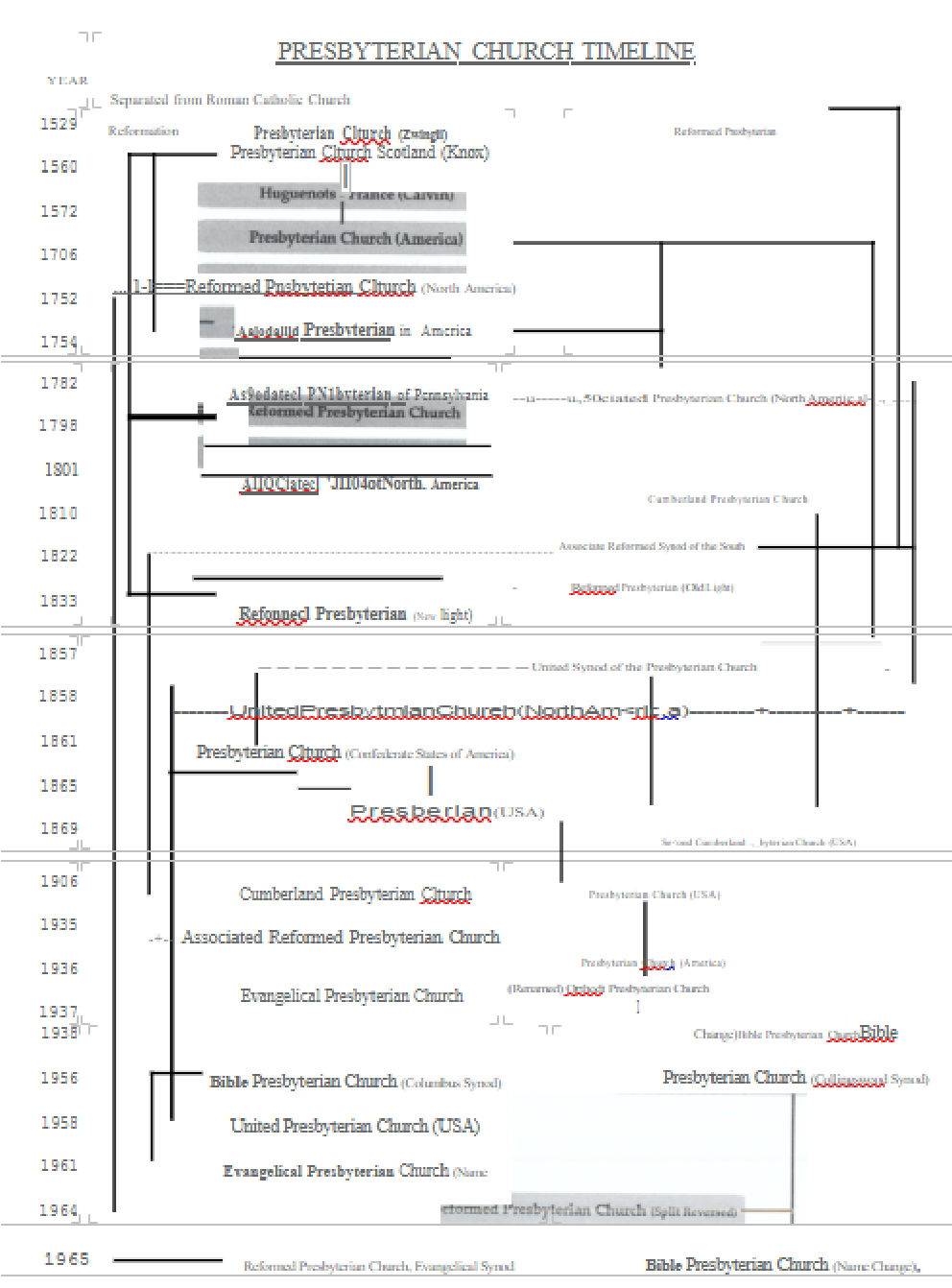
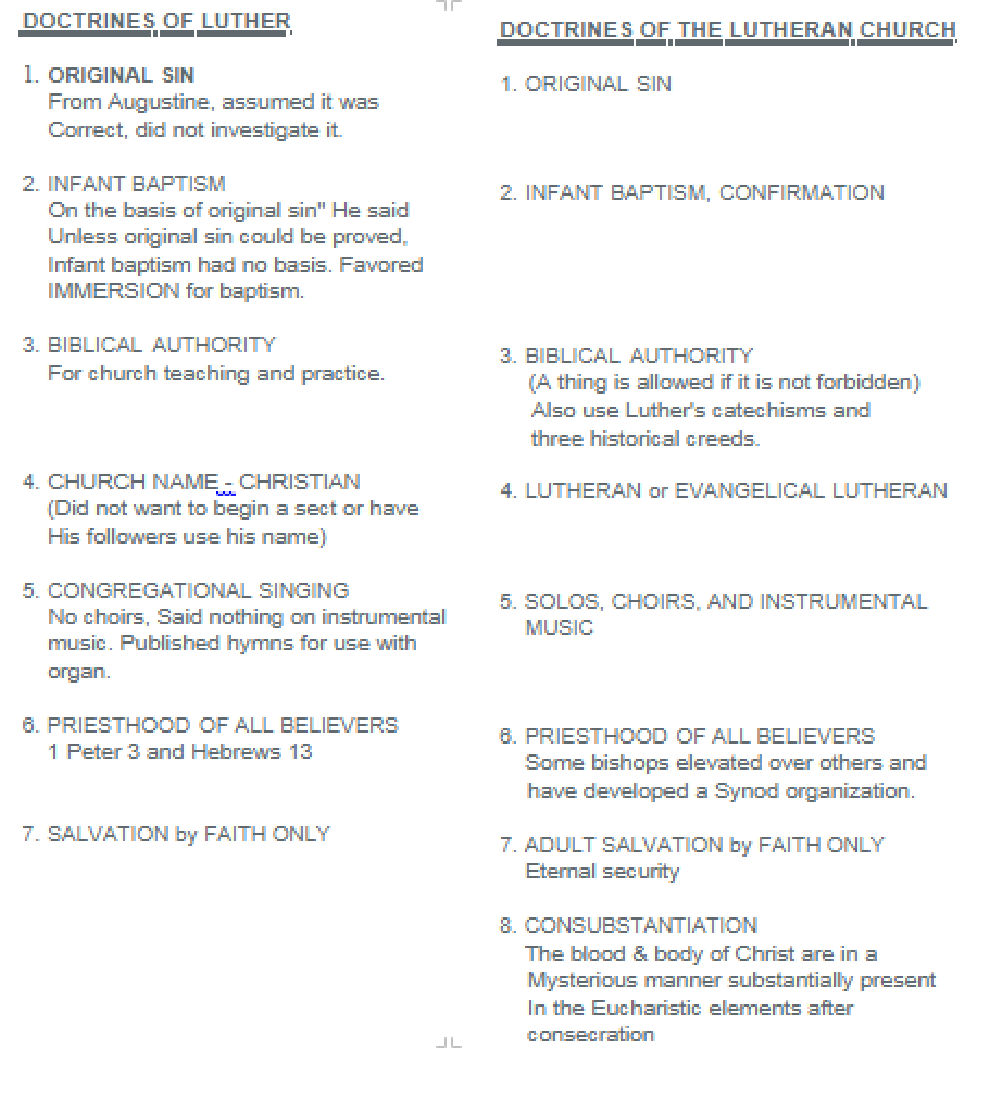
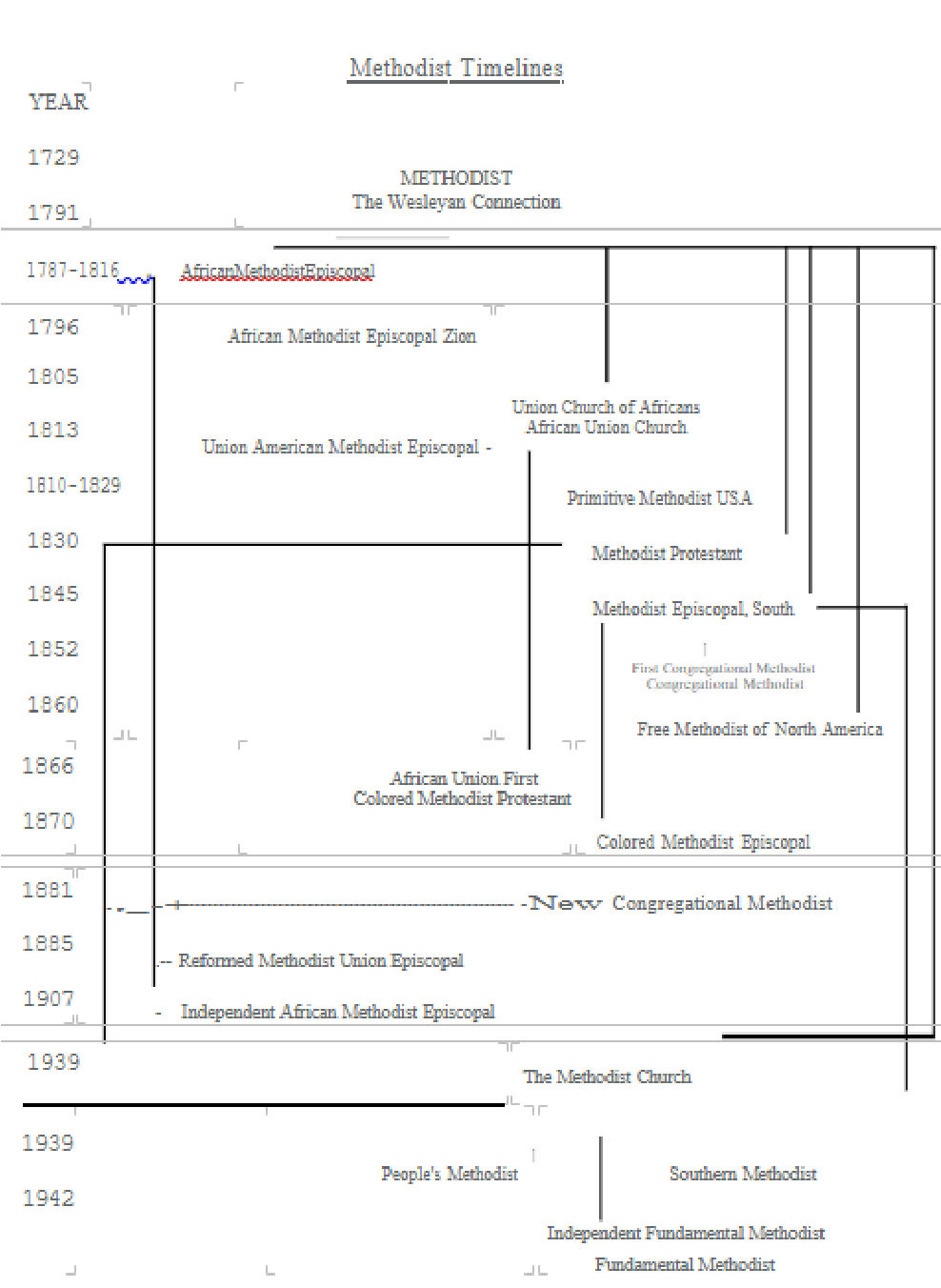
Text and illustrations reproduced from the study “protestantism”. The original PDF is the reference copy.