
Reformation to Present
CHURCH OF THE CHRISTIAN ASSOCIATION
The church of the Christian Association was a part of what is now referred to as the 'Restoration Movement'. In the sixteenth and seventeenth centuries many efforts were made to reform the church and move away from Catholic doctrine and dogma. Many of the Christian Association was a part of what is now referred to as the 'Restoration Movement'. In the sixteenth and seventeenth centuries many efforts were made to reform the church and move away from Catholic doctrine and dogma. Many churches were established to refute salvation by works and control of the scriptures by the church fathers of the day. That era was called the 'Reformation,' or 'Reformation Movement'. The Reformation of the 16th century began with the 95 Theses posted to a Catholic Church door by Martin Luther in 1517, followed by John Calvin, the Anabaptists and the Puritans. These efforts were called 'protestant' because they were a protest to the existing apostate church, and not a restoration of the original, as established in the New Testament. There had been several groups over the early centuries that used the Bible as authority and opposed the 'established' church. Among these were the Paulicians of the 7th century, Waldensians, and the Albigensians of the 12th and 13th centuries. These groups suffered severe persecution from the 'established' churches.
Independent churches began to spring up around the year 1800, not to protest the Catholic Church as 'Protestants', but to restore the church to what it was in the first century, and follow the New Testament as closely as possible. The United States was a new country and people were moving into new territories rapidly, and new congregations and churches were being established on the frontier, as new towns were being formed. Many persons began to re-think the foundations of their religion.
The history of the Christian religion included much apostasy and restorations. There have been many attempts to go back to the Bible on some points and many divisions had occurred as people tried to be faithful to God's word. There have been many attempts to keep people from reading the Bible and knowing the Bible, as a means of controlling the church and its people. There are two things we have had to keep in mind as we study religion. One is the serpent, the devil who was present with Adam and Eve and is present with us today, tempting us in the same ways. The second thing to remember is what Jesus said about His church. Matthew 16: 18b " ... I will build my church; and the gates of hell shall not prevail against it." Since its establishment in AD 33 the Lord's church has existed somewhere, in dungeons, in homes, in secret, and sometimes in the world's favor, even as the apostate churches of the world were the only churches of prominence.
One of these movements for restoration took place in the United States during the 19th century. This movement had many roots as men from New England and the frontier areas, and men who moved from Europe had the desire to return to the Bible as the Word of God, and to adhere to it exclusively. Their concern was to do what God requires, and not what the teachings of men had begun to require. When they saw a need for change and restoration it was then necessary to accomplish this on the basis of what God desires, and had expressed through the writings of the Bible. The restoration movement will never be complete, but will only continue as people continue the effort to restore the New Testament pattern and resist new or the same old apostasies and departures from the word that have caused so many divisions and denominations in the past.
A restoration sprang up in many places from within various religious bodies. In North Carolina, in the years 1790 to 1800, James O' Kelly pleaded for the New Testament to be the only creed and discipline. He left denominationalism and took the name Christian. Abner Jones in Vermont preached that sectarian names and creeds should be abolished, around the year 1800.
Barton W. Stone was born in Maryland in 1772. His mother moved to Virginia and he came into contact with fanatical religion. He was not impressed with this, but was greatly impressed when he heard a Presbyterian Preacher, James McGready, and a sermon on 'God is Love'. He received his license to preach and was called to
preach at Cane Ridge and Concord Kentucky. He was having some problems with Presbyterian doctrine and the Westminster Confession of Faith, but said he could preach as long as it agreed with the Bible. As he taught the Bible he began to part with Calvinism. Stone attended a camp meeting in Logan County, Kentucky in 1801 con- ducted by McGready, and was amazed. In August 1801, Stone began a revival and people came from far and near to participate. About 30,000 people attended from many religious affiliations. This revival lasted 6 or 7 days and thousands turned to God. Many among the Presbyterian leadership did not agree with Stone's ideas or his methods. One preacher who had accepted ideas similar to Stone's was tried for heresy. Stone and others saw what might happen to them and withdrew, forming their own Presbytery, calling it the Springfield Presbytery. Stone soon saw that he could no longer support Presbyterianism and realized that even the organization of the Springfield Presbytery was wrong. He knew that he could only preach those things that advance the Kingdom of God, and accepted the Bible as the only basis for authority. He would use the name 'Christian' only and accepted immersion as the only mode of baptism. Churches began to spring up over a wide area rejecting all authority but the Bible and using only the name ' Christian'. In 1832, the converts of Stone and the disciples of Alexander Campbell joined together and the restoration movement in the United States was a reality.
Alexander Campbell was a student of the Bible, trying to follow it without letting his family training or prejudices interfere with what he was learning. He was able to articulate ideas found in the Bible to others orally and through written word. Alexander Campbell was from a strict Anti-Burger Seceder Presbyterian family. His father, Thomas Campbell was a Presbyterian Preacher. His mother was a strong Christian influence. They worshipped God faithfully in their home and memorized a portion of Scripture every day.
Thomas Campbell moved from Scotland to the United States for health reasons. He called for his family in 1808, the family left by ship for America, but the ship wrecked.
Alexander returned to Glasgow and studied for a year and then the family again left for America. In America, Alexander met men and ideas that changed his life. He began to doubt the views of the Seceder group. Thomas and Alexander shared ideas both had arrived at independently and Thomas wrote his 'Declaration and Address'.
Alexander Campbell began a rigid study of the Bible under the guidance of his father. He studied Greek, Latin, and Hebrew, along with church history. In 1810 he began to preach and received many invitations to speak. His sermons expressed some of the following points:
• Denominations possess the essence of Christianity, but new reformation is to persuade people to abandon human ideas and adopt the Bible as authority.
• Each congregation should be self-governing.
• There is no distinction in the Bible between clergy and laity.
• Infant Baptist is without direct scriptural authority, but a matter where forbearance • Possibility that the Christian Association would have to become a distinct church if others do not accept the overtures for reform
• The idea of having a "thus saith the Lord" might lead to abandonment of things thought to be precious.
Infant baptism became a major issue within the Christian Association. Some of the members of the Brush Run church were convinced that immersion was the only mode of baptism shown to us in the Holy Scriptures.
Thomas Campbell consented to immerse, and in 1812 both Alexander and Thomas Campbell were convinced that immersion is the only mode of baptism.
The Campbells did not wish to form a new religious organization, so they joined the Baptist in the Redstone Association. They believed the Baptist to be as close to what they believed. They told the Baptist what they believed and were accepted by a large majority. But problems began to surface when sermons taught that Christians are not under the Old Testament, and Christians are guided by the New Testament. Teaching about the Lord's Supper, the Sabbath, the union of church and state, and imitation of Jewish customs upset many within the Association. They left the Redstone Association and joined with the Mahoning Association of Baptist, most of whose members were friendly to Campbell's views.
Alexander Campbell became known as a defender of adult baptism by immersion in opposition to infant baptism. This led to debates, especially with Presbyterians. Campbell converted many to believing in immersion by using Scripture and the authorities of Presbyterianism. Alexander began to publish ' The Christian Baptist' paper in 1823. The Christian Baptist was to "espouse the cause of no religious sect, excepting the ancient sect "Called Christians first at Antioch". Its sole object shall be the eviction of truth, and the exposure of error in doctrine and practice." It began with a series of articles on the "Restoration of the Ancient Order of Things." The paper urged abandonment of such things as creeds, unscriptural words and phrases, and theological theories. Articles taught the primitive practice of weekly Lord's Supper, fellowship, simple order of worship, and independence of each congregation under plurality of elders and deacons. The paper also dealt with missionary societies, Sunday Schools, synods, presbyteries, conferences, and various church practices as to whether they were consistent with the New Testament. There was a call for universal Bible Study as the means for restoration. Because of the Christian Baptist publication, and its subject matter, the Mahoning Association became defunct; it melted away as people did study the Bible and formed congregations consistent with its teachings.
Alexander Campbell began a series of debates with Presbyterians again. A debate with W.L. McCalla ended when McCalla refused to answer Campbell's arguments on baptism. In Cincinnati on April 13, 1829, Campbell debated with Robert Owen on the evidences of Christianity. Owen was prepared to argue historical religion. Campbell argued New Testament Christianity. Finally on April 17, Owen conceded Campbell the remainder of the time, and Campbell spoke for twelve hours. There were other debates, one with a Catholic named Purcell.
Campbell visited Nashville Tennessee and converted many people in 1830. On December 30 of that year he preached to most of the preachers in that city. A debate was conducted with Dr. Obadiah Jenkins resulting in the baptism of 30 people. Campbell believed that Christian education played an important part in the Christian religion. Bethany College was opened in 1841.
The center of the Restoration movement was in Pennsylvania and Kentucky. From this center various preachers spread thought-out the middle of the United States. Walter Scott preached in Ohio and was a convert of Alexander Campbell. Others who had been associated with Bar ton W. Stone or the Campbells were John Johnson, Jacob Creath, and 'Raccoon' John Smith. Down to the south in Tennessee and Alabama those who learned from Barton Stone began to preach. Among these were Abner Peeler, John Mulkey, Frank Palmer, J.E. Randolph, and J.E. Matthews. Among the converts of J.E. Matthews was Tolbert Fanning who was baptized near Florence, Alabama in 1827. Fanning made several trips with Alexander Campbell and in 1836 went with him though the Northeast and Canada. Fanning organized what became Franklin College and also established a magazine called the Gospel Advocate in 1855 which is still in publication today.
The organization of the Christian association of Washington, Pennsylvania in 1809 was never intended to be a church. It was only a part of a larger movement to restore people to the New Testament church which had
been in existence since the day the Apostle of Jesus Christ, Simon Peter, preached that sermon as recorded in the book of the Acts of the Apostles, chapter two, and the Lord's church was established. This movement resulted in many congregations of the church of Christ, and in 1906 Christian churches, and a denomination called the Disciples of Christ resulted from divisions in the matter of the use of instruments in worship and mis- sionary societies. The Christian Association was also dissolved somewhere in this process.
MORMON
IS THE BOOK OF MORMON FROM GOD?
We could have asked this question of the Koran which the Muslims believe. It too was said to be given by an angel. The Book of Mormon is the 'cornerstone' of the Church of Jesus Christ of Latter Day Saints (Mormon Church). Mormons consider the Bible, Book of Mormon, Book of Doctrines and Covenants, Pearl of Great Price, and sayings of Joseph the seer, the guides in faith and practice. They believe the Bible to be the Word of God as far as it is translated correctly, and also believe the Book of Mormon to be the Word of God.
Joseph Smith claimed he translated the Book of Mormon from the original record written on golden plates through stones called Urim and Thummin, attended by the angel Moroni and guided by divine power, free from error. He published the book in 1830 in New York.
The Book of Mormon tells the story of America settled by a colony directly from the Tower of Babel to about the 4th century after Christ came to earth. It also claims that Christ came to this continent after His resurrection and planted the Gospel here in its fullness.
The Latter Day Saints claim that the Bible and the Book of Mormon go 'hand in hand' and both testify that Jesus is the Christ, the savior of the world. The Latter Day Saints are a split from 1844, headquartered in Salt Lake City, Utah. There is a reorganized Latter Day Saints in Missouri.
Mormon -alleged Nephite prophet; father of Moroni, the 'resurrected personage', or angel who appeared to Joseph Smith multiple times in 1823 to 1827 and guided him to the Nephite records.
The Book of Mormon has many obvious grammatical and historical errors.
Joseph Smith was to be born of their seed in the direct line of Joseph of Egypt through Lehi and his son Joseph, but according to Mormon all the Nephites were slain, except Moroni, and only Lamanites remained on this continent and their ancestors are the various 'Indian' races. Joseph Smith was of English ancestry. His mother's biography gives his ancestors for 6 generations to England. Mormons claim that this prophecy had a spiritual fulfillment in Joseph Smith. There is nothing spiritual about a prophecy that Joseph Smith was to be "the fruit of thy loins" which is repeated about 14 times in 2 NEPHI 3.
The Book of Mormon is claimed to have been engraved on golden plates about 1600 years ago by a man named Mormon, with his son Moroni giving it some finishing touches and in AD 20 hiding the plates under a stone near the site in Palmyra, New York where these plates were received, under the guidance of the Angel Moroni, by Joseph Smith in 1827. The Book of Mormon then is a very old book. It has many words, phases, and expressions which are modern, having no known equivalents in any ancient language, and it has references to discoveries, facts, ideas, and concepts which were unknown to the period which it covers. It mentions a 'compass' for which there is no record that any people of antiquity ever used,
It has an 'ass' and a 'horse' in this continent, which were not here until the Spaniards came about 480 years
- It is also interesting that many scriptures repeating what the Bible says are written in the King James
English which was not translated until 1611.
Is one book as good as another? Is the Book of Mormon a counterfeit? It does contradict the Bible! Alma 46:13-16 has a band of Christians, true believers in Christ, who belonged to the Church of God, who took upon them gladly, the name of Christ or Christians; several centuries before the coming of Christ. Acts 11:26 says, "The disciples were called Christians first at Antioch." The book of Mormon alleges that the Nephite who lived centuries before Christ's coming understood completely information concerning Him which were given to us in the gospel; the identity of His mother, his miracles, temptations, crucifixion, resurrection, etc. such as neither man nor angel ever possessed until Christ was glorified. The Apostle Paul said it was a mystery. Read Ephesians 3:3-5, 9 and Colossians 1:26. The book of Mormon claims to be consistent and friendly to the Bible; it tends to undermine it instead.
The Latter Day Saints do not accept Christ as the final prophet through whom God is speaking today as the Bible teaches. They do not accept the New Testament as the final covenant. It is a different gospel.
Joseph Smith claimed God revealed to him that 8 years is the age of accountability. Mormon children are baptized at age 8. Infant baptism is denounced as a false practice.
Boys in Mormonism are ordained in the Aaronic Priesthood at age 12 as deacons. (Aaronic priests in the Bible had to be of the tribe of Levi.)
Boys in Mormonism are ordained in the Melchizedek Priesthood at age 18 as elders. (The Bible gives qualifications of elders as married with faithful children.)
Seventy - Second of three steps of Melchizedek Priesthood at age 18. This is an office, not a number.
High Priest is the highest step in the Melchizedek priesthood of the Mormons.
The subtitle printed on copies of the King James Bible by Mormons is 'Another Testimony of Jesus Christ.'
The 'Pearl of Great price contains 13 articles of faith to express the teachings of the Mormon faith. It was the third document authored by Joseph Smith and one of the 'standard works' of the Mormon Church (source of Polytheistic and racist doctrines of Mormonism.)
Doctrines and Covenants - The Book of Commandments. A collection of 65 revelations said to have been given to Smith and his associates published in 1833, has had more than 2500 changes and additions, is said by Mormons to be inspired.
Word of Wisdom - Dietary regulations of Mormons included in Doctrines and Covenants as a revelation from one of the Mormon gods; must be kept or one cannot enter the highest of three Mormon heavens.
"As man now is, God once was, as God now is, man may become." - The goal of Mormonism, which is to become God, and to express the nature of God, which Mormons allege is that of a glorified human. There is also a "Mother god" in Mormon teachings.
"Baptism for the dead." A practice of Mormon 'proxy baptism' in which a living person is immersed in water by a Mormon priest to affect the salvation of a deceased person who died without baptism.
Blood Atonement - Mormons teach that there are sins for which the blood of Jesus cannot atone. Among these are murder, adultery, apostasy, and unspecified sins against Mormons. To be forgiven their blood must be "spilled on the ground." The blood of the sinner plus the blood of Jesus is an adequate atonement.
The Book of Mormon is said to be inspired and is the book to guide the western world; the Bible being only for the Eastern world. The text has been corrected/ changed in more than 5500 instances since the original edition in 1831.
Ezekiel 37 (Two Sticks) - Mormons allege the 'two sticks' represents 2 books - the Bible and the Book of Mormon. The sticks are the northern and southern kingdoms of Israel and Judah, God calls them "Two Nations" which shall become united.
Alma 7:10 says Jesus was born at Jerusalem. The Bible says Bethlehem. Micah 5:2 and Luke 2: 1-7.
God was once a man, but became God (Elohim). (As we have been asking, "Where did that man come from then?") God has a physical body as does His wife. The Father, Son, and Holy Ghost are three separate gods. Other gods exist also. Jesus, a separate God from God from the Father, was created as a spirit child by the Father and mother in heaven. He is the elder brother of all men and spirits, not just Christians. His body was created by sexual union between Elohim and Mary. Jesus was also married. (Can we ask, what kind of relationship will He have when the church becomes His bride?) His death on the cross did not provide atonement for sin, but does not provide everyone with resurrection.
There is no salvation outside of the Mormon Church. Salvation is by works, including faith in the church leaders, the Mormon baptism, tithing, and rituals. Salvation is being exalted to godhood. Eventually nearly everyone will go to one of three levels of heaven. Murderers and apostates go to outer darkness. Baptism on behalf of the dead is also practiced.
Young men make a two-year commitment as missionaries, visiting door to door. No alcohol, tobacco, coffee, or tea is used. The church members enjoy an extensive social network.
(The church of Jesus Christ of Latter saints was founded by Joseph Smith, not Jesus Christ.)
RELEVANT SCRIPTURES FROM THE BIBLE
Hebrews 1:1-2 "God, who at sundry times and in divers manners spoke in time past unto the fathers by the prophets, hath in these last days spoken unto us by His Son, whom He hath appointed heir of all things, by whom also He made the worlds."
Galatians 1:6-8 "I marvel that you are so soon removed from Him that called you into the grace of Christ unto another gospel: which is not another. but there are some that trouble you, and would pervert the gospel of Christ. But though we, or an angel from heaven preach any other gospel unto than that which we have preached unto you, let him be accursed."
Galatians 1:9-12 "As we said before, so say I again, If any preach any other gospel unto you than that you have received, let him be accursed. For do I now persuade men or God? Or do I seek top please men? For if I pleased men (still continued to please men) I should not be the servant of Christ. But I certify you, brethren, that the gospel which was preached of me is not after men, For I neither received it of man, neither was I taught it, but by revelation of Jesus Christ."
2 Peter 1:3 "Seeing that His divine power hath granted unto us all things that pertain to life and godliness."
John 16:13 "Howbeit when he, the spirit of truth is come, he will guide you into all truth: for he shall not speak of himself: but whatsoever he shall hear, that shall he speak: and he will show you things to come."
Jude 3 "Beloved, when I gave all diligence to write unto you of the common salvation, it was needful for me to write unto you, and exhort you that ye should earnestly contend for the faith which was once delivered unto the saints."
DISCIPLES OF CHRIST
he Disciples of Christ is a Protestant denomination in the United States. The first state convention and societies meet in 1839. The first national convention was held in 1849. Its full name is Christian Church, Disciples of Christ. The denomination developed during the restoration movement during the 1800's. Its founders were of Presbyterian back ground including Thomas and Alexander Campbell in Pennsylvania and Barton W. Stone in Kentucky.
The consensus of this movement was that Christians should unite in the simple faith in Jesus Christ, and that doctrines, creeds, and practices of denominationalism should be abolished. The group lead by Barton Stone in Kentucky organized under the name "Christians". In Pennsylvania, Thomas and Alexander Campbell advocated closer relations with Christians whether Presbyterian or otherwise and desired the Bible as the basis for faith instead of church creeds. He was censured for this and formed 'The Christian Association of Washington County, Pennsylvania. Thomas Campbell published a 'Declaration and Address' which was to become the basis for the Christian Church, Disciples of Christ.
The concept was taught that every church should be independent and autonomous, that creeds, clerical titles, authority and privilege of men had no justification in scripture. The Lord's Supper was to be served every Sunday and baptism is for believers only and by immersion under water.
Alexander Campbell worked in close fellowship with Barton W. Stone who used the name 'Christian' to identify the group. Campbell used the name 'Disciples'. In 1832 the Christians and the Disciples merged and become known as the Christian Church (Disciples of Christ).
Conflict arose among the Disciples during the second half of the 19th century. The differences between 'conservatives' and 'progressives' caused the conservative Disciples to withdraw in protest against the development of missionary societies and the use of instrumental music in worship, for which they could find no scriptural authority. By 1906 the seceding groups had separated into independent Churches of Christ, remaining true to scriptural authority, while the Disciples followed the path of denominationalism.
In 1968, a restructuring plan was adopted that resulted in mission, education, and other church agencies being coordinated through a general assembly. A general board was established, but local churches still retained their property rights, independence in selecting preachers, and determining worship and programs of work. The Disciples now participate in the National and World Council of Churches, The Consultation on Church Union, and have global missions coordinated by the United Christian Missionary Society.
ADVENTISTS
The ADVENT is the second coming of Jesus Christ.
Christ has promised to return and most Christian do believe He will return. William Miller was influential in high lighting this teaching and even set a date of sometime between March 21, 1843 and March 21, 1844 that it would occur. Miller became a Baptist in 1816 and began a study of prophecies in Daniel and Revelation and concluded by calculating weeks as years the time of the advent.
When the advent failed to occur as he predicted many of his followers left him, but some waited for a new date Miller had set of October 22, 1844. Some of his followers sold their property and settled all accounts, praying and waiting for the Lord's return. When that date came and went some applied a 'spiritual' return to it. There was a wide difference of view point and many questions were reviewed as they wait for the resurrection and return of Christ. Who are to arise, the righteous and the wicked or only the righteous? Is there to be eternal punishment of the wicked or annihilation? When should the Sabbath be celebrated, Sunday or Saturday or not at all? Over these questions and others Adventists, as organized bodies became divided into four major groups.
- Seventh-day Adventists
- Advent Christian Church
- Church of God (General Conference)
- Primitive Advent Christian Church
ADVENTIST NOTES
Seventh-day Adventists are the largest group of Adventist and are present through out most of the world. They trace their beginnings back to the 1840's and convictions on the Sabbath back to the Seventh Day Baptist of New England and Europe.
Seventh-day Adventist are Premillennial. They expect 3 separate resurrections.
- The righteous dead at the beginning of the Millennium. (1000-year reign of Christ on this earth)
- The unrighteous dead at the end of the Millennium. (The righteous to be reigning with Christ)
- The Great White Throne Judgment.
There is no scripture that supports Christ's Millennial reign on this earth. Jesus said in John 18:36, "My Kingdom is not of this world." - The kingdom is now - Luke 9:27 and Colossians 1:13.
They claim modern prophecy and that 9 of the gifts in1 Corinthians 12 are available today. (1 Corinthians 13:8- 10 says these gifts "shall cease", "be done away".)
They have a church manual of 27 beliefs of which 13 must be believed and one must sign a statement that they believe these prior to immersion in water for baptism to become a member of SDA. (No one baptized into the Lord's church in the examples given in the Book of Acts had to sign anything to become a Christian.)
They teach that God will utterly destroy the wicked by burning them to extinction in the Valley of Hinnom south of the City of Jerusalem in Israel following the final judgment.
Armageddon - Revelation 16:16 - SDA have made this a 'literal' battle which must be a 'spiritual' battle because of the imagery used to describe it.
Forgiveness of sins - accomplished by Christ in the atonement at Calvary according to SDA, but insufficient to accomplish final salvation until combined with the blotting out of sins, which will be accomplished by Satan at the end of the age.
(No basis for this found in the Bible.)
Foot washing observed in connection with the Lord's Supper, observed quarterly. Investigative Judgment - SDA claim that Jesus entered the sanctuary of heaven
October 22, 1844 to read the books of the lives of all persons born from creation until judgment to enable him to render a righteous verdict at the "Great White Throne Judgment," the third judgment.
SDA along with Jehovah's Witnesses contend that this present earth will never be destroyed, but will endure eternally. 2 Peter 3:10 says it will "be burned up" "the elements shall melt with a fervent heat."
Tithing - 10 percent of income bound as a law of the church .
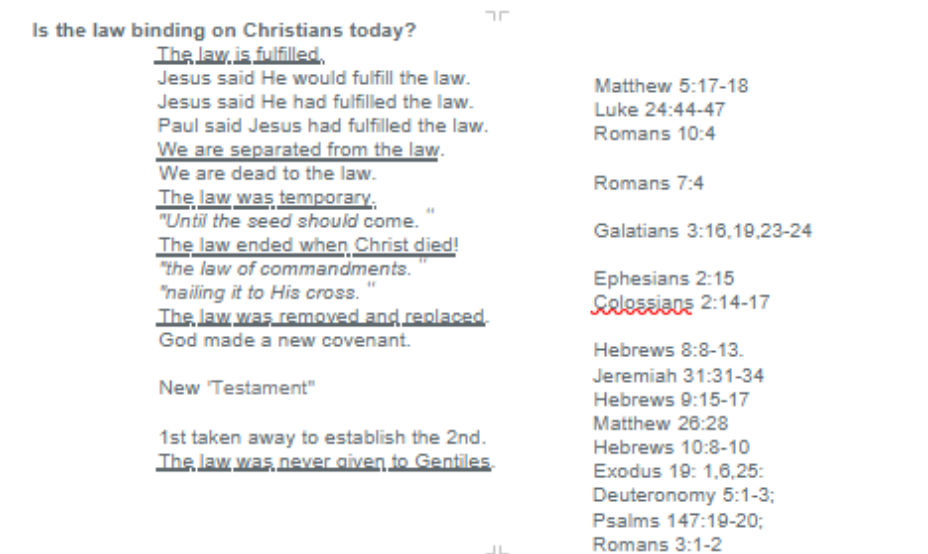
The Seventh Day Adventist say Saturday is the day of worship as given in the 10 Commandments.
All of the law would pass at once.
Not one jot or tittle... 'till all' Matthew 5:17-18 Fulfilled all the law, prophets, & psalms Luke 24:44-49 Jesus fulfilled both 'moral' & 'ceremonial' laws.
Moral = 10 Commandments Romans 7;4
Ceremonial = feast, fasts, foods. Colossians 2:14-17 Now we have the 'law of Christ!' Galatians 6:1-2
BAHA'I WORLD FAITH
Babism preceded the Baha'i faith and is a religion that developed as a branch or offshoot of the Shite sect of Islam. At Shiraz, Persia in 1844 Mirza Ali Muhammad became known as the Bab which in Persian means 'the gate', because he was considered the gate, or door to spiritual truth.
Bab declared that the prophets were a divine manifestation of God Himself, and that he, the Bab, was also one of these prophets. He claimed to be equal to Muhammad in importance, and that he was the one to proclaim an ever greater 'Manifestation'. Nineteen years after the founding of Babism this greater one would appear.
The Bab wrote a new holy book called the Bayan or Revelation. This book was to supersede the Koran. Babism conflicted with many principles of Islam. It forbade polygamy and the use of concubines. It proclaimed that a time was coming in which all religions would be united under one spiritual leader.
As Babism spread, the Shah, Nasr-ed Din, was persuaded that the teachings of Babism would be destructive to the state, and initiated persecution of the Babists. The Babists revolted but after a two year civil war, were put down. The Bab was imprisoned and executed in 1850.
After the death of the Bab, his religion continued to be taught in Persia and the middle east. In 1863, 19 years after the Bab predicted a divine figure would appear, Mirza Hoseyn Ali Nun, called Bahaullah, proclaimed himself to be that 'Manifestation'. On the basis of Babism, he founded a new religion called Bahai.
The Persian government continually persecuted Bab factions and Bahaullah was tortured and imprisoned for the rest of his life. Bahaullah sought to establish a universal religion. He taught moral and social improvement and his ideas were spread by hid son Abbas, later called Abd ul-Baha. Abd ul-Baha was also a political prisoner for many years, but in 1908, when parts of the Ottoman Empire were overthrown, he was set free. He then traveled to Europe and North America introducing his father's teachings. He taught the Bahai faith as a set of principles including social aims. These social ideas included abolishing racial and religious prejudice, equality of the sexes, use of an international language, education, and a universal faith.
The writings of the Bab, Bahaullah, and Abd ul-Baha are sacred literature of Bahai. The head quarters of Bahai were in Haifa, Israel. There is a Bible interpreted spiritually, to conform to Bahai theology.
God is an unknowable divine being who reveals Himself through 'manifestations' who are prophets or religious leaders including Moses, Confucius, Buddha, Jesus, Muhammad, and of course Bahaullah.
Jesus is one of the many manifestations of God. Each manifestation supersedes the previous as new teachings are presented about God. Jesus then, is not God, had no resurrection from the dead, and is not the only way to God as He claimed to be. (Wouldn't this make Him a liar and a fraud rather than a manifestation from God?) Jesus return to earth was in the form of Bahaullah. The spirit of truth then refers to Bahaullah.
Salvation is by faith in the manifestation of God, Bahaullah, and knowing and living by Bahaullah's principles and teachings. Meetings are called 'spiritual assemblies'.
Have we had more recent manifestations such as Sun Myung Moon and the Unification Church, or L, Ron Hubbard and Scientology, or the New Age Movement, or shall we be looking for another manifestation? What happens to the other manifestations that were happening at about the same time as Babism in the 1800's such as Mormonism, The Great Awakening, or the Restoration Movement? Should we be looking for new ideas in religion or should we be looking back to the origins of religions and the manifestations given by God? Is there no truth to the words in Hebrews 1:1? "God who in time past spoke to our forefathers through the prophets at many times and in various ways, has in these last days spoken to us by His Son, whom He appointed heir of all things, and through whom he made the universe." John 14:6, "Jesus said to him, (Thomas) I am the way, the truth, and the life, no man can come to the father (God) but by me." If Jesus is acknowledged as being a prophet, but His words are not true, then He was definitely a liar, and not a manifestation of God. If His words are true as He claimed, then He is the way to God and needed no further person such as Bahaullah to manifest God for Him.
Is the Bahai religion as good as any another?
CHRISTIAN REFORMED CHURCH
The Christian Reformed Church was founded in1857 in the United States by Dutch Protestants. The doctrine is Calvinistic, and similar to the Reformed Churches, but the membership was Dutch, while the Reformed Church had mixed ethnic membership. The name Christian Reformed Church was adopted in 1904. They separated from the Dutch Reformed Church after being in the United States for a while. The Headquarters for this church has been in Grand Rapids, Michigan.
Doctrines of the Old Testament were mixed with the New Testament teachings in creating the 'reformed' doctrines and traditions. The Heidelberg Catechism was taught and memorized. Worship, doctrine, and government followed the canons, creeds, confessions, and catechisms established at the Synod of Dort in 1618 and 1619. Doctrine favors the teaching of John Calvin, and accepts and practices of infant baptism and quarterly observance of the Lord's Supper. The Ten Commandments were read and the Apostle's Creed was recited by the whole congregation each week. Admonitions against worldliness included abstaining from strong drink, playing cards or throwing dice, dances, theaters, and fairs. They called Sunday the Sabbath and were to go to church and rest only on that day. Other activities on Sunday were considered "desecrating the Sabbath". Over the years many members have chosen to ignore these admonitions and have been participating in all of these 'vices'.
The Reformed Church followed the path of accepting a position in the broader Protestant world, but the Christian Reformed sought to remain true to the Dutch heritage and separated from American Christianity and culture, and this did slow its process of conforming to it. In the early years of the Christian Reformed Church there was the use of a 'motto', "In isolation is our strength". Despite this original character, the Christian Reformed Church went though the process of Americanization as the Reformed Church had only lagging behind by a few generations. The immigrant church experienced transition and change by gradually adopting ways that it had once shunned and avoided. Examples of this are Sunday Schools, instrumental music using organs and pianos, entertainment by choirs, soloists, and singing groups, and hymns in worship where once only Psalms were sung. Slowly, the Christian Reformed Church followed the path of its 'older sister', the Reformed Church.
SALVATION ARMY
The Salvation Army is a religious organization as well as a charity. It was a religious organization first founded by a Methodist preacher along Methodist doctrinal lines. He began mission work in the streets and tried to send his converts to organized churches, but they were not accepted there. (This can still be a problem in churches which form themselves into fraternities and are reluctant to allow open membership of people not of their race or social status. In the General Epistle of James in the 2nd chapter there are warnings against partiality.) He began his Christian Mission to keep his 'volunteers' and later changed 'volunteer army' to Salvation Army.
The doctrines of the Salvation Army are orthodox Trinitarian. They emphasize a Holy God, a Holy Bible, and a holy people, The members affirm that they have surrendered themselves to God. Doctrines are Arminian rather than Calvinistic holding that the love of God is as wide as His universe, and that He gives His gifts freely to all. A recruit may be 'sworn in' and may advance to the rank of officer through training. The form of government is like the military with Lieutenant to Major, and a Commissioner. Each officer is an ordained minister, with both men and women serving as officers, The Salvation Army works with all races, creeds, or ages, to foster love of god and to provide for the needy.
The salvation Army was founded in 1865 in London, England by the English Minister William Booth. It moved toward being international when a group of its members moved to the United States in 1880 and established a branch in New York City. From there the movement spread to many parts of the world. The International Headquarters have been located in London, Eng land; the United States has had headquarters in Verona, New York and Alexandria, Virginia.
The 'Army' has operated in about 100 countries, providing religious services, moral education, counseling, and social services. It operates hospitals, drug and alcohol rehabilitation centers, camps, day care centers, and other social services.
Many people who contribute to the Salvation Army think of the organization as a charity. People of all faiths contribute to the good works done for social causes and to help the needy. (Some members of the Salvation Army have been members of other religious organizations at the same time not considering the Army a religious body but only a charity.) Occasionally members still preach on sidewalks, streets, and outdoor places teaching things from the Bible which are fundamentally Christian. The official publication of the salvation Army is called the 'War Cry'.
JEHOVAH'S WITNESSES
A native American religious movement founded by Charles Taze Russell in 1872 in Pitts burgh, Pennsylvania. Russell had been both a Presbyterian and a Congregational but was uncertain of his faith. He met and studied with Adventist and was impressed by
the teachings of the second coming of Christ and His Kingdom.
He organized the people he studied with and incorporated the Millennial Dawnists with him self as president. The headquarters were moved to Brooklyn, New York in 1909 and were called the International Bible Students, and Russellites. They were not known as Jehovah's Witnesses until 1931. The governing body is called the Watch Tower Bible and Tract Society headed by a board of seven ministers. Local congregations are organized as affiliated branches which are devoted to the distribution of literature. All members are ministers. They are trained by the local congregations. They also conduct large regional and national assemblies at which many of the new members are baptized by immersion.
Worship is conducted in local 'Kingdom Halls'. Witnesses are opposed to all established branches of religion and are not called churches. They have a strong missionary zeal as all of them are ministers. They pay for all of the literature that they distribute themselves. (If they cannot get the convert to buy it.) Members devote 15 hours a month to ministry. Pioneers are required to give at least 100 hours a month, and Missionaries devote 150 hours+ and are sent to foreign lands or isolated areas to form new congregations. All Pioneers provide their own support with some getting small amounts of support.
The Watchtower is a periodical they publish on alternate weeks. Awake is published on the other alternating weeks. Make sure of things is a pocket size doctrinal guide for Jehovah's Witnesses recommended for those learning their teachings. The New World Translation is a special Watchtower translation of the Bible published in 1960. It differs significantly from standard version translations. The cross on which Jesus died is called a 'Torture stake'. In John 1:1 "and the Word was God" becomes "and the Word was a_ god". Errors of Jehovah's Witnesses cannot be demonstrated from it nor does it support their doctrine. Those who sincerely study the Bible have been known to defect or were excommunicated.
Russell predicted that Jesus Christ would return in 1914. When He did not, it was claimed that He came silently and unseen. Revelation 1:7 says "every eye shall see Him." In October 1966 Awake published a prophecy that the Millennium would begin in 1975, saying other dates had been set and failed but this new date would not fail because "now we have the evidence - all of it!" They lost a few members and baptized less but they explained the error of the prophecy was a lapse of time between the creation of Adam and the creation of Eve, and that the millennium would begin when that brief period of time relapsed.
144,000 - also called 'Bride Class' is a term referring to 'super saints' among them who will be rewarded eternally in heaven with Christ. Ordinary saints receive their rewards on a rejuvenated earth.
Revelation chapters 7 and 14 mention these 144,000, but the number is made up entirely from the various tribes of Israel. (These tribes are clearly listed in the New World Translation also.)
This is ignored and only the number 144,000 is taken to be literal. Their evidence that they are in the 144,000 is a purely subjective 'inner witness', or feeling.
They teach that God will utterly destroy the wicked by burning them to extinction in the Valley of Hinnom south of the city of Jerusalem in Israel following the final judgment. This is taken from Adventist teachings.
Baptism - immersion in water is required as an act of dedication, unnecessary for salvation, most often administered during the annual Convention to enjoy press coverage and encourage others.
Armageddon - Revelation 16:16 -Viewed as a 'literal' battle which will occur the plain of Esdraelon below Mount Megiddo in Palestine. Jehovah's Witnesses, being conscientious objectors, cannot participate, but will be joyful spectators.
Lord's Supper - Observed annually on the 14th of Nissan (Passover) at 7:00 PM on whatever day that falls. All are required to be present but only the anointed, or 144,000 are allowed to partake. They call the feast the "Memorial" since they refuse to call Jesus 'Lord', maintaining that He is a created being as an archangel. (They cannot deal with Psalms 90:2, Micah 5:2 or Acts22:16 - Jesus is Lord from everlasting.)
Jehovah's Witnesses along with Seventh Day Adventist contend that this present earth will never be destroyed, but will endure eternally. (2 Peter 3:10 say it will "be burned up" "the elements shall melt with a fervent heat.")
CHRISTIAN SCIENCE
For Christian Scientists there is no bad or evil. Sin, discord, pain, sickness, and death- these things do not exist except as illusions or wrong ideas in our minds. God is all that He has made, and living by divine principle of perfect harmony, we never experience any of these evils. (Understanding God scientifically - having full knowledge) Calamity and death do not exist, all problems solved, and we can succeed in business, reform our characters, think positive thoughts, and "pass on" instead of dying.
God is defined as all that exists, as spirit, mind, life, soul, truth, love, and the conceiver of all that exists. (Not a personality as Jesus taught) Since God is all and God is Spirit, matter does not exist! If matter does not exist, neither does evil! The only real thing is God, and God is good. Whatever is not of God exists only in wrong thinking! God is also in man so man shares God's perfect goodness and indestructibility.
The claim to be 'scientific' separates them from 'faith healers' - It is not God's miracles but harmony to God's universe and spiritual law. When we properly understand God and this law, the mind is free of error and the person is well.
CHRISTIAN SCIENCE is a religion based on the writings Mary Baker Eddy (1821-1910) as she applied the life and teaching of Jesus Christ, especially those dealing with healings in the New Testament. Her book, "Science and Health with Key to the Scriptures" was published in 1875 under the name Mary Baker Glover. She was married in 1843, but her husband died within a year. Poor health, separation from her only child and other misfortunes caused her to turn to the Bible for relief and guidance. She searched for laws of spiritual healing. In 1877 she married Asa Eddy, a third husband who helped her in establishing Christian Science. The book 'Science and Health' she claimed was the final revelation from God and the key to understanding the Bible. She also claimed the Bible has many mistakes in it. Where have we heard this before? Was it Muhammad, Joseph Smith, or Charles Taze Russell? Which one is the final revelation from God? Do we need another revelation? The New Testament claims to provide all things "profitable for doctrine, for reproof, for correction, for instruction in righteousness" as recorded in 2 Timothy 3:16-17. Why do we need more?
Mary Baker Eddy was born in Bow, New Hampshire. She attributed a sudden recovery from a severe injury in 1866 to her "glimpse of the great fact' that life is in and of the spirit who is God. She established a church in 1879 in Bow, New Hampshire and taught others that through prayer they could avail themselves of this spiritual law and dispel sickness, the operation of God's power. In 1881 she moved to Boston, Massachusetts and the membership of her church grew rapidly, and it spread around the country from there. Later it moved to foreign countries also. She was the 'Pastor' of her church. The Lord's Church requires that 'pastors' (also called shepherds, elders, or bishops) are to be "the husband of one wife" in 2 Timothy 3:2 indicating they are male.
The church was reorganized in 1892 and named THE FIRST CHURCH OF CHRIST SCIENTIST. The organization is prescribed in the 'Manual of the Mother Church' written in 1895 and last revised in 1908. Mary Baker Eddy was the author of this book also. Churches are designated as branches of the 'Mother Church.' Doctrines and worship follow the principles provided by the author in the book science and health which was revised several times. Churches hold weekly testimonial meetings, at which members relate experiences of healing and regeneration. Church services use readings from the Bible and 'Science and Health.' They use no ordinances like baptism or the Lord's Supper. Christian Science avoids the use of doctors of medicine and have Practitioners to help people pray through the false reality of illness.
In 1898 she founded the Christian Science Publishing Society and has written and edited many publications. In 1908 she founded the Christian Science Monitor, an international daily newspaper.
CHURCHES OF GOD
There are many churches and religious bodies that use the name Church of God. Many of these are small independent groups. Some use another distinctive word to identify and distinguish themselves from other churches of God. Words like Holiness, Adventists, Apostolic, or the name of a city are used for this purpose. There were Churches of God in England in 1664 with a Seventh Day Baptist connection.
In 1948 a Division in the Church of the Brethren resulted in the establishment of a church called Church of God (New Dunkers).
The Church of God with headquarters in Anderson Indiana began about 1880. It was a movement toward Christian unity and the New Testament preferring not to be considered a 'denomination' among existing churches, but rather identifying with the visible and invisible church in a free fellowship of believers. Doctrines
of this church include belief in the divine inspiration of the scriptures, forgiveness of sins through the atonement of Christ, repentance of the believer, an experience of holiness, the personal return of Christ without millennial reign, the Kingdom of God is established now, there will be a final judgment and resurrection of the dead with reward for the righteous, and punishment for the wicked, Baptism is by immersion in water. They believe the church is the body of Christ, made up of Christians, sects and denominations are an obstacle to unity, unscriptural, and should be removed. They also believe that God desires this restoration of the New Testament ideal in His Church, and that this restoration should be based on spiritual experience and not on creedal agreement. If we give this some thought we find most of what this church professes to be in line with what the New Testament teaches. Restoration though, would have to be spiritual experience based on the written Word of God and not personal spiritual experience which can come from spirits not of or from God. The General Ministerial Assembly meets annually in convention and camp meeting at Anderson, Indiana. The church is governed by a congregational system and maintains the idea that God governs His Church, but they agree that human organization is quite necessary and ministers meet in voluntary state and regional conventions, which are mainly advisory.
A group which was organized in Monroe County, Tennessee in August, 1886, was first known as a Christian Fellowship and was called the Christian Union, Richard Spurling was the leader of this group. In May, 1902 this group was reorganized under the name Holiness Church. A. J. Tomlinson joined them in 1903 and was elected as General Moderator in 1909. He was impeached in 1923 and withdrew forming the Tomlinson Church of God which later was changed to the Church of God of Prophecy. This group was headquartered in Cleveland, Tennessee and was under the leadership of Milton Tomlinson after 1943. Homer A. Tomlinson organized a group under the name Church of God in Queens Village, New York, which later headquartered in Huntsville, Alabama. A small group left the Church of God of Prophecy in February 1957 led by Grady Kent and formed the Church of God of All Nations, headquartered in Cleveland, Tennessee.
In 1886 a split occurred in the followers of Richard Spurling and claims to be the 'Original Church of God.' This group too is in Cleveland, Tennessee. This group believes the whole Bible, 'rightly divided' and that creeds that bind the conscience are not scriptural, yet they follow the doctrines of repentance, justification, and regeneration as defined by Martin Luther, and sanctification as defined by John Wesley. They believe in the 'filling of the Holy Spirit' evidenced by 'speaking in tongues as the Spirit gives utterance' even though in rightly dividing the bible the gift of tongues was to cease along with the other miraculous gifts as recorded in 1 Corinthians 14. They baptize by immersion in water, partake of the Lord's Supper, give free will offerings, and perform foot washing. Local congregations, following the apostolic pattern, are self-governing. The church recognizes Ephesians 4:14 in organization using ministers, apostles, deacons, extorters, evangelists, bishops, and teachers. It would be difficult to use apostles since all of the Lord's apostles are long deceased, but the use of the written word from the apostles is still relevant.
The Church of God (Apostolic) was organized in 1896 at Danville, Kentucky by Elder Thom as Cox. This group was first known as the Christian Faith Band, and then was incorporated in 1919 under the present name. Admission to this church is only after repentance for sin, confession, and baptism. This differs from those following a Protestant line of thought which use baptism for some other purpose and make the claim that salvation occurs before bap ism. The Bible clearly says that baptism is "for the remission of sins" and that "baptism does now save us."(Refer to Acts 2:38 and 1 Peter 3:21) They also teach holiness and practice foot washing and the Lord's Supper. There is a General Assembly as the governing body with officers called the Apostle or General Overseer, and Assistant Overseer, District Elders, Pastors, Evangelists, and Preachers.
The Church of God and Saints of Christ began in Lawrence Kansas in 1896 by William Crowdy. Crowdy had been a Baptist deacon who claimed visions from God and a divine com mission to bring the truth of God to the
world. Here we have another person establishing a church on vision rather than the previously established Word of God in the Holy Bible. Why is it that all these people bringing 'truth' can conflict with previous 'truth' and the written Word? Crowley became the first bishop of this church. They believe that their church is built on the patriarchs, prophets, and apostles of the Jewish tradition. Jesus Christ is their chief cornerstone. There is an executive bishop as the head of the church and the bishop's council. There is a Board of Presbytery, a body of 12 men which is the law-making body, and an Ecclesiastical Council, and under these work district officers, deacons, teachers, and missionaries. Local churches have overseers and are divided by districts and each has an Evangelist who assists the bishop of that district's denominational National Business assembly, and Religious Assembly, called Passover, which is held annually. Both of these are under the guidance of the Executive Bishop.
In 1897 C.H. Mason and C.P. Jones were rejected by Baptists in Arkansas for an over emphasis on holiness which includes sanctification evidenced by 'signs of speaking in tongues' as Holy Spirit baptism. Doctrine stresses speaking in tongues, repentance, regeneration, justification, sanctification, a gift of healing as an evidence of the baptism of the Holy Spirit, with 'holiness' considered a prerequisite to salvation. Their ordinances include baptism by immersion, foot washing, and the Lord's Supper. There are Presiding, Assistant Presiding, and State Bishops, District Superintendents, Pastors, Evangelists, Deacons, and Departmental Presidents. The name of this group is Church of God in Christ.
The Church of God (Adventists) began first in Michigan separating themselves from the Second Advent Church during a debate over the name of a press being established in Battle
Creek, Michigan. Some wanted the name Church of God while others wanted the name Seventh-day Adventist. Division occurred when the Adventist name was chosen, and this eventually resulted in two groups with the same name; one group in Denver, Colorado with a press at Stanberry, Missouri, and the other group In Salem, West Virginia. Headquarters were first established in Stanberry, Missouri in 1900. AN. Dugger, who was prominent in establishing the Salem Church, went to Jerusalem forming still another Church of God called Jerusalem "the World Headquarters of the Church of God." These churches observe the seventh day as a Sabbath, practice foot washing, and avoid pork in their diet. On the end time they are Premillenialists. There is a General Conference meeting biannually.
In 1914 another church was organized and it was chartered at Alachua, Florida in 1923 as the Church of God by Faith, Inc. Officers consist of a Bishop, and an Executive Secretary. A General Assembly meets three times a year. Doctrines include regeneration, sanctification, and the baptism of the Holy Ghost and with fire, speaking in tongues.
In 1927, Herbert W. Armstrong, a business man of Quaker and Methodist background, became a member of a Church of God in Oregon. He was ordained by the Oregon Conference and established a local congregation in Eugene, Oregon. He began a radio broadcast in 1934 and a monthly bulletin called 'The Plain Truth'. The church was incorporated under the name of the broadcast as "The Radio Church of God" and the broadcast later became known as "The World Tomorrow". The headquarters were eventually changed to Pasadena, California where the church had founded a college in1947. The Corporate name of the church was changed in 1968 to The Worldwide Church of God. Doctrines from the Old Testament and New Testament are mixed and selected. There is belief that Jesus is deity, but the Trinity and the Person of the Holy Spirit is denied. Salvation is by faith in observance of some legalistic Old Testament rituals, The Saturday Sabbath, Jewish feasts, and dietary laws are observed. (The use of the word Sabbath originally was the seventh day of the week. Many Christians had begun to use the word to mean 'day of rest' the now Sunday, the first day of the week is also being referred to as a Sabbath by some.) The church believes the 10 tribes of Israel migrated to northwest Europe and England, and are now the English speaking world. Anglo Saxons of England and the United States are believed to be the
descendants of Ephraim and Manasseh. We are all members of God's family. Christmas and Easter are considered Pagan holidays. The Worldwide Church of God is the one true church, and the gospel it teaches is the only true gospel. Doctor Armstrong taught that the Bible interprets itself, but he is recognized as the true interpreter by his followers. No collections are taken at the Saturday services because the church is supported by three tithes. Each member gives one tenth of annual income to the general fund for the work of the church, and a second tenth of income is given for personal religious obligation which includes a requirement for members to spend eight days each summer at regional conventions. A third tenth is given for widows, orphans, and other destitute persons. There has been dissent to the third tithe and the question of remarriage of divorced persons. A defection brought about the formation of another church called the Associated Churches of God. Here there is no requirement for a third tithe and divorced persons are permitted to remarry and remain members of this church. Local church congregations are autonomous. (Refer to separate chapter on the Worldwide Church of God.)
In 1968, fourteen bishops of the Church of God in Memphis withdrew from that church to form the Church of God in Christ International. Their disagreement was of policy and authority in the government of the church and not doctrine. Their doctrine is Wesleyan, emphasizing grace, a full baptism by the Holy Ghost, and speaking in tongues.
Sometimes in reviewing churches set up by men there are some confusing and even contradictory statements and teachings, In The Manual of the Church of God or Sanctified Church headquartered in Nashville, Tennessee, of 1953, is the statement; "The Manual of the Church of God or sanctified Church is the Supreme Law, authority of the entire body or church . All members of said church, whether bishop or board or pastor or layman, shall be governed by and obey said Manual" Then on the same page within the Preface after listing various scriptures it reads... "We conclude that all things should be governed by the word of the Lord - as all things will be judged by the word of the Lord. St. John 12:48. 11 Is the Church of God to be governed by a manual written by men or by the Word of God?
The New Testament church among other names was referred to as The Church of God. There were local congregations in various places and we read of the Churches in Asia, etc. These are not different churches, or different kinds of churches, but congregations of the body of Christ, the Christ of Christ or Church of God. They were to be of one mind, under one faith, one baptism, on Lord, one God and Father of all. They were to speak the same things. Everything needed to conduct a Christian life and a congregation of the Lord's people was given to us in the New Testament Epistles, and Jude verse three says "you should earnestly contend for the faith which was once (for all) delivered to the saints. 11
Churches using the name Church of God today are divided; as Adventists using the Old Testament Sabbath, some claim Holiness and Pentecostal gifts of tongues or prophecy, some follow Wesleyan or Calvinist teachings, and some deny the scriptures teaching on remarriage. Our question:
Is one Church of God as good as another?
CHRISTIAN AND MISSIONARY ALLIANCE.
In 1881 in New York City, New York, the Reverend A.B. Simpson originated the Christian and Missionary Alliance. Simpson was a Presbyterian minister but left that church to carry on an independent evangelistic work among the unchurched. Why is it that when people feel the need to evangelize, they find it difficult to bring the converts into the established church? Who else would you evangelize? Certainly, there would be very few prospects among those who are already members of the church!
The Christian and Missionary Alliance was divided into two bodies at first, one for local work and one for foreign work. In 1897 the two works were combined. Work is carried on in districts in the United States and Canada. Each of the churches are self-governing and engaged in missionary work and evangelistic activities. There is an overall general conference which meets annually in various places in the United States or Canada.
The Alliance is strongly evangelical and considered fundamentalist. The Alliance stands for a literal inspiration of the Bible and the atoning work of Jesus Christ. While holding to the Bible there is also a belief in supernatural religious experience. They believe in the 'Premillenial' return of Christ, Spirit baptism, and practical holiness with a separation from the world. They have no written creed as such, but hold to a gospel of Christ as Savior, Sanctifier, Healer, and coming Lord.
UNITED BRETHREN IN CHRIST
In 1889 at a general conference of the United Brethren held in York, Pennsylvania, a dispute arose over proposed changes in the church constitution concerning permitting members to join lodges or secret societies. One of the dissenting groups which opposed these changes formed the Church of the United Brethren in Christ. It is interesting to think about a united group of brethren having within itself a group leaving to form an other group of united brethren. Would not this act alone indicate that they were not united? The dissent was one of discipline and not of doctrine. In doctrine this group has in common their belief in the Trinity, humanity, and atonement of Christ. Their manner of living was along scriptural lines, avoiding alcoholic drinks, baptism, and observance of the Lord's Supper.
They hold local, annual, and general conferences separately from the United Brethren. Ministers, district superintendents, general church officials, and bishops meet with church delegates to conduct these conferences. Both men and women are eligible to work in the ministry. Missionary societies work in the areas of evangelism and church aid in the United States and in many foreign countries. They work with other evangelistic groups and denominations, while maintaining loyalty to the old constitution.
UNITY, SCHOOL of CHRISTIANITY
There is an organization that has School in its name and Christianity in its name, but does not acknowledge Jesus as God. Jesus was just a man who had a 'Christ' consciousness. Christ is a state of perfection that can be in every person. Christ has been reincarnated many times before. Jesus did not die to be a sacrifice for any person's sin, nor did He rise from the dead physically, and He will never return to earth in any physical form.
Charles and Myrtle Fillmore founded this organization in 1889 in Kansas City, Kansas, USA. It has been headquartered in Unity Village in Lees Summit, Missouri.
Millions of pieces of literature are printed each year. Unity Magazine, Metaphysical Bible Dictionary, and Lessons of Truth, are among their publications. Their Bible is interpreted with the 'hidden' meanings.
God is understood as an invisible and impersonal power. The word 'God' is interchangeable with things such as 'Principle', 'Law,' 'Being', 'Mind' or 'Spirit'.
The Holy Spirit is the concept of law of God in action. The power of God is a thought in the mind of man. The Holy Spirit is not a person. Each person is a Son of God, in this way Jesus was also a Son of God. There is no evil, devil, sin, poverty, or old age. A person is reincarnated until these truths are learned, and the person becomes perfect.
Death is a movement to a different body until the enlightenment is achieved. There is no literal hell, or heaven.
There is no link to the line of God's dealings with man though Adam, Seth, Noah, Abraham, or the covenant with the people of Israel. Since God is impersonal, these things could not develop into a line of promise of the savior, the seed of the woman, which we have been following. The religion, while including the word Christianity in its name, does not follow in any way the teaching of Jesus Christ or His disciples. This religion has a mix of eastern religions teaching reincarnation, but little reality. This religion gives us very little hope, since there is no promise of heaven, or a future with God.
CHURCH OF GOD IN CHRIST, HOLINESS
The Church of God in Christ Holiness is a protestant denomination that was organized by two Baptists, C. P. Jones and C.H. Mason. The church was organized in Arkansas in 1895. The headquarters of the church has been in Memphis, Tennessee.
The church places a strong emphasis on sanctification, or holiness, which like other holiness or Pentecostal groups is deemed essential to salvation. The theology of this church is Trinitarian and the Holy Bible in held as the main religious authority, and is literally interpreted. Speaking in tongues is considered a sign of the baptism of the Holy Spirit. Practices include the Lord's Supper, foot washing, and baptism by immersion in water.
The Church of God in Christ, Holiness has a highly organized structure with boards, commissions, and a national convention that meets annually.
PENTECOSTAL CHURCHES
Pentecostal Churches are a large variety of religious organizations which have a common belief in the experience of holiness as evidenced by 'speaking in tongues', (that is speaking in an unknown tongue), an 'infilling of the Holy Spirit' using ecstatic utterances frequently unintelligible to the listeners. There is the concept that this is what happened to the Apostles of Jesus Christ as recorded in Acts 2 of the New Testament in the Holy Bible. Speaking in unknown tongues in the New Testament was acceptable and necessary as everyone heard in their own language then while the speaker was speaking in only one tongue.
Among churches that are Pentecostal in practice are:
Assemblies of God
Calvary Pentecostal Church, Inc.
Church of God of Prophecy
Church of God in Christ
Elim Fellowship
Emmanuel Holiness Church
International Pentecostal Assemblies
International Pentecostal Holiness Church
Pentecostal Assemblies of the World, Inc.
Pentecostal Church of Christ
Pentecostal Church of God of America, Inc.
Pentecostal Fire-Baptized Holiness Church
Pentecostal Free-Will Baptist Church. Inc.
Pentecostal Oneness Church
Pentecostal Holiness Church
United Pentecostal Church International.
Many of the Pentecostal churches grew out of the Methodist and Baptist backgrounds. The earliest Pentecostal church grew out of the Holiness Movement of the late 1800's. An independent Holiness preacher, Charles Fox Parham, is believed to have begun the Pentecostal revival in 1901. Speaking at his Bethel Bible College in Topeka, Kansas, Parham claimed that such speech indicated "true baptism in the spirit". The first Pentecostal church was the Church of God (Cleveland Tenn.). This church which had been a holiness church accepted Pentecostal teaching about spirit baptism in 1906. Some groups trace their roots to a revival led by A.J Tomlinson, an American Bible Society Salesman who founded the Church of God in 1903. In 1917 the Pentecostal Movement divided into several independent groups. Some of the larger groups of Pentecostal churches now belong to the Pentecostal World Conference, an international conference.
Pentecostal worship tends to be highly emotional and filled with a sense of the presence of the Holy Spirit. Some expect other spiritual gifts, such as healing of the sick. Pentecostal churches differ greatly from one another in their interpretations of faith and practice. Certain beliefs are held in common such as, the premillenial return of Christ, speaking in tongues, and baptism, usually by immersion. With the Lord's Supper many groups practice foot washing. Many other small groups identify with the Pentecostal movement but do not call themselves Pentecostal. Some identify with the term 'charismatic', and many protestants and Roman Catholics have claimed to have experienced Spirit Baptism.
The Apostles of Jesus Christ did have spiritual gifts, being able to speak in tongues that others could understand; they had gifts of healing and prophecy as well.
As recorded in First Corinthians chapter 13, the Apostle Paul said prophecies and tongues shall cease, and vanish away. Is there a need for speaking in tongues today? Who can understand them? The Apostle Paul continued in chapter 14 to clarify the position on tongue speaking and spiritual gifts and said "Yet in the church I had rather speak five words with my understanding, that by my voice I might teach others also, than ten thousand words in an unknown tongue."
There are many Pentecostal churches.
Is one Pentecostal church as good as another?
CHURCH OF THE NAZARENE
The major representatives of the Holiness Movement along with the Pentecostal church es are the Church of God of Anderson Indiana, and the Church of the Nazarene.
The Church of the Nazarene is a protestant denomination created by a merger of three in dependent holiness groups. It was organized at Pilot Point, Texas in 1908.Originally named Pentecostal Church of the Nazarene, the word Pentecostal was dropped in 1918.The name change was done to separate any connection with Pentecostal groups 'speaking in tongues', as this practice was not endorsed by the Church of the Nazarene. The international headquarters have been at Kansas City, Missouri. The principle governing body of this denomination is a general assembly. There are administrative departments for world missions, local missions, publication, evangelism, benevolence, education, and the ministry.
Members of the Nazarene church adhere to a Methodist line of theology as taught by John Wesley. A major doctrine is of entire sanctification, or Christian perfection. This is also the doctrine of holiness churches. The sacraments of Baptism (by sprinkling, pouring or immersion) and the Lord's Supper are recognized, as is the Second coming of Christ. The Holy Bible is used as the sole religious guide.
Is the Church of the Nazarene as good as the Methodist Church from which its doctrine derives? Is the Church of the Nazarene as good as the Holiness churches of which it originated when it merged? Is one church as good
as another?
CHRISTIAN CHURCH
The Christian Church resulted from divisions in 1906 in the matter of the use of instruments in worship and missionary societies, and separated from the Christian Association and Disciples of Christ. They were a part of the Restoration Movement and in 1832 when there was merger of the group called Christians and the group called Disciples they were known as the Christian Church (Disciples of Christ.)
Churches of Christ are governed by what the Bible says. Christian Churches are governed by what the Bible does not say! The instruments of mechanical music used in the Christian Churches are an example. They are used in worship because people enjoy them and the Bible does not specifically forbid them. 1 Corinthians 10:1- 3, -Verse 10, "Now I beseech you brethren, by the name of our Lord Jesus Christ that you all speak the same things and that there be no divisions among you: but that you be perfectly joined in the same mind and in the same judgment." We can obey this command only by being guided by the same source, the Bible, and returning to the 'old paths'. When people decide they desire something and have made up their minds to have it, then often a different way of looking at the scriptures is necessary. Our Lord prayed for Unity in John 17:20-
- To have unity we must accept what the Bible says and refrain from what it does not say!
If there are to be no divisions among Christians is anything that divides God's house a major thing? Can very small changes led to significant apostasies over time? The Christian Church has left the line of Truth, not holding to scriptural authority in organization, doctrine, or worship. Preachers are often called 'Pastors'. In God's organization there is a plurality of elders in charge of a congregation. In many Christian Church preachers take charge of the church too. Some take a title that only belongs to God, and are called 'reverend'. The Missionary Societies have also corrupted the New Testament organization taking on the function and responsi- bility of the church, without church oversight. These are separate organizations usurping the work of the church. They are not the church. Some recognize 'holy weeks or holidays'. Some have made women elders on church boards in Christian Churches. {The Bible says that a woman is not permitted to "have dominion over a man." 1 Timothy 2:12. God says the elder must be the husband of one wife. 1 Timothy 3:2)
Small changes occurring periodically lead to new traditions. Many now receive into fellowship the unimmersed or those immersed for the wrong purpose. Some now have a ceremony for the dedication of babies which in church history has led to infant baptism.
The division between Churches of Christ and Christian Churches began when a melodeon, a musical instrument was introduced into the church of Midway, Kentucky in 1859. From this simple change and departure from God's word has come a jazz orchestra to sway the crowd and join the head crooner while barefooted girls dance through symbolizing supplications, humility, and prayer.
Recently along with the cornets and saxophones the crowd sways and tap dancers and crooners do songs like "I Love to Tell the Story" or "My faith looks up to Thee" and the congregation applauded as young men and women demonstrate the latest dance steps to interpret the message.
To refrain from the use of instruments in worship is to respect the Word of God. Again, we repeat scriptures which tell us of the authority of Christ and the Word given for our instruction:
Hebrews 1:1-2, "God, who at sundry time and in various manners spoke in time past unto the fathers by the prophets, has in these last days spoken unto us by His Son, whom He has appointed heir of all things, by whom He made the worlds."
Jude 3, "Beloved, when I gave all diligence to write to you of the common salvation, it was needful for me to write unto you, and exhort you that you should earnestly contend for the faith which was once delivered unto the saints."
2 Timothy 3:16-17, "All scripture is given by inspiration of God and is profitable for doctrine, for reproof, for correction, for instruction in righteousness: That the man of God may be perfect, thoroughly furnished unto all good works."
Should the manner and mode of worship be determined by the custom or vote of the local congregation or by a respect for the standard established in the words of the New Testament? Did God say "Use your natural talents" to worship? Are innovations of instruments and dance consistent with New Testament teachings?
ECUMENICAL MOVEMENT
The worldwide movement for cooperation and unity among Christian churches is called the Ecumenical Movement. A search for unity has become a major concern of Christian churches during the 1900s. Protestants began meeting to explore closer cooperation in 1910 at The World Missionary Conference, held in Edinburgh. The desire for unity is not new. The New Testament written by the Apostles of Jesus Christ frequently wrote of the need for unity, that we all be one, but also warned that certain teachers would come into the church with false doctrine and false gospels. In 1848, a group in London, England formed the Evangelical Alliance to give Christians an opportunity to unite in friendship and discussion. This began a trend toward the Ecumenical movement.
Beginning as early as 325A.D. there was a meeting, called a council, at Nicaea. There were representatives who attended from churches throughout the known world. Other councils were held many times over the years. These councils did not bring unity but provided a forum for debate and dissent. Some resulted in the creeds of men and brought people further from the truth found in the New Testament.
Even the word church has come to mean different things to different people depending on their association with, or their knowledge of, a particular denomination. With more than 300 different kinds of churches they
have found it necessary for each to be identified by some other word than just the word 'church'. The term 'ecumenical' for the Roman Catholic Church became a concern for Christian unity and a renewal of that church. To the Catholic viewpoint, church unity could mean nothing less than a return of all other religious groups to the "one true church". To Independents the one true church does not include Catholics or Protestants, but only Christians who follow the New Testament exclusively. To Protestants who have advanced the idea of the modern ecumenical movement the term has applied not only to Christian unity, but more broadly to the worldwide mission of Christianity. The endeavor for unity was to be applied in the areas of evangelism, service, and doctrine. These three aspects are furthered through the World Council of Churches which became an entity in 1948.
In Stockholm, when the Universal Christian Conference on Life and Work was convened to study the application of the gospel to industrial, social, political, and international affairs the movement proceeded under the slogan "service unites but doctrine divides". In 1927 in the meeting of the First World Conference on Faith and Order, the conference concluded that "it is God's will that Christians have unity, and while we may justify the beginnings of disunion, we lament its continuance."
Ecumenism claims some progress since the 1970s. Consolidation of Protestant churches has progressed more rapidly. There have been increasing consensus of doctrinal questions that were once highly disputed, and there is growing cooperation at all levels. There has been dialog between Christian. Anglican, Orthodox, Protestant, and Roman Catholic. In the areas of peace, international disaster relief, the Roman Catholic and World Council of Churches have pooled resources; in the United States Christian churches have joined with Jewish groups to achieve racial justice.
The Leadership of the Ecumenical Movement made clear that they do not seek a unity that would ignore basic theological differences. There are some major obstacles, such as the desire of some to use women in ministry that the Bible assigns to men; there is the problem of Papal authority and the authority of the various classis and synods. There are moral issues such as contraception, divorce and remarriage, abortion, homosexuality, and the general fear of big church control.
After almost a century of Ecumenical efforts and talk of unity, the direction of the churches is still a matter of what man can do to unify and work together for social and political causes. There is not much movement toward the unity that was taught by the Apostle Paul in returning to the source of truth and away from the doctrines and traditions of men. The effort is not about what God has done, or what God requires of us. The closest efforts toward unity were done by groups such as the Anabaptists, the Mennonites, and also the restoration movement of the 1800's where the call was to speak where the Bible speaks and remain silent where the Bible is silent, and to remain independent of the large apostate churches. Until the Bible becomes the only guide for the rule and practice of the church and all agree to abide by the New Testament as the source and origination of the church, can there be unity of the Lord's church? There may be unity of religious organizations but can they represent the Lord's church? Jesus is and must be the head of His church. If all men submitted to Him, then would there be unity? How many churches would there be then? How many churches did Jesus establish? Why do mere men desire to control the Lord's church? Would it not be more in keeping with the commandment of Jesus Christ if men were to serve the church and their fellow man instead of setting up organizations of control?
WORLDWIDE CHURCH OF GOD
The Worldwide Church of God was founded by Herbert W. Armstrong in 1934 in the state of Oregon, USA. There are splinter groups but the main headquarters has been in Pasadena, California.
The Worldwide Church of God publishes a monthly magazine called "Plain Truth", assorted booklets and a Bible. They have had a Television program for many years called "The World tomorrow".
Originally Herbert Armstrong denied the Trinity, defining God as a family of individuals, but still one infinite and eternal God. More recently Worldwide Church of God leaders have accepted a Trinitarian concept of God.
Jesus is God in human form. Herbert W. Armstrong suggested that Jesus was to return in 1975, but obviously this teaching is no longer supported. Recent doctrinal changes include a belief that Jesus was raised from the dead spiritually and physically, but some still follow Armstrong beliefs. The teaching about the Holy Spirit has changed some also. The Holy Spirit is now viewed as personal, rather than impersonal.
Salvation is by grace, the unmerited favor of God. Members ought also to recognize Old Testament Sabbath and feast days, along with dietary prohibitions, avoiding pork or shellfish.
After death resurrected believers will live on the new earth. The unsaved will face judgment.
The Worldwide Church of God has undergone some changes as leadership changed. Church doctrines vary and some are changing toward a more liberal Biblical view. Former Armstrong concepts such as not using professional medical treatment and the teaching of deity for mankind, or the Anglo-lsraelism doctrines have been mostly abandoned.
When changes are made in a church, shouldn't those changes be in the direction of what the Bible teaches in the New Testament, rather than the opinions of church leaders? What other authority can there be for a religion that follows the path of what God has been doing in His dealings with man from the beginning until now?
COMMUNITY CHURCHES
The term Community Church can apply to many variations of individual church- es and without any specific organization or pattern. The most recent movement of Community Churches are patterned after the large, fast- growing church called
Saddleback Valley Community Church in Southern California, began by a Baptist preacher named Rick Warren, and the Willow Creek Community Church in South Barrington, Illinois.
These churches have attracted many because of their 'interdenominational' outlook of doctrine, hype, and jive song. entertainment, (Musical bands and drama) emotional appeal, and strong sense of involvement. Hand waving and applause are frequently used to create enthusiasm. Praise teams or multiple song leaders are used as 'Worship leaders'.
There is often a concise statement of the congregational objectives, based on Biblical principles. They teach love for the Lord and for your neighbor, making disciples, baptizing them, and educating them for discipleship. Disciples are organized to form 'Circles of Commitment', a plan to bring the 'un-churched' and members closer and closer to the 'core' of the church. The circles from the outside in are: Community, Crowd, Congregation, Committed, and the Core.
At each step of the development process, members are asked to make a commitment.
First: Committing to membership, knowing Christ, and making a covenant of membership.
Second: Committing to spiritual maturity, and making a covenant of maturity.
Third: Committed to ministry, serving Christ, and making a covenant of Ministry.
Fourth: Committing to a life ministry, and making a mission covenant.
Some congregations that do not feel comfortable about signing a covenant statement don't do it, but use an educational program stressing steps of involvement to teach every member to be a minister.
Small groups are a key to the concept. Bible study, bringing in visitors, and meeting each other's needs are part of the small group functions. 'Institutionalism' and 'traditionalism' are considered problems.
Advertising to the community, and visiting in the community to follow up mailings is done in an effort to build a 'crowd' and to find 'seekers' ... There are support groups, service groups, and Bible study groups.
Community churches support denominational holidays and celebrations with others such as, Methodists, Christian Churches, Presbyterian, and Baptist, as well as Billy Graham campaigns, since their doctrines are similar. Justification is by faith and baptism is not held to be strictly necessary for salvation.
They extend the name 'Christian' to include denominations which do not practice immersion, accept infant baptism, embrace creeds, and confessions of faith.
WORLD COUNCIL OF CHURCHES
The World Council of Churches was founded in 1948 in Amsterdam, the Netherlands. It has become an international organization made up of more than 320 Protestant, Anglican, Catholic, and Orthodox churches that promotes ecumenical fellowship, service, and study. 'Ecumenical' is a word which means the whole household of faith, embracing all races, all nations, and all branches of the church. The council is defined in its constitution as a fellowship of churches which confess the Lord Jesus Christ as God and savior according to the scriptures and therefore seek to fulfill together their common calling to the glory of the one God, Father, Son, and Holy Spirit. The name 'Christ' comes from the Greek word Christos, which for the Jews was Messiah, and refers to the Savior promised from Adam to Abraham and his seed, and prophesied throughout the Old Testament of the Holy Bible.
The council works to promote cooperation and unity among all the churches of the world. The Roman Catholic Church which has not been a member of the council does cooperate in a number of its programs. The activities of the council include education; worldwide missionary and evangelical work: promotion of world peace, social and racial justice; and aid to refugees, the sick, and the underprivileged. Since 1961 when the Eastern Orthodox churches were voted in there has been some concern that the sympathies of the council has favored people from communist countries and have been unable to help in some other areas where struggles against communism existed. One of the problems of the church at large over time has been the union of church and state and the politics of the state over ruling the church. Would the World Council to be effective and meet its stated goals have a need to avoid political entanglements?
The principle authority in the World Council of Churches is an assembly of delegates, which meet every seven years. There is a 150-member central committee which meet annually, and a permanent secretariat, headed by
a general secretary. These offices administer the programs of the council. Decisions of the council are not binding on member churches. The council has headquarters in Geneva, Switzerland.
UNIFICATION CHURCH
The Unification Church which is officially the Holy Spirit Association for the Unification of World Christianity is a religious movement founded by Korean minister and writer, Sun Myung Moon. It was founded in South Korea in 1954.
Sun Myung Moon began his religious career as a Presbyterian minister, but he was expelled from the Presbyterian denomination because of his unorthodox teachings. In 1954 he found it necessary to flee from North Korea and went to South Korea where he established the Unification Church.
The key writings are the Divine Principle and the Outline of the principle by Sun Myung Moon. Moon wrote the Principle after intensive study of the Bible, ancient Korean Shamanism, and Chinese Tai ji lore. Moon maintained that through the agency of a "Lord and Lady" of the Second Advent, which was Moon and his wife, a holy kingdom would be established on earth. Moon taught that the crucifixion of Jesus Christ prevented Him from establishing His own kingdom through marriage and procreation. The Lord and Lady of the Second Advent were to fulfill the purpose of Christ and also save the world from the satanic influence of Communism.
Moon taught that God is both positive and negative. God created the universe out of Himself; the universe is His body. God does not know what will happen in the future and is Himself suffering. God is dependent on human beings, especially Sun Myung. There is no belief of a Trinity. Jesus was a perfect man, but not God. (An obvious conflict since Jesus claimed to be God, if not He was a liar, not a perfect man.) The virgin birth of Jesus is denied. The mission of Jesus was to unite the Jews behind Him, find a perfect bride, and begin a perfect family. The mission of Jesus failed. This is why the Second Coming of Christ is being fulfilled in Sun Myung Moon who will finish the mission. The Holy Spirit is a female who works with Jesus in the spirit to guide people to Sun Myung Moon.
The Unification Church is a highly disciplined organization. Members are active in missionary and humanitarian work. Members often live in communal housing, and obedience and acceptance of the True Parents, Moon and his wife, eliminates sin and results in perfection. (Communal = communism?)
Members sold candy and flowers on the street to raise money. A characteristic practice is the performing of mass wedding ceremonies for members. One mass wedding claimed 30,000 couples. An effort is made by Moon to unite couples of different racial backgrounds.
After death a person goes to the spirit world. There is no resurrection. Everyone who follows Sun Myung Moon will be saved. It is said that even Satan could be saved if he followed Moon. Members believe that Jesus bows down to Sun Myung Moon and that Moon is King of Kings and Lord of Lords, the Lamb of God.
Can a religion that mixes Christian, Chinese, and Korean philosophies be as good as any other religion? Could there be evidence of an anti-Christ movement in this religion? Are there any hints of blasphemy toward Christ here? Can a religion that depends on an individual human be relied on many years after that individual has died? Has this mission to save the world from communism been completed?
SCIENTOLOGY
Scientology is a religion began in California in 1954 by an American Science Fiction Writer L. Ron Hubbard. The headquarters has been in Los Angeles, California, USA.
Scientology is based on the book Dianetics written by L. Ron Hubbard. Dianetics is a method of psychotherapy that Hubbard developed. He also wrote the book The Modern Science of Mental Health in 1950 which has been a good seller. These books claim to provide techniques for better mental health by confronting memories not entirely accessible to the conscious mind.
Religious officials known as auditors help members to improve their mental health by con fronting subconscious memories of painful experiences, which provoke irrational behavior. Members pay to attend seminars as a part of this process. Weekly meetings are ceremonies using technological talk and observe the birth of the founder and the anniversary of the book Dianetics.
Scientology does not consider God as Supreme Being. Everyone is an immortal spirit with unlimited powers over its universe, although not all are yet aware of this.
Jesus, is rarely mentioned, was not the creator, and not in control of supernatural powers, and did not die for the sins of others. Jesus was not cleared from mental defects.
There is no sin or hell or need for repentance. Salvation is freedom from reincarnation. Working with the Auditor on hang-ups can achieve this clear mental condition.
Scientology, if it is a religion at all, is of little use to those who do not need psychotherapy. With Scientology as its name we would expect some basis of science in its teachings. Scientific proofs for Hubbard's theories remain demonstrated in the scientific community.
UNITED CHURCH OF CHRIST
There are a number of groups calling themselves a united church. There is one group known as The United Church of Christ. Sometimes confused with the Church of Christ when the word "United' is omitted. This church resulted from a merger of four denominational bodies; United Church of Christ, Congregational Church, Christian Church, (Disciples of Christ) and the Evangelical and Reformed Church. Their constitution was adopted in Philadelphia in July 1961.
Recently there were television Advertisements that referred to this church as "the Church of Christ" leaving the word 'United' omitted. This Ad suggested that churches other than the United Church of Christ stand at their doors and refuse to admit certain ethnic groups and homosexuals into their buildings. This Ad may be exaggerated to make a point, but it is untrue and misleading. True churches of Christ will welcome all to attend services. No one is denied entrance into a worship service. It is hoped that all will come, and if they are not Christians, that they will hear the gospel message, obey it, repent from the ways of the world, and be saved. If the Ad from this denomination means that some people are denied fellowship or membership in the church, this can be true. A person, to be a member of the Lord's church, must believe in Jesus Christ to be the Son of God, repent of past sins, (change the lifestyle) confess faith in Christ, and be baptized into Christ for the
remission of those sins, and at this time the Lord adds this person to His church. Unless one has been born again into God's family, he is not in the church of the Lord.
The Apostle Paul wrote to the Corinthian church that "the unrighteous will not inherit the Kingdom of God" and he included in the number, "fornicators, idolaters, adulterers, homosexuals, sodomites, thieves, covetous, drunkards, revilers, and extortioners." This is found in 1 Corinthians 6:9-10.
Paul says, "And such were some of you, but you were washed, you were sanctified, and justified in the name of the Lord Jesus and by the Spirit of God." Sins can be forgiven and all can become members of the body of Christ, but under His terms. No one who refuses to repent of their sins can be forgiven or be members of the Lord's church. You can be a member of some man made denominational organization, because of the regulations established by that denomination, but that does not connect you to God or the Lord's church, which we have been following by time line since the creation of man and the establishment of God's plan for man "before the foundation of the earth."
If believers were united the world would believe. Jesus prayed for unity as recorded in John17. In verse 21 He said,"...That they all may be one, even as thou Father, art in me, and I in thee, that they also may be one in Us, that the world may believe that thou didst send Me." (American Standard Version)
Is disunity and apostasy the cause of so many variations in Christianity? Is this why we do not have a true united church of Christ? Shouldn't all churches be part of the united church of Christ?
NEW AGE
New Age is a religious concept which as been generated in more recent times, although no specific founder or date is recorded, and no specific organization is claimed. New Age is a 'movement' of a broad based mixture of spiritual, social, and political ideas. It seems to have a common goal of changing individuals and their society by a spiritual awareness process. The New Age is called a Utopian vision, to achieve an era of harmony and progress. Its influence reaches into activist groups, businesses, and professional group as well as the individual. The movement strives for unity and peace.
The New Age Movement is based on Eastern mystics, some Hinduism, and Paganism or Gnosticism. Gnosticism itself is mixed with Greek and Oriental philosophy from the period of the first century AD. It teaches that knowledge, rather than faith is the greatest good and through knowledge salvation can be attained. There is a mix of Bible passages used, Hindu, Buddhist, and Taoist writings; even some Native American beliefs. Astrology, mysticism, and magic, have a place in the New Age. It can include meditation, yoga, astrology, trances, hyp- nosis, tarot cards, and contact with spirits.
The modern movement has more recent roots in 19th century spiritualism and the 1960 'counterculture.' Organized religions and materialism were rejected in favor of Eastern mysticism and direct spiritual experiences. The movement bought together feminists, ecological, spiritual, and human potential groups and created a large market for books, magazines, workshops, and tape recordings as well as healing and meditation aids, natural foods, and crystals.
Crystals are used to get into harmony with God, for psychic healing, contact with spirits, or developing a higher consciousness. Everything is God and everyone is God. God is an impersonal force or a principle. People themselves have an unlimited power and need to discover that potential. Techniques for self improvement and an idea that an individual is responsible for and capable of everything from self-healing to creating the world, have found applications in counseling, health care, sports, corporations, and even some armed forces.
Attitudes about the environment, our families, our work, medicine and cures, and world peace have been debated because of ideas associated with the New Age Movement. Since man is divine he can experience psychic phenomena and contact beings not of this earth.
Jesus is not the one true God or savior. He was a spiritual model who tapped into divine power in the same way that anyone can. He did not rise physically but rose to a higher spiritual realm. Human reincarnations occur until one reaches that level as impersonal force or principle equated as God. There is no eternal life as a resurrected person, and there is no literal hell or heaven.
There is a need to offset bad karma with good karma; the result is a future state from the acts done in the present life. To do this one can tap into supernatural power through meditation, self awareness, and spirit guides. Self-awareness achieved is to be reborn.
Is the New Age Movement any better than the Paganism, Hinduism, or other philosophies on which it is based? Does it hold any promise better than the covenant God gave to Abraham? Is this the ultimate religious experience we seek? Isn't this New Age only a new application of the old ages
Text and illustrations reproduced from the study “Reformation to Present”. The original PDF is the reference copy.