
The Great Separation
Randolph Dunn
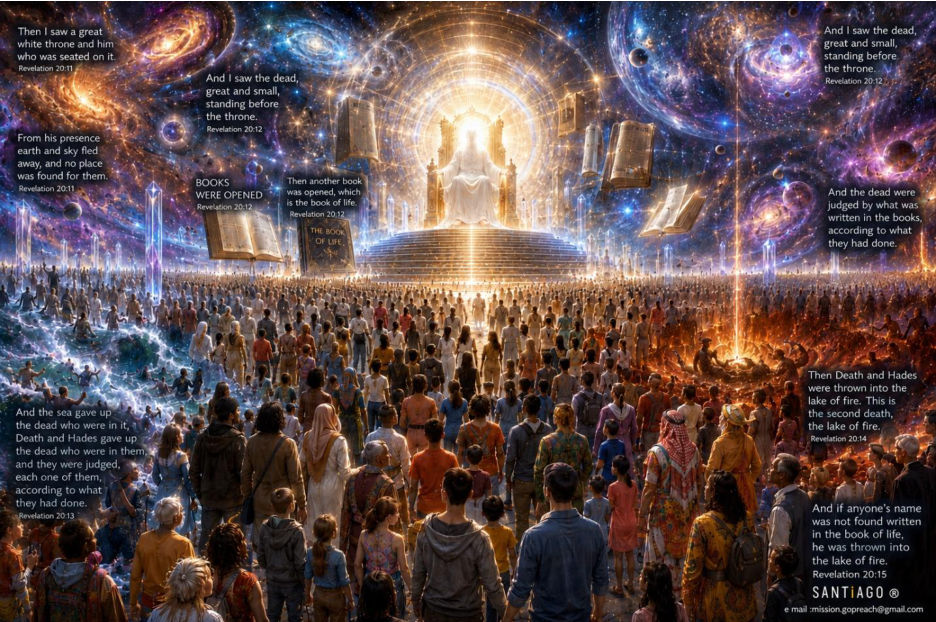
by Randolph Dunn Adapted from Got Questions, edited by Roberto Santiago
“Then I saw a great white throne and him who was seated on it. From his presence earth and sky fled away, and no place was found for them. And I saw the dead, great and small, standing before the throne, and books were opened. Then another book was opened, which is the book of life. And the dead were judged by what was written in the books, according to what they had done. And the sea gave up the dead who were in it, Death and Hades gave up the dead who were in them, and they were judged, each one of them, according to what they had done. Then Death and Hades were thrown into the lake of fire. This is the second death, the lake of fire. And if anyone's name was not found written in the book of life, he was thrown into the lake of fire.” (Revelation 20:11-15)
The Scriptures teach that Christ will return and that humanity will stand before God in final accountability. Revelation describes this moment in solemn language:
“Then I saw a great white throne and him who was seated on it. From his presence earth and sky fled away, and no place was found for them.” — Revelation 20:11
The Bible consistently presents resurrection as part of God’s final work. Paul writes that the dead will be raised imperishable and that mortality will put on immortality (1 Corinthians 15:42–54). Revelation adds that the dead, “great and small,” stand before the throne and are judged according to what is written in the books. — Revelation 20:12–13
Jesus Himself warned that verbal profession alone is not enough:
“Not everyone who says to me, ‘Lord, Lord,’ will enter the kingdom of heaven, but the one who does the will of my Father who is in heaven.” — Matthew 7:21–23
This passage reminds us that God’s judgment is not based merely on appearance, religious activity, or public reputation. Scripture repeatedly teaches that God examines the heart and that every life is ultimately brought into the light.
At the same time, the New Testament proclaims the hope of redemption through Christ. Those who belong to Him are described as cleansed, forgiven, and reconciled through His sacrifice. Paul writes:
“There is now no condemnation for those who are in Christ Jesus.” — Romans 8:1
Salvation is presented as the work of God’s grace through Christ, not the result of human merit. Yet the same Scriptures also teach accountability. Paul told the Corinthians:
“For we must all appear before the judgment seat of Christ, so that each one may receive what is due for what he has done in the body, whether good or evil.” — 2 Corinthians 5:10
The phrase “judgment seat” comes from the Greek word bēma, referring to a raised platform used in courts and public settings. In the ancient world it could also refer to the place where officials evaluated athletic contests and rewarded competitors. Paul uses this imagery to emphasize personal accountability before Christ.
Jesus taught similar principles in His parables. In Luke 19:11–27, a nobleman entrusts responsibilities to his servants and later returns to require an account from them. The point is clear: what we do with what God entrusts to us matters.
The New Testament therefore holds two truths together. First, salvation originates in Christ and His atoning work. Second, believers are still called to faithfulness, obedience, perseverance, and stewardship.
Paul develops this further in 1 Corinthians 3:10–15. Using the image of a building tested by fire, he explains that the quality of each person’s work will be revealed. Some works endure; others do not. The passage emphasizes evaluation and accountability, while also affirming God’s saving grace.
“The Lord descends, the dead in Christ rise, and the faithful are gathered to Him. 1 Thessalonians 4:16–17
When “The Lord descends, the dead in Christ rise, and the faithful are gathered to Him. (1 Thessalonians 4:16–17) Because of this, Christians are called to live carefully and faithfully. James reminds believers that words and actions matter, and Jesus taught that people will give account even for careless speech (Matthew 12:36). The New Testament never treats discipleship casually.
The biblical message is therefore both sobering and hopeful. God’s judgment is real, impartial, and according to truth. Yet the gospel also announces reconciliation, forgiveness, and eternal life through Christ. The Scriptures call every person to faithfulness, humility, repentance, and perseverance as they await the fulfillment of God’s final kingdom.
Finally, Revelation closes with Christ’s declaration:
“Look, I am coming soon! My reward is with me, and I will give to each person according to what they have done.” (Revelation 22:12) But, “The wages of sin is death.” (Romans 6:23) “These will go away into eternal punishment.” Matthew 25:46
The reward Christ brings with Him is Eternal Life for those redeemed by His blood and His mercy and Everlasting Death, the wages of unforgiven sin, for all others.
Text and illustrations reproduced from the study “The Great Separation”. The original PDF is the reference copy.