
Daniel
Outlined Bible
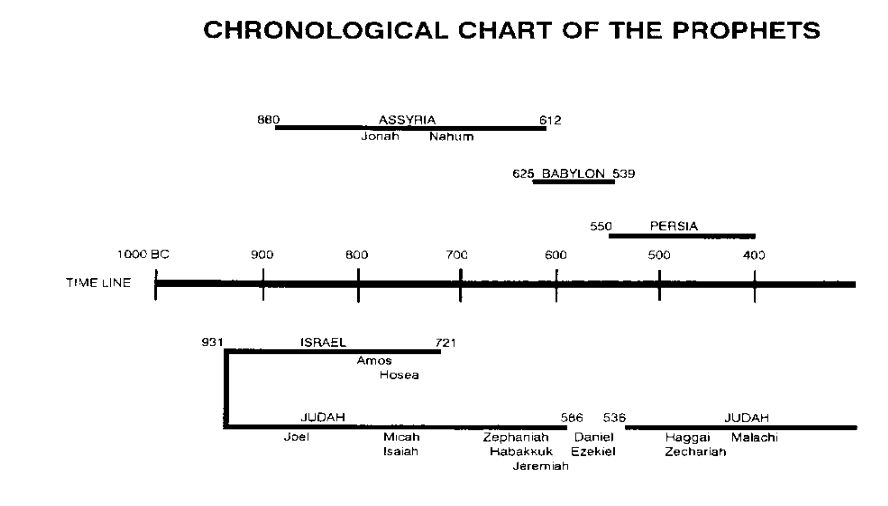
Introduction: The book of Daniel is a fascinating work. Part of it is composed of puzzling apocalyptic imagery, while other parts share with us some of the most inspiring stories in all scripture. The book was written in two languages. Daniel 2:24b-7:28 is composed in Aramaic [or Syrian or Chaldee] and the rest of the book is in Hebrew. That fact reflects Daniel's personal history (see "Background" section) and the impact the captivity would have on the Jewish culture.
Name - the book is named for the prophet who wrote it.
Author - Daniel
- Daniel was born into a wealthy and noble family in Judah.
- In 606 BC he was among the thousands taken captive in the first wave of Babylonian conquest. (1:1-7)
- Daniel distinguished himself in government service.
- He was specially trained for leadership in Nebuchadnezzar's court. (1:3-6)
- King Darius appointed Daniel as one of his three chief administrators (6:3), and planned to set him over his whole kingdom (6:4).
- Throughout his captivity and promotions, he remained a deeply spiritual man, faithful to his God and his convictions. (cf. 1:8-16; 6:1)
- He proclaimed the message of God faithfully. (5:24-8)
- He was given the ability to interpret dreams and visions.
[1] Those of others. (2-5) [2] His own. (7-12)
- Despite his great faith and special ability, he never claimed credit for himself. (2:27-30)
- Though liberal scholars have questioned Daniel's authorship of the book, there is little doubt about that fact.
- The book itself presents Daniel as the author. (cf. Daniel 7:2; 8:1; 9:2; 12:4)
- The historicity of Daniel is found in his contemporary Ezekiel, who speaks of him several times.
- The testimony of Jesus is that this book was written by "Daniel, the Prophet." (Matthew 24:15)
- The discovery of the Dead Sea Scrolls has provided further archaeological evidence of Daniel's authorship.
Purpose
- The initial purpose of the book was to allow captive Judah to know its immediate and long-term future.
- It told the captives that the political kingdoms of the earth would come and go.
- The book called for them to be faithful to God.
- In addition to the above, the purpose for readers of all generations is to show God's providential hand bringing about His will.
- Background of the book.
- Remember that Daniel was taken in the first wave of Babylonian captivity (606 BC).
- He lived during the zenith of Babylon's power and witnessed its fall to the Medes and Persians.
- The book covers the period from 606 BC (1:1) to 536 BC (10:1).
- Main message of the book.
- The main message of the book is the sovereignty of God.
- Through the powers of Babylon, Persia, Greece, and Rome, God would bring to bear His purposes.
- The same could be said today of the U.S., Russia, China, etc.
- With regard to individuals, God does not control the decisions of human beings (cf. Joshua 24:15; John 3:16), but He uses our choices to bring about His desired ends.
- Outline of the book.
- The story of Daniel and others.
- Daniel and three other captives from Judah are trained for service in Nebuchadnezzar's court. (1:1- 7)
- They wouldn't defile themselves with the King's food. (1:8-16)
- Through their fast, God sustained and blessed them for their integrity. (1:17-21)
- When Nebuchadnezzar had a troubling dream, only Daniel could interpret it. (2:1-45)
- He was then given a prominent position in the King's court. (2:46-9)
- Nebuchadnezzar erected a golden image for worship (3:1-7), but Shadrach, Meshach, and
Abednego refused to bow before it. (3:8-12)
- The three were cast into a fiery furnace but were delivered by God. (3:13-30)
- Nebuchadnezzar had another dream that Daniel interpreted. (4:1-27)
- Its message was fulfilled when Nebuchadnezzar became temporarily insane because of his pride. (4:28-33)
- He recovered and praised God. (4:34-37)
- Under Nebuchadnezzar's successor, Belshazzar, Daniel interpreted mysterious writing which appeared on the wall. (5:1-28)
- The prophecy was fulfilled that very evening when Darius the Mede conquered Babylon and
Belshazzar was killed. (5:29-31)
- Daniel was given an honored position in Darius' court. (6:1-3)
- Jealous peers plotted against him (6:4-9), but when Daniel was thrown into the den of lions, God shut their mouths. (l 4:10-28)
- Daniel's Visions and Prophecies. (Daniel 7:1 -12:13)
- The second half of the book goes from a personal record of Daniel's life to revelations he received about the kingdom of God. These included the:
- Vision of four great beasts. (7:1-28)
- Vision of the ram and shaggy goat. (8:1-27)
- Vision of the 70 weeks. (9:1-27)
- Vision of events during the Maccabean era. (10:1-12:3)
- Daniel was then told to seal the book. (12:4-5)
- Key themes of the book.
- The earthly kingdoms and the Kingdom of God.
- In Daniel 2, Nebuchadnezzar has a dream about an image made of four different materials.
- This image had ahead of gold, a chest and arms of silver, a belly and thighs of brass, legs of iron and feet of iron and clay.
- Daniel interpreted the meaning as four earthly kingdoms:
[1] Gold was Babylon. [2] Silver was Medo-Persia. [3] Brass was Greece. [4] Iron was Rome.
- In the days of the fourth kingdom, a stone, not cut by human hands, would roll down and destroy the image.
- That stone obviously pointed to the establishment of God's church. (cf. Acts 2)
- In Daniel 7, the prophet shares a vision of four beasts.
- I believe they stand for the same four empires.
- In Daniel 7:13-14, the resurrection, ascension and exaltation of the Christ appear to be described.
- It seems likely the atrocities committed by the fourth beast refer to the Roman persecution of the early church, (cf. 7:19-27)
- In Daniel 8, there is a vision of a ram and a shaggy goat.
- These are prophetic images of the second and third kingdoms. (i.e. Medo-Persia and Greece)
- The "prominent hour" of the shaggy goat is probably a reference to Alexander the Great. (cf.
Daniel 8:9-14)
- The "small hour” could well be a symbol of Antiochus Epiphanies. (8:9-14)
- The "seventy weeks" of Daniel 9.
- The interpretations offered for this passage are varied.
- Two major ones are worth consideration:
- Some claim the seventy weeks (or seventy-sevens) are a number of years (i.e. 490 years).
[1] If you begin with the decree of Artaxerxes to Ezra in 458 BC (cf. Ezra 7:6-7; 9:9) and come forward 69 x 7 years (i.e. 483 years), you arrive at a date of 26 AD - the year Jesus began his public ministry. (cf. 9:25) [2] The seventieth week would then be the completion of His work. (cf. l 9:26-27)
- More likely, the seventy weeks of years is entirely symbolic of the whole period necessary for the messianic work to come to fruition and be fulfilled. (cf. 9:24)
- Faith with integrity.
- The Bible is filled with examples of heroes and heroines who kept their faith and the integrity of their walk with God through difficult circumstances.
- Joseph. (Genesis 38-50)
- Esther.
- John the Baptizer. (Matthew 14:1-2)
- All of Hebrews 11.
- Daniel brings two classic examples of the same principle:
- Shadrach, Meshach, and Abednego and the fiery furnace.
- Daniel and the lion's den.
- Because both of the situations ended with the heroes not being harmed, we sometimes draw the wrong message from their stories.
- The message is not that God will always keep his people away from harm. (cf. Hebrews 11:35-38)
- The message is wrapped up in the response the three captive Kings gave to Nebuchadnezzar in
Daniel 3:16-17.
- The correct message to their stories is to walk by faith.
DANIEL Summarized Bible
“In the third year of the reign of Jehoiakim king of Judah, Nebuchadnezzar king of Babylon came to Jerusalem and besieged it. And the Lord gave Jehoiakim king of Judah into his hand, with some of the vessels of the house of God. And he brought them to the land of Shinar, to the house of his god, and placed the vessels in the treasury of his god. Then the king commanded Ashpenaz, his chief eunuch, to bring some of the people of Israel, both of the royal family and of the nobility, youths without blemish, of good appearance and skillful in all wisdom, endowed with knowledge, understanding learning, and competent to stand in the king's palace, and to teach them the literature and language of the Chaldeans. Among these were Daniel, Hananiah, Mishael, and Azariah of the tribe of Judah. … Daniel resolved that he would not
defile himself with the king's food, or with the wine. Therefore, he asked the chief of the eunuchs to allow him not to defile himself. … As for these four youths, God gave them learning and skill in all literature and wisdom, and Daniel had understanding in all visions and dreams.” (Dan 1:1-6; 8; 17)
Nebuchadnezzar’s Dream of Stature “Now Nebuchadnezzar had a dream he did not remember. So, he called his wise men to tell him what his dream was and interpret it. The astrologers answered the king, "There is not a man on earth who can do what the king asks! No king, however great and mighty, has ever asked such a thing of any magician or enchanter or astrologer. What the king asks is too difficult. No one can reveal it to the king except the gods, and they do not live among men." This made the king so angry and furious that he ordered the execution of all the wise men of Babylon. The decree was issued to put the wise men to death, and men were sent to look for Daniel and his friends to put them to death. But Daniel spoke to him with wisdom and tact. He asked the king's officer, "Why did the king issue such a harsh decree?" Arioch then explained the matter to Daniel. At this, Daniel went in to the king and asked for time, so that he might interpret the dream for him. The following day Daniel went to Arioch, whom the king had appointed to execute the wise men of Babylon, and said to him, "Do not execute the wise men of Babylon. Take me to the king, and I will interpret his dream for him.”
The dream “The king asked Daniel ‘Are you able to tell me what I saw in my dream and interpret it?’ Daniel replied, ‘No wise man, enchanter, magician or diviner can explain to the king the mystery he has asked about, but there is a God in heaven who reveals mysteries.’ ‘You looked, O king, and there before you stood a large statue — an enormous, dazzling statue, awesome in appearance. The head of the statue was made of pure gold, its chest and arms of silver, its belly and thighs of bronze, its legs of iron, its feet partly of iron and partly of baked clay. While you were watching, a rock was cut out, but not by human hands. It struck the statue on its feet of iron and clay and smashed them. Then the iron, the clay, the bronze, the silver and the gold were broken to pieces at the same time and became like chaff on a threshing floor in the summer. The wind swept them away without leaving a trace. But the rock that struck the statue became a huge mountain and filled the whole earth.”
The interpretation “You, O king, are the king of kings. The God of heaven has given you dominion and power and might and glory; in your hands he has placed mankind and the beasts of the field and the birds of the air. Wherever they live, he has made you ruler over them all. You are that head of gold. After you, another kingdom will rise, inferior to yours. Next, a third kingdom, one of bronze, will rule over the whole earth. Finally, there will be a fourth kingdom, strong as iron — for iron breaks and smashes everything — and as iron breaks things to pieces, so it will crush and break all the others. Just as you saw that the feet and toes were partly of baked clay and partly of iron, so this will be a divided kingdom; yet it will have some of the strength of iron in it, even as you saw iron mixed with clay. As the toes were partly iron and partly clay, so this kingdom will be partly strong and partly brittle. And just as you saw the iron mixed with baked clay, so the people will be a mixture and will not remain united, any more than iron mixes with clay. "In the time of those kings, the God of heaven will set up a kingdom that will never be destroyed, nor will it be left to another people. It will crush all those kingdoms and bring them to an end, but it will itself endure forever.” (Daniel 2)
Thus, the gold head represented the Babylonian empire, silver chest represented the empire of the Meads and Persians, bronze belly stood for the mighty Greek nation and the legs and feet of iron and clay represented the Roman Empire. The Rock not made with human hands would be the Messiah, the Son of God and His Kingdom on earth, His Church.
Image of Gold King Nebuchadnezzar made an image of gold, ninety feet high and nine feet wide, and set it up on the plain of Dura in the province of Babylon. He then summoned the satraps, prefects, governors, advisers, treasurers, judges, magistrates and all the other provincial officials to come to the dedication of the image he had set
- He stated Whoever does not fall down and worship will immediately be thrown into a blazing furnace.
However, Shadrach, Meshach and Abednego refused. Nebuchadnezzar was furious with rage but gave them another opportunity to worship the golden image. They refused again stating, “If we are thrown into the blazing furnace, the God we serve is able to save us from it, and he will rescue us from your hand, O king.” He was more furious, his attitude toward them changed and he ordered them to be cast into the fire. Then King Nebuchadnezzar leaped to his feet in amazement and asked his advisers, “Weren't there three men that we tied up and threw into the fire? I see four men walking around in the fire, unbound and unharmed, and the fourth looks like a son of the gods.” Nebuchadnezzar shouted “Shadrach, Meshach and Abednego, servants of the Most-High God, come out! Come here!” They saw that the fire had not harmed their bodies, nor was a hair of their heads singe; their robes were not scorched, and there was no smell of fire on them. Then Nebuchadnezzar said, “Praise be to the God of Shadrach, Meshach and Abednego, who has sent his angel and rescued his servants!” (Daniel 3)
Dream of the Tree “I had a dream that made me afraid. These are the visions I saw while lying in my bed: I looked, and there before me stood a tree in the middle of the land. Its height was enormous. The tree grew large and strong and its top touched the sky; it was visible to the ends of the earth. Before me was a messenger, a holy one, coming down from heaven. He called in a loud voice: 'Cut down the tree and trim off its branches; strip off its leaves and scatter its fruit. Let the animals flee from under it and the birds from its branches. But let the stump and its roots, bound with iron and bronze, remain in the ground, in the grass of the field. Let him be drenched with the dew of heaven, and let him live with the animals among the plants of the earth. Let his mind be changed from that of a man and let him be given the mind of an animal. Daniel was greatly perplexed for a time, and his thoughts terrified him. So, the king said, ‘Belteshazzar (also known as Daniel), do not let the dream or its meaning alarm you.’
Interpretation “O king, you are that tree! This is the decree the Most High has issued against my lord the king: You will be driven away from people and will live with the wild animals; you will eat grass like cattle and be drenched with the dew of heaven. Seven times will pass by for you until you acknowledge that the Most- High is sovereign over the kingdoms of men and gives them to anyone he wishes. The command to leave the stump of the tree with its roots means that your kingdom will be restored to you when you acknowledge that Heaven rules. Therefore, O king, be pleased to accept my advice: Renounce your sins by doing what is right, and your wickedness by being kind to the oppressed. It may be that then your prosperity will continue." He did not humble himself or renounce his sins.
Twelve months later, as the king was walking on the roof of the royal palace of Babylon, he said, "Is not this the great Babylon I have built as the royal residence, by my mighty power and for the glory of my majesty?" The words were still on his lips when a voice came from heaven, "This is what is decreed for you, King Nebuchadnezzar: Your royal authority has been taken from you. Immediately what had been said about Nebuchadnezzar was fulfilled. He was driven away from people and ate grass like cattle. His body was drenched with the dew of heaven until his hair grew like the feathers of an eagle and his nails like the claws of a bird.”
“At the end of that time (seven years) I, Nebuchadnezzar, raised my eyes toward heaven, and my sanity was restored. Then I praised the Most- High; I honored and glorified him who lives forever. At the same time that my sanity was restored, my honor and splendor were returned to me for the glory of my kingdom. My advisers and nobles sought me out, and I was restored to my throne and became even greater than before. Now I, Nebuchadnezzar, praise and exalt and glorify the King of heaven, because everything he does is right and all his ways are just. And those who walk in pride he is able to humble.” (Daniel 4)
Human Hand Writing on the Wall “Belchazzar now the king gave a great banquet for a thousand of his nobles and drank wine with them. They brought in the gold goblets that had been taken from the temple of God in Jerusalem, and the king and his nobles, his wives and his concubines drank from them. As they drank the wine, they praised the gods of gold and silver, of bronze, iron, wood and stone. Suddenly the fingers of a human hand appeared and wrote on the plaster of the wall, near the lampstand in the royal palace. The king watched the hand as it wrote. His face turned pale and he was so frightened that his knees knocked together and his legs gave
- The king called out for the enchanters, astrologers and diviners to be brought and said to these wise men of Babylon. They could not read the writing or tell the king what it meant. So, King Belshazzar became even more terrified and his face grew more-pale. His nobles were baffled. Daniel was brought before the king, and the king I have heard that you are able to give interpretations and to solve difficult problems. O king, the Most-High God gave your father Nebuchadnezzar sovereignty and greatness and glory and splendor. Because of the high position he gave him, all the peoples and nations and men of every language dreaded and feared him. But when his heart became arrogant and hardened with pride, he was deposed from his royal throne and stripped of his glory. He was driven away from people and given the mind of an animal; he lived with the wild donkeys and ate grass like cattle; and his body was drenched with the dew of heaven, until he acknowledged that the Most-High God is sovereign over the kingdoms of men and sets over them anyone he wishes. But you his son, O Belshazzar, have not humbled yourself, though you knew all this. You did not honor the God who holds in his hand your life and all your ways. Therefore, he sent the hand that wrote the inscription a) God has numbered the days of your reign and brought it to an end b)
You have been weighed on the scales and found wanting and c) Your kingdom is divided and given to the Medes and Persians.” That very night Belshazzar, king of the Babylonians, was slain, and Darius the Mede took over the kingdom.” (Daniel 5)
Daniel Cast into a Den of Lions “Darius to appointed 120 satraps (provincial governors) to rule throughout the kingdom, with three administrators over them, one of whom was Daniel. The satraps were made accountable to them so that the king might not suffer loss. Now Daniel so distinguished himself among the administrators and the satraps by his exceptional qualities that the king planned to set him over the whole kingdom. The other satraps requested the king to issue an edict that anyone who prays to any god or man during the next thirty days, except to you, O king, shall be thrown into the lions' den. The king issued the decree and put it in writing
so that it cannot be altered — in accordance with the laws of the Medes and Persians. When Daniel learned that the decree had been published, he went home to his upstairs room where the windows opened toward Jerusalem. Three times a day he got down on his knees and prayed, giving thanks to his God, just as he had done before. The satraps said to the king, ‘Daniel, who is one of the exiles from Judah, pays no attention to you, O king, or to the decree you put in writing. He still prays three times a day.’ When the king heard this, he was greatly distressed; he was determined to rescue Daniel and made every effort until sundown to save
- At the first light of dawn, the king got up and hurried to the lions' den. When he came near the den, he called to Daniel in an anguished voice, ‘Daniel, servant of the living God, has your God, whom you serve continually, been able to rescue you from the lions?’ Daniel answered, ‘O king, live forever! My God sent his angel, and he shut the mouths of the lions. They have not hurt me, because I was found innocent in his sight. Nor have I ever done any wrong before you, O king.’” (Chapter 6)
Daniel’s Dream of Four Beast “In my vision at night I looked, and there before me were the four winds of heaven churning up the great
- Four great beasts, each different from the others, came up out of the sea. ‘The first was like a lion, and it had the wings of an eagle. I watched until its wings were torn off and it was lifted from the ground so that it stood on two feet like a man, and the heart of a man was given to it. And there before me was a second beast, which looked like a bear. It was raised up on one of its sides, and it had three ribs in its mouth between its teeth. It was told, Get up and eat your fill of flesh!’ ‘After that, I looked, and there before me was another beast, one that looked like a leopard. And on its back, it had four wings like those of a bird. This beast had four heads, and it was given authority to rule. After that, in my vision at night I looked, and there before me was a fourth beast — terrifying and frightening and very powerful. It had large iron teeth; it crushed and devoured its victims and trampled underfoot whatever was left. It was different from all the former beasts, and it had ten horns. Then there before me was another horn, a little one, which came up among them; and three of the first horns were uprooted before it. This horn had eyes like the eyes of a man and a mouth that spoke boastfully.”
“As I looked, ‘thrones were set in place, and the Ancient of Days (the Eternal God) took his seat. His clothing was as white as snow; the hair of his head was white like wool. His throne was flaming with fire, and its wheels were all ablaze. A river of fire was flowing, coming out from before him. Thousands upon thousands attended him; ten thousand times ten thousand stood before him. The court was seated, and the books were opened. There before me was one like a son of man, coming with the clouds of heaven. He approached the Ancient of Days and was led into his presence. He was given authority, glory and sovereign power; all peoples, nations and men of every language worshiped him. His dominion is an everlasting dominion that will not pass away, and his kingdom is one that will never be destroyed.’”
Interpretation “The four great beasts are four kingdoms that will rise from the earth. But the saints of the Most-High will receive the kingdom and will possess it forever — yes, for ever and ever. ‘Then I wanted to know the true meaning of the fourth beast, which was different from all the others and most terrifying, with its iron teeth and bronze claws — the beast that crushed and devoured its victims and trampled underfoot whatever was left. I also wanted to know about the ten horns on its head and about the other horn that came up, before which three of them fell — the horn that looked more imposing than the others and that had eyes and a mouth that spoke boastfully. As I watched, this horn was waging war against the saints and defeating them, until the Ancient of Days came and pronounced judgment in favor of the saints of the Most-High, and the
time came when they possessed the kingdom. The fourth beast is a fourth kingdom that will appear on earth. It will be different from all the other kingdoms and will devour the whole earth, trampling it down and crushing it. The ten horns are ten kings who will come from this kingdom. After them another king will arise, different from the earlier ones; he will subdue three kings. He will speak against the Most-High and oppress his saints and try to change the set times and the laws. The saints will be handed over to him for a time, times and half a time.’”
“But the court will sit, and his power will be taken away and completely destroyed forever. Then the sovereignty, power and greatness of the kingdoms under the whole heaven will be handed over to the saints, the people of the Most-High. His kingdom will be an everlasting kingdom, and all rulers will worship and obey him.” (Daniel 7)
Daniel’s Vision of a Ram “I looked up, and there before me was a ram with two horns, standing beside the canal, and the horns were long. One of the horns was longer than the other but grew up later. I watched the ram as he charged toward the west and the north and the south. No animal could stand against him, and none could rescue from his power. He did as he pleased and became great. As I was thinking about this, suddenly a goat with a prominent horn between his eyes came from the west, crossing the whole earth without touching the ground. He came toward the two-horned ram I had seen standing beside the canal and charged at him in great rage. I saw him attack the ram furiously, striking the ram and shattering his two horns. The ram was powerless to stand against him; the goat knocked him to the ground and trampled on him, and none could rescue the ram from his power. The goat became very great, but at the height of his power his large horn was broken off, and in its place four prominent horns grew up toward the four winds of heaven. Out of one of them came another horn, which started small but grew in power to the south and to the east and toward the Beautiful Land. It grew until it reached the host of the heavens, and it threw some of the starry host down to the earth and trampled on them. It set itself up to be as great as the Prince of the host; it took away the daily sacrifice from him, and the place of his sanctuary was brought low. Because of rebellion, the host (of the saints) and the daily sacrifice were given over to it. ‘How long will it take for the vision to be fulfilled — the vision concerning the daily sacrifice, the rebellion that causes desolation, and the surrender of the sanctuary and of the host that will be trampled underfoot?’ He said to me, ‘It will take 2,300 evenings and mornings; then the sanctuary will be re-consecrated.’ He said: "I am going to tell you what will happen later in the time of wrath, because the vision concerns the appointed time of the end. The two-horned ram that you saw represents the kings of Media and Persia. The shaggy goat is the king of Greece, and the large horn between his eyes is the first king. The four horns that replaced the one that was broken off represent four kingdoms that will emerge from his nation but will not have the same power. A stern-faced king, a master of intrigue, will arise. He will become very strong, but not by his own power. He will cause astounding devastation and will succeed in whatever he does. He will destroy the mighty men and the holy people. He will cause deceit to prosper, and he will consider himself superior. When they feel secure, he will destroy many and take his stand against the Prince of princes. Yet he will be destroyed, but not by human power. ‘The vision of the evenings and mornings that has been given you is true, but seal up the vision, for it concerns the distant future.’” (Daniel 8)
Daniel’s Prayer “Daniel, understood from the Scriptures, according to the word of the Lord given to Jeremiah the prophet, that the desolation of Jerusalem would last seventy years. So, I turned to the Lord God and pleaded with him in prayer and petition, in fasting, and in sackcloth and ashes. The Lord did not hesitate to bring the
disaster upon us, for the Lord our God is righteous in everything he does; yet we have not obeyed him. Now, our God, hear the prayers and petitions of your servant. For your sake, O Lord, look with favor on your desolate sanctuary. Give ear, O God, and hear; open your eyes and see the desolation of the city that bears your Name. We do not make requests of you because we are righteous, but because of your great mercy. O Lord, listen! O Lord, forgive! O Lord, hear and act! For your sake, O my God, do not delay, because your city and your people bear your Name.”
“While I was speaking and praying, confessing my sin and the sin of my people Israel and making my request to the Lord my God for his holy hill—while I was still in prayer, Gabriel, the man I had seen in the earlier vision, came to me in swift flight about the time of the evening sacrifice. He instructed me and said to me, ‘Daniel, I have now come to give you insight and understanding. Seventy 'sevens' are decreed for your people and your holy city to finish transgression, to put an end to sin, to atone for wickedness, to bring in everlasting righteousness.”
“From the issuing of the decree to restore and rebuild Jerusalem until the Anointed One, the ruler, comes, there will be seven 'sevens,' and sixty-two 'sevens.' It will be rebuilt with streets and a trench, but in times of trouble. After the sixty-two 'sevens,' the Anointed One will be cut off and will have nothing. The people of the ruler who will come will destroy the city and the sanctuary. The end will come like a flood: War will continue until the end, and desolations have been decreed. He will confirm a covenant with many for one 'seven.' In the middle of the 'seven' he will put an end to sacrifice and offering. And on a wing (of the temple) he will set up an abomination that causes desolation, until the end that is decreed is poured out on him.” (Daniel 9)
Vision of Man in Linen “When Cyrus was king, I was standing on the bank of the great river, the Tigris, I looked up and there before me was a man dressed in linen, with a belt of the finest gold around his waist. His body was like chrysolite, his face like lightning, his eyes like flaming torches, his arms and legs like the gleam of burnished bronze, and his voice like the sound of a multitude. Its message was true and it concerned a great
- ‘Do not be afraid, Daniel. Since the first day that you set your mind to gain understanding and to humble yourself before your God, your words were heard, and I have come in response to them. I have come to explain to you what will happen to your people in the future, for the vision concerns a time yet to come.’ My strength is gone and I can hardly breathe. Do not be afraid, O man highly esteemed, I will return to fight against the prince of Persia, and when I go, the prince of Greece will come; but first I will tell you what is written in the Book of Truth. Three more kings will appear in Persia, and then a fourth, who will be far richer than all the others. When he has gained power by his wealth, he will stir up everyone against the kingdom of Greece. Then a mighty king will appear, who will rule with great power and do as he pleases.
After he has appeared, his empire will be broken up and parceled out toward the four winds of heaven. It will not go to his descendants, nor will it have the power he exercised, because his empire will be uprooted and given to others.” (Daniel 10 & 11)
Comment: Daniel’s dream occurred “in the third year of Cyrus king of Persia (10:1). Or 534 B.C., when he had yet four years to reign, and must have been the first of the three. The two following him would be Cambyses II (530-522 B.C.) and Darius Hystaspes (522-486 B.C.). The fourth would be Xerxes I (486-465 B.C.), the richest and most powerful of the Persian kings -- likely the Ahasuerus of the Book of Esther. He invaded Greece but was defeated at Salamis (480 B.C.). This was by no means the end of
the Persian Empire, but put it in decline and Greece in the ascendancy, until finally Persia fell to the Grecian king Alexander the Great in 330 B.C.” The Book of Daniel by Cecil Wright
End of Times “At that time Michael, the great prince who protects your people, will arise. There will be a time of distress such as has not happened from the beginning of nations until then. But at that time your people — everyone whose name is found written in the book — will be delivered. Multitudes who sleep in the dust of the earth will awake: some to everlasting life, others to shame and everlasting contempt. But you, Daniel, close up and seal the words of the scroll until the time of the end. there before me stood two others, one on this bank of the river and one on the opposite bank. One of them said to the man clothed in linen, who was above the waters of the river, ‘How long will it be before these astonishing things are fulfilled?’ ‘It will be for a time, times and half a time. When the power of the holy people has been finally broken, all these things will be completed.’ I heard, but I did not understand. So, I asked, ‘My lord, what will the outcome of all this be?’ He replied, ‘Go your way, Daniel, because the words are closed up and sealed until the time of the end.’” (Daniel 12)
Key Points from Daniel ➢ Daniel resolved not to defile himself. ➢ The God of Heaven revealed to the king that there would be four earthly kingdoms, beginning with Babylon. During the fourth kingdom, the God of Heaven will set up His kingdom that will never be destroyed - a spiritual kingdom. ➢ One cannot always be able to defend or protect himself, but God is able to do so. ➢ Humble yourself - Renounce your sins by doing what is right. ➢ If you do not humble yourself or honor God, you will be found wanting and suffer the consequences of your actions. ➢ You must not yield to man’s laws that violate God or His commands. ➢ The Son of Man has been given authority, glory, and sovereign power and His kingdom will last forever. ➢ Our Lord is righteous in everything He does. ➢ When one of God’s children sets his mind to gain understanding and humbles himself before God, he will be heard. ➢ Everyone whose name is found written in the book (book of life) will be delivered, including the dead. ➢ Those not written in the book will be delivered to everlasting shame and contempt. ➢ Again, when one sets his mind to gain understanding and to humble yourself before your God, your words were heard.
Text and illustrations reproduced from the study “Daniel”. The original PDF is the reference copy.