
Job
Outlined Bible
Introduction: The average reader would not recognize these five books of poetry (Job -Song of Solomon) as such because Hebrew poetry is not of sound and sight like our English poetry. They are of thought. While unusual to us, poetry in any language or culture has a special power and impact on a sensitive heart.
The book of Job, along with Proverbs and Ecclesiastes, are also referred to as "wisdom literature". Reflective in tone, wisdom literature deals with the deep questions of life (e.g. - existence, purpose, happiness, etc.). Job deals with questions in practical life, one of which may be the greatest and most perplexing questions of the human experience - the problem of suffering.6 Name - The book is named for its principal character.
Author - The author is unknown.
Purpose - The purpose of the book is to address the problem of the suffering of righteous people.
- The "problem" lies in the following logic:
- Our God is infinitely good, loving, and powerful.
- Why do those made in His image suffer?
- The book does not give a full intellectual explanation, but spiritual counsel.
- Background of the book.
- Job was a historical character. (cf. Ezekiel 14:14, 20; James 5:11)
- He likely lived in the days of the patriarchs. (i.e. - after the days of the flood and before the time of
Moses)
- The length of his life supports that view. (42:16)
- Job is seen functioning as a priest for his family, a typical role in the patriarchal days. (1:5)
- The Mosaic Law and/or revelations from the prophets are never referred to in all the theological discussions of Job and his friends.
- The series of events outlined in the book likely occurred around 2000 BC.
- The writing of the book in its current form likely did not occur until about the time of Solomon (ca. 950 BC) when interest in wisdom literature was at a peak.
- Main Message of the book.
- As stated in the “Purpose" section, the book is concerned with the problem of human suffering.
- It is perhaps the most challenging question that confronts believers.
- Job’s wife and “friends” posed the shallow narrow perspective that one's suffering is always a direct result of his/her sin.
- This concept is not only shallow but unbiblical. (cf. John 9:1f)
- Also, it offers no help or solace to the one suffering.
- The response offered by the book of Job is practical rather than theoretical.
- It doesn't deal so much with the "Why" of suffering, but more with the "How" to cope with it.
- The primary premise set forth is to trust in the absolute sovereignty of God. (Job 38:1-42:6)
- This same message is proclaimed in several New Testament passages. (cf. Romans 8:28; 2
Corinthians 12:9-10)
III Outline of the book.
- The Prologue. (Job 1:1-2:13)
- Job is introduced as an upright and righteous man (1:8) and also a man of great wealth. (1:13)
- Satan questions the sincerity of Job's faith (1:6-11) and is allowed by God to put him to the test. (1:13-2:8)
- Job lost his oxen and servants. (1:13-16)
- He lost all his camels. (1:17)
- His ten children all died when a windstorm collapsed the house where they were feasting. (1:18-21)
- Job's health was even taken from him. (2:1-8)
- Job's friends come to sympathize with him. (2:11-13)
- Discussions of Job's condition. (Job 3:1-:40)
- After Job laments his condition (3:1-26) three rounds of speeches are given.
- Each round has Job, Eliphaz, Bildad and Zophar debating the reason for Job's suffering.
- The first round (4:1-14:22) the second round (15:1-21:34), and the third round (22:1 - 31:40) of speeches are poetic in form.
- The general conclusion reached in the friends' speeches is that such extraordinary turmoil must be due to great sin in Job's life.
- Elihu's speeches. (Job 32:1-37:24)
- Elihu is a younger man who has been listening to these speeches and is disappointed in what he's heard. (32:1-5)
- He delivers four speeches of his own. (Job 32:6 - 33:33; 34:1-37; 35:1-16; 36:1 -37:24)
- In these he comes closer to the truth than the others.
- He rebuked Job for justifying himself before God.
- He rebuked the three friends for talking much but saying little.
- Elihu pointed out that suffering can serve for instruction as much as punishment.
- God's response to Job. (Job 38:1-42:6)
- In two magnificent addresses God challenged Job to explain the wonders of his creation.
- Job quickly learned that he could never understand a fraction of what God knew, and he responded in submission and surrender.
- God did not explain to Job why he suffered; rather He simply wanted Job to trust Him and bow before Him.
- Epilogue. (Job 42:7-17)
- God rebukes Job's friends. (42:7-10)
- Job's health is restored, his wealth is restored twofold, and he is blessed with ten children. (42:11- 17)
- Key Themes of the book.
- The problem of suffering.
- How can an omnipotent, all good and loving God allow evil, pain, and suffering in this world?
- While not offering a total explanation, the book touches on some reasons for its presence in the world.
- Suffering tests character. (Job 1:6-12; cf. James 1:2-4)
- Suffering can result from one's own sin. (Job 4:7-9; cf. John 5:14)
- Suffering refines its object. (Job 23:10; cf. Malachi 3:2-3)
- Some suffering can be the result of God's discipline. (Job 33:19-30; Hebrews 12:4-11)
- Each of these is valid in certain situations.
- No single one of these is a universal explanation for suffering.
- The book of Job makes it clear that it is beyond human understanding to always pinpoint suffering's cause. (Job 38:1ff)
- It is particularly important not to view all suffering as punishment from God. (cf. John 9:11)
- The "patience" of Job.
- The expression "the patience of Job" has come to us from the KJV rendering of James 5:11.
- If you read the book of Job, you found him to be anything but patient (as we normally define the word).
- Job moaned and whined about his condition. (3:1-26; 6:1-13)
- He lashed out at the unsympathetic, shallow perspective of those around him. (6:14-30)
- Job even complained about God to God. (30:20-23)
- The original word rendered "Patience" in the KJV is better translated “steadfastness” (RSV),
“perseverance” (NIV) and “stood firm” (NEB).
- Job is an example of a steadfast man who courageously clings to God even when he doesn’t understand. “In all this, Job did not sin by charging God with wrongdoing.” (1:22)
- The sovereignty of God.
- Perhaps the most inspiring part of the book is God's magnificent address to Job. (Job 38-41)
- Powerful and poetic, it reminds us of the awesome majesty, sovereignty, and greatness of God.
JOB
Summarizes Bible
Tragedy Strikes Job Job appears to have been one of the Patriarchs God talked with. Job offered burnt offerings to God just as Noah did. His time on earth is uncertain. He lived in the land of Uz possibly south and east of the sea later to be names the Dead Sea. The time he lived could have been before, during or after Abraham from UR of the Chaldees or Melchizedek from Salem, possibly later to be Jerusalem.
Job was a righteous man according to what God said to Satan. Satan questioned the reason why Job was righteous. So, God allowed Job’s righteousness to be tested. First his wealth, then his family followed by his health. Added to all his misery Job’s wife said “‘Do you still hold fast your integrity? Curse God and die.’ But he said to her, ‘You speak as one of the foolish women would speak. Shall we receive good from God, and shall we not receive evil?’ In all this Job did not sin with his lips.”
Some of Job’s friends heard of his calamity and go to comfort and sympathize with him. They wept upon seeing him and for seven days nothing was said. Finally, Job feeling sorry for himself began a lament of his condition.
- “Job opened his mouth and cursed the day of his birth. He said: ‘May the day of my birth perish, and the night it was said, 'A boy is born!'”
- “Why did I not perish at birth, and die as I came from the womb?”
- “Or why was I not hidden in the ground like a stillborn child, like an infant who never saw the light of day?”
- “What I feared has come upon me; what I dreaded has happened to me. I have no peace, no quietness; I have no rest, but only turmoil.” (Job 1 – 3)
Key Point from Tragedy Strikes ➢ God knows His righteous people.
➢ Satan also knows them and wishes to destroy the relationship between them and God. ➢ God’s righteous people know that God knows them and how they live righteously among the unrighteous. ➢ The attitude of the righteous must be like that of Job - “The Lord gave and the Lord has taken away; may the name of the Lord be praised.”
Eliphaz and Job Eliphaz speaks
- If someone ventures a word with you, will you be impatient? But who can keep from speaking? Think how you have instructed many, how you have strengthened feeble hands. Your words have supported those who stumbled; you have strengthened their faltering knees. But now trouble comes to you, and you are discouraged; it strikes you, and you are dismayed. Should not your piety be your confidence and your blameless ways your hope?
- Consider now: Who, being innocent, has ever perished? Where were the upright ever destroyed? As I have observed, those who plow evil and those who sow trouble reap it. At the breath of God, they are destroyed; at the blast of his anger, they perish.
- Can a mortal be more righteous than God? Can a man be more-pure than his Maker?
- Call if you will, but who will answer you? To which of the holy ones will you turn? Resentment kills a fool, and envy slays the simple.
- Blessed is the man whom God corrects; so, do not despise the discipline of the Almighty.
- We have examined this, and it is true. So, hear it and apply it to yourself.
Job replies
- If only my anguish could be weighed and all my misery be placed on the scales! It would surely outweigh the sand of the seas — no wonder my words have been impetuous.
- Oh, that I might have my request, that God would grant what I hope for, that God would be willing to crush me, to let loose his hand and cut me off! Then I would still have this consolation — my joy in unrelenting pain — that I had not denied the words of the Holy One.
- A despairing man should have the devotion of his friends, even though he forsakes the fear of the Almighty. But my brothers are as undependable as intermittent streams.
- Now you too have proved to be of no help; you see something dreadful and are afraid. Have I ever said, 'Give something on my behalf, pay a ransom for me from your wealth, deliver me from the hand of the enemy, ransom me from the clutches of the ruthless'?
- I have been allotted months of futility, and nights of misery have been assigned to me. When I lie down, I think, 'How long before I get up?' The night drags on, and I toss till dawn. My body is clothed with worms and scabs, my skin is broken and festering.
- What is man that you make so much of him, that you give him so much attention, that you examine him every morning and test him every moment?
- Will you never look away from me, or let me alone even for an instant?
- If I have sinned, what have I done to you, O watcher of men? Why have you made me your target? Have I become a burden to you? Why do you not pardon my offenses and forgive my sins? (Job 4-7)
Key Points from Eliphaz and Job
➢ People often accept life’s tragedies as direct actions from God when in reality they are from Satan. ➢ Accusers base their condemnation on opinions rather than facts. ➢ Pain and anguish can cause despair resulting in doubt of God’s love. ➢ Attitude in times of tragedy should be – my joy in unrelenting pain is I had not denied the words of the Holy One.
Bildad and Job Bildad
- How long will you say such things? Your words are a blustering wind. Does God pervert justice? Does the Almighty pervert what is right?
- If you are pure and upright, even now he will rouse himself on your behalf and restore you to your rightful place.
- Surely God does not reject a blameless man or strengthen the hands of evildoers. He will yet fill your mouth with laughter and your lips with shouts of joy. Your enemies will be clothed in shame, and the tents of the wicked will be no more." Job
- I know that this is true. But how can a mortal be righteous before God? Though one wished to dispute with him, he could not answer him one time out of a thousand. His wisdom is profound, his power is vast. Who has resisted him and come out unscathed?
- How then can I dispute with him? How can I find words to argue with him?
- Though I were innocent, I could not answer him; I could only plead with my Judge for mercy.
- He is not a man like me that I might answer him, that we might confront each other in court. If only there were someone to arbitrate between us, to lay his hand upon us both, someone to remove God's rod from me, so that his terror would frighten me no more. Then I would speak up without fear of him, but as it now stands with me, I cannot.
- I loathe my very life; therefore, I will give free rein to my complaint and speak out in the bitterness of my soul. I will say to God: Do not condemn me,
- Tell me what charges you have against me.
- Why then did you bring me out of the womb? I wish I had died before any eye saw me. If only I had never come into being, or had been carried straight from the womb to the grave! Are not my few days almost over? Turn away from me so I can have a moment's joy before I go to the place of no return, to the land of gloom and deep shadow, to the land of deepest night, of deep shadow and disorder, where even the light is like darkness. (Job 8 – 10)
Key Points from Bildad and Job ➢ Harsh and condemning words especially from friends hurt. ➢ In despair one needs to remember God is just, righteous and merciful. ➢ Mortal man is unable to argue with God about his mortal life. ➢ God does not reject a blameless man … But how can a mortal be righteous before God.
Zophar first speech Zophar • Are all these words to go unanswered? Is this talker to be vindicated? Will your idle talk reduce men to silence? Will no one rebuke you when you mock? You say to God, 'My beliefs are flawless and I am
pure in your sight.' Oh, how I wish that God would speak, that he would open his lips against you and disclose to you the secrets of wisdom, for true wisdom has two sides. Know this: God has even forgotten some of your sin.
- The eyes of the wicked will fail, and escape will elude them; their hope will become a dying gasp. Job replied:
- But I have a mind as well as you; I am not inferior to you.
- Men at ease have contempt for misfortune as the fate of those whose feet are slipping.
- Ask the animals they will teach, the birds will tell you, the fish will inform you that the hand of the Lord is the life of every creature and the breath of all mankind.
- To God belong wisdom and power; counsel and understanding. He silences the lips of trusted advisers and takes away the discernment of elders. He pours contempt on nobles and disarms the mighty.
- My eyes have seen all this, my ears have heard and understood it. What you know, I also know; I am not inferior to you. But I desire to speak to the Almighty and to argue my case with God. You, however, smear me with lies.
- You are a worthless physician, all of you! If only you would be altogether silent!
- Keep silent and let me speak; then let come to me what may.
- Listen carefully to my words; let your ears take in what I say. Now that I have prepared my case, I know I will be vindicated. Can anyone bring charges against me? If so, I will be silent and die.
- Only grant me these two things, O God. How many wrongs and sins have I committed? Show me my offense and my sin. Why do you hide your face and consider me your enemy?
- If only you would hide me in the grave and conceal me till your anger has passed! If only you would set me a time and then remember me! If a man dies, will he live again? All the days of my hard service I will wait for my renewal to come. You will call and I will answer you; you will long for the creature your hands have made. Surely then you will count my steps but not keep track of my sin. My offenses will be sealed up in a bag; you will cover over my sin. (Job 11- 14)
Key Points from Zophar First Speech ➢ Acquisitions and praise of men are based on opinions and some facts. ➢ Defense of acquisitions should not condemn the accuser but confront the charges with truth and facts. ➢ Only God knows and understands man’s trial and tribulations. He desires all to remain faithful to Him while being tested by Satan. ➢ Will we be able to plea our case before God as Job did? Thankfully Jesus Christ will do our pleading – we cannot.
Eliphaz 2nd Speech
- Would a wise man answer with empty notions?
- You even undermine piety and hinder devotion to God. Your sin prompts your mouth; you adopt the tongue of the crafty. Your own mouth condemns you, not mine; your own lips testify against you.
- Why has your heart carried you away, and why do your eyes flash, so that you vent your rage against God and pour out such words from your mouth?
- Listen to me and I will explain to you; let me tell you what I have seen.
- All his days the wicked man suffers torment, the ruthless through all the years stored up for him. Terrifying sounds fill his ears; when all seems well, marauders attack him. He despairs of escaping the
darkness; he is marked for the sword. He wanders about — food for vultures; he knows the day of darkness is at hand. Distress and anguish fill him with terror.
- Distress and anguish fill him with terror; they overwhelm him, like a king poised to attack, because he shakes his fist at God and vaunts himself against the Almighty, defiantly charging against him with a thick, strong shield. Job replied:
- I have heard many things like these; miserable comforters are you all! Will your long-winded speeches never end? What ails you that you keep on arguing?
- Men open their mouths to jeer at me; they strike my cheek in scorn and unite together against me. God has turned me over to evil men and thrown me into the clutches of the wicked. I have sewed sackcloth over my skin and buried my brow in the dust. My face is red with weeping, deep shadows ring my eyes; yet my hands have been free of violence and my prayer is pure. "O earth, do not cover my blood; may my cry never be laid to rest! Even now my witness is in heaven; my advocate is on high. My intercessor is my friend as my eyes pour out tears to God; on behalf of a man he pleads with God as a man pleads for his friend.
- Only a few years will pass before I go on the journey of no return. (Job 15 – 17)
Key Point from Eliphaz 2nd Speech ➢ It is not how highly one thinks about their knowledge and wisdom, but how helpful it is to others. ➢ Comforting others in times of trouble is not achieved by statements that they are the cause of such problems. ➢ Life is short and often full of sorrow. But knowing Christ is interceding for us increases one’s worship, honor and praise of Him.
Bildad 2nd Speech
- When will you end these speeches? Be sensible, and then we can talk. Why are we regarded as cattle and considered stupid in your sight? You who tear yourself to pieces in your anger, is the earth to be abandoned for your sake? Or must the rocks be moved from their place? Job replied:
- How long will you torment me and crush me with words? Ten times now you have reproached me; shamelessly you attack me. If it is true that I have gone astray, my error remains my concern alone. If indeed you would exalt yourselves above me and use my humiliation against me, then know that God has wronged me and drawn his net around me.
- He has alienated my brothers from me; my acquaintances are completely estranged from me. My kinsmen have gone away; my friends have forgotten me.
- Have pity on me, my friends, have pity, for the hand of God has struck me. Why do you pursue me as God does? Will you never get enough of my flesh?
- I know that my Redeemer lives, and that in the end he will stand upon the earth. And after my skin has been destroyed, yet in my flesh I will see God; I myself will see him with my own eyes — I, and not another. How my heart yearns within me!
- If you say, 'How we will hound him, since the root of the trouble lies in him,' you should fear the sword yourselves; for wrath will bring punishment by the sword, and then you will know that there is judgment." (Job 18 – 19)
Key Points from Bildad 2nd Speech ➢ Insensitivity to pain and anguish of others is a tragedy often done by well-meaning friends. ➢ Know that your redeemer gives relief to suffering righteous souls. ➢ Do not blame God for tragedies of life as they are not from Him. They are from Satan. He wants to separate you from God.
Zophar 2nd Speech
- My troubled thoughts prompt me to answer because I am greatly disturbed. I hear a rebuke that dishonors me, and my understanding inspires me to reply.
- Surely you know how it has been from of old, ever since man was placed on the earth, that the mirth of the wicked is brief.
- Though evil is sweet in his mouth and he hides it under his tongue, though he cannot bear to let it go and keeps it in his mouth.
- He has oppressed the poor and left them destitute; he has seized houses he did not build.
- The heavens will expose his guilt; the earth will rise up against him. A flood will carry off his house, rushing waters on the day of God's wrath. Such is the fate God allots the wicked, the heritage appointed for them by God. Job replied:
- Listen carefully to my words; let this be the consolation you give me. Bear with me while I speak, and after I have spoken, mock on.
- Why do the wicked live on, growing old and increasing in power?
- Who is the Almighty, that we should serve him? What would we gain by praying to him?' But their prosperity is not in their own hands, so I stand aloof from the counsel of the wicked.
- Can anyone teach knowledge to God, since he judges even the highest?
- I know full well what you are thinking, the schemes by which you would wrong me. You say, 'Where now is the great man's house, the tents where wicked men lived?'
- So how can you console me with your nonsense? Nothing is left of your answers but falsehood! (Job 20 – 21)
Key Point from Zophar 2nd Speech ➢ Can anyone teach knowledge to God, since He judges even the highest?
Eliphaz and Bildad Eliphaz • Can a man be of benefit to God? Can even a wise man benefit him? What pleasure would it give the Almighty if you were righteous? What would he gain if your ways were blameless? Is it for your piety that he rebukes you and brings charges against you? Is not your wickedness great? Are not your sins endless? You demanded security from your brothers for no reason; you stripped men of their clothing, leaving them naked. You gave no water to the weary and you withheld food from the hungry, though you were a powerful man, owning land an honored man, living on it. And you sent widows away empty- handed and broke the strength of the fatherless. That is why snares are all around you, why sudden peril terrifies you, why it is so dark you cannot see, and why a flood of water covers you. • Submit to God and be at peace with him; in this way prosperity will come to you. Accept instruction
from his mouth and lay up his words in your heart. If you return to the Almighty, you will be restored: If you remove wickedness far from your tent. Bildad
- Dominion and awe belong to God; he establishes order in the heights of heaven.
- How then can a man be righteous before God? How can one born of woman be pure? Job replied:
- Even today my complaint is bitter; his hand is heavy in spite of my groaning. If only I knew where to find him; if only I could go to his dwelling! I would state my case before him and fill my mouth with arguments. I would find out what he would answer me, and consider what he would say. Would he oppose me with great power? No, he would not press charges against me. There an upright man could present his case before him, and I would be delivered forever from my judge.
- But he knows the way that I take; when he has tested me, I will come forth as gold. My feet have closely followed his steps; I have kept to his way without turning aside. I have not departed from the commands of his lips; I have treasured the words of his mouth more than my daily bread.
- For a little while they are exalted, and then they are gone; they are brought low and gathered up like all others; they are cut off like heads of grain.
- If this is not so, who can prove me false and reduce my words to nothing?" (Job 22 – 25)
- How you have helped the powerless! How you have saved the arm that is feeble! What advice you have offered to one without wisdom! And what great insight you have displayed! Who has helped you utter these words? And whose spirit spoke from your mouth?
- As surely as God lives, who has denied me justice, the Almighty, who has made me taste bitterness of soul, as long as I have life within me, the breath of God in my nostrils, my lips will not speak wickedness, and my tongue will utter no deceit. I will never admit you are in the right; till I die, I will not deny my integrity. I will maintain my righteousness and never let go of it; my conscience will not reproach me as long as I live.
- I will teach you about the power of God; the ways of the Almighty I will not conceal. You have all seen this yourselves. Why then this meaningless talk?
- Where then does wisdom come from? Where does understanding dwell? It is hidden from the eyes of every living thing.
- God understands the way to it and he alone knows where it dwells, for he views the ends of the earth and sees everything under the heavens. When he established the force of the wind and measured out the waters, when he made a decree for the rain and a path for the thunderstorm, then he looked at wisdom and appraised it; he confirmed it and tested it. And he said to man, 'The fear of the Lord — that is wisdom, and to shun evil is understanding.
- How I long for the months gone by, for the days when God watched over me, when his lamp shone upon my head.
- When the Almighty was still with me and my children were around me, they listened to me expectantly, waiting in silence for my counsel. But now they mock me, men younger than I, whose fathers I would have disdained to put with my sheep dogs. Now my life ebbs away; days of suffering grip me. Night pierces my bones; my gnawing pains never rest. In his great power (God) becomes like clothing to me; he binds me like the neck of my garment.
- If I have denied justice to my menservants and maidservants when they had a grievance against me,
what will I do when God confronts me? What will I answer when called to account? • If I have put my trust in gold or said to pure gold, 'You are my security,' if I have rejoiced over my great wealth, the fortune my hands had gained. • Then these also would be sins to be judged, for I would have been unfaithful to God on high. (Job 26 – 31)
Key Point from Eliphaz and Bildad ➢ Job wanted to find God to plead his case as he closely followed his steps and kept to his way without turning aside. ➢ Christ is the intercessor to plead the case for those who God has put into His Body through trust and obedience. ➢ As long as I have life within me, the breath of God in my nostrils, my lips will not speak wickedness, and my tongue will utter no deceit. ➢ The fear of the Lord – that is wisdom. ➢ What will I do when God confronts me? What will I answer when called into account? Elihu Elihu became very angry with Job for justifying himself rather than God. He was also angry with the three friends, because they had found no way to refute Job, and yet had condemned him.
- I am young in years, and you are old; that is why I was fearful, not daring to tell you what I know. I thought, 'Age should speak; advanced years should teach wisdom.' But it is the spirit in a man, the breath of the Almighty, that gives him understanding. It is not only the old who are wise, not only the aged who understand what is right.
- I gave you my full attention. But not one of you has proved Job wrong; none of you has answered his arguments.
- You have said in my hearing — I heard the very words — 'I am pure and without sin; I am clean and free from guilt.
- I tell you, in this you are not right, for God is greater than man. Why do you complain to him that he answers none of man's words?
- For God does speak — now one way, now another — though man may not perceive it. Job replied:
- I am innocent, but God denies me justice. Although I am right.
- I am considered a liar; although I am guiltless, his arrow inflicts an incurable wound.' What man is like Job, who drinks scorn like water? He keeps company with evildoers; he associates with wicked men. For he says, It profits a man nothing when he tries to please God.
- Suppose a man says to God, 'I am guilty but will offend no more. Teach me what I cannot see; if I have done wrong, I will not do so again.' Should God then reward you on your terms, when you refuse to repent? You must decide, not I; so tell me what you know.
- Job speaks without knowledge; his words lack insight.' Oh, that Job might be tested to the utmost for answering like a wicked man! To his sin he adds rebellion; scornfully he claps his hands among us and multiplies his words against God.
- But now you are laden with the judgment due the wicked; judgment and justice have taken hold of you. Be careful that no one entices you by riches; do not let a large bribe turn you aside. Would your wealth or even all your mighty efforts sustain you so you would not be in distress? (Job 32 – 37)
Key Point from Elihu ➢ Thinking too highly of one’s knowledge and wisdom is a step toward sin and failure. ➢ Claiming to have the Spirit of God is not equivalent to having it. ➢ Anger prevents clear thinking and speaking. It makes it difficult for hearers to accept the intended message.
God Speaks Who is this that darkens my counsel with words without knowledge? Brace yourself like a man; I will question you, and you shall answer me.
God began asking many unanswerable questions in several categories too many to list in this presentation, such as:
- Foundation of the cosmos
- Seas, waters and springs of the deep
- Darkness and light
- Weather -snow, hail, rain dew
- Starry heavens
- Living creatures – animals, birds, fish
Job’s reply to God
- I know that you can do all things; no plan of yours can be thwarted.
- Who is this that obscures my counsel without knowledge? Surely, I spoke of things I did not understand, things too wonderful for me to know.
- Listen now, and I will speak; I will question you, and you shall answer me. My ears had heard of you but now my eyes have seen you. Therefore, I despise myself and repent in dust and ashes. In anger God speaks to Eliphaz, Bildad and Zophar for they were speaking about things they did not know. But because of righteous Job He forgave. (Job 38 – 42)
Key Point from God Speaks ➢ No mortal man has knowledge or wisdom to challenge or question God or his power, love, justice or mercy.
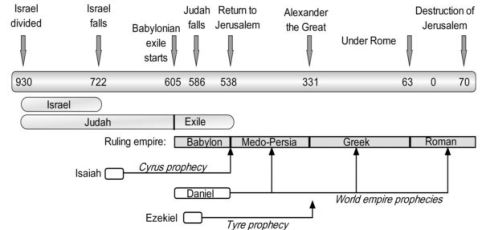
Time line from divided Kingdom to destruction of Jerusalem
Text and illustrations reproduced from the study “Job”. The original PDF is the reference copy.