
Is it Immersion, pouring over or Sprinkle On
Baptism - Is it Immersion, Pouring over or Sprinkle On?
Topical Bible Studies
BibleWay Publishing‘s objective is to make Bible lessons available to anyone interested in learning more about God and His will. It is the non-profit Bible ministry of Randolph Dunn.
Lessons can be studied online, in classrooms, by Zoom, downloaded to a digital device, emailed, printed, or used by individuals, groups, or churches in their Bible educational ministry. Using these lessons by copying, downloading, emailing, or printing you agree not to alter, add, or replace the content of any lesson.
BWP recommends that you study your Bible to determine the accuracy of what is stated in these lessons or from any other source. Commentaries and teachings of preachers, ministers, pastors, priests, and rabbis are the authors’ understanding and are not equivalent to the inspired Bible.
You should always verify all comments, opinions, and teachings since it is YOUR responsibility to seek, know, and do the will of God.
To check the truth of any teaching, read different Bible translations, consult Bible dictionaries and lexicons to learn the meaning of unfamiliar words or phrases. Be careful accepting dictionary definitions, as word and phrase meanings change over time. Also, multiple Greek words have different meanings that can be translated into one English word which can distort the original meaning.
May you allow God to guide you in your study of His Holy Word, the Bible.
BWP.Topical@gmail.com
MUST BAPTISM BE DONE BY IMMERSING A PERSON IN WATER INSTEAD OF JUST SPRINKLING OR
POURING WATER ON THEM?
I think the answer is yes and these are some reasons why. The Greek word translated “baptize” means immerse. Baptism is from the Greek baptizo which always means to “dip”, “immerse”, or “submerge. Modern English dictionaries may give other definitions but this only reflects modern usage. This does not necessarily show what the word means in the language of the Bible. Greek dictionaries of Bible words show “baptize” means to immerse: Thayer's Lexicon on baptizo says: “to dip, immerse, submerge.” Strong’s Concordance defines baptizo, “to make whelmed i.e.: fully wet.” Lydell and Scott define it as “To dip, dip under.” Exponents of sprinkling overlook an important factor. The original New Testament text and the spoken language of that day was Greek. The authors of the New Testament knew the Greek word baptizo meant to immerse. They also knew the Greek word rantizo meant to sprinkle and the Greek word cheo meant to pour. These often used words were never interchangeable, having separate meanings. If God had intended for baptism to be sprinkling, the Greek word rantizo, or pouring, the Greek word cheo, He would have been employed them rather than immersion, the Greek word baptizo.
- The Bible Evidence
The best way to understand a Bible command is to study the passages that refer to it in context comparing them to other passages on the subject. This is how we learn the meaning of words. Notice what baptism requires and consider what action fits what the Bible says:
- Baptism requires water
The element or substance used is not inherent in the word “baptize.” The substance, though, used in the baptism that Jesus commanded everyone, is water.
- Acts 10:47-48 — “Surely no one can refuse the water for these to be baptized...”
- Baptism requires much water
- John 3:23 states, “And John also was baptizing in Aenon near to Salim, because there was much water there...” “Much water” is not needed if one is merely being sprinkled or poured, but it is necessary for immersion.
- In baptism people came to water.
- Acts 8:36 — “They came to some water.”
- Matthew 3:5-6 — “Then Jerusalem was going out to him, and all Judea, and all the district around the
Jordan; and they were being baptized by him in the Jordan River, as they confessed their sins.”
Some people think the eunuch pulled out a bottle of water and Philip used some of it to baptize him. Not so! The water used to baptize the eunuch was a body of water they came to as they traveled. When people receive sprinkling or pouring, do they need to go to the water? No, the water can come to them, because not much is required, but when people are immersed, they go to the water.
- Baptism involves going down into and coming up out of the water.
- Mark 1:9-10 — “It came to pass in those days that Jesus came from Nazareth of Galilee, and was baptized by John in the Jordan. And immediately, coming up out of the water, He saw the heavens opening, and the Spirit descending upon Him” (NKJV reads ‘like a dove).
- Acts 8:38-39 reads, “...and they both went down into the water, Philip as well as the eunuch; and he baptized him. And when they came up out of the water...”
Here the obvious reference is to immersion. Does sprinkling or pouring require going down into the water? No, but baptism does.
- Baptism is a burial and a resurrection.
- Colossians 2:12 — “... buried with Him in baptism, in which you were also raised with Him through faith in the working of God, who raised Him from the dead.”
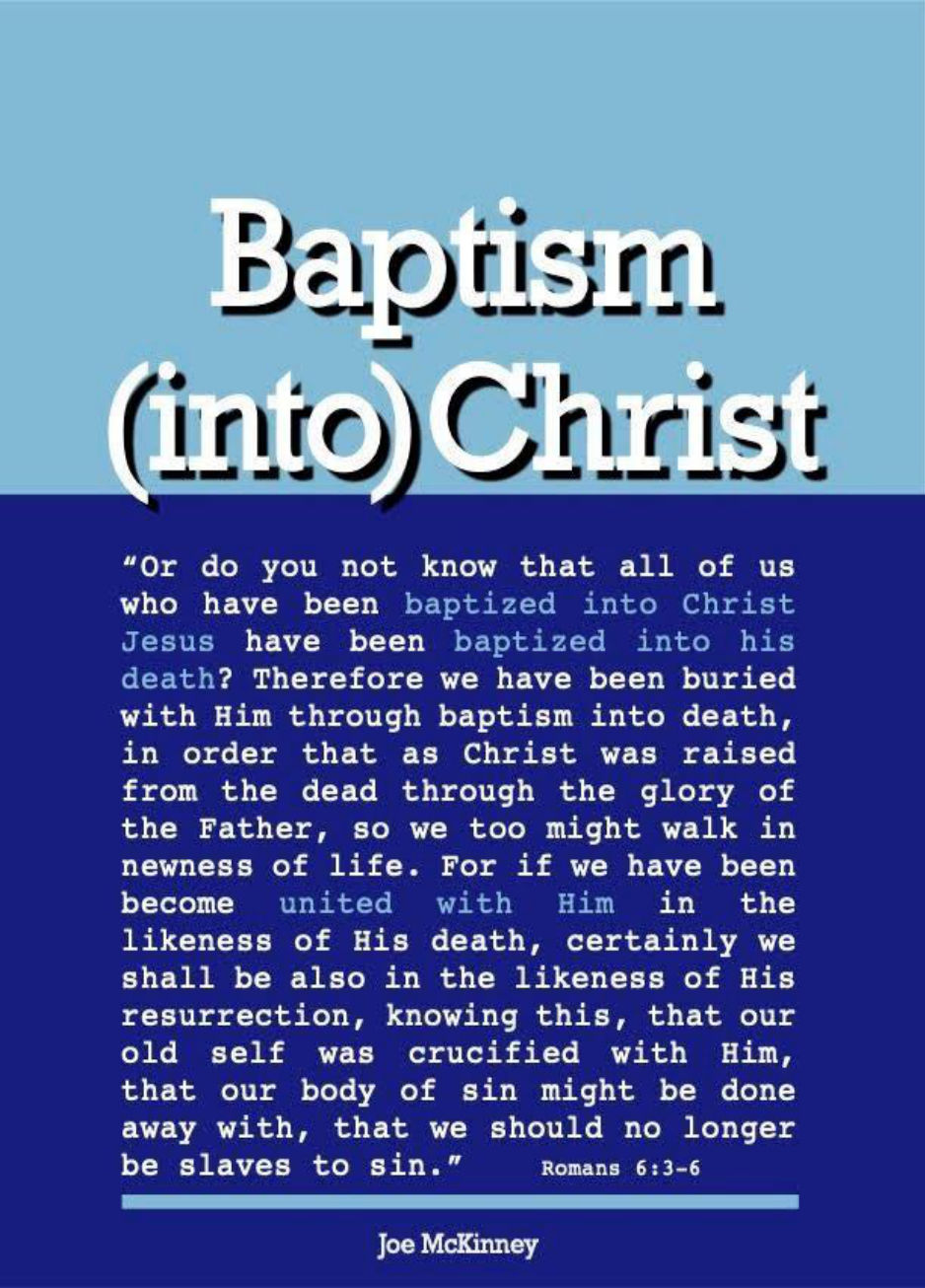
- Romans 6:4-5 — “Therefore we have been buried with Him through baptism into death, in order that as
Christ was raised from the dead through the glory of the Father so we too might walk in newness of life. For if we have become united with Him in the likeness of His death, certainly we shall be also in the likeness of His resurrection.”
In baptism, we are buried with Jesus and raised with Him. As He was buried in the earth, we are buried in baptism.
Some say baptism is “just a symbol” of Jesus' burial, so it does not matter how it is done. There is a symbolic element in baptism, but how does that prove that the action does not matter?
Do the passages say Jesus was buried, but it doesn't matter whether or not we are buried? It says we are buried and we are raised in baptism. The one to be baptized is to be buried and raised.
Actually, symbols are important, especially, when it was God Himself who selected the symbols. Who would presume to change what God wanted?
Obviously, death, burial and resurrection in baptism is something that God wants us to know and be reminded of by the symbolic action that He chose for us to do. See Romans 6:1 — 12 and see how important and practical it is for the Christian to be reminded that he died with Christ in baptism. “What shall we say then? Shall we continue in sin that grace might increase? May it never be! How shall we who died to sin live in it? Or do you not know that all of us who have been baptized into Christ Jesus have been baptized into His death? Therefore, we have been buried with Him through baptism into death, in order that as Christ was raised from the dead through the glory of the Father so too might walk in newness of life. For if we have become united with Him in the likeness of His death, certainly we shall be also in the likeness of His resurrection, knowing this, that our old self was crucified with Him, that our body of sin might be done away with, that we should no longer be slaves of sin. For he who has died has been freed from sin. Now if we have died with Christ, we believe that we shall also live with Him, knowing that Christ, having been raised from the dead, is to never die again; death no longer is master over Him. For the death that He died, He died to sin, once for all; but the life that He lives, He lives to God. Even so consider yourselves to be dead to sin, but alive to God in Christ Jesus. Therefore, do not let sin reign in your mortal body, that you should obey its lusts.” (Romans 6:1-12) Is There A Certain Formula Of Words That Must Be Spoken When One Is Baptized?
I do not believe there is such a formula and here are the reasons why:
- Some say: “I baptize you in the name of the Father, the Son, and the Holy Spirit”
- Some say: “I baptize you in the name of Jesus.”
- Some add to these: “for the remission of sins” or “for the remission of sins and to receive the gift of the Holy
Spirit.”
- Some even baptize the person three times, once “in the name of the Father”, again “in the name of the Son” and finally “in the name of the Holy Spirit.”
- Some do not believe that it is required to say anything special, as long as the person being baptized understands what they are doing and why they are being baptized.
- Does doing something in the name of another require repeating a formula using that person’s name?
- The apostles could not cast out demons, heal the sick, or do other miracles except in the name of Jesus but Peter sometimes omitted saying this formula (Acts 9:40).
- Christians pray in the name of Jesus but did not always repeat this formula (Acts 4:23-30).
- Preaching is done in the name of Jesus (Luke 24:46, 47) but this doesn’t mean that these words always have to be repeated for the preaching to be valid.
- All we do, we do in Jesus’ name (Colossians 3:17) but this doesn’t mean the words must always be repeated.
- Actually, the scriptures do not teach that a certain formula of words must be said when one is baptized.
- No single identical formula was given in examples of Bible baptisms:
- Matthew 28:19 — “in (eis into) the name of the Father and of the Son and of the Holy Spirit”
- Acts 2:38 — “in (epi upon ) the name of Jesus Christ”
- Acts 8:16 — “in (eis into) the name of the Lord Jesus”
- Acts 10:48 — “in (en in) the name of the Lord”
- Acts 19:5 — “in (eis into) the name of the Lord Jesus”
- Some ideas about what “in the name of” means:
- Thayer: “by one’s command and authority, acting on his behalf, promoting his cause.”
- Pulpit Commentary: “into the power ... influence ... faith ... family of”
- International Critical Commentary: “by way of consecration to”
- W F. Flemington: “into the ownership of”
Questions
Answer each question, then submit your work to your instructor for grading.
Text and illustrations reproduced from the study “Is it Immersion, pouring over or Sprinkle On”. The original PDF is the reference copy.