
Spiritual Milk
Joe McKinney
INTRODUCTION
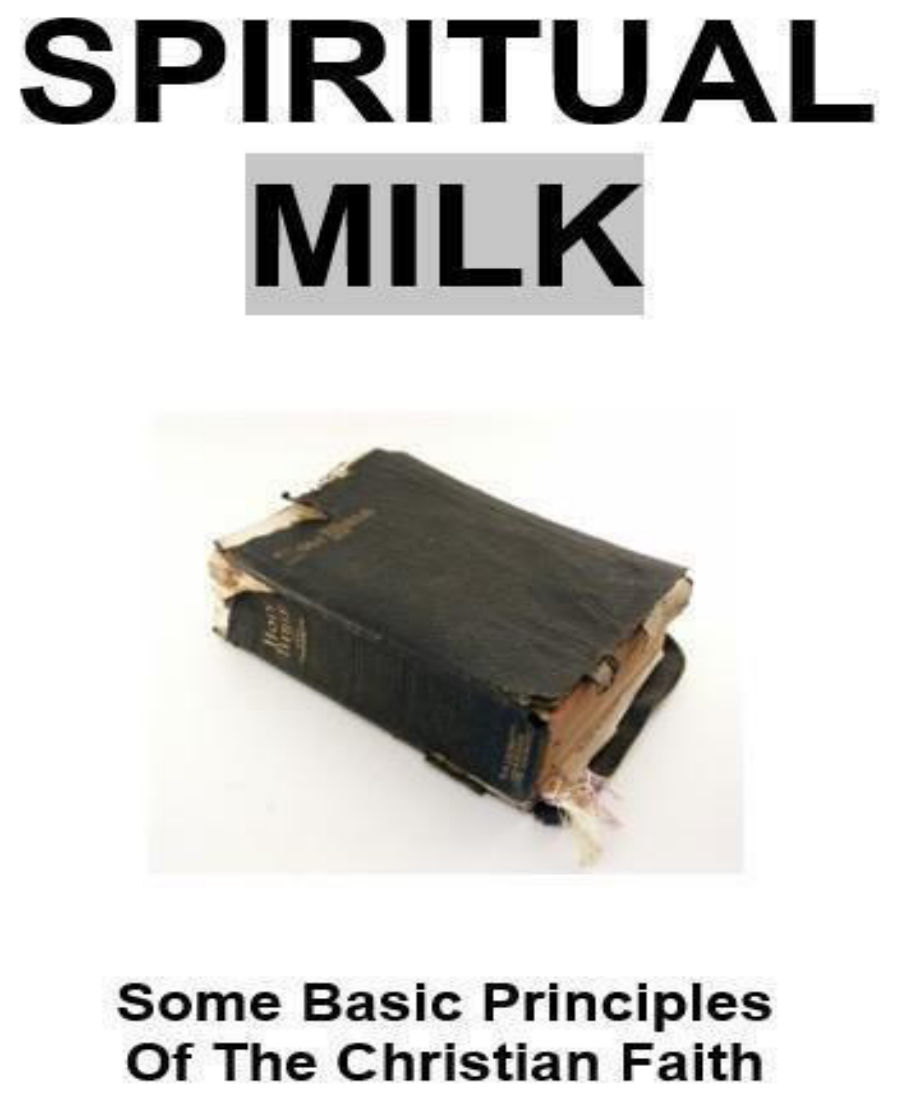
These lessons are called “Spiritual Milk” because they were written for new Christians or new babes in Christ. They compare the needs and growth of a new Christian to those of a newborn baby. There are five basic stages in the development of a newborn and the sequence of the lessons follows this progression.
Like a newborn baby soon after its birth starts seeking the mother’s breast to feed, as a newborn Christian, you need to feed yourself with the Word of God. Before understanding theology and doctrines; before knowing how to crawl or walk; even before understanding the importance of nutrition to your health, you need spiritual nutrition. It comes from the Word. Lesson 1.
The newborn baby leaves his mother’s womb to enter into a new world. This can be a big shock but there is no turning back. He can never return to his mother’s womb. The same thing happens to the new Christian. The change of life is radical and there is no return. You need to understand the nature of your new life in Christ in order for you to assume your new identity. Who are you now that you’ve been born of the water and of the Spirit? Lessons 2, 3 and 4
It is not considered normal when a child is born but does not grow. If he does not grow mentally, he is called retarded. If he does not grow physically. he is called a dwarf: But if you don’t develop your Christian life, you’re going to die! God tells us how to grow spiritually. Lesson 5
When a baby is born, being a newborn, he starts to be fed and to be cared for almost exclusively by his mother, receiving much more than he contributes. But there comes the time when he is going to assume his place in the family. He starts eating at the table with the others, building relationships, accepting responsibilities and fulfilling duties. All this is part of his development. You also, as a new Christian, need to take your place in the family of God, the church. Lessons 6, 7, 8 and 9. Living beings multiply themselves. The child that was generated from the love of his parents grows and soon the day arrives to repeat the process. God said to Adam and Eve: "Be fruitful and multiply." We are here today because of this blessing from God. In the spiritual life the command is also "Be fruitful and multiply." You were born and live with the purpose of reproducing yourself spiritually. Disciples are to make disciples. Lesson 10
The rest of these studies – Lessons 11, 12, 13, 14, 15 and 16 are designed to provide some additional practical information you will need as you progress in your Christian life. May God bless you and guide you in the greatest blessing and challenge of life - living the Christian life.
FIRST STAGE– YOU NEED SPIRITUAL NUTRITION
Lesson 1 "WERE YOU BORN? IT’S TIME TO EAT!"
"As newborn babes, desire the pure milk of the word, that you may grow thereby if indeed you have tasted that the Lord is gracious.” I Peter 2:2-3 Like a newborn baby soon after its birth starts seeking the mother’s breast to feed, as a newborn Christian, you need to feed yourself with the Word of God. Before understanding theology and doctrines; before knowing how to crawl or walk; even before understanding the importance of nutrition to your health, you need spiritual nutrition. It comes from the Word. So, start now. Do not wait even a single day. Take the Bible and start your daily nourishment. Here are some suggestions to help you get started.
LISTEN TO THE WORD
Do not miss the meetings of the church and, when you attend, pay attention to the sermons and Bible classes. Always have pen and paper with you to make notes. You may need to review them at home and get together with someone to clear up any doubts. Be diligent in doing this. Be like that newborn baby that sometimes acts as though it is dying of hunger! And of course, you will never want to arrive at the church meetings without your Bible.
READ THE WORD
Read the entire Bible in one year. There are printed plans where you can record each chapter you’ve read. By reading three chapters a day and five on Sundays, you will read the whole Bible in one year! This will give you a general survey of the Bible. Since it is a reading and not an intensive study, it may be helpful to use an “easy-toread” version of the Bible. For deeper studies use a more literal translation like NKJV or NASB
STUDY THE WORD.
Pray, asking God for understanding. Let God's Holy Spirit speak to you through His Word. Instead of studying what somebody else thinks about some passage, read for yourself in the words that the Holy Spirit directed to be written. Read directly from the Bible. This will be your own personal study.
Follow a system of study. It’s not wise to open blindly to just anywhere in the Bible and start studying without thinking about the context. The diligent student is always building on what he has already learned. So study a book, a chapter, or some Bible topic.
Take notes of your thoughts, questions, doubts and reflections during your study. Keep a special notebook to do it in. All of us know that a good thought, a special perception or a new understanding is easily forgotten. Write down the results of your studies.
Think about the following questions and make notes of the answers in your study notebook: What does this word mean? Analyze verse by verse. Define the difficult words. Take note of a reference to a parallel passage. Make an outline of the paragraph.
What don’t I understand? Write your doubts and questions. Many of your doubts will become clear as you study other parts of the Bible.
What is the summary of this passage? Be brief.
Choose some verses to memorize. Without a doubt, Jesus did this. Make a list of the memorized verses to review them frequently.
Meditate on what you’ve studied. This is a very important step. Meditation is what will give depth to your study of the Word. It doesn’t mean a method of meditation like some Eastern religions use (transcendental meditation, for example), but simply that you reflect, think, apply and analyze what you’ve learned in the Word.
MAKE A PERSONAL APPLICATION OF THE WORD.
Apply the lesson to yourself, asking about each passage: Is there some example I can follow? Is there something that I must avoid? Is there a commandment that I should obey? Is there a promise that would prove beneficial? What does this passage teach about God or Jesus? Is there some difficulty to be examined? Is there something that I should pray about? What will help me with my problems?
SHARE THE WORD
Choose somebody and share with him some significant truths that you are learning in your studies. This serves for his edification and more. When you express to others what you’ve studied, then this knowledge becomes your own personal property.
PRACTICE THE WORD
As James wrote, "Be doers of the word and not hearers only, deceiving yourselves." (James 1:22) The true knowledge of the Word of God comes when you put into practice what it teaches. Be like the wise man that built his house on the rock instead of on the sand. (Matt. 7:24-28)
A SUGGESTION
Choose a commandment, attribute or biblical principle each week to practice. Write this in your study notebook and day by day, look for opportunities to practice what the word is teaching you. This way the Word of God becomes the Living Word in you.
MEMORIZE:
II Timothy 3:16, 17. All Scripture is given by inspiration of God, and is profitable for doctrine, for reproof, for correction, for instruction in righteousness, that the man of God may be complete, thoroughly equipped for every good work. Questions
- As a newborn Christian are you feeding on God’s word?
True
False
- How does one learn what God desires of them?
Study the Bible
Study with other Chrisians
Both
- A diligent student is always increasing his knowledge of God’s word by determining if there are other scriptures about the subject being studied.
True
False
- A good student must understand the meaning of words in their context in order to understand what God has stated in His message to them.
True
False
- How does one make application of God’s word
Follow Biblical examples
Avoid teachings and actions condemmed in the Bible
Search for commands to obey
Learn the promises of God
Examine difficulies to get a better understanding
Pray
All the above
SECOND STAGE - UNDERSTAND YOUR NEW IDENTITY
Lesson 2
YOUR BODY IS NOW THE TEMPLE OF THE HOLY SPIRIT OF GOD. The newborn baby leaves his mother’s womb to enter into a new world. This can be a big shock but there is no turning back. He can never return to his mother’s womb. The same thing happens to the new Christian. The change of life is radical and there is no return. In fact, whoever thinks about going back should know that for the ones who return to the old life after having been born again in Christ, “the latter end is worse for them than the beginning." (II Peter 2:20-22).You need to understand the nature of your new life in Christ in order for you to assume your new identity. Who are you now that you’ve been born of the water and of the Spirit?
"...therefore, if anyone is in Christ, he is a new creation; old things have passed away; behold all things have become new." II Corinthians 5:17 "Therefore. we were buried with Him through baptism into death, that just as Christ was raised from the dead by the glory of the Father, even so we also should walk in newness of life" - Romans 6:4
YOUR BODY WAS PURCHASED BY JESUS CHRIST
Read 1 Corinthians 6:12-20 and notice the following:
Your physical body now has a divine purpose - vv12, 13. Think about this: the purpose of a suitcase is to carry clothes and the purpose of a stove is to cook food. So, what do you do with the suitcase and stove? Sweeping the floor with the suitcase, or playing games on the stove would not be the correct use for these things. It is the same with your body now that it belongs to the Lord and is to be used for His purposes.
Your body is so important that, someday, God will raise it from the dead - v14. All who have the Holy Spirit living in them have the guarantee that they will be raised to the glory of God. The Bible says "you were sealed with the Holy Spirit of promise, who is the guarantee of our inheritance until the redemption of the purchased possession, to the praise of His glory" (Ephesians 1:13-14). You have a guarantee from God that He will not leave your body in the grave, but, in the resurrection, you will receive a glorified body, no longer subject to pain, sickness, loneliness or sorrow. You will have a body suitable for the good things of life: joy, happiness, immortality, peace and eternal fellowship in Heaven with Jesus, God and all His other sons.
Your body is a member of the Lord - v15. If you had the power to control the legs, the arms, the eyes or the hands of Jesus, what would you do with them? Would you carry them to indecent places? Would you expose them to pornography? Would you participate in filthy habits? Would you commit immoral acts? Would you smoke? Would you drink? Would you take drugs? Would you hurt these members of His body? Would you kill them? Of course not! Even so do not treat your body, which is a member of Christ’s body, in this way.
Your body is a sanctuary of the Holy Spirit of God - v19. God’s sanctuary is a place for worship to take place in a spirit of reverence and dedication.
Your body is not yours. - Vvl9-20. You are only a caretaker (steward, administrator) of God’s belongings and not the owner so always ask yourself: "What does God want me to do with this body of His?"
"I live in a house. It’s not a perfect house. It has its good points and bad points but in spite of everything, I like it. I’ve lived in it for so long that I’ve grown accustomed to it. Some time ago, the richest, purest, most generous, kindest and most wonderful man in the world bought my house. He paid a high price for it - more than it was worth - so, evidently, he wanted it very much. He bought it but did not evict me from it. In fact, He came to live in the house with me. I have to confess that it is great to have him in the same house with me, but I also have to confess that I had to make some changes. Now, I feel the need to take better care of the house, to keep it clean and to never do anything that he disapproves of because he bought it - the house belongs to him. It’s not mine anymore." It’s obvious that this house is my body. Jesus bought it and came to live in it with me, through the Holy Spirit. Now I want to use it as He wishes because He is the owner and I am the tenant. Now, before doing anything, speaking any word, thinking any thought, or participating in any activity, I want to ask: "Is this the right thing to do with the body that belongs to Jesus?"
QUESTIONABLE USES OF GOD’S TEMPLE
Sometimes it’s hard to decide if a certain activity is prohibited or allowed. Even among religious people, there are big differences of opinions about certain things. For example dancing, drinking alcoholic beverages, smoking, watching TV, playing football and other sports, playing cards, going to the movies, going to the swimming pool, playing the lottery, working in a bar, wearing a miniskirt, voting in the elections, being a politician, listening to certain music, using drugs, getting married to an unbeliever, being in the military, etc.
We don’t find specific rules about these things in the Bible. It’s not always enough to just look for a simple prohibition or permission in the Bible. The Bible often teaches by principles instead of rules and regulations. Here are some thoughts, then, that you might want to consider before taking part in some activity:
Decide, first of all, that you are going to do God’s will, before even knowing what His will is. (Read John 7:17.) Ask yourself honestly:
- "What is the desire of my heart? To please God or please myself?" (See Matthew 6:33 and Romans 12:1, 2.)
- Does the Bible have some clear instruction or teaching about this activity?
- Will this activity force me to have some association that could corrupt me by its influence? (I
Corinthians 5:13)
- Is this activity unnecessarily harmful to my health? (Romans 12:1; I Corinthians 10:31)
- Is this activity going to hinder me in fulfilling my responsibilities as a Christian? (II Corinthians 6:1418)
- Can this activity damage my influence as a Christian before others? (Romans 12:2; I Corinthians 8:7-13; 10:23-38; II Corinthians 7:1; Titus 2:12)
- Could this activity cause my brother to stumble (to fall into sin)? (Romans 14)
- Do I have doubts about this activity? If I do it, would I be acting against my own conscience? (Romans 14:23)
- What would Jesus do in my place? (I Peter 2:21)
Questions
Answer each question, then submit your work to your instructor for grading.
Text and illustrations reproduced from the study “Spiritual Milk”. The original PDF is the reference copy.