
Reform? or Restore?
Randolph Dunn
Reform?
or
Restore?
Chapter 1 Reformation Movement The Renaissance 1517 – 1648 AD
Between 1118 and 1518 the Catholics and the German Emperor took turns (depending on who was in power) martyring Christians as they were discovered. About 4,000 (throughout Central Europe [including Alsace Lorraine in central Germany]) died as a result of persecution during these four centuries. Thus, these churches in Alsace Lorraine are partially responsible for the influence that led Martin Luther to break from Catholicism. Luther likely never heard of their teachings, however, he objected to the way the Christians were murdered by the Catholic Church. In fact, Luther was even suspected by Catholicism of being “in close connection with the heretical churches in Alsatia, (a region of Alsace).” Nevertheless, the Anabaptist churches in Europe faced persecution from both Catholics and Protestants.
The Renaissance popes were notoriously worldly. Abuses such as simony, nepotism, and financial excesses increased. The Catholic Church was riddled with venality [capable of being obtained for a price] and immorality. The sale of Indulgences was a particularly unfortunate practice because it impinged upon true spiritual repentance and improvement of life. At the same time, a genuine upsurge of popular religiosity manifested itself and increased the disparity between the people's expectations and their ability to satisfy spiritual needs.
Martin Luther (1483- 1546)
Martin Luther's spiritual predecessors included men such as John Wycliffe (1328-1384) and Johannes Hus (1369- 1415), who had attempted to reform the [Catholic] church along similar lines. In 1517 Luther nailed his Ninety Five Theses to the door of the All Saints' Church, in Wittenberg which served as a notice board for university related announcements.[1] These were points for debate that criticized the Church and the Pope. The most controversial points centered on the practice of selling indulgences and the Church's policy on purgatory.
en.wikipedia.org/wiki/Protestant_Reformation
In 1520, Luther published three pamphlets that
- Described Rome's abuses
- Demanded reforms in morals and in dogma
- Attacked some of the sacraments, transubstantiation, and worship of the saints
- Insisted that the Bible alone constituted the final authority for a Christian.
therestorationmovement.com/lessons/chlesson03.htm
1 Refer to thebiblewayonline.com study Silence of the Scripture.
Luther espoused 1 -- "What is not against Scripture is for Scripture, and Scripture for it." REFLECTIONS by Al Maxey Issue #401, June 30, 2009 from wikisource.org/wiki/AnteNicene
_Fathers/Volume_III//Apologetic The_Chaplet, _or_De_Corona/Chapter_II
Luther was a threat [at least in Germany]. When he founded his “church” in 1520, Catholics knew they had a problem. The Anabaptist churches were mistakenly lumped together with them. Catholics were running scared, and killing everyone (Christian and protestant alike). Catholics were no longer satisfied with killing Christians as they were accidentally found; now they were actually hunted. In AlsaceLorraine alone, out of nearly 100,000 members, about 42,000 were burned for not renouncing Christianity in favor of Catholicism. This massacre occurred from about 1525 to 1536. Circumstances were similar everywhere. By 1595, The Christians in
Alsace Lorraine numbered merely 1,000. Most congregations had been extinguished. Congregations in Moravia, though severely depleted in membership, managed to flee to Hungary, Poland, Ukraine, and Crimea. By 1799,
Eulogius Schneider (a catholic priest) beheaded the last three martyrs for not participating with Napoleon in the French Revolution. (adapted from allexperts.com/q/Critics-Catholicism-3337/Questions-1.htm Marvin Howard)
The result was the near extermination of the church in Europe.
Ulrich Zwingli (1484 –1531)
The Reformation in Switzerland initially developed in Zurich under the leadership of the priest Ulrich Zwingli. Zwingli had been influenced by Erasmus and by Christian humanism. He arrived at an evangelical understanding of Christianity from his study of the Bible and from contacts with Lutherans. On Jan. 1, 1519, he began a 6-year series of sermons on the New Testament that moved the city council and the people of Zurich toward reform. The favorable response to The Sixty-Seven Articles, which he prepared for a public disputation with a papal representative in 1523, proved the popularity of his program. He called for the abolition of the Mass (and its replacement by a symbolic Lord's Supper), independence from episcopal control, and a reform of the city-state in which both priests and Christian magistrates would conform to the will of God. mb-soft.com/believe/txn/reformat.htm
He attacked the custom of fasting during Lent, corruption in the ecclesiastical hierarchy, promoted clerical marriage, and attacked the use of images in places of worship. en.wikipedia.org/wiki/Huldrych_Zwingli
Zwingli maintained that anything 2 "not enjoined or taught in the New Testament should be unconditionally rejected." REFLECTIONS by Al Maxey Issue #401, June 30, 2009 taken from http://en.wikisource.org/wiki/AnteNicene_Fathers/ Volume_III/Apologetic/The_Chaplet,_or_De_Corona/Chapter_II
Radical Reformation
Beginning in Switzerland and Germany, the Radical Reformation birthed many Anabaptist groups throughout Europe. Historically, the radical reformers operated under several names.
Brethren or Swiss Brethren – were a group of radical evangelical reformers who initially followed Ulrich Zwingli of Zürich, but later started the movement now known as Anabaptism. In 1525, Felix Manz, Conrad Grebel, George Blaurock, and others formed a new group, which rejected infant baptism and preached what the Brethren claimed was true Christianity. Based on Sola Scriptura [scripture alone], the Swiss Brethren declared that since the Bible does not mention infant baptism, it should not be practiced by the church. This was subsequently refuted by Ulrich Zwingli. Consequently, there was a public dispute, in which the council affirmed Zwingli's position. This crystallized the Swiss Brethren and resulted in their persecution by all other reformers as well as the Catholic Church.
It is important to note that the Anabaptists were first persecuted by the Protestants under Zwingli. They had arisen on his watch, in his town, and were his former disciples. Perhaps he was afraid that the existence of several rival versions of Protestant would irreparably harm his chances of accomplishing any reform. Perhaps...
but nothing can justify his actions. He had the magistrate's ear; he was in charge of Reform. The council declared that rebaptizing was a capital crime, so let's enforce it.
Felix Manz became the first Anabaptist martyr in 1527, ten short years after Luther had nailed up his theses. He was drowned in the river right in the middle of Zurich. Other Anabaptists were beaten or banished. These became standard practices in Protestant territories.
Because of persecution by the authorities, many of these Anabaptists moved from Switzerland to neighboring countries. Some of the Swiss Brethren became known as Mennonites after the division of 1693, a disagreement between the Jacob Amman and Hans Reist groups. en.wikipedia.org/wiki/Swiss_Brethren
Mennonites - an Anabaptist denomination named after the Frisian, Menno Simons (1496–1561). The teachings of the Mennonites were founded on their belief in both the mission and ministry of Jesus
2 Refer to thebiblewayonline.com - Silence of the Scripture.
Christ, which they held to with great conviction despite persecution by the various Roman Catholic and Protestant states. Rather than fight, the majority survived by fleeing to neighboring states where ruling families were tolerant of their radical belief in adult baptism. en.wikipedia.org/wiki/Mennonite Hutterites – share a common ancestry with the Anabaptists, along with the Mennonites and Amish and as would logically follow, share many of the same beliefs and doctrine. Hutterites differ in one major aspect: they believe in sharing their possessions in common as demonstrated by Christ and His Apostles and as later further refined and described in the Book of Acts. hutterites.org/HutteriteHistory/index.htm
Amish - The Amish movement descends from the 16th century fellowship known as the Swiss Brethren or Anabaptists, and part of the Radical Reformation. Anabaptist means "one who baptizes again"; a reference to those who had been baptized as infants, but later adopted a belief in "believer's baptism" and therefore were baptized as believing adults. The Amish movement takes its name from Jakob Ammann (c1656 —c1730), who believed Mennonites were drifting away from the teachings of Menno Simons and the 1632 Mennonite Dordrecht Confession of Faith. The Amish like the Swiss Anabaptists were scattered by persecution throughout Alsace. wikipedia.org/wiki/Amish#History
But these Radical Reformers or Anabaptists referred to themselves as: Brethren and Believers and Christians.
In 1524, when the disputations at Zurich were still very recent, Balthasar Hubmaier (living in Catholic territory) published several articles representative of his theology. Those below are taken from Estep: 1. Faith alone makes us holy before God. 2. This faith is the acknowledgment of the mercy of God which he has shown us in the offering of his only begotten son. This excludes all sham Christians, who have nothing more than an historical faith. 3. Such faith cannot remain passive but must break out to God in thanksgiving and to mankind in all kinds of works of brotherly love. Hence all vain religious acts, such as candles, palm branches, and holy water will be rejected. 4. Those works alone are good which God has commanded us and those alone are evil which he has forbidden. 5. The mass is not a sacrifice but a remembrance of the death of Christ. Therefore, it is not an offering for the dead or for the living... 6. As often as the memorial is observed should the death of the Lord be preached in the language of the people. . . 7. As every Christian believes for himself and is baptized, so each individual should see and judge by the
Scriptures if he is rightly provided food and drink by his pastor. ritchies.net/p4wk4.htm.
In February 1527 Michael Sattler, a Swiss Anabaptist, and others put forth the Schleitheim Confession. Its main points were:
- Baptism was to be administered to believers only. Infant baptism, "the greatest and first abomination of the pope," is not to be practiced.
- The "ban" [excommunication or withdrawal] should be observed by local churches against those who fall into sin, after a first and second private warning.
- The bread and wine should only be broken with baptized believers, and no others.
- True Christians should be separated from the world system, including its "church attendance", oaths, the sword, etc.
- There should be shepherds among the flock, who will preach, etc., and will be supported by the church. If a pastor is taken from the flock, another should be ordained in his place.
- The "sword," i.e., the magistracy or rulership, is outside of Christ's perfection and is to be left to the world to exercise. Christians should not exercise self-defense nor become magistrates, nor use the secular sword against spiritual offenses [government persecuted for being in the wrong religion].
- Christians should not make an oath, but let their yes be yes and their no be no. ritchies.net/p4wk4.htm
On May 20, 1527, Michael Sattler, the author of the Anabaptist Schlietheim Confession, was executed by Catholic authorities. Even though the Catholic King Ferdinand had declared drowning (the "third baptism") the best antidote to Anabaptism. Sattler had been sentenced to have his tongue cut out, his flesh cut with hot irons, and then to be burned at the stake. Others were burned or drowned by Catholic authorities. Burning seems to have been favored by Catholics, less by Protestants.
In addition to the above, Protestant and Catholic nations alike resorted to torture and other forms of abuse. Estep estimates that thousands died in Europe in the sixteenth century, but hard numbers will never be available. ritchies.net/p4wk4.htm
In summary, we see for over 400 years a few people scattered over Europe had a desire to use scripture alone and return to God; i.e.:
- Waldensians – around 1179
- Albigenses
- around 1200
- Wycliffe
- 1328 - 1384
- Hus
- 1372 - 1415
- Chelčický
- 1374 - 1460
- Luther
- 1483 - 1546
- Zwingli
- 1484 - 1531
- Radical Reformers
- 1525
Another thing in common was that they were all persecuted. But that should not be any surprise for Jesus told his disciples: This is my command: Love each other. If the world hates you, keep in mind that it hated me first. If you belonged to the world, it would love you as its own. As it is, you do not belong to the world, but I have chosen you out of the world. That is why the world hates you. Remember the words I spoke to you: 'No servant is greater than his master.' If they persecuted me, they will persecute you also. If they obeyed my teaching, they will obey yours also. They will treat you this way because of my name, for they do not know the One who sent me. (John 15:17-21) Another reformer appears. One who did not use scripture alone for his doctrine but adopted those of the Augustine.
John Calvin (1509-1564)
Calvin was known at the University of Paris as “The Accusative Case” because of his critical, fault-finding attitude. He changed from the study of law to theology at his father’s wish. Influenced by the humanists Erasmus and Lefevre, he began to study the Bible and Luther’s writing. Sometime later, probably in 1533, he had a “conversion experience” and began his religious career. In 1534 he left France due to persecution.
In 1541 he returned to Geneva where he became very powerful. “Virtually every breath and every heartbeat of its citizens was controlled by Calvin. Calvin was guilty of inflicting horrible tortures on those who opposed him. The most notorious case of this was Servetus, against whom Calvin served as a prosecutor.
Servetus was condemned to death by slow burning. Calvin claimed to have sought to change the form of execution, but there is not a shred of evidence to show this, either in the minutes of the trial or elsewhere. He also accused a number of opponents of treason and put them on the rack [an engine of torture, consisting of a large frame, upon which the body was gradually stretched until, sometimes, the joints were dislocated (dictionary.die.net/to put to the rack)] to obtain proof of his accusations. To be fair, it should be pointed out that the Protestants were only following the age-old example of the Catholic Church in using civil power to enforce spiritual principles. Calvin ruled with an iron hand until his death.” “Ism’s” Calvinism, REW, pages 9-12
Calvin’s Institutes of the Christian Religion 3 reveals his theology. They did not originate with Calvin but merely systematized, arranged and developed by him. He borrowed frequently from Augustine, and Augustine had borrowed from Ambrose and other church Fathers. 4 No doubt the Fathers were influenced by the Gnostic heresy and even by the old Persian concepts of matter being inherently evil within itself. Calvin built his system upon the foundation laid by the earlier reformers, especially Luther
3 Refer to thebiblewayonline.com study - Institutes of the Christian Religion. 4 Refer to Augustine’s Thinking and Beliefs page 31.
and Bucer, and others but his peculiar gifts of learning, of logic, and style made him pre-eminently the outstanding theologian of the Reformed movement. Underlying the whole system was the dominant thought of the infinite and transcendent sovereignty of God, to know whom man’s supreme end is.
But not like prior reformers who desired to rely only on the Bible Calvin wrote his own doctrines in Institutes of the Christian Religion which are summarized below and are discussed individually later.
Sovereignty - God is ultimate; therefore, His will is ultimate and final. Unconditional election - According to His sovereign will He foreordained all things. He foreordained sin itself. He did this for His own glory. To further enhance His own glory, He predetermined that of sinners, He would save some and condemn others. He did this according to His own will so that it has nothing to do with anything men do.
Limited Atonement - For His elect, God has provided atonement and salvation through the blood of His Son Jesus Christ.
Total hereditary depravity - The problem is that through Adam's sin, his nature was corrupted, and this nature has been passed down to his descendants.
Irresistible grace - Having this corrupt nature, men cannot come to the knowledge of God by themselves. Even the elect cannot respond to God, cannot have faith, until the Holy Spirit opens their hearts to believe and understand. The grace of God, exerted in behalf of His elect, and, according to His sovereign will, cannot be thwarted.
Perseverance of the saints - The elect will be saved. His grace will sustain the elect and will not be removed so that they cannot be lost. Their salvation is sure.
Jacobus Arminius (1560-1609)
England had to some extent held Arminianism views. But Arminianism was started by Jacobus Arminius who was taught by Calvin’s son-in-law. Unable to defend the Calvinistic beliefs he rejected his Calvinistic background and sought to modify Calvinism so that “God might not be considered the author of sin, nor man
an automation in the hands of God.” His modified beliefs caused much controversy among the Calvinists in Holland.
“His followers faced persecution from Calvinists; 200 pastors lost their posts, statesman John van Olden Barneveldt was beheaded, Hugo Grotius was imprisoned for life but escaped two years later. By 1635 the persecution had waned and followers began to return to Holland once again.
They spread a principle of toleration throughout the churches in Holland so that there was much more religious toleration.” Adapted from “selected quotes taken from The Moody Handbook of Theology by Paul Enns”.
The Reformation sought, at least in some measure, to redirect the focus away from such legalistic ritualism, reintroducing the people to the joy of relationship with the Father by grace through faith, apart from such restrictive regulation. In 1647, for example, the Westminster Assembly completed and adopted the Westminster Larger Catechism, which was a rather lengthy list of 196 questions and responses helping to define the significant aspects of one's faith and practice. Question #180 "What is it to pray in the name of Christ?" In the response it is noted that our Lord's injunction is NOT complied with "by bare mentioning of His name, but by drawing our encouragement to pray, and our boldness, strength, and hope of acceptance in prayer, from Christ and His mediation." (Adapted from REFLECTIONS by Al Maxey Issue #405- July 27, 09)
Chapter 2
Restoration Movement
1648 – 1849 AD
The Reformation Movement ended and the Restoration Movement began with a series of religious wars that culminated in the Thirty Years' War. From 1618 to 1648 the Catholic House of Habsburg and its allies fought against the Protestant princes of Germany, supported at various times by Denmark, Sweden and France. The Habsburgs, who ruled Spain, Austria, the Spanish Netherlands and much of Germany and Italy, were staunch defenders of the Catholic Church. Some historians believe that the era of the Reformation came to a close when Catholic France allied itself, first in secret and later on the battlefields, with Protestant states against the Habsburg dynasty.[1] For the first time since the days of Luther, political and national convictions again outweighed religious convictions in Europe.
The movement began as an attempt to reform the Catholic Church. Many western Catholics were troubled by what they saw as false doctrines and malpractices within the [Catholic] Church, particularly involving the teaching and sale of indulgences. Another major contention was the practice of buying and selling church positions (simony) and what was seen at the time as considerable corruption within the Church's hierarchy. This corruption was seen by many as systemic, even reaching the position of the Pope. en.wikipedia.org/wiki/Protestant_Reformation#Conclusion_and_legacy
While the Middle Ages saw some calls for a restoration of a primitive form of Christianity, such as John Wycliffe and John Hus, these groups were driven underground. As a result, it is difficult to find any direct links between the restoration movement and these earlier dissenters.[3]:13
For in 1229 Council of Toulouse in Canon 14 stated “We prohibit also that the laity should be permitted to have the books of the Old or New Testament; unless anyone from motive of devotion should wish to have the Psalter
or the Breviary for divine offices or the hours of the blessed Virgin; but we most strictly forbid their having any translation of these books. hol.com/~mikesch/banned.htm
Beginning with the Renaissance period [15th to 17th centuries] intellectual roots become easier to discern.[3]:11 At the heart of the Reformation there was an emphasis on the principle of "scripture alone" [one of Luther’s points ][3]:22-23 This, along with the related anti-traditionalism and insistence on the right of individuals to read and interpret the Bible for themselves, formed part of the intellectual background of early Restoration Movement leaders.[3]:32 Persecution did not end with the Reformation as clearly evidenced in Foxe’s Book of Martyrs.
In 1532, Thomas Harding, who with his wife, had been accused of heresy, was brought before the bishop of Lincoln, England and condemned for denying the real presence in the Eucharist Sacrament. He was then chained to a stake, erected for the purpose, at Chesham in the Pell, near Botely; and when they had set fire to the fagots [a bundle of sticks bound together for fuel], one of the spectators dashed out his brains with a billet. The priests told the people that whoever brought fagots to burn heretics would have an indulgence to commit sins for forty days.
Also, John Tewkesbury, a plain, simple man, who had been guilty of no other offence against what was called the holy Mother Church, than that of reading Tyndale's translation of the New Testament. At first, he was weak enough to adjure, but afterward repented, and acknowledged the truth. For this he was brought before the bishop of London, who condemned him as an obstinate heretic. He suffered greatly during the time of his imprisonment, so that when they brought him out for execution, he was almost dead. He was conducted to the stake in Smithfield, where he was burned, declaring his utter abhorrence of popery, and professing a firm belief that his cause was just in the sight of God.
Thus, were Christ's people betrayed every way, and their lives bought and sold. For, in the said parliament, the king made this most blasphemous and cruel act, to be a law forever: that whatsoever they were that should read the Scriptures in the mother-tongue (which was then called "Wickliffe's learning"), they should forfeit land, cattle, body, life, and goods, from their heirs forever, and so be condemned for heretics to God, enemies to the crown, and most arrant traitors to the land.
There are countless examples of unspeakable and unimaginable torture during this period of English history. Many people fled England for the New World to escape poverty and persecution.
Adapted from Foxe's Book of Martyrs
This policy of prohibiting the reading of the Bible other than by the priest was reaffirmed by the Council of Trent (1545-64) which placed the Bible on its list of prohibited books and forbade any person to read the Bible without a license from a Roman Catholic bishop or inquisitor. jesus-is-lord.com/nobible.htm
John Locke (1632 – 1704)
John Locke sought a way to address religious division and persecution without abandoning scripture.[3]:78 To do this, Locke argued against the right of government to enforce religious orthodoxy and turned to the Bible to supply a set of beliefs that all Christians could agree upon,[3]:78-79 that is to "reduce religion to a set of essentials upon which all reasonable persons might agree."[3]:80 The core teachings that he viewed as essential were: a. The messiahship of Jesus b. Jesus' direct commands.[3]:78-79
Christians could be devoutly committed to other Biblical teachings but, in Locke's view, they were nonessentials over which Christians should never fight or try to coerce each other.[3]:79 Unlike the Puritans and the later Restoration Movement, Locke did not call for a systematic restoration of the early church.[3]:79
John Wesley (1703 – 1791)
Wesley's contribution as a theologian was to propose a system of opposing theological stances. His greatest theological achievement was his promotion of what he termed "Christian Perfection", or holiness of heart and life. Wesley held that, in this life, Christians could come to a state in which the love of God, or perfect love, reigned supreme in their hearts. His evangelical theology, especially his understanding of Christian perfection, was firmly grounded in his sacramental theology. He continually insisted on the general use of the means of grace (prayer, scripture, meditation, Holy Communion, etc.) as the means by which God sanctifies and transforms the believer.
To be made perfect in love meant that a Christian could live with a primary guiding regard for others and their welfare. He based this on Christ's quote that the second great command is "to love your neighbor as you love yourself." In his view, this orientation would cause a person to avoid any number of sins against his neighbor. This love, plus the love for God that could be the central focus of a person's faith, would be what Wesley referred to as "a fulfillment of the law of Christ."
Wesley believed that the living core of the Christian faith was revealed in Scripture, and the Bible was the sole foundational source of theological or doctrinal development. … However, he believed that doctrine had to be in keeping with Christian orthodox tradition.
The doctrines which Wesley emphasized were prevenient grace, personal salvation by faith, witness of the Spirit and sanctification. [Prevenient grace is divine grace which precedes human decision. It exists prior to and without reference to anything humans may have done. As humans are corrupted by the effects of sin, prevenient grace allows persons to engage their God-given free will to choose the salvation offered by God in Jesus Christ or to reject that salvific offer. wikipedia.org/wiki/Prevenient_Grace]
These views and beliefs were modified again and championed by John Wesley. These beliefs as stated in The Moody Handbook of Theology by Paul Enns are shown in the following table:
Election based on (fore) knowledge - God elected those whom He knew would of their own free will believe in Christ and preserve in the faith.
Unlimited Atonement- In His atonement, Christ provided redemption for all mankind, making all mankind savable. Christ’s atonement becomes effective only to those who believe.
Natural Ability- Man cannot save himself; the Holy Spirit must effect the new birth.
Prevenient Grace- Preparatory work of the Holy Spirit enables the believer to respond to the gospel and cooperate with God’s salvation.
Conditional Preservation- Believers have been empowered to live a victorious life. But they are capable of turning from grace and losing their salvation.
Prevenient grace was the theological underpinning of his belief that all persons were capable of being saved by faith in Christ. Unlike the Calvinists of his day, Wesley did not believe in predestination. He understood that Christian orthodoxy insisted that salvation was only possible by the sovereign grace of
- He expressed his understanding of humanity's relationship to God as utter dependence upon
God's grace. God was at work to enable all people to be capable of coming to faith by empowering humans to have actual existential freedom of response to God.
Wesley contended that a part of the theological method would involve experiential faith. In other words, truth would be vivified in personal experience of Christians (overall, not individually), if it were really truth. And every doctrine must be able to be defended rationally. He did not divorce faith from reason. Tradition, experience and reason, however, were subject always to Scripture, Wesley argued, because only there is the Word of God revealed 'so far as it is necessary for our salvation.'[15] In 1770 he wrote "There are many doctrines of a less essential nature ... In these we may think and let think; we may 'agree to disagree.' But, meantime, let us hold fast the essentials..."[20] [This sure sounds like Locke’s core essentials 50 to 70 years earlier.]
Wesley promoted many social justice issues of the day, including the prison reform and abolitionism movement. He helped to organize and form societies of Christians throughout England, Scotland, Wales and Ireland as small groups that developed intensive, personal accountability, discipleship and religious instruction among members. His great contribution was to appoint itinerant, un-ordained preachers who travelled widely to evangelize and care for people in the societies. Young men who acted as their assistants were called "exhorters" who functioned in a similar fashion to the twelve apostles after the ascension of Jesus.
Adapted from wikipedia.org/wiki/John_Wesley
Puritans – 16th – 17th Centuries
One of the basic goals of the English Puritans was to restore a pure, "primitive" church that would be a true apostolic community.[3]:40,41 This mindset was a critical influence in the development of the Puritans in Colonial America.[3]:50-56
Separate Baptists (1730 – 1740)
During the First Great Awakening a movement developed among the Baptists known as Separate Baptists. Two themes of this movement were the rejection of creeds and "freedom in the Spirit [The Bible as the only rule for proper church order to be followed carefully while avoiding precise details of biblical form which leads to legalist Biblicism ]."[3]:65 The Separate Baptists saw scripture as the "perfect rule" for the church [therefore, no need for a creed ].[3]:66 However, while they turned to the Bible for a structural pattern for the church, they did not insist on complete agreement on the details of that pattern.[3]:67 This group originated in New England, but was especially strong in the South where the emphasis on a biblical pattern for the church grew stronger.[3]:67 In the last half of the 18th century it spread to the western frontier of Kentucky and Tennessee, where the Stone and Campbell movements would later take root.[3]:68 The development of the Separate Baptists in the southern frontier helped prepare the ground for the Restoration Movement, as the membership of both the Stone and Campbell groups drew heavily from among the ranks of the Separate Baptists.[3]:67
Separate Baptist restorationism also contributed to the development of the Landmark Baptists in the same area at about the same time as the Stone-Campbell Restoration Movement. Under the leadership of James Robinson Graves, this group looked for a precise blueprint for the primitive church, believing that any deviation from that blueprint would keep one from being part of the true church.[3]:68 [Can they both be right, is either one right or
are they both wrong?] wikipedia.org/wiki/Restoration_Movement
James O'Kelly (1732 -1826)
O'Kelly was an early advocate of seeking unity through a return to New Testament Christianity.[4]:216 In 1792, dissatisfied with the role of bishops in the Methodist Episcopal Church, he separated from that body. O’Kelly's movement, centering in Virginia and North Carolina, was originally called Republican Methodists. In 1794 they adopted the name Christian Church.[5]
O’Kelly, Rice Haggard and others defined five cardinal principles of the Christian Church
- Christ is the only head of the church
- The name Christian is the only acceptable name
- The Bible is the only rule of faith
- Christian character is the only test of church fellowship
- The right of private judgment is the privilege of all.
The Eternal Kingdom, F.W. Mattox, p. 312
Elias Smith (1764 – 1846) and Abner Jones (1767 – 1840) Abner Jones a doctor left the Baptist church and formed a church he called the Christian Church in Lyndon, Vermont with the Bible as its only creed. The Eternal Kingdom, F.W. Mattox, p.313
Elias Smith of Vermont joined Dr. Jones in a movement espousing views similar to those of O’Kelly.[3]:68[6]:190 They believed that members could, by looking to scripture alone, simply be Christians without being bound to human traditions and the denominations that had been brought over from Europe.[3]:68[6]:190
Barton W. Stone (1772 – 1844)
While attending Guilford Academy in North Carolina in 1790,[2]:71 Stone heard James McGready (a Presbyterian minister) speak.[2]:72 A few years later he became a Presbyterian minister himself.[2]:72 As Stone looked more deeply into the beliefs of the Presbyterians, especially the Westminster Confession of Faith, he doubted that some of the church beliefs were truly Bible-based.[2]:72,73 He was unable to accept the Calvinistic doctrines of total depravity, unconditional election, and predestination.[2]:72, 73
Cane Ridge Revival
In 1801, the Cane Ridge Revival in Kentucky would plant the seed for a movement in Kentucky and the Ohio River valley to disassociate from denominationalism and to become just Christians only - neither Catholic, Protestant nor Jew. In 1803 Stone and others withdrew from the Kentucky Presbytery and formed the Springfield Presbytery. The defining event of the Stone wing of the movement was the publication of Last Will and Testament of The Springfield Presbytery, at Cane Ridge, Kentucky, in 1804. The Last Will is a brief document in which Stone and five others announced their withdrawal from Presbyterianism and their intention to be solely part of the body of Christ.[7] The writers appealed for the unity of all who follow Jesus, suggested the value of congregational self-governance, and lifted the Bible as the source for understanding the will of God.
Christian Connection Elias Smith had heard of the Stone movement by 1804, and the O'Kelly movement by 1808.[6]:190 The three groups merged by 1810.[6]:190 At that time the combined movement had a membership of approximately 20,000.[6]:190 This loose fellowship of churches was called by the names "Christian Connection/Connexion" or "Christian Church."[3]:68[6]:190
Characteristics of the Stone Movement The cornerstone for the Stone movement was Christian freedom, which led them to a rejection of all the historical creeds, traditions, and theological systems that had developed over time and a focus on a primitive Christianity based on the Bible.[3]:104,104
While restoring primitive Christianity was central to the Stone movement, they saw restoring the lifestyle of the early church as essential, and during the early years "focused more . . . on holy and righteous living than on the forms and structures of the early church.[3]:103 The group did also seek to restore the primitive church.[3]:104 However, due to concern that emphasizing particular practices could undermine Christian freedom, this effort tended to take the form of rejecting tradition rather than an explicit program of reconstructing New Testament practices.[3]:104 The emphasis on freedom was strong enough that the movement avoided developing any ecclesiastical traditions, resulting in a movement that was "largely without dogma, form, or structure."[3]:104,105 What held "the movement together was a commitment to primitive Christianity."[3]:105
Another theme was that of hastening the millennium.[3]:104 Many Americans of the period believed that the millennium 5 was near and based their hopes for the millennium on their new nation, the United States.[3]:104
Members of the Stone movement believed that only a unified Christianity based on the apostolic church, rather than a country or any of the existing denominations, could lead to the coming of the millennium.[3]:104 Stone's millennialism has been described as more "apocalyptic" than that of Alexander Campbell, in that he believed people were too flawed to usher in a millennial age through
4 Refer to thebiblewayonline.com - Millennium 5 http://en.wikipedia.org/wiki/Eschato loy human progress.[8]:5,7 Rather, he believed that it depended on the power of God, and that while waiting for God to establish His kingdom, one should live as if the rule of God were already fully established.[8]:6
For the Stone movement, this had less to do with eschatological theories [the study of theology and philosophy concerned with the final or the ultimate destiny of humanity, commonly referred to as the end of the world .] 6 and more about a commitment to live as if the kingdom of God were already established on earth.[8]:6,7 This apocalyptic perspective or world view led many in the Stone movement to adopt pacifism, avoid participating in civil government, and reject violence, militarism, greed, materialism and slavery.[8]:6 en.wikipedia.org/wiki/Restoration_Movement
Thomas Campbell (1763 – 1854)
Another restoration movement was launched when Thomas Campbell published the Declaration and Address of the Christian Association of Washington in 1809. In which he set forth some of his convictions about the
church of Jesus Christ, as he organized the Christian Association of Washington, in Washington County,
Pennsylvania, not as a church but as an association of persons seeking to grow in faith.[1]:108-111 On May 4, 1811, the Christian Association constituted itself as a congregationally governed church and became known as Brush Run Church.[1]:117 When their study of the New Testament led the reformers to begin to practice baptism by immersion, the nearby Redstone Baptist Association invited Brush Run Church to join them for the purpose of fellowship. They agreed provided that they would be "allowed to preach and to teach whatever they learned from the Scriptures."[9]:86
Alexander Campbell (1788 – 1866)
Thomas' son Alexander joined him in the U.S. in 1809, and before long assumed the leading role in the movement.[3]:106 The Campbells worked within the Redstone Baptist Association during the period 1815 through 1824. While both the Campbells and the Baptists shared baptism by immersion and congregational polity, [often known as congregationalism, a system of church governance in which every local church congregation is independent, ecclesiastically sovereign, or autonomous - wikipedia.org/wiki /Congregationalist_polity] it was soon clear that he and his associates were not traditional Baptists. Within the Redstone Association, the differences became intolerable to some of the Baptist leaders when Alexander Campbell began publishing a journal, The Christian Baptist, promoting reform. Campbell anticipated the conflict and moved his membership to a congregation of the Mahoning Baptist Association in 1824.[1]:131
Alexander used The Christian Baptist to address what he saw as the key issue of reconstructing the apostolic Christian community in a systematic and rational manner. Part of this should be clearly distinguishing between essential and non-essential aspects of primitive Christianity.[3]:
Things he identified as essential to apostolic Christianity were: a. congregational autonomy b. a plurality of elders in each congregation c. weekly communion and d. immersion [of believers] for the remission of sins."[3]:106 Among those things he rejected as non- essential were:
- the holy kiss
- deaconesses
- communal living
- foot washing and
- charismatic exercises."[3]:106
Walter Scott (1796-1861)
In 1827, the Mahoning Association appointed Walter Scott as an evangelist. Through Scott’s efforts, the Mahoning Association grew rapidly. In 1828, Thomas Campbell visited several of the congregations formed by Scott and heard him preach. Campbell believed that Scott was bringing an important new dimension to the movement with his approach to evangelism.[1]:132-133 In 1830, The Mahoning Baptist Association disbanded. Alexander ceased publication of the Christian Baptist, and in January 1831, he began publication of the Millennial Harbinger.[1]:144-145 wikipedia.org/wiki/Restoration_Movement
Influence of the Enlightenment
Thomas Campbell was a student of the Enlightenment philosopher John Locke [1632-1674].[3]:82 Remember Locke had two core principles a) The messiahship of Jesus and b) Jesus' direct commands. Campbell proposed the same solution to religious division as had been advanced earlier by Herbert and Locke: "reduce religion to a set of essentials upon which all reasonable persons might agree."[3]:80 The essentials he identified were those things for which the Bible provided:
- Thus saith the Lord,' b. Approved precedent"[3]:81
He also argued for "a complete restoration of apostolic Christianity."[3]:82 Thomas believed that creeds served to divide Christians. He also believed that the Bible was clear enough that anyone could understand it and, as a result, that creeds were unnecessary.[11]:114
Alexander Campbell was also deeply influenced by Enlightenment thinking, in particular the Scottish School of Common Sense of Thomas Reid and Dugald Stewart.[3]:84 This group saw the Bible as providing concrete facts rather than abstract truths, and advocated a scientific or Baconian approach to interpreting the Bible that would begin with those facts, arrange the ones applicable to a given topic, and then use them to draw conclusions.[3]:84 Alexander reflected this approach arguing repeatedly that "the Bible is a book of facts, not of opinions, theories, abstract generalities, nor of verbal definitions."[3]:84 He believed that if Christians would limit themselves to the facts found in the Bible, they would necessarily come to agreement, and he saw those facts as providing a blueprint or constitution for the church.[3]:84 wiki/Restoration_Movement
Characteristics of the movement
Thomas Campbell's approach combined the Enlightenment approach to unity with the Reformed and Puritan traditions of restoration.[3]:82,104 The Enlightenment affected the Campbell movement in two ways. First, it provided the idea that Christian unity could be achieved by finding a set of essentials that all reasonable people could agree on. The second was the concept of a rational faith that was formulated and defended on the basis of a set of facts derived from the Bible.[3]:85, 86
4 Refer to thebiblewayonline.com - Millennium
Like many others of his time, Alexander Campbell believed in the millennial 6theory. However, his was more optimistic than Stone's.[8]:6 He had more confidence in the potential for human progress and believed that Christians could unite to transform the world and initiate a millennial age.[8]:6 Alexander's approach was basically postmillennial, anticipating that the progress of the church and society would lead to an age of peace and righteousness before the return of Christ.[8]:6 This optimistic approach meant that, in addition to commitment
to primitivism, there was also a progressive strand to his thinking.[8]:7 en.wikipedia.org/wiki/Restoration_Movement Chapter
Millennialism
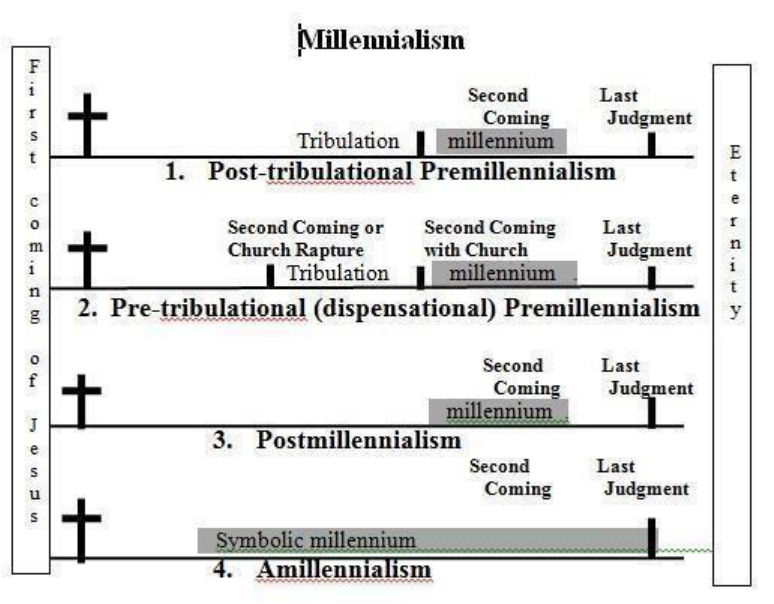
The term "millennium" does not occur in English translation. It is from a Latin word meaning a thousand years. The various interpretations are:
Premillennialists take it that Christ's kingdom has not yet been established and that his second literal and bodily coming to earth will precede its establishment, after which he will reign for a thousand years before the end of history.
Dispensationalists believe that Israel is distinct from the Church, and that God will establish a millennial kingdom in Israel where Christ, upon His return, will rule the world from Jerusalem for a thousand years
Postmillennialists believe Christ's kingdom was established as a sequel to his first coming, that the millennium will be a golden age of the kingdom lasting till near the end of history and after which Christ will come a second time at the end of history.
Amillennialists do not accept any of these theories, but for various reasons. Some of them believe that no time element at all is symbolized by the thousand years, but simply the completeness of the victory of Christ and his saints over Satan and all his agents. See comparison on the following page.
en.wikipedia.org/wiki/Postmillennialism
The first clear opponent of premillennialism associated with Christianity was Marcion (85-160 AD). Marcion opposed the use of the Old Testament and most books of the New Testament that were not written by the apostle Paul. He was the first great heretic who broke drastically with the faith of the early church in abandoning the doctrine of the imminent, personal return of Christ. Marcion did not believe in a real incarnation, and consequently, there was no logical place in his system for a real Second Coming. He expected the majority of mankind to be lost denying the validity of the Old Testament and its Law. Other pre-Nicean premillennialists were Irenaeus, Justin, Theophilus, Tertullian, and Hippolytus of Rome. en.wikipedia.org/wiki/Premillennialism
Millennialism is also a doctrine of medieval Zoroastrianism concerning successive thousand-year periods, each of which will end in a cataclysm of heresy and destruction, until the final destruction of evil and of the spirit of evil by a triumphant king of peace at the end of the final millennial age (supposed by some to be the year 2000). "Then Saoshyant [In Persian mythology Saoshyant is the one who will come to renew all life at the end of time.] makes the creatures again pure, and the resurrection and future existence occur" (Zand-i Vohuman Yasht 3:62).
Various other social and political movements, both religious and secular, have also been linked to millennialist metaphors
What does the Bible state? Revelation 20:1-15
- “And I saw an angel coming down out of heaven,
- having the key to the Abyss and holding in his hand a great chain.
- He seized the dragon, that ancient serpent, who is the devil, or Satan, and bound him for a thousand years.
- He threw him into the Abyss, and locked and sealed it over him, to keep him from deceiving the nations anymore until the thousand years were ended.
- After that, he must be set free for a short time.
- I saw thrones on which were seated those who had been given authority to judge.
- And I saw the souls of those who had been beheaded because of their testimony for Jesus and because of the word of God. They had not worshiped the beast or his image and had not received his mark on their foreheads or their hands.
- They came to life and reigned with Christ a thousand years. (The rest of the dead did not come to life until the thousand years were ended.) This is the first resurrection. ▪ Blessed and holy are those who have part in the first resurrection.
- The second death has no power over them, but they will be priests of God and of Christ and will reign with him for a thousand years.
- When the thousand years are over, Satan will be released from his prison and will go out to deceive the nations in the four corners of the earth — Gog and Magog — to gather them for battle. In number they are like the sand on the seashore. They marched across the breadth of the earth and surrounded the camp of God's people, the city he loves. But fire came down from heaven and devoured them.
- And the devil, who deceived them, was thrown into the lake of burning sulfur, where the beast and the false prophet had been thrown. They will be tormented day and night for ever and ever.
- Then I saw a great white throne and him who was seated on it. Earth and sky fled from his presence, and there was no place for them.
- And I saw the dead, great and small, standing before the throne, and books were opened. Another book was opened, which is the book of life. The dead were judged according to what they had done as recorded in the books. The sea gave up the dead that were in it, and death and Hades gave up the dead that were in them, and each person was judged according to what he had done. Then death and Hades were thrown into the lake of fire. The lake of fire is the second death. If anyone's name was not found written in the book of life, he was thrown into the lake of fire.
A brief explanation
- An Angel from Heaven - John is on earth when he sees this part of the vision
- Having the key to the abyss – In chapter nine Satan had this key, so now He has been defeated.
- The dragon bound for 1000 years - The devil is totally and perfectly [completely] defeated and bound with reference to his working through Rome against the church, (witness the chain, the pit,
and the sealing closed). This was the end of the history of the Roman Empire but not for Satan. He would be released to try again using other nations.
- For 1000 years - 1000 years does not speak of a time period but a state of affairs. Applied to Satan it is total defeat. Applied to the saints it is total victory. The number 1000 means totality. Psalm 50:10 says God owns the cattle on a thousand hills. Deuteronomy 7:9 says God keeps His promises for a thousand generations. Psalm 105:8 and 1 Chronicles 16:15 says God commanded His word for a thousand generations. The idea is totality and not a limited time period.
Notice some other ideas or theories regarding the 1000 years:
- 1000 years is the whole Christian dispensation (from then until the end of time). The problem with this idea is that it requires a little time period of earth history after the end of time.
- 1000 years is all of time until just before the second coming of Christ. The problem with this idea is that it would limit the reigning priest-hood period of the Christians to less than the whole Christian era.
- 1000 years following the destruction of Rome Christianity flourished. The problem with this idea is that it would require the dead martyrs to be raised about a thousand years ago.
- Satan in the sealed abyss - Satan is not limited in action, he is stopped!
- Satan loosed for a little time to deceive the nations - This is not a time period but a message where
God says to the Christians: "I protected you in the past and will do it in the future, anywhere, anytime, against any foe. This is God's guarantee for the future, just like in Ezekiel 38-39.
- Those sitting on thrones - Those who sit on thrones are reigning. They are those to whom was given the authority to judge. Who are they? They are victorious, faithful saints, living or dead. Jesus had promised that the overcomers would share with Him in ruling over the nations (Revelation 2:26f; 3:21; 11:15-18; 18:20). This is the same as Daniel 7: 21, 22.
- Souls of them beheaded for Jesus' sake - These are the martyrs in the persecution. They are resurrected (they live) and reign with Christ. Picture the battleground after the battle of Revelation 19 with the ground littered with the bodies of the slain. Those slain who are Christian martyrs are resurrected and join the living saints on thrones to rule with God. Those who were killed did not lose out because immediately they were raised to die no more. This is the "first resurrection." Notice that these are only the martyrs in the conflict of Revelation and not those Christians who had died all throughout history. This is not a literal resurrection that will happen when Jesus returns. Here is only a symbolic way of saying the faithful saints are victorious and secure.
- The rest of the dead - are those who died in the vision in service of the beast and they remain dead for 1000 years (symbolically) only to be raised up and destroyed again. They were living losers. They
are dead losers and they will live again only to be losers. Verse 5 is parenthetical. To get the sense read v4 then v5b: ("The Christian martyrs lived and reigned with Christ for a thousand years. This is the first resurrection.") That the foes of Jesus remain dead for a thousand years simply means that they were totally defeated in their war against Christ and the church. It is not referring to a literal time period.
- The first resurrection - this is the resurrection of martyrs for Jesus. It is called "first" because John will see a second resurrection. Both God's servants and the beast's servants died in the first death but only the good guys are in the first resurrection. The first resurrection is to life and reigning but the second resurrection is to the second death. The message is that the dead in Christ share in the victory just as surely as do the living servants of God.
- Priests of God …reign 1000 years - this doesn't talk about how long Jesus reigns but how long the saints would reign. The point here is not time but total victory and blessedness. What they had before they died (kingdom of priests), continued after they died. In life and in death the servants of
God are victorious.
- Satan loosed and deceives the nations (again) - Satan will continue to operate in the world to destroy the faith of God's servants.
- Gog and Magog - They are anybody yet nobody in particular just as they were used in Ezekiel 38,
- The message is this in both places: God says to His people: "I have already defended you and made you victorious in this present crisis and I will do it again whenever you need it." The emphasis is on the size of this new future enemy (whatever) and the ease with which God will defeat them also. Christians, don't worry about God's desire and ability to protect you against any and all enemies, now or in the future! A note about premillennial theories: All attempts to create a huge army of God-haters in a world where Satan does not act and only God's servants live is doomed to failure (especially if you believe in the impossibility of apostasy).
- The devil cast into the lake of fire - The lake of fire symbolizes total defeat. Nobody returns after being thrown into the lake of fire. This is not about eternal punishment but victory of God's people and defeat of God's enemies.
- Great white throne - is not the literal judgment day before which all men must appear one day. This is just like Daniel 7:9-12 where Rome (the fourth kingdom) is judged.
- Second resurrection - the beast's worshippers are raised. The servants of God are not because they were raised 1000 years earlier (in the vision).
In this vision the devil is bound 1000 years to show how he was totally defeated in his war against the church using Rome. He is loosed a little while because after Rome there would be other attempts and they would meet the same fate. Victory is presented by the vision of saints (living ones and raised ones) reigning and judging in perfect [complete] victory. This chapter says complete victory of Christ and His church and complete defeat for Satan and the church persecuting Roman Empire. Revelation 20 explanation from The Revelation of John The Apostle, Joe McKinney, TheBibleWay Online
Chapter 4
Mergers and Divisions
Merge of the Stone and Campbell movements
The Campbell movement was characterized by a "systematic and rational reconstruction" of the early church, in contrast to the Stone movement which was characterized by radical freedom and lack of dogma.[3]:106-108
Despite their differences, the two movements agreed on several critical issues.[3]:108 Both saw restoring apostolic Christianity as a means of hastening the millennium.[3]:108 Both also saw restoring the early church as a route to Christian freedom.[3]:105 And, both believed that unity among Christians 8 could be achieved by using apostolic Christianity as a model.[3]:108 The commitment of both movements to restoring the early church and to uniting Christians was enough to motivate a union between many in the two movements.[8]:8, 9 en.wikipedia.org/wiki/Restoration_Movement
Note: Since both believed in church autonomy, what was purpose of merging?
"Raccoon John" Smith (1784-1868)
The two groups united at High Street Meeting House, Lexington, Kentucky with a handshake between Barton W. Stone and "Raccoon" John Smith, Saturday, December 31, 1831.[9]:116-120 Smith had been chosen, by those present, to speak on behalf of the followers of the Campbells.[9]:116
Two representatives of those assembled were appointed to carry the news of the union to all the churches: John Rogers, for the Christians and "Raccoon" John Smith for the reformers. Despite some challenges, the merger succeeded.[1]:153-154 Many believed the union held great promise for the future success of the combined movement, and greeted the news enthusiastically.[8]:9
5 Refer to thebiblewayonline.com - United In Christ
With the merger, there was the challenge of what to call the new movement. Clearly, finding a Biblical, nonsectarian name was important. Stone wanted to continue to use the name "Christians." Alexander Campbell insisted upon "Disciples of Christ". As a result, both names were used.[1]:27-28
From the beginning of the movement, the free exchange of ideas among the people was fostered by the journals published by its leaders. Alexander Campbell published The Christian Baptist and The Millennial Harbinger. Stone published The Christian Messenger.[12]:208. In a respectful way, both men routinely published the contributions of others whose positions were radically different from their own.
When Stone and Alexander Campbell's Reformers (also known as Disciples and Christian Baptists) united in 1832, only a minority of Christians from the Smith/Jones and O'Kelly movements participated.[6]:190 Those that did were from congregations west of the Appalachian Mountains that had
come into contact with the Stone movement.[6]:190 The eastern members had several key differences with the Stone and Campbell group: an emphasis on conversion experience, quarterly observance of communion, and nontrinitarianism.[6]:190 Those who did not unite with Campbell merged with the Congregational Churches in 1931 to form the Congregational Christian Churches.[6]:191 In 1957, the Congregational Christian Church merged with the Evangelical and Reformed Church to become the United Church of Christ.[6]:191 en.wikipedia.org/wiki/Restoration_Movement
Strains of War, Societies and Singing/Church Music
Once the pioneer preachers of the Restoration Movement, such as Stone and the Campbell's, had formulated the basic principles of the Movement, they began to preach with a vigor that stimulated the church to a period of phenomenal growth. Estimates among the disciples themselves placed their numbers at 100,000 in 1836 and at 200,000 or even 300,000 in 1850. According to the census of 1850 the disciples constituted the fourth largest religious body in the nation. The census of 1870 placed it at fifth place. The zealous labors of the pioneer preachers, as well as the freedom from denominational shackles offered by the Restoration to liberty-loving
Americans, powered this period of rapid progress. However, disruptive influences lay on the horizon, and they threatened to hamper, or even undo, all of this progress. I. The Civil War
The Civil War was greatly disruptive to the American religious scene. Some churches were divided and others were so discouraged that they ceased to meet. The whole nation including many brethren were so caught up with war fever that little room was left in their hearts for spiritual concern. Young men of the church went off to join the ranks of the Blue and the Gray, and not a few of them died in battle. Some preachers deplored brethren taking up arms against one another, while others, forgetting their calling and disclaiming their brethren in the opposing section, themselves unsheathed the sword. One preacher and college president by the name of James A. Garfield became noted for his valor, was
promoted to the rank of brigadier-general, and eventually became the twentieth president of the United States.
Two questions were brought to the attention of Christians by the Civil War or its issues. One was the slavery question. Could a Christian Scripturally own slaves? If so, how was he required to treat them? Though there were extremists on both sides of the question, it seems that most preachers were neutral and encouraged Christians in the North and South not to allow this to become a divisive issue. … The prevailing view among brethren seemed to be that slavery was a political, rather than moral, question. The Bible did not expressly forbid slavery but rather regulated it (Lev. 25:39-46; I Cor. 7:17-24; Eph. 6:59; Philemon). Most brethren, while wishing to avert religious division and war over this matter, probably hoped that slavery would eventually be brought to a peaceable and legal end. The other question to attract Christian's concerns was the Christian's participation in carnal warfare. Again, the most devout and influential preachers were opposed to brethren's involvement in warfare and pled with brethren not to become involved, though their pleas seem to have fallen on deaf ears for the most part.
- The Missionary Society
Since most congregations during the Restoration Movement formed themselves into intercongregational associations of some sort, the question of "cooperation" was soon raised among the brethren. While those in Stone’s following looked with suspicion at such organizing efforts, those of Campbell's following seemed to think that some sort of extra-congregational cooperation or organization was well-nigh essential to the progress of the cause. Consequently, brethren at first began to meet in informal, district gatherings. However, as time went by these "cooperation meetings" increased in formality and scale. District meetings became state meetings, and state meetings became national meetings. At first, such meetings were defended on the basis that they were only intended to encourage, inform, and unify brethren, and promote evangelism. Alexander Campbell wrote extensively in defense of greater organization among local churches. Brethren finally met in Cincinnati, Ohio in 1849 and formed the American Christian Missionary Society. Alexander Campbell had concerns that holding conventions would lead the movement into divisive denominationalism. He did not attend the gathering.[12]:245 However, he was elected its first president. As soon as the Society was formed opposition to it began to mount. Interrupted temporarily by the Civil War, this opposition continued to increase until conflict over the Society gradually issued in an open breech of fellowship between the advocates and the adversaries in the latter half of the Nineteenth Century.
The bases of objections to the missionary society have varied, but the most notable ones may be summarized as follows:
- there is no Scriptural authority for it
- it is not needed, for the church is sufficient to do the spiritual work that needs to be done • it supplants the church, and
- it infringes upon the independence and autonomy of the local churches.
- Instrumental Music
About the time that the American Christian Missionary Society got underway the question of instrumental music in the worship of the churches arose. Not long before the Civil War the church at Midway, Kentucky became the first church on record to introduce instrumental music into worship (supposedly to aid their deplorable singing). Practically every church and preacher of influence, including Campbell himself, stood united in their opposition to instrumental music in worship. However, following the Civil War churches began to use the instrument more and more and the battle over it was joined with increasing fury. The objections to instrumental music in worship have substantially been:
- it is an unauthorized addition to the singing directed by the New Testament (Eph. 5:19; Col. 3:16)
- it is not instructive to the intelligence (I Cor. 14:15), and
- it is contrary to the spiritual character of the church's worship. The contentions over the missionary society and the instrument, as well as lesser ones, finally escalated into a division among the churches that was formally recognized by the Religious Census in 1906. bible.ca/history/eubanks/historyeubanks-42.htm
Are these same objections valid today for the following organizations or activities?
- Disaster relief or Global Samaritans
- Healing Hands International
- World Christian Broadcast
- Gospel Broadcast Network
- Inner City Ministries
- Restoration Radio
- One congregation overseeing multiple congregations mission work
- Singing along in deep feeling of reverence and praise to God with religious music, “gospel music” on the radio, a CD or music group where all media use musical instruments.
- Multiple song leaders or praise teams.
Some Teachings of the Restoration (Stone – Campbell Movement) These two movements shared several key beliefs.
- They believed the Bible was the inspired Word of God and the ultimate authority in the life of the believer.
- They believed the models and patterns of church life in the New Testament were meant to demonstrate God’s plan for the church through the ages.
- They believed God intended His people, the church not just one assembly or congregation, to be united, not divided. Agreement on the essentials of the New Testament faith can create the unity
God intended for His church. After Campbell’s death, fault lines began to form in the movement. The problem was not with the founding principles but with their application. Everyone agreed on the principle of unity around New
Testament essentials, but not everyone agreed on what those essentials were or how to determine what should be considered essential. Two primary schools of interpretation formed their battle lines over the question of instrumental music in worship. The group that eventually became the non-instrumental Churches of Christ took a position that prohibited “innovations” in worship that were not specifically commanded in the New Testament. Lacking a New Testament command to use instruments in worship, they argued for their prohibition. The other interpretation position was that since there was not a specific command prohibiting the use of a musical instrument then it was allowable. Refer to thebiblewayonline.com study Bible Forty years after Campbell’s death, the split was officially recognized and the non-instrumental churches we recognized as a separate group.
Sadly, the divisions of this unity movement were not over with this division. The Christian Church movement had another issue simmering just below the surface is the issue of baptism. One of the joyful restorations of the early Campbell/Stone movement was the restoration of baptism by immersion into the church. Infant baptism by sprinkling was a virtually universal practice among the historic European churches represented on the American frontier. As they turned to the New Testament for guidance, the reformers discovered the mode of baptism in the New Testament church was almost certainly total immersion, not sprinkling. They further determined that the only acceptable candidate for baptism is someone of sufficient age to choose baptism for him or herself. Again, the movement was nearly unanimous on the core issue. The divisive question was how to regard those who considered themselves to be Christian but were un-immersed. On one side were those who believed church membership and assurance of salvation should only be offered to those who were immersed. On the other side were those who regarded adult immersion as the ideal but recognized the genuine Christian faith of those baptized by other means in other traditions. The real question is fellowship and how God wants it practiced.
In the late 1920’s this issue came to a head in a series of ugly fights over cooperation on the mission field between Campbell/Stone missionaries and those of traditions who baptize infants. One side wanted to demand that Campbell/Stone missionaries confine any cooperation the mission field to denominations that practiced immersion. Others saw the need to cooperate with others regardless of their baptismal theology. Refer to thebiblewayonline.com - baptism
The struggle became so intense that another split ensued. Thousands of congregations left the movement and formed their own non-denominational group centered around the North American Christian Convention. This group consisted of those who found baptism by immersion to be an absolute issue. Those who stayed in the old International Convention of Christian Churches tended to be those who were more open to accepting the unimmersed as Christians in their own right. The split has been slowly progressing for about 70 years.
In recent decades, yet another division has begun to occur. Since 1985 Disciple Renewal has been challenging the theological liberalism that has grown up in the Christian Church (Disciples of Christ) denomination that formed in 1968 out of the old International Convention of Christian Churches.
Disciple Renewal began with a commitment to work within the denomination for change and spiritual renewal. Unfortunately, as time went by it became clear that the denomination was totally closed to change or challenge, and Disciple Renewal formed Disciple Heritage Fellowship as a gathering point for those who left the denomination and for evangelicals who were still in the denomination. Though no one wanted to see division, division is slowly taking place. For the first time, division is focused on the founding principles of the movement, not just the working out of the details.
The Disciples of Christ have abandoned their belief in the inspiration and reliability of the Bible, denied there is a consistent New Testament faith to which we can return, and traded the idea of unity around biblical essentials for unity by negotiation between denominational bodies. discipleheritage.org/downloads/10.pdf
Restoration Timeline
John Locke
1632 - 1704
John Wesley 1703 – 1791 James O’Kelly 1732 – 1826 Elias Smith 1764 – 1846 Abner Jones 1767 – 1840 Barton Stone 1772 – 1844 Thomas Campbell 1763 – 1854 Alexander Campbell 1788 – 1866 Walter Scott 1796 – 1861 “Raccoon” John Smith 1784 – 1868
Restoration About the turn of the 18th century, several religious leaders independent of each other began to question how so many differing teachings and practices set forth in so many associations in their creeds all be the church of the Bible. They reasoned that God wanted unity so why could not everyone just turn to the Bible and the Bible alone to find God’s instruction to man. In fact, this appears to be the meaning of the parable of the sower in Luke 8. By returning to the Word and planting it in good and honest hearts, free from the control of men and, their creeds and doctrines, it will produce obedient people, Christians, the church Jesus established.
The heart of the restoration movement was to unite believers:
- Cease to use of government to enforce religion
- Use scripture alone. Reject all human creeds and dogma
- Obtain and retain love of God and man
During this movement, various leaders offered their understanding of the requirements for believers in Christ to become united in Him.
Locke
- Rejected the right of church through government to establish and enforce a state religion
- The Bible supplies a set of essential beliefs upon which all reasonable people can agree: i. The messiahship of Jesus
- Jesus’ direct commands
- Nonessentials upon which Christians disagree should not be forced upon others
Wesley
a. Agree to disagree on non-essential doctrine b. Cease fighting and arguing about the non-essentials Separate Baptists
- Reject all creeds and use only the Bible as the perfect rule but without requiring complete agreement on pattern
- Avoid precise detail as it leads to legalism and division
Landmark Baptists
- The Bible is a precise blueprint without any deviations allowed
- Deviation from blueprint keeps one from true church
O’Kelly/Haggard
- Christ is the only head of the church
- The name Christian is the only acceptable name
- The Bible is the only rule of faith
- Christian character is the only test of church fellowship
- The right of private judgment is the privilege of all.
Barton Stone
- Congregational governance
- Restoring the lifestyle of the early church that is holy and righteous living rather than or over form and structures
- Freedom in Christ is more important than the emphasis of a particular practice [as a ritual].
Campbell
- Approved precedent added to core /essential beliefs.
- The Bible is a book of facts (not opinions, theories, abstract truths, or verbal definitions), and a rational faith was to be formulated and defined upon these facts.
- Congregational autonomy
- A plurality of elders in each congregation
- Weekly communion and
- Immersion of believers for the remission of sins
- Thus saith the Lord,
Congregationalists
- People needed a conversion experience
During this long period of time, they differed in many ways some unwilling to cut the ties of past teachings and practices yet, they recognized their current “church” was not like the church they read about in their Bible.
Many if not most of these reformers and restorationalists had one thing in common they wanted to either reform, restore or return to the church of the Bible and to be united with all other believers and to be Christians only.
There was unity for a time, but diverse and polarizing opinions emerged:
- The Bible is a blueprint, constitution or pattern where complete agreement on details is not required. For those IN CHRIST living righteously among men and before God was more important than adhering to form, structure and precise understanding.
- The Bible is a precise blueprint that must be followed without deviation. Those who deviate from the leaders’ interpretation of the precise blueprint are not to be fellowshipped. Consequently, there is a continual defining the preciseness of the blueprint which leads to disagreement and more separation.
To remain united and in fellowship, issues must be prayerfully resolved:
- Who decides the degree of preciseness of understanding one must have to remain in fellowship -
God or Man?
- Does one’s interpretation of some non-gospel teaching determine another’s fellowship with God or another Christian?
- Can one be in fellowship with God but not with others in Christ?
- If the Bible is silent on a subject does that silence require a thing or prohibit it? Likewise, when the Bible specifies something it neither requires nor prohibits something else.
- The writings of church fathers, reformers, restorationists, or today’s authors cannot be a condition of man’s fellowship with God or His children.
Even after achieving some success, it was not long, like their forefathers after 100 AD, that they began to drift and accept doctrines of the past and establish new creeds or reestablish old ones.
Conclusion
There appears to be a common thread running throughout history. Each generation draws upon the beliefs and thoughts of past generation. Leaders and or writers record their conclusions which the next generation draws upon. Some are accepted others reject probably based upon their prior understandings and concepts. This process is absolutely necessary in the world of the unknown such as medicine, computers, chemistry, physics and math where there is not nor has ever been a revealed standard. Therefore, each piece of knowledge is a building block.
This study has shown that men and leaders of their generation tend to accept the opinions of “learned men” of the past rather than relying on a thorough study of the words from God. Observe.
- Justin Martyr was a disciple of Socrates and Plato and did not appear to have prepared himself very well in regard to the scriptures.
- Irenaeus of Lyons relied upon The Shepherd of Hermas as scripture.
- Origen corrected the Septuagint from his knowledge of Hebrew. But his Stoic, Neo-Pythagorean, and
Platonic beliefs clouded his reasoning.
- Ambrose’s theology was significantly influenced by that of Origen.
- Augustine admired Cicero and ranked him above all other ancient writers and retained his dual system of the soul and body belief.
- Wycliffe relied upon Jerome’s flawed Latin Vulgate in translating the Bible into English, which may have been all that was available to him.
- Luther was taught to be suspicious of and to test everything but still accepted much of the “church fathers” teachings.
- John Calvin often quoted the teachings of Augustine and Ambrose.
- John Locke’s teachings influenced Thomas and Alexander Campbell.
Believers in Christ were persecuted for their refusal to deny Christ and accept another Gospel or to conform to some other religious doctrine, such as; a) Judaism, b) Pagan or Emperor Worship while under Imperial Rome, c) Catholicism during and after the Middle or Dark ages or d) Catholicism and Protestantism in the Reformation and Restoration eras.
By relying upon divinely revealed knowledge one can obtain a more accurate knowledge and understanding of the will of God.
During hundreds of years through persecution, many have attempted to return to God using only the Bible. The last 200 years or so have seen many differences in opinion or interpretation which when put on the same standing as revealed truth has resulted in new religious organizations. One needs to determine if they are part of the problem by asking themselves “Have I personally searched the scriptures to determine what it states in reaching my conclusions? Or, have I searched the Bible to see if my ‘Biblical doctrine’ can be found and interpreted to conform to my belief and conclusion.”
The following is a list of some relative recent teachings staunchly believed and made a test of fellowship. Many of them have been rejected in whole or in part. • The “emblems” of the Lord’s Supper must be covered.
- The bread used in the Lord’s Supper must be made from wheat flour, broken after prayer and before distributing to the members to partake.
- The Cup, fruit of the vine, must be fermented wine.
- Only one cup can be used not individual cups.
- Bible classes divide the church, therefore cannot be practiced.
- Singing as worship to God must not include a musical instrument or in harmony but chants.
- Women must have their head covered with something other than their hair when assembled.
- Women cannot cut or trim their hair.
- Congregations of Christians cannot own buildings.
- Meals cannot be eaten within the “church building.”
- Owning a gym, family life centers, and camps is sinful.
- Christians cannot participate in Christmas.
- Mixed swimming cannot be tolerated as it is sinful.
- Dancing of any kind is sinful.
- Participating in government, even voting is sinful.
- Serving in the armed forces is sinful.
- Donations to church-affiliated schools and colleges are sinful.
- Using any literature other than the Bible is wrong.
- The name of the church must be “____” without any location.
- Drinking any alcoholic beverage is sinful.
- Using tobacco of any kind is sinful.
- Marriage among races is not biblical.
- The Bible prohibits Christians from owning slaves.
- Churches cannot cooperate in any endeavor.
- Congregations cannot employ a preacher on a regular basis.
- Multiple song leaders at a time is entertainment and therefore sinful.
Many devout people, past and present, believe their interpretations were the exact will of God. Yet, many have been rejected in whole or in part upon further study. What changed? Was it the Bible or man’s interpretation? Do we NOW know ALL the TRUTH? Will what we so firmly hold as conditions of fellowship with God be proven wrong in generations to come? Are our beliefs so FINAL that we are beyond learning?
The Gospel or Gospel of Christ is:
- God, as Jesus of Nazareth, was human but without sin, offered
His physical body to God as the blood sacrifice, sin-offering, for the removal of sin.
- His burial and subsequent resurrection was victory of death.
- His ascension back to His previous abode with God, the Father.
Those who put their trust in Him by being buried into His death are resurrected as new spiritual beings. They grow into the likeness, image, and nature of God by living (walking in) the teachings
(doctrines) of Christ and His Apostles only and are in fellowship with God and all others in Christ even if they have some different understanding of some teaching other than the Gospel.
We must diligently study scripture, accept its truths and be willing to follow it wherever it leads us.
Chapter 7 Summary Some Teachings and practices of Reformers Wycliffe
- Christ is the head of the Church
- Church Leaders must be moral men – not purchase position
- The Bible is the sole authority for man – not the Catholic Church
- Only two orders of church leaders – elders and deacons
Luther
- Bible alone constitutes final authority for a Christian
Restoration About the turn of the 18th century, several religious leaders independent of each other begin to question how so many differing teachings and practices set forth in so many associations in their creeds all be the church of the Bible. They reasoned that God wanted unity so why could not everyone just turn to the Bible and the Bible alone to find God’s instruction to man. In fact, this appears to be the meaning of the parable of the sower in Luke 8. By returning to the Word and planting it in good and honest hearts, free from the control of men and, their creeds and doctrines, it will produce obedient people, Christians, the church Jesus established.
The heart of the restoration movement was to unite believers:
- Cease to use of government to enforce religion
- Use scripture alone. Reject all human creeds and dogma
- Obtain and retain love of God and man
During this movement, various leaders offered their understanding of the requirements for believers in Christ to become united in Him.
Locke
- Rejected the right of church through government to establish and enforce a state religion
- The Bible supplies a set of essential beliefs upon which all reasonable people can agree: i. The messiahship of Jesus
- Jesus’ direct commands
- Nonessentials upon which Christians disagree should not be forced upon others
Wesley
a. Agree to disagree on non-essential doctrine b. Cease fighting and arguing about the non-essentials Separate Baptists
- Reject all creeds and use only the Bible as the perfect rule but without requiring complete agreement on pattern
- Avoid precise detail as it leads to legalism and division
Landmark Baptists
- The Bible is a precise blueprint without any deviations allowed
- Deviation from blueprint keeps one from true church
O’Kelly/Haggard
- Christ is the only head of the church
- The name Christian is the only acceptable name
- The Bible is the only rule of faith
- Christian character is the only test of church fellowship
- The right of private judgment is the privilege of all.
Barton Stone
- Congregational governance
- Restoring lifestyle of early church that is holy and righteous living rather than or over form and structures
- Freedom in Christ is more important than emphasis of a particular practice [as a ritual].
Campbell
- Approved precedent added to core /essential beliefs.
- Bible a book of facts (not opinions, theories, abstract truths or verbal definitions) and a rational faith was to be formulated and defined upon these facts.
- Congregational autonomy
- A plurality of elders in each congregation
- Weekly communion and f.
Immersion of believers for the remission of sins
- Thus saith the Lord,
Congregationalists
- People needed a conversion experience
During this long period of time, they differed in many ways some unwilling to cut the ties of past teachings and practices yet, they recognized their current “church” was not like the church they read about in their Bible.
Many if not most of these reformers and restorationalists had one thing in common they wanted to either reform, restore or return to the church of the Bible and to be united with all other believers and to be Christians only.
There was unity for a time, but diverse and polarizing opinions emerged:
- The Bible is a blueprint, constitution, or pattern where complete agreement on details is not required. For those IN CHRIST living righteously among men and before God was more important than adhering to form, structure, and precise understanding.
- The Bible is a precise blueprint that must be followed without deviation. Those who deviate from the leaders’ interpretation of the precise blueprint are not to be fellowshipped. Consequently, there is a continual defining the preciseness of the blueprint which leads to disagreement and more separation.
To remain united and in fellowship, issues must be prayerfully resolved:
- Who decides the degree of preciseness of understanding one must have to remain in fellowship
- God or Man?
- Does one’s interpretation on some non-gospel teaching determine another’s fellowship with
God or another Christian?
- Can one be in fellowship with God but not with others in Christ?
- If the Bible is silent on a subject does that silence require a thing or prohibit it? Likewise, when the Bible specifies something it neither requires or prohibits something else.
- The writings of church fathers, reformers, restorationists or today’s authors cannot be a condition of man’s fellowship with God or His children.
Even after achieving some success, it was not long, like their forefathers after 100 AD, that they began to drift and accept doctrines of the past and establish new creeds or reestablish old ones.
Conclusion There
appears to be a common thread running throughout history. Each generation draws upon the beliefs and thoughts of past generation. Leaders and or writers record their conclusions which the next generation draws upon. Some are accepted others reject probably based upon their
prior understandings and concepts. This process is absolutely necessary in the world of the unknown such as medicine, computers, chemistry, physics and math where there is not nor has ever been a revealed standard. Therefore, each piece of knowledge is a building block.
This study has shown that men and leaders of their generation tend to accept the opinions of “learned men” of the past rather than relying on a thorough study of the words from God. Observe.
- Justin Martyr was a disciple of Socrates and Plato and did not appear to have prepared himself very well in regard to the scriptures.
- Irenaeus of Lyons relied upon The Shepherd of Hermas as scripture.
- Origen corrected the Septuagint from his knowledge of Hebrew. But his Stoic, Neo-Pythagorean and
Platonic beliefs clouded his reasoning.
- Ambrose’s theology was significantly influenced by that of Origen.
- Augustine admired Cicero and ranked him above all other ancient writers and retained his dual system of the soul and body belief.
- Wycliffe relied upon Jerome’s flawed Latin Vulgate in translating the Bible into English, which may have been all that was available to him.
- Luther was taught to be suspicious of and to test everything but still accepted much of the “church fathers” teachings.
- John Calvin often quoted the teachings of Augustine and Ambrose.
- John Locke’s teachings influenced Thomas and Alexander Campbell.
Believers in Christ were persecuted for their refusal to deny Christ and accept another Gospel or to conform to some other religious doctrine, such as; a) Judaism, b) Pagan or Emperor Worship while
under Imperial Rome, c) Catholicism during and after the Middle or Dark ages or d) Catholicism and Protestantism in the Reformation and Restoration eras.
By relying upon divinely revealed knowledge one can obtain a more accurate knowledge and understanding of the will of God.
During hundreds of years through persecution many have attempted to return to God using only the Bible. The last 200 years or so has seen many differences in opinion or interpretation which when put on the same standing as revealed truth has resulted in new religious organizations. One needs to determine if they are part of the problem by asking themselves “Have I personally searched the scriptures to determine what it states in reaching my conclusions? Or, have I searched the Bible to see if my ‘Biblical doctrine’ can be found and interpreted to conform to my belief and conclusion.”
The following is a list of some relative recent teachings staunchly believed and made a test of fellowship. Many of them have been rejected in whole or in part. • The “emblems” of the Lord’s Supper must be covered.
- The bread used in the Lord’s Supper must be made from wheat flour, broken after prayer and before distributing to the members to partake.
- The Cup, fruit of the vine, must be fermented wine.
- Only one cup can be used not individual cups.
- Bible classes divide the church, therefore they cannot be practiced.
- Singing as worship to God must not include a musical instrument or harmony but chants.
- Women must have their heads covered with something other than their hair when assembled.
- Women cannot cut or trim their hair.
- Congregations of Christians cannot own buildings.
- Meals cannot be eaten within the “church building.” • Owning gyms, family life centers, and camps is sinful.
- Christians cannot participate in Christmas.
- Mixed swimming cannot be tolerated as it is sinful.
- Dancing of any kind is sinful.
- Participating in government, even voting is sinful.
- Serving in the armed forces is sinful.
- Donations to church-affiliated schools and colleges are sinful.
- Using any literature other than the Bible is wrong.
- The name of the church must be “____” without any location.
- Drinking any alcoholic beverage is sinful.
- Using tobacco of any kind is sinful.
- Marriage among races is not biblical.
- The Bible prohibits Christians from owning slaves.
- Churches cannot cooperate in any endeavor.
- Congregations cannot employ a preacher on a regular basis.
- Multiple song leaders at a time is entertainment therefore sinful.
Many devout people, past and present, believe their interpretations were the exact will of God. Yet, many have been rejected in whole or in part upon further study. What changed? Was it the Bible or man’s interpretation? Do we NOW know ALL the TRUTH? Will what we so firmly hold as conditions of fellowship with God be proven wrong in generations to come? Are our beliefs so FINAL that we are beyond learning?
The Gospel or Gospel of Christ is:
- God, as Jesus of Nazareth, was human but without sin, offered
His physical body to God as the blood sacrifice, sin-offering, for the removal of sin.
- His burial and subsequent resurrection was victory of death.
- His ascension back to His previous abode with God, the Father.
Those who put their trust in Him by being buried into His death are resurrected as new spiritual beings. They grow into the likeness, image and nature of God by living (walking in) the teachings (doctrines) of Christ and His Apostles only and are in fellowship with God and all others in Christ even if they have some different understanding on some teaching other than the Gospel. We must diligently study scripture, accept its truths and be willing to follow it wherever it leads us.
Text and illustrations reproduced from the study “Reform? or Restore?”. The original PDF is the reference copy.