
Servants In General
Servants (in General) Teachers
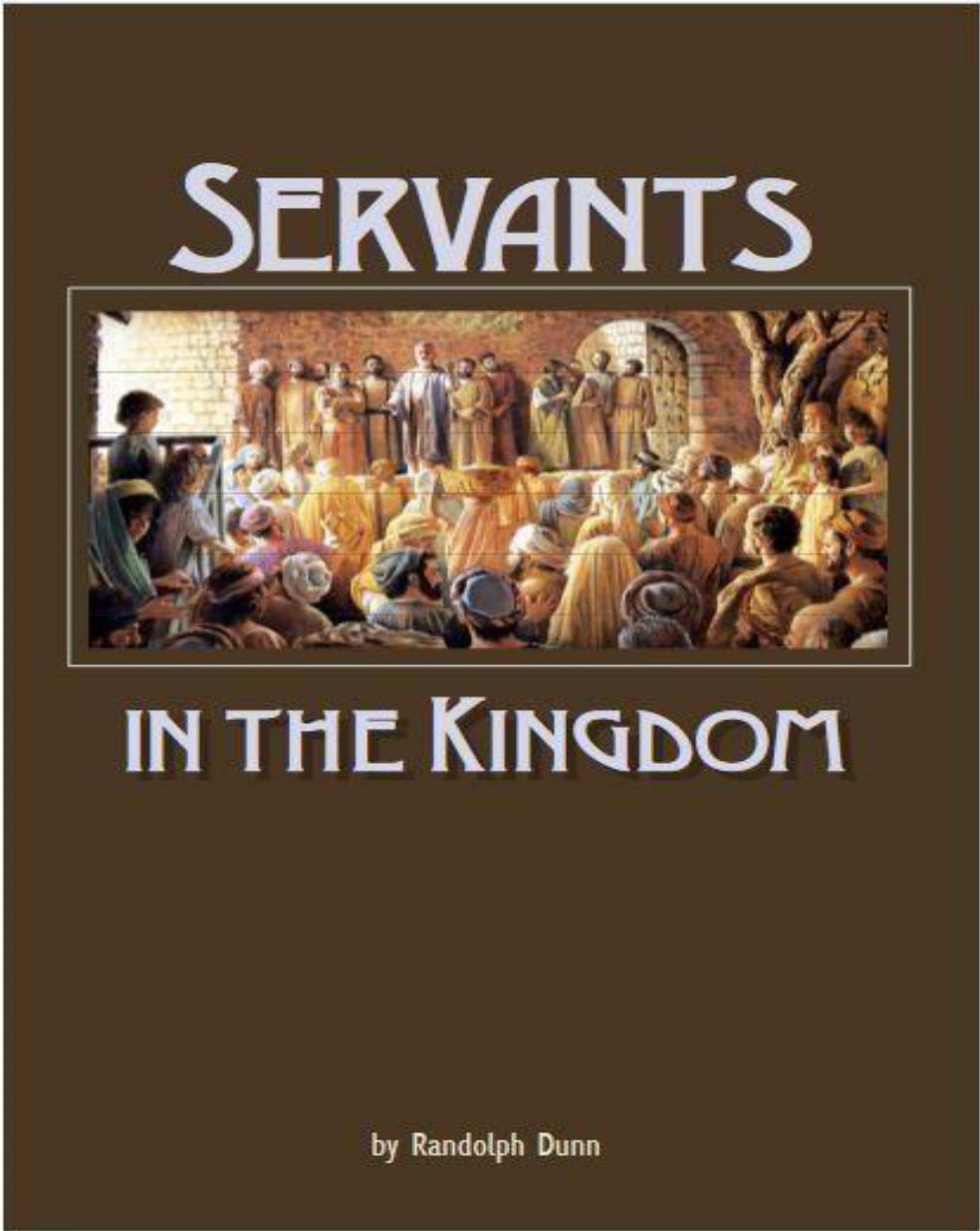
“For though by this time you (man or woman) ought to be teachers, you need someone to teach you again the basic principles of the oracles of God. You need milk, not solid food, for everyone who lives on milk is unskilled in the word of righteousness, since he is a child. But solid food is for the mature, for those who have their powers of discernment trained by constant practice to distinguish good from evil.” (Hebrews 5:12-14)
The common theme throughout the New Testament is to proclaim the Gospel to the lost. First-century evangelists performed the function of teaching the gospel to the lost according to Acts 8:4. The Christians, man and woman, who were scattered from Jerusalem proclaimed the Word wherever they went.
These (those mentioned in verse 4) went on ahead and were waiting for us at Troas, but we sailed away from Philippi after the days of Unleavened Bread, and in five days we came to them at Troas, where we stayed for seven days. On the first day of the week, when we were gathered together to break bread, Paul talked with them, intending to depart on the next day, and he prolonged his speech until midnight. (Acts 20:5-8)
Comment: The Greek word dialegomai translated “talked” (mistranslated as preached in the KJV) means, to converse, discourse, argue or discuss. So, Paul did not preach a “pulpit” sermon but discussed the results God gave from his proclaiming Christ.
Today preachers primarily present their interpretation of some Biblical subject of their choosing to those in Christ without any opportunity for questioning or discussing. However, some preachers teach directly from the Bible by directing their thoughts to the passage under consideration. There is no mention of proclaiming the Gospel (Christ and His death, burial and resurrection) again to those already in Christ, the saved.
God relies on Christians within His kingdom to teach and proclaim the gospel so that none perish and all remain faithful as a living sacrifice. The mission of the living Body of Christ, men and women is to:
- go into all the world and proclaim the Gospel (Mark 16:15).
- do good to all people, especially to believers (Gal. 6:9-10).
- encourage, edify, members of the Body (1 Corinthians 14).
- speak to one another in psalms and hymns (Ephesians 5:19).
- offer your bodies to God as living sacrifices (Romans 12:1).
The most effective method of evangelizing is on an individual basis. It would be rare if conversions occurred from mass communications, a method used to create awareness and to provide a source for obtaining additional information.
If the gospel is to be preached to the entire world, then congregations of Christians must place more emphasis on evangelism regardless of the English name associated with the activity; e.g., teacher, minister, missionary, evangelist, preacher, servant, pastor, elder, watchman or disciple - but using Bible names will prevent confusion.
What is to be taught? o Gospel – Mark 15:16
o Power of God unto salvation – Romans 1:16 o Death, burial, resurrection and ascension of Christ o Word - Acts 13:1-5 o
Apostles’ Doctrine – Acts o Everything I commanded – Matt 28:19 Who is to teach? o Evangelists – 2 Timothy 4:5 o Disciples – Mark 15:16 o Christians scattered abroad – Acts 8:4 How is the teaching to be done? o No particular method is to be excluded, nor is any specific method required. To whom is God’s message to be taught? o All creation – Mark 15:16 When are His servants to teach? o Teach as the opportunity becomes available. Where are those in Christ to take the Gospel? o Wherever they went. Acts 8:4 o Where and when a person is interested. Acts 13:7 o When assembled together. Acts 20:7 o In foreign countries- Acts 13:2-3 o All the world – Mark
16:15
“In the church at Antioch there were prophets and teachers (Greek didáskaloi): Barnabas, Simeon called Niger, Lucius of Cyrene, Manaen (who had been brought up with Herod the tetrarch) and Saul. While they were worshiping the Lord and fasting, the Holy Spirit said, ‘Set apart for me Barnabas and Saul for the work to which I have called them.’” (Acts 13:1- 2)
“But if you call yourself a Jew and rely on the law and boast in God 18 and know his will and approve what is excellent, because you are instructed from the law; 19 and if you are sure that you yourself are a guide to the blind, a light to those who are in darkness, 20 an instructor of the foolish, a teacher of children, having in the law the embodiment of knowledge and truth— 21 you then who teach others, do you not teach yourself?”(Romans 2:17-22)
Comment: “Instructor” from the Greek word paideuteén meaning one who instructs another.
Comment: “Teacher” from the Greek word didáskalous, didáskoon or didáskeis meaning one who instructs
“Not many of you should presume to be teachers, my brothers, because you know that we who teach will be judged more strictly.” (James 3:1-2)
“But there were also false prophets among the people, just as there will be false teachers among you. They will secretly introduce destructive heresies, even denying the sovereign Lord who bought them — bringing swift destruction on themselves. Many will follow their shameful ways and will bring the way of truth into disrepute. In their greed (Greek pleonexia) these teachers will exploit you with stories they have made up.” (2 Peter 2:1-3) Comment: “False teacher” from the Greek pseudo-didáskaloi with pseudo meaning false and didáskaloi meaning or teacher.
Comment: Greed generally refers to an unsatisfied desire for more money but can also include an inordinate desire for power or prestige.
“And in the church God has appointed first of all apostles, second prophets, third teachers, then workers of miracles, also those having gifts of healing, those able to help others, those with gifts of administration, and
those speaking in different kinds of tongues. Are all apostles? Are all prophets? Are all teachers? Do all have gifts of healing? Do all speak in tongues? Do all interpret?” (1 Corinthians 12:28-30)
“The man Christ Jesus, who gave himself as a ransom for all men — the testimony given in its proper time. And for this purpose, I was appointed a herald and an apostle — I am telling the truth, I am not lying — and a teacher of the true faith to the Gentiles.” (1 Timothy 2:5-7)
“But it has now been revealed through the appearing of our Savior, Christ Jesus, who has destroyed death and has brought life and immortality to light through the gospel. And of this gospel I was appointed a herald and an apostle and a teacher. That is why I am suffering as I am. Yet I am not ashamed, because I know whom I have believed, and am convinced that he is able to guard what I have entrusted to him for that day.” (2 Timothy 1:10-12)
Comment: “Herald,” or “preach” is from the Greek word keerux.
“And the Lord's servant must not quarrel; instead, he must be kind to everyone, able to teach, not resentful. Those who oppose him he must gently instruct, in the hope that God will grant them repentance leading them to a knowledge of the truth, and that they will come to their senses and escape from the trap of the devil, who has taken them captive to do his will.” (2 Timothy 2:24-26)
Christians should be involved in teaching in some manner, Hebrews 5:11. One of the requirements for shepherds, guardians or sentinels, from the Greek word episkopeés is to be skillful in communicating, so they can exhort and rebuke those God has assigned to their care. Shepherds who pass their teaching function to a paid professional does not appear to be a biblical concept. According to Ephesians 4:12, shepherds are to “equip the saints for the work of ministry (diakonia), for building up the body of Christ.”
Examples of some servant’s actions So, every Christian is a servant performing a work necessary to keep the body of Christ vibrant. Therefore, the following scriptures provide a few examples of their actions.
“Let all the house of Israel therefore know for certain that God has made him both Lord and Christ, this Jesus whom you crucified."37 Now when they heard this they were cut to the heart, and said to Peter and the rest of the apostles, "Brothers, what shall we do?" 38 And Peter said to them, "Repent and be baptized every one of you in the name of Jesus Christ for the forgiveness of your sins, and you will receive the gift of the Holy Spirit. 39 For the promise is for you and for your children and for all who are far off, everyone whom the Lord our God calls to himself." 40 And with many other words he bore witness and continued to exhort them, saying, "Save yourselves from this crooked generation." 41 So those who received his word were baptized, and there were added that day about three thousand souls. The Fellowship of the Believers. 42 And they devoted themselves to the apostles' teaching and fellowship, to the breaking of bread and the prayers. 43 And awe came upon every soul, and many wonders and signs were being done through the apostles. 44 And all who believed were together and had all things in common.” (Acts 2:36-45)
“And there arose on that day a great persecution against the church in Jerusalem, and they were all scattered throughout the regions of Judea and Samaria, except the apostles. 2 Devout men buried Stephen and made great lamentation over him. 3 But Saul was ravaging the church, and entering house after house, he dragged off men and women and committed them to prison. 4 Now those who were scattered went about preaching the word.” (Acts 8:1-5)
“Now those who had been scattered by the persecution in connection with Stephen traveled as far as Phoenicia, Cyprus and Antioch, telling the message only to Jews. 20 Some of them, however, men from Cyprus and Cyrene,
went to Antioch and began to speak to Greeks also, telling them the good news about the Lord Jesus. 21 The Lord's hand was with them, and a great number of people believed and turned to the Lord.” (Acts 11:19-21)
“Now in these days prophets came down from Jerusalem to Antioch. 28 And one of them named Agabus stood up and foretold by the Spirit that there would be a great famine over all the world (this took place in the days of Claudius). 29 So the disciples determined, everyone according to his ability, to send relief to the brothers living in Judea. 30 And they did so, sending it to the elders by the hand of Barnabas and Saul.” (Acts 11:27-30)
“On the Sabbath we went outside the city gate to the river, where we expected to find a place of prayer. We sat down and began to speak to the women who had gathered there. 14 One of those listening was a woman named Lydia, a dealer in purple cloth from the city of Thyatira, who was a worshiper of God. The Lord opened her heart to respond to Paul's message. 15 When she and the members of her household were baptized, she invited us to her home. ‘If you consider me a believer in the Lord,’ she said, ‘come and stay at my house.’ And she persuaded us.” (Acts 12:12-13)
“He (Herod) proceeded to arrest Peter also. This was during the days of Unleavened Bread. 4 And when he had seized him, he put him in prison, delivering him over to four squads of soldiers to guard him, intending after the Passover to bring him out to the people. 5 So Peter was kept in prison, but earnest prayer for him was made to God by the church. … he (Peter) went to the house of Mary, the mother of John whose other name was Mark, where many were gathered together and were praying.” (Acts 12:3-6 … 13-15)
“He (Paul) was accompanied by Sopater son of Pyrrhus from Berea, Aristarchus and Secundus from Thessalonica, Gaius from Derbe, Timothy also, and Tychicus and Trophimus from the province of Asia. 5 These men went on ahead and waited for us at Troas. 6 But we sailed from Philippi after the Feast of Unleavened Bread, and five days later joined the others at Troas, where we stayed seven days. 7 On the first day of the week, we came together to break bread. Paul spoke to the people and, because he intended to leave the next day, kept on talking until midnight.” (Acts 20:4-8)
“After three months we set sail in a ship that had wintered in the island, a ship of Alexandria, with the twin gods as a figurehead. Putting in at Syracuse, we stayed there for three days. And from there we made a circuit and arrived at Rhegium. And after one day a south wind sprang up, and on the second day we came to Puteoli. There we found brothers and were invited to stay with them for seven days. And so, we came to Rome. And the brothers there, when they heard about us, came as far as the Forum of Appius and Three Taverns to meet us. On seeing them, Paul thanked God and took courage.” (Acts 28:11-16)
Warning to all Christians
Peter issued a warning to all Christians, "there were also false prophets among the people, just as there will be false teachers among you. They will secretly introduce destructive heresies even denying the sovereign Lord who bought them - bringing swift destruction on themselves. Many will follow their shameful ways and will bring the way of truth into disrepute. In their greed (for money, power, control or prestige) these teachers will exploit you with stories they have made up.” (2 Peter 2:1-3)
Comment: The prevention of false teaching can be obtained by a better knowledge and understanding of the teachings of Christ and the apostles. Another possibility of a false teaching can come from preacher whose personal opinions and interpretations are unknown by not having been fully disclosed before hiring, (a hireling) – a wolf in sheep's clothing - see 2 Timothy 4:3-5.
The Holy Spirit through the apostle John in Revelation 2 and 3 warned the Christians in six churches in Asia to repent (change their ways) as they had fallen away or were gradually falling away from Christ.
Questions
Answer each question, then submit your work to your instructor for grading. You will also see a self-check score.
Text and illustrations reproduced from the study “Servants In General”. The original PDF is the reference copy.