
Egypt and its gods
EGYPT
In Genesis chapter 12 we are introduced to the land of Egypt. In the time of Abraham (about 2000 BC) the Egyptians had a Pharaoh. What else did they have at this time?
Remember Romans 1:22-23, "Professing themselves to be wise, they became fools and changed the glory of the uncorruptable God into an image like to corruptible man, and to birds, and four footed beasts, and creeping things."
The gods of Egypt were either animal, bird, or insect. They had deities which represented every phase of life. They changed one God into many gods (Polytheism). They believed, as many others have, in one Great God, almighty, and eternal. But... they considered 'that this being was too great and mighty to concern Himself with the affairs and destines of humans'. So... He 'permitted the management of this world ... to hordes of "gods" and demons, good and bad spirits.' This is what the Egyptians believed.
This was also how the Apostle Paul found things when he went to Greece; in Athens he found the monument 'to the unknown God'. Acts 17:23. If a man worships all these different gods he cannot know the living and true God. Even today from Mars Hill in Athens you can see the Parthenon with all of its temples for various gods.
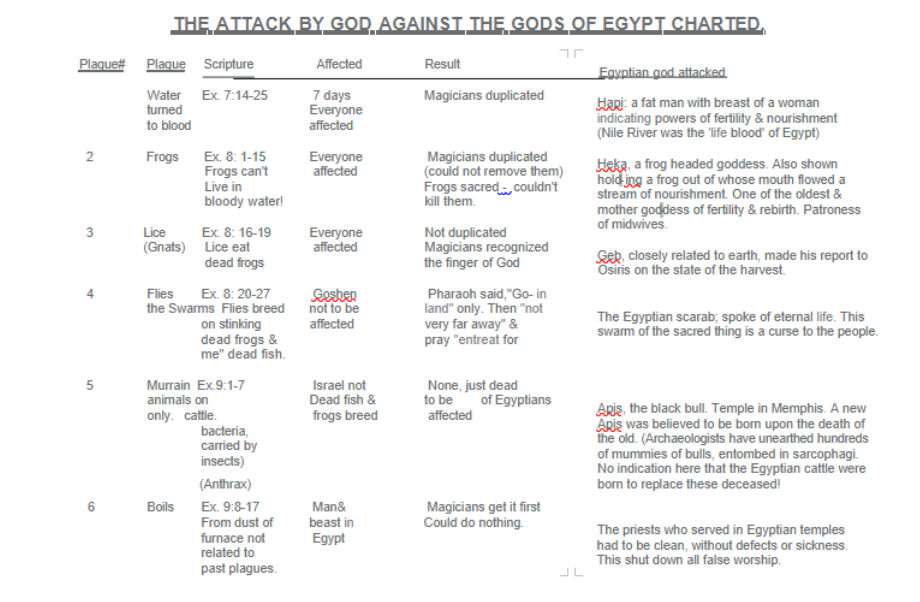
Let's look at the time of the Exodus where the Lord God attacks the gods of Egypt to show them who He is. To "multiply my signs and wonders in the land of Egypt." Exodus 7:3 "and against all the gods of Egypt I will execute judgment. I am the Lord." Exodus 12:12.
We are familiar with the 10 plagues necessary to free God's people from Egypt. First let us note that God took the man that we normally know as one of God's prophets, and made him His representative before the Pharaoh as "a god to Pharaoh." Exodus 7:1. Then He appointed Aaron to be the prophet of Moses. Pharaoh was elevated in Egypt as a god. God put Moses above him. At the word of Moses these plagues would occur! As God would use a prophet as spokesman, so Moses would have Aaron as his prophet.
Pharaoh asked the question "Who is the Lord, that I should obey His voice to let Israel go? I know not the Lord; neither will I let Israel go." Exodus 5:2
God was very considerate in dealing with this Pharaoh and the Egyptians. He warned Pharaoh at the beginning (call it a contest) "Either let my son go or I will slay your son." In Exodus 4:22,23, God claimed that the nation, "Israel is my son, even my firstborn." (They are in the line of promise - Genesis 3) God sent many plagues (warnings) before He touched the first born of Egypt, giving Pharaoh time to acknowledge God and let Israel
- The Pharaoh did not choose to take those opportunities and in the last plague this is what happened! Do we get any of these warnings today?
Now let's look at "The gods of Egypt"
At their first visit to Pharaoh, Aaron's rod was made a serpent. Exodus 7:10. (tannin, the Hebrew word as used in Psalm 74:12, 'leviathan', Isaiah 27:1 'leviathan the piecing serpent' and
Job 7:12 'whale' is some kind of amphibian, or aquatic creature. The most common in Egypt was the Crocodile. The first use for serpent was 'nashash' in chapter 4:3, here it is 'tannin= whale... In Jeremiah 9: 11 it is a dragon. In the books of Isaiah and Ezekiel it is rendered a dragon.) The same word can be rendered 'leviathan' or 'dragon'.
The Egyptians worshipped the Crocodile. Sebak was a deity of evil with a crocodile head. Apepi was the arch enemy of all the solar gods, and appeared in the form of a crocodile. The Egyptians engaged in a magical ritual in the temple of Amen-Ra in Thebes. Apepi was thought to try to prevent the rising of the sun god Ra. He stirred up lightning, thunder, storms, hurricanes, and rain, trying to block out the sun with clouds, mist, fog, and darkness. The Egyptian ritual was an effort to restrict Apepi. It was a prominent worship of Egypt and the first thing against which God delivers a blow.
The Apostle Paul mentions these magicians and uses them as an example in 2 Timothy 3:8, "now as Jannes and Jambres withstood Moses, so do these resist the truth, men of corrupt minds, reprobate concerning the faith." These Egyptian magicians had some limited power!
Do we encounter this type of person today? Those who "resist the truth, men of corrupt minds, reprobate concerning the faith."
7 Hail Ex. 9:18-35 Goshen not to be affected. Pharaoh admitted sin, & asked for prayers. VS27 VS 14-16 & 19-21 Warned to get cattle inside A chance for believers to avoid the hurt. Iris, goddess of the air, (supposed to control the rains, etc.)
8 Locusts Ex. 10: 1-20 The face of the earth in thy coast. All the trees, herbs, Etc God asks, "How long?" VS 3, Pharaoh asks "How long?" VS 7 Pharaoh admitted sin, & asked for prayers VS 16 The wind was worshipped in Egypt under the name Kneph. VS 11: Did not want to allow children to go. Pharaoh told them to go before the plague. (Conditional obedience)
9 Darkness Ex.10:21-29 The land of Egypt 3 days Darkness in the daytime, this judgment is against the sun god, Ra; the chief god they worshipped. (Ra or Re, depicted with a human body & head of a hawk. Main symbol - sun disk & obelisk. The chief temple was at the city of Heliopolis.
10 Death of Ex. 11& 12 the first born Death to the firstborn of Egypt, man
and beast. Pharaoh said "Go- take flocks & herds and be gone, and bless me also. Ch. 12: 31-32
- 12:12 "against all the gods of Egypt I will execute judgment: I am the Lord."
Final Red Sea Ex. 14:5-31 Death of all of the host of Pharaoh's
Army. Freedom for Israel Pharaoh Himself.
COMMENTS ON THE GODS OF EGYPT.
There was apostasy, even in the worship of false gods. People have a hard time remaining in the old paths. First they knew the true God, then they created their own gods, and then they changed the powers assigned to their creations. Example: Ra was, in the original system, considered the creator and controller of the universe. Ra later became associated with other 'important deities' particularly Amon and Horus. Worship of Ra was more general than other deities except Osiris and frequently combined with worship of Amun, Num, and Sebak. This produced the compound systems of Amun-Ra., Num-Ra, and Sebek-Ra; deities adored together.
But Ra came after Ptah. In ancient Egyptian mythology, one of the greatest and earliest gods described as "creator of the earth," father of the gods and the beings of this earth, "father of beginnings" was Ptah. Usually represented as a mummy with the symbols and spirit of life, power, stability, light, and truth. Had the power of both sexes within him and considered 'Double god'. The sacred beetle which brought forth "without the agency of sex" was placed on Ptah's shoulders as his head. Originally 'one god' (Monotheism) then later Polytheism, but Ptah always at the head of the 'gods'. Whatever gave life was worthy of their adoration
Osiris was one of the principle Egyptian deities. Originally the local god in the ancient cities of Abydos and Busiris on the western bank of the Nile (about 100 miles south of Thebes) where most of the ancient Egyptians kings are buried. Osiris represented the male productive force in nature and became identified with the setting
- He was considered the ruler of the realm of the dead in the mysterious region below the western horizon.
He was both brother and husband to Isis, goddess of the earth and the moon. Osiris, as king of Egypt, had a people very barbarous, and taught them law, agriculture, and religion. He was murdered by his brother Set. Set scattered his body, Isis found and buried the remains, and claimed that their son Horus was sired by a temporarily regenerated Osiris. Horus avenged his father's death by killing Set and then ascended to the throne. Osiris lived on in the underworld as the ruler of the dead, but also though Horus, regarded as the source of new life.
At the annual festival, great lamentation was made for Osiris's death. A bull was filled with bread, honey, and incense, drenched in oil and set afire. While the flames burned the people lamented, what remained of the sacrifice was eaten. A serpent was slain if effigy.
Blessing and life were good, but there was also evil in the world. There was a spirit of evil. He was the serpent called Typhon by the Greeks, the Egyptians called him Set, in Hebrew Satan.
Set was the genius of malevolence; a murderer, he slew Osiris.
Horus, in Egyptian Mythology, was god of the sky, light, and goodness. One of the major deities, the great helper, the pillar of the worlds. Horus, son of Isis, the nature goddess, and Osiris, the god of the underworld does honor to the spirit of his father. After Osiris was murdered by his evil brother Set, the god of darkness and evil, Horus avenged his father's death by killing his uncle. Worshipped throughout Egypt, Horus was usually shown as a falcon headed man. He is the genius of light. He rides in a sun-boat and stabs the serpent Apopi. He treads crocodiles under his feet. The form of the winged disc - triumphs over the Hippopotamus. Horus destroys shamelessness and sin when he is invoked. All mankind rejoiced when they see the sun and praise the son of Osiris and the serpent turns and flees. (Horus is the 'Apollo' of the Greeks.)
Lesser gods of Egypt:
Thoth - moon god (the head of Ibis)
Mat- goddess of truth. Her son the Jackal - headed Anubis.
The next, 4 genie called the Amenu who presided over embalming.
Chnun
Khem - the Greek 'Pan'.
Nit
Looking back at these myths, can we see how man has made gods even of other men?
In the story of the Exodus of the people of Israel and in the stories of gods of Egypt, can we determine if one god is as good as another? Was the religion of Egypt as good as that of the Chadeans? Is one religion just as
Text and illustrations reproduced from the study “Egypt and its gods”. The original PDF is the reference copy.