
Pagans
PAGANISM, HEATHENS, IDOLATRY: A heathen according to Webster is "one who does not believe in the God of the Bible; one who is neither a Christian, Jew, or Mohammedan; an irreligious person; pagan, unenlightened.
Also related to these are a WORSHIP of NATURE, PANTHEISM, and POLYTHEISM. Paganism is also the beliefs and practices in the worship of nature. Paganism may include Pantheism, a belief that the whole of everything is divine, (as the Bible says, "God is all
and in all," but this would not indicate that all things in nature should be worshipped as God.) Polytheism is a belief in many gods. Animism is belief that the natural features of the world are invested with divine powers. Divine is partaking of the nature of God, sacred and holy.
Paganism as it was before Christ and in the early years after Christ was stamped out by the Roman Empire around 400 AD, but by definition it still exists.
WHERE DID THE HEATHEN WORLD COME FROM? WHAT ARE THE SOURCES OF RELIGIONS?
We will deal with some of them here and some we will have to look into later.
Can without the truth of God's word is in a primitive state and ignorant, and incapable of
rightly directing his steps and religious tendencies. Proverbs 1:7, "The fear of the Lord is
the beginning of knowledge; but fools despise wisdom and instruction." You can have a doctorate in thinkology from the finest university, but to have real knowledge it is necessary that you have the fear of the Lord first, or all else is folly. Put another way in Proverbs 9:10, "The fear of the Lord is the beginning of wisdom: and the knowledge of the holy is understanding." What do we need first before we really know anything?
Remember Romans 1:21-23. Can we apply any of this to what is happening in religion today? "Because that, when they knew God, they glorified Him not as God, neither were they thankful; but became vain in their imaginations, and their foolish heart was darkened. Professing them selves to be wise, they became fools, and changed the glory of the uncorruptible God, into an image like corruptible man, and to birds, and four-footed beasts, and creeping things."
In his ignorance man bows down to whatever appeals vividly and forcefully to his imagination and understanding -natural phenomena such as rain, wind, thunder, the heavenly bodies; and so on.
Why is idolatry so emphatically denounced in the scriptures? It is denounced not as some kind of small error of the ways, but as the very essence of iniquity. Why are there such terrible penalties attached to it? How did these people get into such a condition of ignorance of God?
The first mention of idols (images) used as gods in the scriptures is in Genesis 31:18-42. They were stolen from Laban by his daughter Rachel. When Laban was searching for them, Rachel hid them in the camel's furniture. This would indicate the approximate size of these images used as gods. r1erse 30, 32, & 34) The importance of these gods to Laban. and Rachel is shown here by her need to steal them and Laban's pursuit of Jacob to get them back. They were not just household knick-knacks!
Jacob's family in some way blended the worship of false gods with the acknowledgment and worship of the true God. We will see this practice in various religions and sects as we look at the origins and practices in religions. This attempt to reconcile different and opposing principles and practices in religion is called syncretism. The religion of God perverted by dancing or sex orgies or adding symbols such as a Bull to represent God leads to total Paganism in time.
A good reading is found in Isaiah 45. This declares to the King of Persia who God is and what will become of the makers of idols.
In the New Testament we are told what an idol is. 1 Corinthians 8:1-7, verse 4b, "we know that an idol is nothing in the world", verse 5, "there be that are called gods."
And finally, in Revelation 21:8, "idolaters - shall have their part in the lake which burneth with fire and brimstone, which is the second death." (Burneth' indicates continuously) Rev elation 20:14, 15, "And death and hell were cast into the lake of fire. This is the second death, and whosoever was not found written in the Book of Life was cast into the lake of fire."
In Genesis 11 we had the human race as it existed gathered together in the land of Shinar: and we learned from Romans 1:18-29 that, although they knew God, they gave Him up, "they glorified Him not, neither were they thankful" "changed the glory of the uncorruptable God into an image made like corruptible man, and to birds, and fou-footed beasts, and creeping things." "changed the truth of God into a lie and worshipped and served the creature more than the Creator. "
What happened then?
"Wherefore God gave them up to uncleanness through the lusts of their own hearts." Etc. God gave them up in Genesis 11:1-9, confounded their language and scattered them. When did this occur? Genesis 10:25 gives us a clue. In the days of Peleg was the earth divided. God does have a point at which He will allow man to go his own way. Proverbs 1:29- 31, "for that they hated knowledge, and did not choose the fear of the Lord: they would have none of my counsel; they despised my reproof; therefore, shall they eat of the fruit of their own way, and be filled with their own devices."
God allowed nature to take its course for those who did not choose Him, those who rejected Him.
Let's keep an eye out for change; watch for changes in God's covenants with man, and in man's systems of religion. Watch for the sources of Paganism and Polytheism. Watch for evidences of Paganism today in our movies, television shows, and in the news.
POLYTHEISM
Many religions which turned to Polytheism originated with one God. Some of the ancient religions have had a clear tendency toward one superior God, and at one time had Monotheism, which is the belief in just one God. Polytheism is the belief in the existence of many gods or divine beings. These gods may represent forces of nature, objects, animals, insects, and birds, things in the heavens like stars, things on earth like mountains, rain, or fire. There is a mixture of animals and man in some forms represented as gods.
Polytheism has a relationship to a belief in various kinds of spirits or demons. This is also found in Animism, Totemism, and Ancestor worship. There is usually assigned a hierarchy to the various deities, and these are described in the sacred writings or myths.
Polytheism was prominent in the religion found in Egypt, Hinduism, and Roman or Greek Mythology. The Old Paganism had elements of forms from many religious ideas, including polytheism, witchcraft, and animal sacrifice.
The Christian people in some areas also digressed to forms of polytheism in the veneration of saints or angels, prayer to the Virgin Mary, use of holly, box, and bay, and Christmas trees in celebrations, and even songs honoring the Christmas tree or the Christ substitute, Santa Claus.
Theories as to why polytheism originated include a need for supernatural moral sanctions or for some assumption that they could appease the uncontrollable forces of nature. Sometimes there was a connection to the social structure in class distinctions such as when the Pharaoh of Egypt was considered a god or a son or god along with the veneration of many other objects as gods that controlled the forces of life.
In the first chapter of the book of Romans we have an explanation of how polytheism occurred. People knew God and the things of God had been shown to them. But when they knew God, they did not glorify Him as God and became vain in their imaginations, and they changed the glory of the incorruptible God into an image like unto corruptible man, and to birds, beasts, and creeping things. They changed the truth into a lie! This is common to what man has done to most religions, whether polytheist or monotheistic.
ANIMISM
Animism as the word sounds is from the Latin word anima, which would give the idea of something animal or animated. It is a theory of the existence of some force that is not material. It is the concept of 'breath or soul', to which all life and action are attributable. It is a belief that the soul is a vital principle upon which organic development depends. An Animist is one who believes that all nature is endowed with life. It is also a belief in spiritual beings. Some believe that the human mind is a non-material entity that interacts with the body by the brain and nervous systems.
All religions involve some form of animism. Even primitive peoples without written traditions, believe that spirits or souls are a cause of life in humans. There are ideas of phantoms, shadows, and spirits that can move from person to person or into plants, animals, and even lifeless objects. The Bible confirms the idea that man has a soul, or spirit, and that persons have life after leaving the body. It also speaks of other non- material beings such as spirits and angels. It should not be surprising than that religions of all kinds have used this concept and have imaged it in so many ways.
Christianity and the other religions such as the Islamic faith believe in a reward system in life after death for the soul. Conditions of obedience and faith are a vital part of these religions with the promise of salvation from sin and the wrath of God when these conditions are met. Heaven and Hell are waiting for the souls of men after this life is completed and the soul separates itself from the flesh.
CHALDEA
Where did that come from? This is the question we are asking. It is the same question we asked when considering Evolution. It is the same question we will ask with everything where we want an objective and reasonable view of things. This will be our question as we look at the sources of religions. We will look to the earliest sources of history, archaeology, and ancient mythology. From Ridpath's 'History of the World' published in 1914 we can find accounts of the principal events of the human race from its beginning to more modern times. Recent sources of history and especially archaeology can shed some light as do the older books, but can be suspect where obvious efforts to rewrite history are noted. The dispersion of the races into Egypt, Chaldea, Assyria, Media, Babylonia, Persia, Parthia, and Greece, along with their religious ideas can be found in these ancient history volumes. This information goes back to around 4000 BC.
The religious system of the Chaldeans began with the creation of the world. This was taught by the priests of Babylon and has been preserved in the fragment of Berosus and is as follows:
"Once all was darkness and water. In this chaos lived horrid animals, and men with two wings, and others with four wings and two faces, and others with double organs, male and female. Some had the thighs of goats and horns on their heads; others had horse's feet, or were formed behind like a horse and in front like a man. There were bulls with human heads, and horses and men with heads of dogs, and other animals of human shape with fins like fishes, and fishes like sirens, and dragons, and creeping things, and serpents, and wild creatures, the images of which are to be found in the temple of Bel."
"Over all these ruled a woman of the name of Omorka. But Bel divided the darkness and clove the woman asunder, and of one part he made the earth, and of the other the sun and moon and planets: and he drew off the water and proportioned it to the land, and prepared and arranged the world. But those creatures could not endure the light of the sun and became extinct."
"When Bel saw the land uninhabited and yet fruitful,l he smote off his head and bade one of the gods mingle the blood which flowed from his head with earth, and form therewith men and animals and wild creatures who could support the atmosphere. A great multitude of various tribes inhabited Chaldea, but they lived without any order, like the animals."
"Then there appeared to them from the sea, on the shore of Babylonia, a fearful animal of the name of
- His body was that of a fish, but under the fish's head another head was attached, and on the fins were feet like those of a man, and he had a man's voice. The image of the creature is still preserved. The animal came at morning, and passed the day with man, but he took no nourishment, and at sunset went again to the sea, and there remained for the night. The animal taught men language and science, the harvesting of seed and fruits, the rules and boundaries of land, the modes of building cities and temples, arts and writing, and all that pertains to the civilization of human life."
The legends of Berosus, a third century priest, author of a history of Chaldea and Assyria, are known to us because of the writings of Eusebius of Caesarea in the third century AD.
A story of the great flood was also told by the Chaldeans as is found in most early stories of beginnings found in Europe, Asia, Africa, and the Eskimos and 'Indians' of the Americas. The Chaldean version is called 'The Gilgamesh Epic' and was translated from tablets found in the library of King Assurbanipal of the period 669-626 B.C. This account has some similarities to the Biblical account and is a relatively recent Archaeological discovery.
In the origin of religion in Chaldea the names of Bel and Nimrod are some what confused...
- (Isaiah 46:1) supreme god of the Babylonians is a Chaldaic form of Baal and is also used in the sense of being "Lord" or "owner". Bel presided over the air. His consort was Be/it. Bel has been identified with the Greek god Zeus but with some differences. As Bel-Merodach, the god was connected with the planet
Jupiter in astral mythology with the productive power of nature. (this god was also called 'Be/us' by the Greeks.)
Bel had titles such as "the Supreme." "The Procreator or the Lord of spirits."
There is some confusion between what the titles and offices of Bel and those of the 'Half Mythical' Nimrod were after Nimrod's deification. When the great hunter was enrolled among the gods his attributes and epithets were merged with that of Bel. In later times there was little distinction between the deified Nimrod and Bel. Genesis 10:8-10 "And Cush begat Nimrod: he began to be a mighty one in the earth. He was a mighty hunter before the Lord; wherefore it is said, Even as Nimrod the mighty hunter before the Lord, and beginning of his kingdom was Babel, and Erech, and Accad, and Calneh, in the land of Shinar."
The hero god Bel-Nimrod or "the Hunter Lord" had his chief seat of worship at Calneh or Nipur. Be/tis was the wife of Nimrod... Together with Anu and Hea he consulted a trinity of Chaldean gods.
Lesser gods.
Hea - Fish monster who taught the Chaldeans letters and Astronomy. "Giver of good gifts". Sometimes called "Lord of the Abyss" or "Lord of the Sea." Like Poseidon of the Greeks his symbol was the serpent, the common emblem among the oriental nations of superhuman wisdom. Dav-kina was his queen. (Isn't this interesting that a creature relating to a serpent would show up to instruct people. It has a similar creature as in the story in the Garden of Eden with Adam and Eve.)
Gods of the planets.
Sin - Moon god - earlier name was Hurk, same root as Ur, the city of worship.
Sames -god of the sun - (symbol is the circle)
Bin - Storm god - Uranus of the Greeks
Adar - The Lord of Saturn (Semitic names = Bar & Nin.)
Oan -who taught Chaldeans art and science.
Merodach - (the most ancient) "The old man of the gods" God of judgment, justice, and right. (from the earlier worship system) Even then they could not stay on the old paths, but had changes - apostasy. Zirbanit was his queen.
Nergal -Planet Mars - King of battles and champion of the gods.
Bilit- Planet Venus - The Lady, 'queen mother of the gods' - fertility and birth. Opposed to this goddess was /star, the 'goddess of war and ruin.'
Nebo- Planet Mercury - Forethought, intelligence, and prophecy. (Not one of the early gods.)
The source of these gods was the Zodiac. The affairs of life seemed to receive their laws and conditions from the skies. The antecedents of good and evil were the stars. Merodach was the author of good. Adar, the breeder of evil.
The Chaldean religion , while telling us their origins, and a wide variety of gods with interesting stories, does not follow the line of the savior, and offers us no future with God. The stories do not connect us to a promise of the 'seed of the woman' but fit the writing in Romans 1: 22, 23... "changed the glory of the uncorruptable God into an image made like corruptible man, and to birds, and four-footed beasts, and creeping things... "
The curse on the Chaldeans because of their images and idols is in Jeremiah, chapters 50 and 51.
EGYPT
In Genesis chapter 12 we are introduced to the land of Egypt. In the time of Abraham (about 2000 BC) the Egyptians had a Pharaoh. What else did they have at this time?
Remember Romans 1:22-23, "Professing themselves to be wise, they became fools and changed the glory of the uncorruptable God into an image like to corruptible man, and to birds, and four footed beasts, and creeping things."
The gods of Egypt were either animal, bird, or insect. They had deities which represented every phase of life. They changed one God into many gods (Polytheism). They believed, as many others have, in one Great God, almighty, and eternal. But... they considered 'that this being was too great and mighty to concern Himself with the affairs and destines of humans'. So... He 'permitted the management of this world ... to hordes of "gods" and demons, good and bad spirits.' This is what the Egyptians believed.
This was also how the Apostle Paul found things when he went to Greece; in Athens he found the monument 'to the unknown God'. Acts 17:23. If a man worships all these different gods he cannot know the living and true God. Even today from Mars Hill in Athens you can see the Parthenon with all of its temples for various gods.
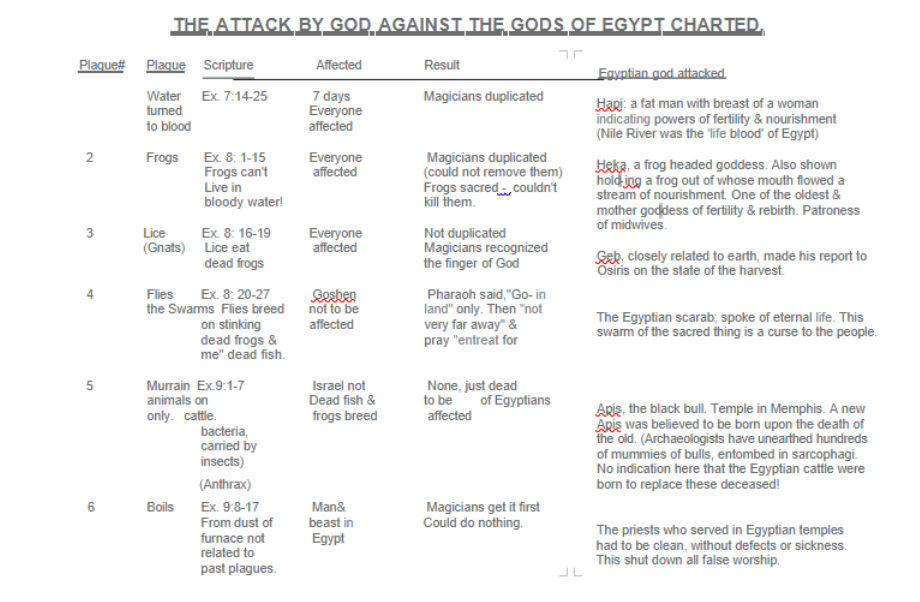
Let's look at the time of the Exodus where the Lord God attacks the gods of Egypt to show them who He
- To "multiply my signs and wonders in the land of Egypt." Exodus 7:3 "and against all the gods of Egypt I will execute judgment. I am the Lord." Exodus 12:12.
We are familiar with the 10 plagues necessary to free God's people from Egypt. First let us note that God took the man that we normally know as one of God's prophets, and made him His representative before the Pharaoh as "a god to Pharaoh." Exodus 7:1. Then He appointed Aaron to be the prophet of Moses. Pharaoh was elevated in Egypt as a god. God put Moses above him. At the word of Moses these plagues would occur! As God would use a prophet as spokesman, so Moses would have Aaron as his prophet.
Pharaoh asked the question "Who is the Lord, that I should obey His voice to let Israel go? I know not the Lord; neither will I let Israel go." Exodus 5:2
God was very considerate in dealing with this Pharaoh and the Egyptians. He warned Pharaoh at the beginning (call it a contest) "Either let my son go or I will slay your son." In Exodus 4:22,23, God claimed that the nation, "Israel is my son, even my firstborn." (They are in the line of promise - Genesis 3) God sent
many plagues (warnings) before He touched the first born of Egypt, giving Pharaoh time to acknowledge God and let Israel go. The Pharaoh did not choose to take those opportunities and in the last plague this is what happened! Do we get any of these warnings today?
Now let's look at "The gods of Egypt"
At their first visit to Pharaoh, Aaron's rod was made a serpent. Exodus 7:10. (tannin, the Hebrew word as used in Psalm 74:12, 'leviathan', Isaiah 27:1 'leviathan the piecing serpent' and
Job 7:12 'whale' is some kind of amphibian, or aquatic creature. The most common in Egypt was the Crocodile. The first use for serpent was 'nashash' in chapter 4:3, here it is 'tannin= whale... In Jeremiah 9: 11 it is a dragon. In the books of Isaiah and Ezekiel it is rendered a dragon.) The same word can be rendered 'leviathan' or 'dragon'.
The Egyptians worshipped the Crocodile. Sebak was a deity of evil with a crocodile head. Apepi was the arch enemy of all the solar gods, and appeared in the form of a crocodile. The Egyptians engaged in a magical ritual in the temple of Amen-Ra in Thebes. Apepi was thought to try to prevent the rising of the sun god Ra. He stirred up lightning, thunder, storms, hurricanes, and rain, trying to block out the sun with clouds, mist, fog, and darkness. The Egyptian ritual was an effort to restrict Apepi. It was a prominent worship of Egypt and the first thing against which God delivers a blow.
The Apostle Paul mentions these magicians and uses them as an example in 2 Timothy 3:8, "now as Jannes and Jambres withstood Moses, so do these resist the truth, men of corrupt minds, reprobate concerning the faith." These Egyptian magicians had some limited power!
Do we encounter this type of person today? Those who "resist the truth, men of corrupt minds, reprobate concerning the faith."
7 Hail Ex. 9:18-35 Goshen not to be affected. Pharaoh admitted sin, & asked for prayers. VS27 VS 14-16 & 19-21 Warned to get cattle inside A chance for believers to avoid the hurt. Iris, goddess of the air, (supposed to control the rains, etc.)
8 Locusts Ex. 10: 1-20 The face of the earth in thy coast. All the trees, herbs, Etc God asks, "How long?" VS 3, Pharaoh asks "How long?" VS 7 Pharaoh admitted sin, & asked for prayers VS 16 The wind was worshipped in Egypt under the name Kneph. VS 11: Did not want to allow children to go. Pharaoh told them to go before the plague. (Conditional obedience)
9 Darkness Ex.10:21-29 The land of Egypt 3 days Darkness in the daytime, this judgment is against the sun god, Ra; the chief god they worshipped. (Ra or Re, depicted with a human body & head of a hawk. Main symbol - sun disk & obelisk. The chief temple was at the city of Heliopolis.
10 Death of Ex. 11& 12 the first born Death to the firstborn of Egypt, man and beast. Pharaoh said "Go- take flocks & herds and be gone, and bless me also. Ch.
12: 31-32
- 12:12 "against all the gods of Egypt I will execute judgment: I am the Lord."
Final Red Sea Ex. 14:5-31 Death of all of the host of Pharaoh's Army. Freedom for Israel Pharaoh Himself.
COMMENTS ON THE GODS OF EGYPT.
There was apostasy, even in the worship of false gods. People have a hard time remaining in the old paths. First they knew the true God, then they created their own gods, and then they changed the powers assigned to their creations. Example: Ra was, in the original system, considered the creator and controller of the universe. Ra later became associated with other 'important deities' particularly Amon and Horus. Worship of Ra was more general than other deities except Osiris and frequently combined with worship of Amun, Num, and Sebak. This produced the compound systems of Amun-Ra., Num-Ra, and Sebek-Ra; deities adored together.
But Ra came after Ptah. In ancient Egyptian mythology, one of the greatest and earliest gods described as "creator of the earth," father of the gods and the beings of this earth, "father of beginnings" was Ptah. Usually represented as a mummy with the symbols and spirit of life, power, stability, light, and truth. Had the power of both sexes within him and considered 'Double god'. The sacred beetle which brought forth "without the agency of sex" was placed on Ptah's shoulders as his head. Originally 'one god' (Monotheism) then later Polytheism, but Ptah always at the head of the 'gods'. Whatever gave life was worthy of their adoration
Osiris was one of the principle Egyptian deities. Originally the local god in the ancient cities of Abydos and Busiris on the western bank of the Nile (about 100 miles south of Thebes) where most of the ancient Egyptians kings are buried. Osiris represented the male productive force in nature and became identified with the setting sun. He was considered the ruler of the realm of the dead in the mysterious region below the western horizon. He was both brother and husband to Isis, goddess of the earth and the moon. Osiris, as king of Egypt, had a people very barbarous, and taught them law, agriculture, and religion. He was murdered by his brother Set. Set scattered his body, Isis found and buried the remains, and claimed that their son Horus was sired by a temporarily regenerated Osiris. Horus avenged his father's death by killing Set and then ascended to the throne. Osiris lived on in the underworld as the ruler of the dead, but also though Horus, regarded as the source of new life.
At the annual festival, great lamentation was made for Osiris's death. A bull was filled with bread, honey, and incense, drenched in oil and set afire. While the flames burned the people lamented, what remained of the sacrifice was eaten. A serpent was slain if effigy.
Blessing and life were good, but there was also evil in the world. There was a spirit of evil. He was the serpent called Typhon by the Greeks, the Egyptians called him Set, in Hebrew Satan.
Set was the genius of malevolence; a murderer, he slew Osiris.
Horus, in Egyptian Mythology, was god of the sky, light, and goodness. One of the major deities, the great helper, the pillar of the worlds. Horus, son of Isis, the nature goddess, and Osiris, the god of the underworld does honor to the spirit of his father. After Osiris was murdered by his evil brother Set, the god of darkness and evil, Horus avenged his father's death by killing his uncle. Worshipped throughout Egypt, Horus was usually shown as a falcon headed man. He is the genius of light. He rides in a sun-boat and stabs the serpent Apopi. He treads crocodiles under his feet. The form of the winged disc - triumphs over the Hippopotamus. Horus destroys shamelessness and sin when he is invoked. All mankind rejoiced when they see the sun and praise the son of Osiris and the serpent turns and flees. (Horus is the 'Apollo' of the Greeks.)
Lesser gods of Egypt:
Thoth - moon god (the head of Ibis)
Mat- goddess of truth. Her son the Jackal - headed Anubis.
The next, 4 genie called the Amenu who presided over embalming.
Chnun
Khem - the Greek 'Pan'.
Nit
Looking back at these myths, can we see how man has made gods even of other men?
In the story of the Exodus of the people of Israel and in the stories of gods of Egypt, can we determine if one god is as good as another? Was the religion of Egypt as good as that of the Chadeans? Is one
religion just as good as the other?
TORAH - HEBREW
In the continuous line of our timeline of God's dealings with man, we began with the creation and God's dealings with Adam and Eve. We were able to see the fall of man kind from the paradise God had created for them and the beginning of sin against God. Sin may be defined as a missing of the mark, or also as a rebellion against God and His requirements for man. The first law of God would appear to be very simple to follow and understand "Do not eat of the tree of Knowledge of Good and Evil". Soon the influence of that third party called Satan corrupted all of mankind except one line of patriarchs which resulted in the selection by God of a man named Noah who was still faithful to God and His law of sacrifice. Then God destroyed all of the evil persons in the world with a deluge, a flood, and saved Noah and His family. The
story of this flood is told in the Holy Bible in the book of Genesis. It is also found in Archaeology and History in the 'epic of Gilgamesh, and in folklore of almost every civilization.
The Torah, also called the Pentateuch, is the cornerstone of the Hebrew religion. The Pentateuch consists of the first five books of the Bible, which in order are Genesis, Exodus, Leviticus, Numbers, and Deuteronomy. The Pentateuch presents the continuous story from the creation to the death of Moses and the preparation of the People descending from the patriarch Israel, to enter the land of Canaan as promised to them and overseen by God.
When Adam and Eve, the first people sinned against God the penalty for that sin was death. Adam knew that he had sinned and learned that he was naked. He tried to cover that nakedness with fig leaves sewn together. God in His mercy provided an animal to provide a 'coat of skins and clothed' them, covering their
- God provided the first sacrifice of an animal to protect man from separation from God and the spiritual death resulting, by shedding the blood of this animal. God required the sacrifice of animals in worship to Him as told in the story of the sacrifices of Cain and Abel. God also promised that the seed of
Abraham, Isaac, and Jacob, (Israel) would bring the earth a savior from man's sin, and allow man to be re- deemed, or made whole, before God again.
After the flood and the re-habitation of the earth by the descendants of Noah, God's dealing with mankind again involved the sins of man and the breakup into nations and languages as recorded in the story of the building of the Tower of Babel, which violated the requirement of God's law to 'replenish the earth'. Man had begun to build large cities and were honoring men and forgetting God.
God choose a righteous, but not perfect man, to carry the seed of the woman from the promise in Genesis three, and then promised his son Isaac, and grandson, Jacob, that they also would carry that seed of promise. From the line of Israel, it was to be Judah that continued the line and down though the generations to David, and finally to Jesus, from His mother Mary who was of this seed
The Old Testament books from Joshua to Malachi follow the adventures of this race, and record the prophecies of the coming Savior. These books also tell of the failing of the people of Israel who failed to remain faithful to God, the many ways they rebelled against Him, and how they went after other gods of the pagan people who lived around them. In many ways and times they returned to God and were restored to His religion and followed His commandments, but eventually, as had been foretold, they were brought into captivity for rejecting God's commandments. After a period of captivity in foreign lands there was a return of the remnant of the people, and a temporary return to God.
The details of this timeline of history which was the true religion of the one true God is given in the Old Testament although the order of the books are not arranged according to the time sequence in which they occurred. It should be noted that while God had selected the line of Abraham to carry the seed of the Savior, these were not the only people who were faithful to God. Abraham, himself acknowledged Melchisedec as a king and priest of the Most-High God; Moses married a daughter of the priest of Midian; Nebuchadnezzar, King of Babylon was shown and acknowledged the power and majesty of the Most High God; Jonah was sent to Nineveh to preach repentance and the people there did repent and acknowledge God.
The story line of this religion and the men in God's plan for redemption brings us through the captivity in Egypt and the Exodus, or departure from Egypt, the conquest of the land that God had already promised them in Canaan, the continuing conflict between the people of Israel and their neighbors, the frequent
worship of other gods and their return to the God of Heaven, the building of the empire through the times of Kings David and Solomon, the divided kingdom, the decline of the kingdoms, and the subsequent enslavement and emancipation. The stories of the King of Israel and Judah are told with regard to their faithfulness and following God's commandments. Whether these Kings purged the land of the gods of the pagans, or whether they were themselves wicked Kings is told in vivid detail. All of the sins of these kings are brought to light, even the sins of King David who was overall a man after God's own heart.
The laws and commandments to God's people were given to Moses beginning with the Ten Commandments listed in Exodus 20, and including the laws of worship, health and cleansing, food restrictions, social, moral and criminal. Rituals and priests were established and were to be maintained by the tribe and descendants of Levi, a son of Israel. These laws were recorded in the books of Exodus, Leviticus, Numbers, and repeated in the book of Deuteronomy.
The prophets show the call for the return to God when the people strayed away, foretelling of the doom to come because the people did not listen to the prophets of God, and the foretelling of details of the promised Savior, as to when He would come, where He would be born, what His attributes would be, and even of His suffering and death as the sacrifice for the sins of the world. These prophecies are recorded many times in the New Testament as having been completed by Jesus’ birth, life, death, and resurrection from the dead.
There is evidence that there were people who had continued to be faithful to the Hebrew religion even as the period of the years B.C. (Before Christ or before the Christian era) ended and the period of time A.O. (C.E. - Christian era) began. In Luke chapter one, Zacharius a priest in mentioned, and his wife Elisabeth, were both righteous before God. Joseph and Mary are mentioned and Mary was said to be highly favored of the Lord. Cornelius was called a devout man and one that feared God, as recorded in Acts, chapter ten. In Acts, chapter 8, a man from Ethiopia, a man of great authority under the Queen of the Ethiopians had come to Jerusalem to worship and was found reading from the writings of Isaiah, the prophet of God.
This was the true religion of God, and there was no other religion equal to it, because this was the religion established and nurtured by the one true and Holy God. It's purpose was to protect the seed of the Savior and the laws and commandments, the holding of a nation together, the prophets, the Torah and the writings, the priests and religious system, worked together to accomplish this.
When the time was fulfilled as written of by the prophets, the Savior was born into this world, lived the perfect life, declared Himself by miracles and signs, taught His disciples, was rejected as foretold and was crucified, rose again from the dead, and ascended into heaven. Mission accomplished! After His ascension His church was established by His disciples and the need and purpose for the Hebrew religion was complete.
Every scripture and prophecy speaking of the kingdom of Christ in the Hebrew period, every scripture before Acts chapter 2 in the establishment of the church (the Kingdom), speaks of it as in the future. Every scripture after Acts 2 speaks of it as being in existence. In Daniel 2:44 the prophecy is made that the Kingdom will be established. In Matthew 3:1-2, John the Baptist in found preaching that the Kingdom of Heaven is at hand. In Matthew 16: 18 & 19 Jesus said "I will build my church" and gave Peter the "keys to the Kingdom of Heaven", The Lord's church and His kingdom are mentioned as one and the same. In Colossians 1:13 we read that the Father, (God) "has translated us into the kingdom of His dear Son" This is past tense, meaning it is already done, not a future event.
The law of the Hebrew religion had completed its purpose and was nailed to the cross of Christ. Colossians 2:14 "Blotting out the handwriting of ordinances that was against us, and took it out of the way, nailing it to His cross". Galatians 3: 16 to the end of the chapter explain the promise, the law, and the new faith in Christ very well. Excerpts from this passage read "Now to Abraham and his seed were the promises made"- one seed- "which is Christ. And this I say, that the covenant was confirmed before of God in Christ, the law, which was 430 years after, cannot dis-annul, that it should make the promise of none effect, for if the inheritance be of the law, it is no more of promise: but God gave it to Abraham by promise. Wherefore then serveth the law? It was added because of transgressions, until the seed should come to whom the promise was made; and it was ordained by angels in the hand of a mediator. Now a mediator is not a mediator of one, but God is one. But the scripture has concluded all under sin, that the promise by faith of Jesus Christ might be given to them that believe. But before faith came, we were kept under the law, shut up unto the faith which afterwards should be revealed. Wherefore the law was our schoolmaster to bring us unto Christ, that we might be iustified by faith. But after that faith is come, we are no longer under a schoolmaster. For you are all the children of God by faith in Christ Jesus. For as many of you as have been baptized into Christ have put on Christ"
In 2 Timothy 2:15 is says, "Study to show yourself approved unto God, a workman that needeth not to be ashamed, rightly dividing the word of truth". It is necessary when looking at religions to keep in mind the time period of God's dealing with man. The early periods in the Bible tell of God's dealings with the Patriarchs, (Heads of families) After the law of Moses was established that people were to live under that law as defined in the Old Testament (covenant), The early books of the New Testament tell of the life of Jesus the Christ who lived under the law of Moses. The establishment of the church of Christ begins in Acts 2 and the remainder of the New Testament is written to establish and provide the ordinances of His church. The teachings found in these epistles written by the Apostles and Disciples of Christ are what are to be binding on the church today. The law of Christ and the commandments given in the New Testament has not been changed. Jude verse three tells Christians" that you should earnestly contend for the faith which was once delivered unto the saints," and he goes on to warn us that men will come to corrupt the faith, even denying the only LORD God; and our Lord Jesus Christ" The Apostle Paul warned many times that there would be those that would pervert the Gospel of Jesus Christ. In Galatians 1:6-9 he wrote, "I marvel that you are so soon removed from him that called you into the grace of Christ unto another gospel; which is not another; but there be some that trouble you, and would pervert the gospel of Christ. But though we. or an angel from heaven. preach any other gospel unto you . let him be accursed. As we said before, so say I now again, If any man preaches any other gospel unto you than that you have received let him be accursed."
Is any other religion as good as the Gospel of Jesus Christ? Is any other church or religious organization as good as the church of Jesus Christ? Does any other religion follow the promises of God as does the church of the New Testament? Is one religion as good as another? Does another religion promise eternal life with God both here and in the afterlife to come? Does another religion offer peace within and the blessing of God's promises as does the religion of Jesus Christ?
The Hebrew religion is no longer needed, nor is it followed. The Christian religion has superseded it. The Jewish religion does not follow it and no longer follows the ritual, sacrifices, feast days, or priesthood of the Hebrew religion.
HINDUISM
Hinduism goes back to about 2000 BC., about the time of Abraham. It began in India. It is still practiced today in India, East and South Africa, Southeast Asia, the East Indies, and some in England and the Americas. Hinduism is a major world religion with many followers.
About 1500 BC, about the time of Moses, it was influenced toward the 'pantheon of gods' and by the 6th century BC Buddhism had an interaction with Hinduism. Over the course of time it has absorbed parts of many religions, and has a wide variety of beliefs and practices. It induces whatever all the people have believed and practiced and has become a social system extending into every aspect of life. Hinduism is defined by what people do, rather than what they think. Very few practices are shared by all.
Most Hindus worship Shiva, Vishnu, or Devi the goddess, but they also worship many other minor deities peculiar to a particular family or village.
They worship some major gods and like the Egyptians also have a wide variety of lesser gods. Magic spells and the belief in reincarnation are important to this religion. People are born into classes and have to try to achieve a better class the next time they live. They also may return as animals or plants, or even as a mineral.
Hindus believe the universe is a large enclosed sphere, within this sphere are concentric heavens, hells, oceans, and continents, and of course, India at the center. Time is first degenerative, going from the golden age, through two periods of decreasing goodness, to the present age. Time is cyclic, and at the end of each age, the universe is destroyed by fire and flood, and a new golden age begins. Human life is also cyclic. After death, the soul leaves the body and is reborn in another form, a person, animal, vegetable, or mineral. The quality of life in the new birth has been determined by the merit or demerits resulting from all the actions that the soul has performed in its past lives.
Their writings, in the form of 'Epics,' are from 200 BC to AD 500. There are hymns written around 1300 to 1000 BC to a pantheon of gods still used today. There is a textbook for sacrifice and a book of magic spells added around 900 BC. There are writings on the mystical and philosophical meditations about the meaning of existence and the nature of the universe.
The Vedas; these old writings are the original authority for all Hindus regarded as what has been heard from the gods. The Smriti, 'What is remembered' is orally preserved. There is no prohibition to making variations, rewording, or challenging the Smriti. There are other epics or stories which were written at much later dates, probably between 300 BC and 300 AD.
There were 3 classes of people (Brahman) -priestly, warrior, and general populace. A fourth class was added around 600 BC, the 'renouncer' whose goal is to be released from the stages the others have as goals and debts. The Brahman denotes the priest who speaks with cosmic power.
Vishnu is the supreme god, from whose navel a lotus sprang, giving birth to the creator who is called Brahma. Vishnu created the universe, separating heaven and earth. He has rescued it on a number of occasions. He is worshipped in various forms of incarnations, such as fish, the tortoise, or the boar. Other forms are the dwarf, a man-made lion, the Buddha, and some who were originally human heroes. There are gods and goddesses.
Our question has been, "Where did that come from?
There was, about 2000 BC, in the area now called India a people referred to as the 'Vedic Civilization'. About 1500 BC, lndoAryan tribes invaded India and brought with them their European pantheon of gods with a warrior ethic, very worldly, yet religious. By the 6th century BC Buddhism began to have an interaction with Hinduism.
There is no connection to the 'seed of the woman' of Genesis here, no promised savior, and life after death is conditional to past lives, yet there is no remembrance of the past life to base a knowledge of what it takes to gain a better afterlife. There is the same evidence of religion based on the works of that third party, and the host of fallen angels that follow him.
Jude in his little epistle tells us that we should "earnestly contend for the faith which was once delivered to the saints, for there are certain men crept in unawares, who were before of old ordained to this condemnation, ungodly men, turning the grace of God in lasciviousness, and denying the only Lord God, and our lord Jesus Christ. I will therefore put you in remembrance, though you once knew this, how that the Lord , having saved the people out of the land of Egypt, afterward destroyed them that believed not. And the angels, which kept not their first estate but left their own habitation, He has reserved in everlasting chains under darkness unto the judgment of the great day. Even as Sodom and Gomorrah, and the cities about them in like manner, giving themselves over to fornication, and going after strange flesh, despise do minion, and speak evil of dignities. Yet Michael the archangel, when contending with the devil he disputed about the body of Moses, dared not bring accusation, but said, The Lord rebuke you. But these speak evil of those things which they know not, but what they know naturally as brute beasts, in those things they corrupt themselves. Woe unto them! For they have gone the way of Cain, and ran greedily after the error of Balaam for reward, and perished in the gain saying of Core."
The works of the devil are everywhere in religion, yet we must be careful in reviewing various religions that we do not bring accusations, or make judgments which are not ours to make. If Michael the archangel would not bring accusation against the devil; we had best not do it either. His works we can see, his pattern of leading men like Cain, those of Sodom and Gomorrah, and all the religions of the world on a path opposing God, distorting the original truth and the commandments of God as he did with Adam and Eve; providing alternative gods and rules of life, will lead us to suffer the vengeance of eternal fire as well.
Transcendental Meditation is a religion based on Hinduism. It was founded in 1959 in California by Maharishi Mahesh. It has its headquarters in Washington, D. C. USA. It uses Hindu writings and the book, 'Science of Being and the Art of Living', and other writings by the founder.
Also based on Hindu teaching is Hare Krishna, a religion variation found by AC. Swami Bhaktivedanta Prabhupada. The variation was founded in 1965 in New York, N.Y. USA. Prabhupada distributed 'Back to the Godhead' magazine, his commentaries on Hindu scriptures.
Our question is "Is one religion as good as another?" Is Hinduism as good as those religions that were practiced in Chaldea and Egypt. Many aspects of pantheism and polytheism look very similar here. Of course, they did add a few features, but is this religion as good as what we need to find eternal life with God?
Text and illustrations reproduced from the study “Pagans”. The original PDF is the reference copy.