
Hebrews
Cecil N. Wright
Epistle to the Hebrews
INTRODUCTION
- Content. Its author refers to it as a "word of exhortation" (13:22) -- an expression used in Acts 13:15 of a sermon or homily. And its structure is said to show many parallels to a synagogue sermon: (a) thesis (1:1-4), (b) development of arguments in a logical order, and (c) interspersed with hortatory [exhort, encourage –rd] sections ("let us"). Significantly, its exhortations are strongly based doctrinally. Chapters 1:1 to 10:18 are predominantly doctrinal, with exhortations interspersed; Chapters 10:19 to 13:17 are predominantly hortatory, interwoven with related instruction; and Chapter 13:18-25 ends the document with personal messages, including one brief exhortation (v.22). Moreover, no part of Holy Writ is more replete with typology -- Old Testament type and corresponding New Testament antitype.
Style. The document has been described as beginning like an essay or treatise (1:1-4), proceeding as a sermon (through 13:17), and ending like an epistle or letter (13:18-25) -- in v.22 even using the verb epesteila ("I have written"), the usual expression for writing a letter, and in the AV is rendered "I have written a letter." But it ends without identifying its author or naming the locale of its addresses. They seem, however, to have been well acquainted with each other (v.19; 10:34 AV) and mutually acquainted with Timothy (v.23), a convert of and fellow worker with the apostle Paul. It could be that the epistle was designed for a wider readership than those to whom originally sent and its writer left anonymous to prevent its rejection because of prejudice against him (a view early held), though messengers bearing it would likely inform those to whom first sent. (See the third paragraph of the next section.)
- Authorship. The ancient church in the East considered it to be of Pauline authorship. But that view was not always to be uncritically held elsewhere. Clement of Alexandria (155-215 A.D.) held that Paul wrote the epistle in Hebrew and Luke translated it into Greek (because, while compatible in sentiment with Paul’s other epistles, in the main its Greek is more polished and its literary style more elevated and rhetorical than theirs) -- and later,
Eusebius (263-339) A.D.) saying some believed Luke translated it, and others that Clement of Rome did, himself believed the latter more probably did because its style was more like Clement’s. (Yet no witness for a Hebrew original has ever been cited, and the opinion that there was one rests on no historical basis; besides, it seems to be the consensus of language experts that the text in Greek does not read like a Greek translation.) In the West, Tertullian (160-230 A.D.) held that Barnabas was its author. Origen (about 185-254 A.D.), however, expressed himself as follows: "But I would say, that the thoughts are the apostle’s, but the diction and phraseology belong to someone who has recorded what the apostle said, and as one who noted down at his leisure what his master dictated. If, then, any church considers this Epistle as coming from Paul, let it be commended for this, for neither did those ancient men deliver it as such without cause. But who it was that really wrote the Epistle, God only knows."
Significantly, nobody questioned its inspiration. And by the middle, and especially near the end, of the 4th century (the 300s) its authorship was generally accepted as Pauline, without the qualifications of Clement of Alexandria, Eusebius, and Origen as mentioned above, and without being seriously challenged again for more than eleven hundred years, in the sixteenth century, when, during the Protestant Reformation, the question of authorship was reopened.
Other names that have been suggested as probable authors (not as translators or as amanuenses) include Apollos, Luke, Barnabas, Sylvanas, and Clement of Rome. Also, Priscilla (with the assistance of her husband,
Aquila) was suggested in 1900 A.D. by Harnack, a German theologian. (Except for Clement of Rome [who died A.D. 97?], these were personal friends and fellow workers with Paul and presumably would have reflected his theology. All are purely speculative, of course.)
Because of uncertainty as to authorship on the part of some during the Reformation era, this document occupies a unique position in the New Testament scriptures in the order we now have them in most English versions -- the same as in the Latin manuscripts, beginning before unequivocal acceptance of Pauline authorship -- namely, between the definitely Pauline epistles and the so-called general epistles. Had it been considered of Pauline authorship for certain, it likely would have been placed, because of its length, after 2 Corinthians. However, in most of the Greek manuscripts it occurs between 2 Thessalonians and 1 Timothy.
Some have insisted, however, that the very fact that the document is anonymous is presumptive evidence that it was written by Paul, the historical situation being what it was. It was alleged by various early church "fathers" that he did not affix his name to it least its appearance might prevent many of his Jewish brethren from reading it, and judging it on its own merits. And that there was no other against whom there was so strong and general prejudice among both the converted and unconverted Jews of that age, is an uncontroverted fact of history.
Perhaps the strongest argument against Pauline authorship is that in 2:1-4 the writer seems to place himself among those to whom the gospel had been brought by men who had heard the Lord and through whom it had been confirmed by miracle, whereas Paul is on record as explicitly disavowing that he had received it from man or had been taught it except "through revelation of Jesus Christ" (Galatians 1:11-12).
But Robert Milligan, in the introduction to his commentary on Hebrews (pp.14-15), in this reply: "Does not the author often associate himself with his readers for the purpose of more effectually winning their hearts and softening his own admonitions? In the sixth chapter of this same Epistle, the author says, ‘Wherefore leaving the first principles of the doctrine of Christ, let us go on to perfection; not laying again the foundation of repentance from dead works, and of faith toward God, of the doctrine of baptisms, and of the laying on of hands, and of the resurrection of the dead, and of eternal judgment. And this we will do if God permit.’"
Continuing, he says: "Now are we to infer from this, that the writer of this Epistle was as delinquent as were those to whom he wrote? Must we infer from this that he, as well as they, needed to be urged and admonished to go on to perfection in Christian knowledge; and that he, as well as his readers, was really in danger of apostatizing in consequence of his inexcusable neglect of the word of God? Surely not. The Epistle itself is a full and perfect refutation of any and every such allegation. But by a common figure of speech, the Apostle here associates himself with his readers, for the purpose of softening his admonitions; and referring the more delicately to their common trials, interest, and prospects."
Finally, Milligan says (pp.18-19): "That Luke may have served as Paul’s amanuensis in composing it; and that, as an inspired man, he may with Paul’s consent have modified in some measure the style of the Apostle, is not at all improbable. But unless we wholly ignore the testimony of the Christian Fathers, we are constrained to believe that Paul himself is the real author of this Epistle."
4. Destination. Although there is no hint as to the geographical destination of the document (some have argued for Jerusalem, others for Rome, or for Alexandria, though it may have been neither), it appears to have been designed principally for Jewish Christians in danger not only of backsliding (2:1; 4:1) but also of outright apostasy (6:4-6; 10:26-29). There is no point of controversy with either pagans or Gentile Christians touched on, and not even a mention of Gentiles as such (cf. 2:16), but a grave danger of either becoming irreligious or reverting to Judaism -- the latter principally -- hence a heavy emphasis on the superiority of Christianity over Judaism and of Christ over all created beings in heaven or on earth.
4 The general tenor of the document -- (a) use of occasional Hellenistic philosophical terms and (b) all Old Testament quotations being, not from the Hebrew text, but from the Greek translation of the LXX), used by Hellenistic Jews and Greek-speaking Christians -- may indicate the addressees to have been in an environment of Hellenistic Judaism rather than that of Jerusalem or Palestine. But this is not conclusive. For Paul is said to have quoted from both the Hebrew text and the LXX in the epistles bearing his name and addressed to Jewish and Gentile believers alike in the Hellenistic world. And in Jerusalem itself Pilate placed a superscription over the cross of Christ not only in Hebrew but in Latin and Greek (Hellenistic) as well (Luke 23:38, AV; John 19:20). So, the text of Hebrews actually affords no genuine clue to the precise locale of its addressees.
5 In the King James Version, the document’s title reads, "The Epistle of Paul the Apostle to the Hebrews," and the term "Hebrews" at the time of the document usually, but not always, referred to Palestinian Jews. That title, however, rests on late manuscripts and is not authoritative. Yet the title in the oldest manuscripts said to be simply "To Hebrews", is no different as to addressees. And, while not likely to have been a part of the original document either, it was added at a very early date -- and quite likely indicates a very early belief that it was written to Jews living in Palestine.
It is true that Paul spoke of himself as a "Hebrew of Hebrew" (Philippians 3:5), though a citizen of Tarsus, a city of Cilicia (Acts 21:39). But he was also "brought up in this city [Jerusalem], at the feet of Gamaliel, instructed according to the strict manner of the law of our fathers" (Acts 22:3). It was the latter seemingly that entitled him to call himself a Hebrew.
5. Time of Writing. There is no sure proof in the text in regard to that either. The latest time possible would have been the early 90s A.D., for it is quoted by Clement of Rome about 95 or 96 A.D. But there is no evidence that militates against its having been written at least as early as some time in the decade preceding the destruction of Jerusalem in A.D. 70 -- which may well have been "the day drawing nigh" of 10:25, as has been held by a respectable number of scholars. And the texts of 8:4 and 10:11 seem to indicate that the daily sacrifices were still being offered, which was not true after the destruction of Jerusalem and its temple. (See also the following paragraph.)
6. Place of Writing. Some have taken 13:24 ("They of Italy salute you") to indicate that the author was outside of Italy among Italian companions who were sending greetings back home to a community somewhere in Italy -- which would make Rome the document’s most likely destination. But such does not necessarily follow. The passage could just as well mean that the author was in Italy, writing to a community somewhere else and that the Italians referred to were local residents sending greetings to the readers. In case Paul was the author, however, most likely this was written from Rome shortly after release from his first imprisonment, about 63
A.D.
7. Relevance. Though written to a particular local group of Christians at a particular time in history, the document is of perpetual relevance for all Christians -- for both edification and exhortation -- in that human nature does not change, and similar dangers await Christians of every generation -- our generation being by no means an exception. Providing one of the richest studies in Holy Writ, it has been said that "no book of the Bible is more completely recognized by universal consent as giving a divine view of the gospel, full of lessons for all time." And this value is apart from where written, by whom penned, or to whom originally sent, and whether we can or cannot ascertain said data to our complete satisfaction.
Overview
1. God, having spoken at many times and in many ways of old to the fathers by the prophets, in these last days spoke to us by a Son -- a greater Messenger (implied) -- a comparison between THEN and NOW (vs. 1-2).
2. This Son (a) God appointed heir of all things; (b) through him he made the worlds (aionas, ages); (c) he is the radiance of God’s glory and the exact likeness of his Being, (d) and is upholding all things by his powerful word; (e) when he had made purification of sins [a priestly function], he sat down on the right hand of the Majesty on high [indicative of kingship, sharing the sovereignty of the universe], (f) becoming so much better than the angels stated explicitly, have inherited a more excellent name than they (this thought elaborated in the remainder of Chapter 1 [Cf. Philippians 2:5-11] and its implications discussed in Chapter 2) (vs.2b-4).
NOTE: The "son" through whom God has now spoken is the "Lord" (2:4), "Jesus" (2:9). The "Apostle and High
6 Priest of our confession" (3:1), and "Christ" (3:6). These and the above are to be elaborated as the text proceeds.
- SON GREATER THAN THE ANGELS (1:5 - 2:18). 1.
Facts Supporting That Affirmation (1:5-14): (a) God told no angel, "Thou art my Son" (v.5); (b) When Son came into world, angels commanded to worship him (v.6); (c) God makes his angels spirits (not flesh), and his ministers (the angels) a flame of fire (possibly in sense that God is a consuming fire, 12:29) (v.7) -- who, exalted and mighty though they are, nevertheless worship the Son (which seems to be the implication); (d) The Son called God, has an everlasting kingdom, and is anointed with oil of gladness above his "fellows" (above all other kings, making him "Lord of lords, and King of kings," Revelation 17:14) (vs.8-9); (e) The Son called Lord, and had part in creation of the universe, which will perish, be changed, but he will remain the same and his years not fail (vs.10-12); (f) No angel ever told by God, as was the Son, "Sit thou on my right hand" (v.13; cf. Acts 2:34-36); (g) Angels are all ministering spirits (not rulers), sent forth to do service for the heirs of salvation (v.14).
2. Implications Involved in Said Affirmation (2:1-18): (a) Need of taking the message spoken through the Son even more seriously than that spoken through angels (as the law of Moses was, Acts 7:53; Galatians 3:19) (vs.14); (b) The world to come has not been subjected to angels, but to man in the person of the Jesus, his Son, partaker of flesh and blood (not of the nature of angels, and not to help angels) so as to be able to die for his brethren (human beings, with whom he identified himself), overcome death, and deliver them from its bondage, becoming their High Priest and making propitiation for their sins (vs.6-18).
- SON GREATER THAN MOSES
(APOSTLE OF GOD TO ISRAEL, AND A TYPE OF CHRIST) (3:1 - 4:13)
1. Fact of Superior Greatness (1:1-6): (a) Had a part in building God’s house (Israel), Moses did not (vs.1- 4); (b) Moses was a faithful servant in God’s house, but Christ as a Son over God’s house -- "whose house are we, if we hold fast our boldness and the glorying of our hope firm unto the end" (vs.5-6).
2. Exhortations to Meet the Qualifications for Constituting the House of God (3:7 - 4:13); (a) "Harden not your hearts, as in the provocation . . . in the wilderness" (3:7-19); (b) "Let us fear" coming short of the promise of entering into God’s rest for his people" (4:1-11) -- for we cannot deceive him with whom we have to do (vs.1213).
- SON GREATER THAN AARON
(HIGH PRIEST TO ISRAEL, AND A TYPE OF CHRIST) (4:14 - 6:20).
1. Greater Qualifications of Christ (4:14 - 5:14); (a) Passed "through the heavens," with immediate access to God, but can be "touched with the feelings of our infirmities," because he had been "tempted like as we are, yet without sin"; hence, we should "approach with boldness unto the throne of grace, that we may receive mercy, and may find grace to help us in time of need" (4:14-16); (b) Qualifications of a high priest taken from among men (5:1-4); (c) Christ’s qualifications superior, including being a priest for ever after the order of Melchisedek (5:5-10) -- difficult to discuss because readers had become "dull of hearing" (vs.11-14).
2. Exhortations Based Upon the Precarious Condition of Readers (6:1-20); (a) To leave first principles and go on unto perfection (spiritual maturity) (vs.1-3); (b) To avoid apostasy and its certain doom (vs.4-8); (c) To be
7 ‘not sluggish, but imitators of them who through faith and patience (makromimetai, long-suffering) inherit the promises" (vs.9-12); (d) To be assured, as was Abraham, by the immutability of God’s counsel, so as to have "strong encouragement" and steadfast hope as an "anchor of the soul," reaching beyond the "veil," where Jesus as a forerunner has entered for us, "having become a high priest for ever after the order of Melchizedek" (vs.1320).
- SUPERIORITY OF MELCHIZEDEK PRIESTHOOD OVER AARONIC (LEVITICAL) PRIESTHOOD (7:1-28).
- Ways in Which Melchizedek was Different and Superior (vs.1-25); (a) Melchizedek both king and priest (true of Christ also, but not of Aaron) (vs.1-2); (b) His priesthood not hereditary, and having no recorded beginning of days or end of life, he "abideth a priest continually" as it were, (true of Christ also, but not of Aaron) (v.3);
- He was greater than Abraham, blessing him ("the less is blessed of the better"), and receiving tithes of him, so that, so to say, Levi (a great-grandson of Abraham and father of Israel’s priests) paid tithes to him through Abraham, for he was yet in the loins of the latter (vs.4-10).
- Imperfection of the Levitical Priesthood Under Which the Law (of Moses) Had been Received (vs.11-14):
- Seen in the need for another priest after the order of Melchizedek, and not after the order of Aaron (v.11);
Seen in a change of the law, to allow a priest to rise from the tribe of Judah, of which Moses spoke nothing concerning priests (vs.12-14).
- Superiority of the Priesthood of Christ After the Order of Melchizedek (vs.15-28): (a) Made, not after the law of a carnal commandment, but after the power of an endless (akatalutou, indestructible) life (vs.15-17); (b)
Brought in a better hope than the law that had been annulled provided, by which we draw near unto God (vs.1819); (c) Made with an oath whereas the Levitical priesthood was not, and Jesus as Priest became "the surety of a better covenant" (vs.20-22); (d) Provides an unchangeable priesthood, so that the Priest after the new order can save to the uttermost those who draw near to God through him, whereas the Levitical priests could not, because they were themselves hindered by death from continuing (vs.23-25); (e) Proved and illustrated by Christ’s own pure and spotless character and the perfection of his one offering for the sins of the world (vs.2628).
- SUPERIORITY OF THE SON’S HIGH-PRIESTLY MINISTRY
(WITH IMAGERY BORROWED FROM RITUAL OF THE GREAT DAY OF ATONEMENT) (8:1-18).
- In a superior (Heavenly) Tabernacle (8:1-5).
- Under a New and Better Covenant (8:6-13).
- Elaborations on the Foregoing (9:1-28): (a) Nature and limitations of first covenant and its ordinances (9:110);
- Greater and more efficacious sacrifice under the New Covenant (9:11-14); (c) Christ, not Moses, the
Mediator of the New Covenant (9:15-22); (d) Christ himself, not animals, the perfect sacrifice under the New Covenant (9:23-28).
- Reality (Antitype) Now Versus Shadow (Type) Previously (10:1-18): (a) Levitical system (under the law of
Moses) contained only a shadow of good things to come, and not fully efficacious (vs.1-4); (b) Christ, the final sacrifice, represents the supreme reality foreshadowed, and the sacrifice of himself is completely efficacious (vs.5-18).
- HORTATORY AND PRACTICAL SECTION BASED ON FOREGOING (10:19 - 13:17).
- Exhortation the Draw Near to God Through Christ and Not Apostatize (10:19-39): (a) Draw near with a true heart in fullness of faith (vs.19-22); (b) Hold fast the confession of our faith (v.23); (c) Consider one another to provoke unto love and good works, not forsaking assembling together (vs.24-25); (d) If we ‘sin willfully after having received the knowledge of the truth," we incur with certainty the vengeance of God (vs. 26-31);
- But remember your former days, after you were enlightened, how you suffered and sacrificed, and see that you lose not your recompense of reward, persevering in your faith to the saving of the soul rather than shrinking back into perdition (vs.32-39).
- The Faith of Past Heroes Held Up as Examples to Imitate (11:1-40); (a) Nature of faith (vs.1-3); (b) Examples of antediluvians: Abel (v.4), Enoch (vs.5-6), Noah (v.7), (c) Faith of Abraham, Isaac, Jacob, Sarah, and Joseph (vs.8-22); (d) Faith of Moses and the Israelites, also of Rahab (vs.23-31); (e) Other examples of faith (vs. 3240).
- The Example of Jesus (12:1-3): (a) Surrounded by such a cloud of witnesses as the foregoing, let us run with patience (hupomones, steadfastness, perseverance) the race set before us (v.1); (b) Do it looking (aphorontes, looking away) unto Jesus, the author (archegon, chief leader, pioneer) and perfector of our faith, that you do not wax weary, fainting in your souls (vs.2-3); (c) hardships and trials of the Christian life are benevolently intended as discipline to mold our characters (vs.4-11).
- Further Exhortation to Persevere (12:12-29); (a) Based on the forgoing (vs.12-17); (b) BASED ALSO ON
THE TREMENDOUS SUPERIORITY OF OUR EXPERIENCE IN COMING TO GOD AT MOUNT ZION IN THE HEAVENLY JERUSALEM THROUGH CHRIST OVER THAT OF COMING TO GOD AT MOUNT SINAI ON EARTH UNDER MOSES (vs.18-29).
- Exhortation to Duties of the Christian Life (13:1-17); (a) Social duties -- brotherly love, hospitality, remembrance of those in bonds, marriage held in honor and immorality avoided, freedom from the love of money, contentment with what we have (vs.1-6); (b) Religious duties -- remembering former leaders (possibly now dead) and imitating their faith (because Jesus is the same always and expects of us what he expected of them), avoid being carried away by various and strange teachings, be established with grace (through Christ, though it brings reproach) and not with Jewish ritualism, by Christ offer praise to God continually, do good and share what you have, obey them that have the rule over you (tois hegoumenois humon, the leading ones of you) -- your present leaders (vs.7-17).
VIII. EPISTOLARY CONCLUSION (13:18-25).
- Request by Writer -- for prayer of readers, that he might be restored to them the sooner (vs.18-19).
- Benediction (vs.20-21).
- Personal Messages (vs.22-23): (a) Exhortation to "bear with the word of exhortation" that the writer had just written (v.22); (b) Information that "our brother Timothy hath been set at liberty," with the writer expressing hope of seeing them with him shortly (v.23); (c) Request that readers salute their leaders, and all the saints -- presumably for him (v.24a); (d) The ones of (apo, from, or of) Italy (who presumably are with the writer) salute the readers (v.24b).
- Final Benediction (v.25).
Angels - His Ministers Chapter
1:7 (From Psalm 104:4)
9 Translations: Psalm 104:4 "Who maketh his angels spirits, His ministers a flame of fire" -- with "servants" as an alternate reading for "angels" (NKJ V).
"Who maketh winds his messengers; Flames of fire his minister" -- with "his angels winds" as an alternate reading for "winds his messengers" (American Standard Version).
Hebrews 1:7: "And of the angels, He says: ‘Who makes his angels spirits And His ministers a flame of fire" (New King James Version).
"And of the angels he saith, Who maketh his angels winds, And his minister a flame of fire" (American Standard Version).
Paraphrases and/or Commentaries: James Macknight, The Apostolical Epistles: "Who made His angels spiritual substances, and his ministers a flame of fire; -- that is, the greatest thing said of angels is, that they are beings not clogged with flesh, who serve God with utmost activity."
Neil R. Lightfoot, Jesus Christ Today: "But another rendering of the Hebrew [of Psalm 1:4:4 in the American Standard Version] is possible which, instead of making winds His messengers makes His messengers (or angles) winds. This is the translation of the Septuagint, which is followed by the author [of Hebrews], showing that God is able to do with angels whatever he desires. He can change them into winds or into flames of fire. Angels, at their highest, are mere servants. They have no will or rule of their own.* They do not give orders, they obey them."
- They have no will of their own except either to obey or disobey God, as is true of Christians. But they can sin, and some have (2 Peter 2:4; Jude 6). -- C.N.W.
Cambridge Bible Commentary: "Quotation: Psa.104:4. Originally a statement about God: ‘He who makes winds his angels [i.e. messengers], and the fiery flames his servants [ministers]’ (C.T.). Our writer inverts the meaning -- perhaps following the writer of 2 Esdras 8:22, who does the same -- so that it means that the angels do God’s tasks in the world of nature. They are God’s servants."
Tyndale New Testament Commentaries: "The translation of the Hebrew [of Psalm 104:4] could be ‘God makes winds His messengers, and flames of fire His servants.’ The LXX, which is followed by the author has ‘He makes His angels winds, and His servants a flame of fire.’ . . . Some have suggested that God often clothes the angels ‘with the changing garment of phenomena,’ transforming them, as it were, into winds and flames. It is better to take angels as God’s messengers clothed with God’s powers to accomplish His will in the realm of nature. To achieve this they are allowed to cooperate with the storm winds and flames of fire as they did on Mt. Sinai. But, however important their service, and however perfect its performance, they are still the messengers and servants of God. The Son, on the contrary, is addressed by the Father not as a messenger but as God, who occupies an eternal throne, and as Sovereign, who rules his kingdom with righteousness."
- T. Robertson, Word Pictures in the New Testament: "Luneman holds that the Hebrew here is wrongly rendered and means that God makes the winds his messengers (not angels) and flaming fire his servants. That is all true
[that he does such], but that is not the point of this passage. Preachers also are sometimes like a wind storm or a fire."
10 NOTE: In the figure of speech called a metaphor, the comparison is not stated by "as" or "like," but as reality, as in the poet’s statement, "My love is a red, red rose," or in Hebrews 12:29, "Our God is a consuming fire." In effect, Robertson is representing Hebrews 1:7 as a metaphorical statement.
Preacher’s Homiletic Commentary: "The force of the passage lies in the vividness with which it presents the thought of the Most High served by angels who ‘at his bidding speed,’ untiring as the wind, subtle as the fire." (In effect, another representation of the passage as metaphorical.)
Expositor’s Greek Testament: "The writer [of Hebrews] accepts the LXX translation [of Psalm 104:4] and it serves his purpose of exhibiting that the characteristic function of angels is service, and that their form and appearance depend on the will of God. This was the current Jewish view."
- Milligan, Epistle to the Hebrews: "But what is the meaning of the word pneumata in the first clause? Does it mean spirits, as in our Common Version [King James Version], or does it mean winds, as some have alleged?
This must be determined by the scope of the passage, which evidently is, not to degrade, but to exalt the angels as far as possible, with the view of exalting the Son still higher by comparison."
"To say, then, that God makes his angels as strong as the irresistible winds and tempests, would harmonize very well with the Apostle’s design; and also with the scope and construction of the next clause in which God’s ministers are compared, not merely with fire, but with a flame of fire. [This would be to understand the passage metaphorically. – C.N.W.] But in this case, though the word ruach might have been used in the Hebrew [and was], it most likely would have been rendered by the Greek anemos, as in Ex.10:13, 19; 14:21, etc., and not by pneuma, the current meaning of which in both classic and sacred literature, is breath or spirit. Seldom, if ever, does it denote a violent wind or tempest, unless when used figuratively, as in Ex.15.8, 10, for the breath of Jehovah.
"Much more, then, in harmony with the context and general usage is the word spirit as given in our English Version. Throughout the entire Bible, the word spirit often stands in antithesis with the word flesh; the latter being used symbolically for whatever is weak, frail, depraved, and corruptible; and the former, in like manner, for what is strong, pure, and incorruptible. ... In no other, way, therefore, could our author effectually exalt the angels in the estimation of his Hebrew brethren than by calling them spirits; that is, beings ‘who excel in strength,’ and who are wholly removed from all the weaknesses, impurities, and imperfections of the flesh."
"This, too, corresponds well with the history of these pure celestial intelligences, so far as it is given in the Holy Scriptures. They have always served as God’s ministers (leitourgoi), before whom the enemies of Jehovah have often melted away as wax or stubble before a flame of fire. This is abundantly proved and illustrated by the overthrow of Sodom and Gomorrah (Gen. Xix.1-26); the destruction of the firstborn of the Egyptians (Ex.xii,29,30); the punishment of the Israelites under David (2 Sam.xxiv.15-17); the discomfiture of the hosts of Benhadad King of Syria (2 Kings vi.8-23); and the overthrow of the army of Sennacherib (2 Kings xix.35)."
Concluding Remarks:
The reader can see that Hebrews 1:7 presents a problem of translation. It is represented in the differences between the texts of the New King James Version (as well as the old KJV) and the American Standard Version, and by alternate readings in their margins. It chiefly has to do, however, with whether pneumata is to be translated as "spirits" or "winds".
If translated "winds," then both "winds" and "fire" are most likely to be understood metaphorically, as per a goodly number of commentators. If translated "spirits," as by the King James Versions, "fire" is still most likely to be understood metaphorically.
11 Macknight and Milligan are in agreement, and both are in harmony with the King James and New King James textual rendering. But Milligan takes pains to argue at length in support of that rendition, and makes what to this writer is a convincing case.
That accounts for the wording of II, I, (c) in his outline of Hebrews as follows: "God makes his angels spirits (not flesh), and his ministers (the angels) a flame of fire (possibly in a sense that God is a consuming fire, 12:29)" -- that is, metaphorically.
World to Come
Chapter 2:5, 9
- HEBREWS 2:5: "For not unto the angels did he subject the world to come, whereof we speak."
In our common English versions of the New Testament, there are four different words translated "world" (aion, age, 38 times; ge, earth, 1 time; kosmos, usually referring to the universe, 186 times; and oikoumene, referring to the habitable or inhabited earth, 14 times). The latter is the word for "world" in the above text. It occurs in the New Testament 15 times, translated as "world" in Matt; 24:14; Lk.2:1; 4:5; Acts 11:28; 17:6,31; 19:27; 24:5; Rom.10:18; Heb. 1:6 (above); 2:5; Rev.3:10; 12:9; 16:14, and translated "earth" in Lk. 21:26.
With the possible exception of "the world to come" in the above text, all references are to our present earth or, figuratively speaking, its inhabitants, as can be seen by examining each passage. But there is not complete agreement among commentators as to the meaning of "the world to come" (ten oikoumen ten mellousan, the coming inhabited earth, 2:5), which is not the same expression in Greek as "the world to come" in 6:5 (mellontos aionos, a coming age).
Note the following:
1. The Cambridge Bible Commentary: "the world to come: the heavenly world, which in a sense is the theme of the whole letter."
2.
- W. Johnson, People’s New Testament with Notes: "Literally, ‘the inhabited earth of the future.’ The
Jewish dispensation was called by the Jews ‘the present world.’ A dispensation following it would be the world to come.’ The reference is rather to the future gospel ages than to the eternal world."
PERSONAL OBSERVATIONS: Whether or the not Johnson’s conclusion is correct, the reasoning by which he reaches it is not conclusive. It might or might not be correct with reference to Matt.12:32, "neither in this world, nor in that which is to come" (oute en touto to aioni oute en mellonti), uttered while Christ was still living and before the Jewish age had ended. But in Eph. 1:21, written after the Jewish age had ended and the gospel age had already succeeded it, "not only in this world, but also in that which is to come" (ou monon en to aioni touto alla kai en to mellonti), obviously means not only in the present Christian dispensation on earth but also in the eternal age to follow.
And Jesus himself (Mark 10:30; Lk. 18:30), before the Jewish age had ended, promised his apostles certain blessings "now in this time. . . . .and in the world to come eternal life" (nun en to kairo. . . kai en to aioni to erchomeno zoen aionion) -- obviously referring to blessings in their lifetime on earth and eternal life in the eternal world to come.
Moreover, in Lk.20:34-36 Jesus said: "The sons of this world (ainos touto, this age) marry, and are given in marriage: but they that are accounted worthy to attain to that world (ainos ekainou, that age), and the resurrection from the dead, neither marry, nor are given in marriage: for neither can they die any more: for they are equal
12 unto the angels; and are sons of God, being sons of the resurrection." Clearly this does not have reference to the Jewish age as "this world" and to the Christian dispensation on earth as "that world."
So it would seem that Johnson’s conclusion, whether correct or not, is not adequately supported by his premise.)
3. Thomas Hewitt, Tyndale Commentaries: "Some have understood the world to come, he oikoumene he mellousa, as having the same meaning as in the verse, ‘Nevertheless we, according to his promise, look for new heavens and a new earth, wherein dwelleth righteousness’ (2 Pet.3:13). In 6:5 the expression occurs again, but instead of oikoumene (the inhabited earth) aion (age) is used. The expression most probably carries the same breadth of meaning as ‘at the end of these days’ (1:2, RV). Such terms as these have extensive meanings, embracing the entire divine activity to bring about the salvation of man. Calvin remarks that ‘the world to come is not that which we hope for after the resurrection, but that which began at the beginning of Christ’s Kingdom, but it no doubt will have its full accomplishment in our final redemption.’ Whatever meaning is applied to the phrase it is not put in subjection to angels; it merely states that the new order will not be in subjection then but to Christ, the Son of man."
4. James Macknight, Apostolical Epistles: "The gospel dispensation is called ainos milloutos, the age to come, Heb.6:5, but never oikoumene millousan, the inhabitable world to come. The phrase, if I mistake not, signifies the heavenly country promised to Abraham and his spiritual seed. Wherefore, as oikoumene, the world, Lk.2:1, and elsewhere, by a usual figure of speech, signifies the inhabitants of the world, the phrase oikoumene millousan may very well signify the inhabitants of the world to come, called [in] Heb.1:14 ‘Them who shall inherit salvation.’"
5. Robert Milligan, Epistle to the Hebrews: " The world to come (he oikoumene he mellousa) means, not the coming age (ho aion ho mellon) as in Matt.12:39, etc., but the habitable world under the reign and government of the Messiah (ch.1:6). It is the world in which we now live; and in which, when it shall have been purified from sin [emphasis added], the redeemed shall live forever. For man, it was first created (Gen.1:28-31); and to man, it still belongs by the immutable decree of Jehovah."
PERSONAL OBSERVATIONS: Milligan’s comment makes the inhabited earth to embrace both the present and future worlds (ages) under the reign of the Messiah, and seems to have much to commend it.
The time will come when the first heaven and first earth (the earth with its surrounding expanse called heaven, also called heavens) shall pass away but be replaced by a new heaven and a new earth as a continuum, wherein dwells righteousness (2 Pet.3:12-13; Rev.20:11; 21:1-2), with a city, the new Jerusalem, come down out of heaven from God (Rev.21:10-11), inhabited by those whose names are written in the Lamb’s book of life (Rev.21:24-27).
Moreover, since his resurrection and ascension Christ has had all authority in heaven and on earth (Matt.28:19), and will reign in both till all enemies have been put under his feet (Acts 2:33-35), the last of which will be death, and upon its destruction (see Rev.20:13-14) and the end of the present earth, he will deliver up the kingdom to the Father, becoming subject to him (1 Cor.15:20-28) -- evidently, however, though subordinate, being co-regent forever and ever (see Heb.1:8; Isa.9:6-7; Dan. 2:44; Rev.22:1-5).
Note: Should it be insisted that the first three of these passages do not necessarily embrace eternity, surely Rev.22:1-5 does, during which there is to be "the throne of God and of the Lamb" -- in the "heavenly Jerusalem" (Heb.12:22) come to the "new earth" (Rev.21:12,
- -- heaven and earth become one, as it were.
13
- HEBREWS 2:9: "(a) But we behold him who hath been made a little lower than the angels, even Jesus, -- (b) because of the suffering of death crowned with glory and honor, -- (c) that by the grace of God he should taste death for every man."
Such (from the ASV) is as near a literal rendering of the original as possible, and to represent and highlight the original grammatically we have introduced its three major components with (a), (b), and (c) and separated them by dashes.
That makes it evident that (b) and (c) are equally related to (a), and that either (b) or (c) could be omitted without doing violence to the grammatical structure of the sentence. Yet to do so would not say all the author wanted to impress. It likewise becomes evident that (b) relates more closely thought-wise to the preceding v.8, and (c) more closely to the following vs.10-18; and this likely accounts for the order of mention contrary to the order of occurrence.
Various translations have sought to improve the thought communication by paraphrasing, some to a greater degree than others -- but not without blurring to some extent the precise thought connections we have just mentioned. The following examples are offered, with increasing degrees of paraphrase, and the reader will judge as to whether they present an overall improvement for him or her, and how much.
NIV: "but we see Jesus, who was made a little lower than the angels, now crowned with glory and honor because he suffered death, so that by the grace of God he might taste death for everyone."
NAB: "But we do see Jesus crowned with glory and honor because he suffered death: Jesus, who was made a little while lower than the angels, that through God’s gracious will he might taste death for the sake of all men."
Barclay: "What we see is Jesus. For a short time, he was made lower than the angels. But now we see him crowned with glory and honor, because of the death he suffered, for it was the gracious purpose of God that Jesus should experience death for all."
Phillips: "What we actually see is Jesus, after being made temporarily inferior to the angels (and so subject to pain and death), in order that he should, by God’s grace, taste death for every man, now crowned with glory and honor." (Phillips does a beautiful job of rearranging according to the order of occurrence, but in so doing does blur the precise thought connections mentioned above.)
Word ... Dividing Soul & Spirit
Chapter 4:12-13
Text (ASV): "12. For the word of God is living, and active, and sharper than any two-edged sword, and piercing even to the dividing of soul and spirit, of both joints and marrow, and quick to discern the thoughts and intents of the heart. 13. And there is no creature that is not manifest in his sight: but all things are naked and laid open before the eyes of him with whom we have to do."
These verses are the climax of an urgent exhortation for Christians, under Christ, not to make the mistake that Israel had made under Moses, and by disobedience to the word of God forfeited the prospect and promise of entering Canaan with its rest from Egyptian bondage and the rigors of their wilderness journeying, which was a type of the rest in the heavenly Canaan for all the faithful children of God -- of which the weekly Sabbath given to fleshly Israel was also a type.
14 Verse 12 deals with the subjective influence of the word of God with reference to our hearts if we allow it proper access and operation. Verse 13 describes a comparable objective function of the part of God himself with reference to ourselves -- which ought to be a strong motivation for allowing his word to hold sway in our lives.
- "The word of God." Here the phrase obviously refers to the word of God as spoken through prophets (1:1).
Angels (2:2), and his Son (1:2; 2:3), and not to Christ as the Word incarnate, as in Rev.19:13 (cf. Jno.1:1,14; 2: Jno.1). But the introductory word "for" makes its specific application have to do with the "Sabbath rest for the people of God" (4:4), and particularly as to whom may or may not enter it, as spoken through Moses (3:5) and David (4:7) and here through Christ’s inspired spokesman, the writer of the Epistle to the Hebrews (3:7 - 4:11), and no doubt through others of his spokesmen as well (see 4:1-2, 11).
- "Living, and active." That is, God’s word is applicable and binding and effectual -- as much so today under and through Christ as ever in times past -- and in some respects even more so (see 2:1-4; 10:26-31).
Christ is the mediator of a better covenant, with better promises, than the old covenant with fleshly Israel, of which Moses was the mediator (8:6). While God gave fleshly Israel the seventh day, his day of rest from creation, as a weekly Sabbath, was a "shadow" of something better yet to come through Christ (Col.2:16; cf. Heb.8:4-5; 9:11; 10:1).
The weekly Sabbath is not binding on Christians -- because the covenant requiring its observance was abrogated at the death of Christ ("He taketh away the first, that he may establish the second," 10:9), and weekly Sabbath observance was not enjoined under the new covenant mediated by Christ.
As already stated, it was a "shadow" of something better to come through Christ -- a shadow of the Sabbath rest that remains for the people of God (4:6) -- a better rest for the faithful of fleshly Israel of times past as well as of spiritual Israel of these last days. It will be entered when we rest from our works on earth as God rested from his work of creating the heavens and the earth and its inhabitants (Heb. 4:9-11; cf. Rev.14:13).
And it is for the ones "obedient" to the "living, and active" word of God of all earthly dispensations, but not for the "disobedient of any dispensation.
- "Sharper than any two-edged sword" -- the most penetrating kind. In Eph. 6:17, the word of God is called "the sword of the Spirit," used in spiritual combat. The word of God is contemplated here, however, in relation to its ability to penetrate and expose to introspection the inward being of each individual.
- "Piercing even to the dividing of soul and spirit, of both joints and marrow."
"Soul" and "spirit" are often used interchangeably for the "inward man" versus the "outward man" (2 Cor.4:16). But when they are distinguished from each other, "soul" (psuche) has reference to physical animation which man has in common with the animal creation, and "spirit" (pneuma) refers to that part of man created in the image of God, which makes man akin to God in a way the animals are not.
"Joints" are mostly where bones are so fitted and joined together as to facilitate movement in relation to each other. And "marrow" was used figuratively of the depth of the soul, as by Euripides in the 5th century B.C., in Hippolytus 225, "to form moderate friendships, and not to the deep marrow of the soul" (Vincent, Word Studies in the New Testament).
15 So, the above phrase is a figurative expression for the depths of the inward man, penetrated by the word of God and its parts laid open as it were, for introspection -- not that it separates the "soul" from the "spirit" or the "joints" from the "marrow" -- but that it penetrates to the "dividing" of all these parts, figuratively speaking.
- "Quick to discern the thoughts and intents of the heart." This further and more literally expresses and defines the foregoing, except that "quick to discern" does not seem to do justice to the verbal adjective, kritikos, in the Greek text, which means skilled or able in discerning or judging. (Our English word "critic" comes from it.)
"The word carries on the thought of dividing. From krinein to divide or separate, which runs into the sense of judge, the usual meaning in the N. T., judgment involving the sifting out and analysis of evidence. In kritikos the ideas of discrimination and judgment are blended." (Vincent, Word Studies.) With proper access to an operation within the human heart, the word of God lays bare to the individual himself the character not only of his conduct but also of "the thoughts and intents of the heart" -- his own heart.
"In addition, this (kai), the inward operation of the word finds its counterpart in the searching, inevitable inquisition of God himself with whom we have to do" (Marcus Dodds, in his commentary on "Hebrews" in The Expositor’s Greek Testament). That additional fact is stated in the next verse, as follows:
- "13. And there is no creature that is not manifest in his sight: BUT ALL THINGS ARE NAKED AND LAID
OPEN BEFORE THE EYES OF HIM WITH WHOM WE HAVE TO DO" -- or to whom we have to give account.
Hence, among all other things, God knows even our innermost reactions and attitudes toward his WORD, even if we succeed in keeping them secret from many or all of our fellow men. And this ought to be a most POWERFUL motivation for GLADLY allowing it to hold FULL SWAY in our lives, so as not to forfeit the prospect of the Sabbath rest promised to all OBEDIENT children of God after our labors and lives on earth are ended.
Doctrine of Baptisms
"Baptized for the Dead" Chapter 6:2
This is to discuss a question asked as to whether Chapter 6:2 was intended to include "baptized for the dead" (1 Cor.15:29). While it may not have been intended for that purpose, it is not inappropriate for us to discuss that in connection with it.
Because v.30 introduces another argument of the same sort (that continues through v.32), or else, as thought by some, may even be a part of the same argument, we shall give both together, though directing most of our attention to v.29.
Scripture Text (ASV) 29 Else what shall they do that are baptized for the dead? If the dead are not raised at all, why then are they baptized for them? 30 why do we also stand in jeopardy every hour?
This is what is called an argument ad hominem -- that is, to the man -- exposing, in this case, an inconsistency between practice and fact if there is no resurrection of the dead.
16 It makes it obvious (1) that some persons somewhere, if not in Corinth (where it would nearly have to be for an ad hominem argument to be effective against error there), were being "baptized for the dead," whatever that means; (2) that the writer took for granted that his readers were acquainted with that fact; also (3) that it was not a general practice, for those engaged in it were designated as "they", which seems also to exclude the writer. Yet
- no condemnation is expressed, which seems a little strange if it was wrong, and especially so if there were cases of it at Corinth since the general purpose of the Epistle was to correct moral, spiritual, and doctrinal aberrations in the church there.
While Paul’s original readers would have understood the historical setting for his argument without any further elaboration on his part, we today do not have that advantage. And lack of it, plus the flexibility of the word translated "for" in the expression "for the dead," has spawned almost endless theories (between 30 and 40), some obviously false, others more nearly tenable, but none conclusive or completely decisive.
So the best we can do seems to be (1) to notice the most practical ones for our consideration, with whatever comments seem in order, and likewise (2) to call attention to uses of the Greek word huper, also transliterated hyper, and translated "for" in the expression "baptized for the dead" -- which we shall do in reverse order.
In its literal sense huper means over or above or beyond. But in the New Testament, and likewise in the LXX, it occurs only in non-literal senses.
Huper in the New Testament
Huper has 160 occurrences in the New Testament. In 134 of these it occurs with words in the genitive case, including our text; and in 104 it is translated "for" in the KJV; in 12, "of"; in 8, ‘for" (one’s) sake"; in 3, "on (one’s) behalf; in 2, "in (one’s) stead"; in 5, miscellaneous -- one each of the following: "on (one’s) part (Mk.9:40); "concerning" (Rom.9:27); "toward" (2 Cor.7:7); "in the behalf of" (Phil. 1:29a); "by" (2 Thess.2:1).
Huper with the accusative case occurs 20 times, translated "above" 12 times; "more than," 3 times; "than," 2 times; "beyond," once (2 Cor.8:3); "to" once (2 Cor.12:13); "over," once (Eph.1:22).
Huper as an adverb occurs 6 times, translated "very chiefest" 2 times; "more," once (2 Cor.11:23); "exceeding abundantly," once (Eph.3:20b); "exceedingly," once (1 Thess.3:10); "very highly," once (1 Thess.5:13).
Huper with the genitive, as defined by Arndt & Gingrich, Greek-English Lexicon of the New Testament and Other Early Christian Literature: (a). for, in behalf of, for the sake of someone or something: (b). With genitive of the thing, in order to do whatever is under consideration for it; (c). In the place of, instead of, in the name of. (Sometimes this merges with on behalf of, for the sake of.); (d). To denote the MOVING CAUSE or the REASON,* because of, for the sake of, for; (e). above and beyond is possible in huper tes eudokias (Phil.2:13); (f). About, concerning (about equivalent to peri, and frequently interchanges in MSS).
Huper with the accusative: in the sense of excelling, surpassing, over and above, beyond, more than.
Huper as an adverb: more (2 Cor.11:23). (See translations above.)
- Thayer likewise: "4. Of the IMPELLING or MOVING CAUSE; on account of, for the sake of, any person or thing."
17
Selected Interpretations
- Baptism of Proxies on Behalf of Dead Persons. "The only tenable explanation is that there existed amongst some of the Christians at Corinth the practice of baptizing a living Christian in the stead of some convert who had died before that sacrament had been administered to him. Such a practice existed among the Marcionites in the second century [Marcion flourished about 144 A.D.], and still earlier amongst a sect called Cerinthians
[Cerinthus flourished about 100 A.D.]. The idea evidently was that whatever benefit flowed from baptism might thus be vicariously secured for the deceased Christian. St. Chrysostom [died 407 A.D.] gives the following description of it: -- ‘After a catechumen (i.e., one prepared for baptism, but not actually baptized) was dead, they hid a living man under the bed of the deceased; then coming to the bed of the dead man they spake to him, and he making no answer, the other replied in his stead, and so they baptized the "living for the dead."’ Does St. Paul then, by what he here says, sanction the superstitious practice? Certainly not. He carefully separates himself from the Corinthians, to whom he immediately addresses himself, from those who adopted the custom. He no longer uses the first or second person; it is ‘they’ throughout this passage. It is no proof to others; it is simply the argumentum ad hominem. Those who do that, and disbelieve a resurrection, refute themselves. This custom possibly sprang up amongst the Jewish converts, who had been accustomed to something similar in their own faith. If a Jew died without having been purified from some ceremonial uncleanness, some living person had the necessary ablution performed on them [sic], and the dead were so accounted clean." (Ellicott’s Commentary on the whole Bible, late 19th century A.D.)
"‘If the dead rise not at all, what shall they do that are baptized for the dead?’ (ver.29) -- an inquiry of which the Corinthians no doubt felt the full force, but which is rather lost upon us because we do not know what it means. . . .
"The plain meaning of the words, however, seems to point to a vicarious baptism, in which a living friend received baptism as a proxy for a person who had died without baptism. . . . Then, as now, it sometimes happened that on the approach of death, the thoughts of unbelieving persons were strongly turned towards the Christian faith, but before baptism could be administered death cut down the intending Christian. Baptism was generally postponed until youth or even middle life, was passed, in order that a large number of sins might be washed away in baptism, or that fewer might stain the soul after it. But naturally, miscalculations sometimes occurred, and sudden death anticipated a long-delayed baptism. In such cases friends of the deceased derived consolation from vicarious baptism. Someone who was persuaded of the faith of the departed answered for him and was baptized in his stead." (W. Robertson Nicoll, ed., The Expositor’s Bible, early 20th century A.D.)
NOTE: However plausible, a great deal of supposition is involved in the above quotations. Particularly it is not known whether it later grew out of his writing, as believed by many. The flexibility of the word "for" (huper) by no means limits the linguistic possibilities or probabilities to proxy baptism.
2. Baptism of Living Converts to be United with Christ. "Some understand of our Savior himself. Why are persons baptized in the name of the dead Savior, a Savior who remains among the dead, if the dead rise not? But it is, I believe, an instance perfectly singular for hoi nekron to mean more than one dead person; it is a signification which the words have nowhere else." (Matthew Henry’s Commentary, first half of 18th century A.D.)
NOTE: The foregoing phrase, referred to by Matthew Henry and translated "the dead," is plural, not singular, in the Greek text, which he is saying makes it most unlikely to refer to Christ -- and surely correctly so.
18 3. Baptism of Living Converts to be United with Christ and the Christian Dead. "If the dead are not raised, why then are these converts buried in baptism on their account, or with a view to them? Rom.6:3-11 makes Paul’s meaning in this passage very plain. The dead are a class of whom Christ is the head and firstfruits unto resurrection. By baptism we symbolically unite ourselves with that class, and so with Christ, and we do this because of the hope that we shall be raised with that class through the power of Christ (Rom.6:5). But if the dead are not raised at all, then why should converts be united with them by a symbolic burial? Why should they be baptized on their account, or with reference to them? If there is no resurrection, baptism, which symbolizes it, is meaningless. Commentators belonging to churches which have substituted sprinkling for baptism make sad havoc of this passage. Having lost sight of the symbolic meaning of baptism -- that of a union of a convert with the dead and buried Christ as their head and firstfruits unto life -- they are at a loss to know how to interpret the apostle’s words, and in despair assert that Christians were in the habit of being baptized vicariously for their friends who died without baptism. Long after Paul wrote, a similar misunderstanding of this passage led the followers both of Marcion and Cerinthus to practice such vicarious baptisms; but the practice grew out of Paul’s words, instead of his words being called forth by the practice." (McGarvey and Pendleton, Thessalonians, Corinthians, Galatians, and Romans, published 1916 but written through Romans 8 before July 16, 1908.
NOTE: Rom.6:3-11 does speak of our being in baptism "united with (Christ) in the likeness of his death" and "shall be in the likeness of his resurrection." But it does not mention the Christian dead, who would be "they" or "them" (third person) -- only "we" or "our" (first person, embracing all who are "baptized into Christ") and "him," "his," or "Christ" (third person, not the dead also who are in Christ -- to whom we do not sustain quite the same relationship as that with Christ being discussed in Romans). Such being the case, it is difficult to see how the Roman passage makes "very plain" the meaning of "baptized for the dead" in 1 Cor.15:29-30, where Paul speaks of "we" (himself and others in his category) as distinguished from "they" of another category (who are "baptized for the dead"). Thus he seems to make himself not to have been "baptized for the dead" in the sense of the latter passage, whereas, according to McGarvey and Pendleton, he was thus baptized - a flat contradiction.
4. Baptism of Converts with a View to the Resurrection of the Dead. "The Greek expositors took it to be about the dead (huper in the sense of peri as often as in 2 Cor.1:6) since baptism is a burial and a resurrection (Rom.6:26)." (Robertson, Word Pictures in the New Testament, 1931.)
"The Greek expositors regarded the words the dead as equivalent to the resurrection of the dead, and the baptism as a manifestation of belief in the doctrine of the resurrection." (Vincent, Word Studies in the New Testament, 1890.)
NOTE: If by "the dead" Paul meant "the resurrection of the dead," why does he seem to exclude himself from those so believing -- saying "what shall they do" that are baptized for the dead?" instead of "what shall we do?"
5. Baptism of Converts in Hope of the Resurrection of the Dead. "The purpose, scope, and connection will admit of but one meaning - If the dead rise not, what shall they do who are baptized in hope of the resurrection? . . . .
"In view of their dying, they are baptized in order to their well-being after death. If they are not raised from the dead, why are they baptized to fit them for the resurrection?"
"[There is no doubt that the allusion is to some act performed in expectation of future benefit for themselves (emphasis added), which would be lost if the dead did not rise. And the view given here suits the argument and agrees with the context. Foreseeing that faith would cost them the loss of all things, perhaps of life itself, not a few persons, in being baptized, did so, virtually saying with the apostle, ‘We who live are always delivered unto
19 death for Jesus; sake.’ (2 Cor.4:11.) The meaning then is: What is to become of those who on being baptized do so knowing that it may prove their death warrant, if the dead rise not?]" (Lipscomb and Shepherd, 1 Corinthians, 1935.)
NOTE: This is close akin to No.4 above, but more recent exegetes. The first two paragraphs are by David Lipscomb, and the paragraph in brackets is by J. W. Shepherd. While what Lipscomb says is properly descriptive of all thoughtful converts, and what Shepherd says is further descriptive, and no doubt properly so, of most if not all converts conscious of risking their lives by being baptized into Christ, that within itself is not proof of being Paul’s meaning. And it does not seem to be, since he appears to be excluding himself from those he had in mind and was describing.
- Baptism of New Coverts to Take the Place of Christians Recently Martyred. "Else if it [resurrection of the dead] were not so, what should they do who are baptized in token of their embracing the Christian faith in the room of the dead, who have just fallen in the cause of Christ, but are yet supported by a succession of new converts, who immediately offer themselves to fill their place, as ranks of soldiers that advance to the combat in the room of their companions, who have just been slain in their sight? If the doctrine I oppose be true, and the dead are not raised at all, why are they nevertheless thus baptized in the room of the dead, as cheerfully ready, at the peril of their lives, to keep up the cause of Jesus in the world? And indeed, how could my conduct be accounted for in any other light, but supposing we act with a steady and governing view to this great principle and this glorious hope? Why otherwise are we every hour exposed to so much danger in the service of a Master from whom it is evident we have no secular rewards to expect?" (Philip Doddridge, The Family Expositor, 15th
Edition, 1845.)
NOTE: The word huper would lend itself to this interpretation, linguistically. But we have no evidence of a historical context to support such as an ad hominem argument at Corinth at or before the time of 1 Corinthians, or anywhere else on such a large scale till later, when it came to be said that the blood of the martyrs was the "seed of the kingdom."
Paul does, however, make the ad hominem argument with reference to himself as mentioned above -- but seemingly not for the purpose including himself among those he spoke of as being "baptized for the dead," as seems implied above -- for he spoke of them as "they" rather than "we."
Nevertheless, because of the nature of his mission, he was himself in danger of death every day. Later, in 2 Cor.1:8-11, and again in 11:23-33, he describes his dangers and sufferings. The Book of Acts also details a great deal of such (9:22-25, 28-30); 14:19-20; 19:23-41; 21:27-36) -- and the actual martyrdom of Stephen (7:54-60) and of the apostle James (12:1-2) -- but no widespread martyrdoms as yet, and none at all documented for Corinth.
- Baptism Because of Persons No Longer Living. "Paul is referring rather to a much commoner, indeed a normal experience, that the death of Christians leads to the conversion of survivors, who in the first instance ‘for the sake of the dead’ (the beloved dead), and in hope of reunion, turn to Christ -- e.g., when a dying mother wins her son by the appeal, ‘Meet me in heaven!’ Such appeals, and their frequent salutary effect, give strong and touching evidence of faith in the resurrection; some recent examples of the kind may have suggested this reference. Paul designates such converts "baptized for the dead," since Baptism seals the new believer and commits him to the Christian life, with all its losses and hazards. The hope of future blessedness, allying itself with family affections and friendship, was one of the most powerful factors in the spread of Christianity. ... The hope on which these baptisms rest will be stultified, without a resurrection; it will betray them (Rom.5:5)." (G.G.
Findlay, The Expositor’s Greek Testament, ed., W. Robertson Nicoll, early 20th century A.D.)
20 NOTE: This fits precisely one of the definitions of huper with the genitive -- namely, "to denote the moving cause or the reason because of, for the sake of, for" (Arndt & Gingrich); "of the impelling or moving cause; on account of, for the sake of, any person or thing" (Thayer).
In most instances of conversion to and baptism into Christ, some other person or persons have been the chief intermediate and moving cause. And in some instances said person or persons have died before the occurrence of the baptism itself. In such a case, whatever the details may be, the convert has in a very real sense been baptized because of, or on account of, said person or persons. Whether or not this was Paul’s meaning, we cannot know for certain. But it very well could have been -- which this writer cannot say with equal confidence of any other interpretation known to him.
Conclusion
Whether being "baptized for the dead" came within the intended scope of the "teaching of baptisms" mentioned in Heb.6:2, it surely did not include a condoning of proxy or vicarious baptism for the dead, as practiced by some heretical sects in early Christian centuries and by Mormons in our own day. For the scriptures make it clear that each is to be judged and rewarded according to his works (Matt.16:27; Rev.2:23; 20:12, 13; 22:12) -- and by works done by each in the body (2 Cor.5:10) -- not after death, nor in the body of another.
Altar or Censor?
Chapter 9:4
The American Standard Version of Hebrews 9:4 speaks of the Holy of Holies as "having a golden altar of incense" along with the ark of the covenant" and other objects, but in the margin, it reads, "Or, censer." And the King James Version and a few others read "the golden censer." But the majority of the newer translations read as does the text of the American Standard Version, including The New King James Bible. And this indicates a textual and/or translation problem that it is well for us to recognize, whether we think we or others have the solution for it or not.
The Problem Stated
- There is no mention of the "altar of incense" in the Holy Place, as distinguished from the Holy of Holies, in the accepted Greek text of Hebrews in the New Testament scriptures, whereas it is a prominent feature in the
Old Testament text. (2) There is likewise no mention in the Old Testament text of a "golden censer" in either the Holy Place or the Holy of Holies of the Tabernacle, as in the Hebrews text of the King James Version -- though a censer was used for the burning of incense by the high priest "within the veil" (Leviticus 16:12-13) -- that is, inside the Most holy place, where he entered once a year.
As Macknight, in his Apostolical Epistles, comments: "The apostle may [emphasis added, because likewise he may not] have learned from the priests, that the censer used by the high-priest on the day of atonement was of gold, and that it was left by him in the inward tabernacle, so near the vail, that, when he was about to officiate next year, by putting his hand under the veil he could draw it out to fill it with burning coals, before he entered the most holy place to burn incense, agreeably to the direction, Levit.16:12,13."
But, if so (even if there is no proof of it in scripture), there is yet the glaring fact that no "altar of incense" is mentioned in Hebrews as being in the Holy Place, as in the Old Testament text, and no mention in the Old Testament text of such an altar being within the Most Holy Place. And we are still left to search for the simplest explanation that explains the most in the most satisfactory manner. So, we begin with the relevant Old Testament texts and then work our way from there.
21
Relevant Old Testament Texts
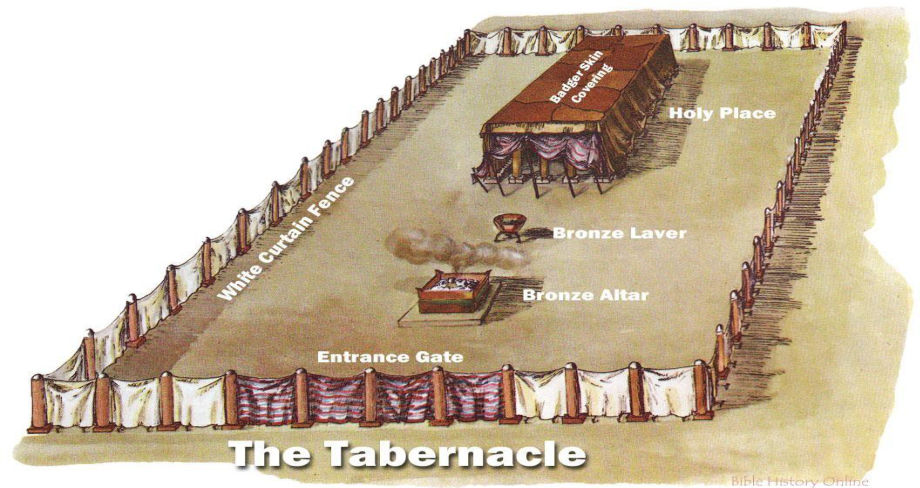
1. Exodus 25-27; 30:1-21 (supplementary), Instructions for Making and Use of the Tabernacle and Its Furniture and Court: (a) Sanctuary or Tabernacle (25:1-9); (b) Ark, with testimony placed in it (25:10-16); (c) Mercy-seat with cherubim above it, placed upon the ark (25:17-22); (d) Table of showbread (25:23-30); (e) Candlestick, with its lamps (25:31-40); (f) Curtains, for covering of tabernacle (26:1-14); (g) Boards, overlaid with gold, for walls (26:15-30); (h) Veil, to separate the Holy Place and Most Holy Place, with the ark and its mercy-seat in MOST HOLY PLACE, and with table and candlestick "without the veil" on the south and north sides respectively of HOLY PLACE (26:31-35); SCREEN for the door of Tent (26:36-37) -- by which the Tent was entered; Altar of burnt offering, overlaid with brass (27:1-8), to be placed in Court of the Tabernacle before the door of the Tent; Court of Tabernacle (27:9-19).
SUPPLEMENTARY: (a) Altar of incense, overlaid with gold, and placed "before the veil [NIV, "in front of the curtain"] that is by [NIV, "before"] the ark of the testimony, before the mercy-seat that is over the testimony" (30:1-10), which may mean it was centered in the Holy Place as the ark and mercy-seat likely were centered in the Most Holy Place -- hence, in the fore part of the tabernacle, which was analogous to that part of the "temple of the Lord" where Zacharias, a priest (but not high priest) and father of John the Baptist, burned incense, and where the "altar of incense" was located (Luke 1:8-11) -- that is, in the HOLY PLACE, not the Most Holy Place, where only the high priest could enter; (b) Laver, made of brass, placed outside the Tent of meeting and between it and the altar (of burnt offering), for Aaron and his sons (high priest and priests) to wash their hands and feet before ministering either inside the Tent or at the altar on the outside (30:17-21).
2. Exodus 40:1-8, Instructions for Rearing of Tabernacle and Placement of Furniture: (a) Rear TABERNACLE of the Tent of meeting (vs.1-2); (b) Place ark of the testimony in the Tabernacle, and screen it with the VEIL (vs.3) -- which would put it within the veil and thus in the Most Holy Place; (c) Bring in table and candlestick (vs.4); (d) Place the golden altar for incense before the ark of the testimony (which would be next to the veil and likely centered rather than being on either side of the Holy Place, just as the ark was likely centered in the Most Holy Place), and put the screen of the DOOR to the Tabernacle of the Tent of Meeting (vs.5) -- which would put the table, candlestick, and altar of incense between the two screens, or inside the Holy Place; (e) Set the altar of burnt offering before the door of the Tabernacle (vs.6) -- which would be outside the Tabernacle; (f) Set the laver between the Tent of meeting and the altar, and put water in it (vs.7); (g) Set up the COURT round about, and hang up the SCREEN of the gate (that is, the gateway) of the court (vs.8).
3. Exodus 40:17-33, Account of Rearing Up of Tabernacle and Placing Its Furniture: (a) TABERNACLE itself reared up (vs.17-19); (b) "Testimony" put into ark, mercy-seat placed above it, and they were put in the Tabernacle and screened with the VEIL (vs.20-21) -- thus separating them from what is mentioned next; (c) Table (for showbread) placed in Tabernacle on north side "without the veil" (vs.22-23) -- that is, in the Holy Place, separated from the Most Holy Place by the veil; (d) Candlestick placed on south side of Tabernacle opposite the table of showbread on the north side (vs.24-25); (e) Golden altar for incense placed in tent of meeting "before the veil" (vs.26027) -- that is, "in front of the curtain" (NIV) that separated the Holy Place from the Most Holy Place; (f) SCREEN of the door (doorway) to the Tabernacle was placed (vs.28) -- separating the Holy Place and its furniture from the court outside; (g) Altar of burnt-offering set at the door of the Tabernacle (vs.29) -- but outside of it; (h) Laver placed between the Tent of meeting and altar, where Aaron and his sons (high Priest and priests) washed their hands and feet when they went into the tent of meeting and when they came near the altar (of burnt offering) (vs.30-31); (i) COURT round about the Tabernacle and altar reared up, and SCREEN of the gate of the court set up (vs.33).
22
The Greek Text of Hebrews 9:4
The Greek word translated in the older versions as "censer" and in most newer versions as "altar," is thumiaterion, from thumiao, to burn incense. It occurs in the New Testament in this passage only, and in the LXX (Greek translation of the Old Testament) only twice, in 2 Chronicles 26:19 and Ezekiel 8:1, and in both places it is spoken of as being held in the hand, and in all Old Testament versions of which I am aware the translation in these passages is "censer." Moreover, "In the inscriptions, papyri,, and classical Greek the meaning of thumiaterion seems to be censer" (Tyndale New Testament Commentaries [1960] on Hebrews 9:4).
The usual word in the LXX for "altar," and in the New Testament also, is thusiasterion, which makes a strong case for translating the other word as "censer" in Hebrews as well as in 2 Chronicles and Ezekiel, as the older versions do. And, since the writer of Hebrews makes use mostly of the LXX in his references to and quotations from the Old Testament, the case for translating thumiaterion as "censer" is made stronger still. In fact, Vine’s Expository Dictionary of New Testament Words (New One-Volume Edition, 1952), a reputable and widely used work, under "CENSER" makes no mention of any other meaning for the latter Greek word.
Yet, over against such considerations, is the fact that Philo (dying about A.D, 50) and Josephus (dying about A.D. 95), both partially contemporary with the writer of Hebrews and both noted Jewish writers using Greek, employed thumiaterion when speaking of the golden altar along with the candlestick and the table in the Holy Place. And later, two other writers, Clement of Alexandria (dying A.D. 215) and Origen (A.D. 185?-245?), did likewise. That would indicate the possibility that the word simply meant, or had at least come to mean, an instrument or a place connected with the offering of incense, and so could mean either a "censer" or an "altar" used for burning incense, and that the writer of Hebrews uses it in the latter sense -- a viewpoint reflected in the majority of modern translations.
Moreover, according to Thayer’s Greek-English Lexicon of the New Testament, both Philo and Josephus, mentioned above, used thumiaterion and thusiasterion interchangeably for the golden altar of incense -- at times one, and at other times the other. Also, according to The Expositor’s Greek Testament, two Greek translations of the Hebrew Old Testament -- by Theodotion, about the middle of 2nd century A.D. (before 160), and by Symmachus, about the beginning of the 3rd century (the 200s A.D.) --- both employ thumiaterion for "altar of incense" in Exodus 31. (The chapter citation, however, is obviously a typographical error, and should be corrected to read Exodus 30 -- verses 1-10 being the part that is applicable).
Agreeably with what we conceded above as a possibility, it needs now to be noted that Thayer says thumiaterion properly refers to "a utensil for fumigating or burning incense. Arndt & Gingrich, in their Greek-English Lexicon of the New Testament and other Early Christian Literature, likewise say that the word means "properly a place or vessel for the burning of incense," and "usually a censer." But they add: "However, Hb 9:4 altar of incense (as Hdt.2,162; Aelian, V.H.12,51; esp. Of the altar of incense in the Jewish temple: Philo, Rer. Div. Her.220, Mos.2,94; Jos., Bell.5,218, Ant 3,147; 198." Also, Moulton and Milligan, in their Vocabulary of the Greek Testament Illustrated from the Papyri and Other Non-Literary Sources, cite several 2nd-century sources of its use, in some of which it refers to a censer "obviously," and "in many contexts, we cannot say whether the censer was fixed or movable" -- that is, whether it would be thought of as an altar or as a censer in terms of the foregoing definitions.
The sum and substance, then, of the foregoing is that the writer of Hebrews most assuredly could have used the Greek word that he did in the sense of "altar of incense," but falls short of proving that he did. If he did, however, that only solves one problem by creating another: (1) It relieves us of having to wonder why he would omit the mention of a piece of tabernacle furniture referred to as prominently as it is in the Old Testament, and substitute "golden censer" not mentioned at all in the Old Testament scriptures as a furnishing of the tabernacle; but (2) it
23 associates the "golden altar of incense" with the Most Holy Place, whereas the Old Testament scriptures give its location as the Holy Place.
So, unless there can be such an association in some sense without its being physically "in" the Most Holy Place, we still have a contradiction between the text of Hebrews and the Old Testament texts. The text of Hebrews 9:4 speaks of the Holy of Holies as "having" a "golden altar of incense" (if that translation is correct), whereas the Old Testament evidence is overwhelming that the altar of incense was located in the Holy Place, next to the veil separation it from the Most Holy Place, but not "in" the Most Holy Place itself.
Therefore, we are faced with the question as to whether the expression "having (echousa) a golden altar of incense" is sufficiently comprehensive or flexible to admit the meaning of belonging in some sense without necessarily having it within. Or does it require us to understand the writer as meaning beyond any doubt that the "altar of incense" was indeed within the Most Holy Place? The answer to that question is crucial to any satisfactory solution to the problem posed at the outset of this review.
Upon a little reflection, it seems necessary to admit the possibility regardless of whether the probability is conceded or not. Each of us has a heart, liver, and lungs within the cavity of the body, and likewise arms and legs as appendages outside the body. And in the same sense the "golden altar of incense" surely could have been considered an appendage of the Holy of Holies, although not spatially within it. And we shall be noticing that later.
But, as of now, we still have the question, What is the simplest explanation that explains the most in the most satisfactory manner? And the answer, so far as each is concerned, will depend somewhat on one’s attitude toward the scriptures and their human authors. There are two main types of approach we wish to consider on the part of those who believe "altar of incense" instead of "censer" to be the correct translation in the passage under consideration, besides two others that have never gained much currency. We shall begin with the latter.
Efforts at Explaining Apparent Contradiction
- Possible Reference to Solomon’s Temple Instead of Tabernacle (1 Kings 7:48-50; 2 Chronicles 4:19-22): It is true that "censers" ("firepans," American Standard Version) are mentioned as being in Solomon’s Temple, but as part of the lavish furnishings of the Holy Place (unless they were stored elsewhere in "the house of God" but used in the Holy Place and possibly elsewhere also) -- not as being in the Most Holy Place, called "the oracle." The latter is not described till the 8th chapter of 1 Kings and the 5th chapter of 2 Chronicles, respectively, and is there not referred to as having any furniture except the ark of the covenant and the cherubim covering it. (See vs.6-8 and vs. 7-8, respectively, in the above chapters.)
The items of stationary furniture for the Holy Place are stated as (1) the golden altar, (2) table of showbread, and
- candlesticks (ten of them instead of one as in the Tabernacle, and situated "before the oracle" instead of located on the south side as in the Tabernacle). And accessories are listed as flowers and lamps (parts or else spare parts of the lampstands or "candlesticks"), and tongs, cups, snuffers, basins, spoons, and firepans ("censers," King James Version, "ash pans" in margin) -- all of gold. Most of the accessories are thought to have been for use in connection with servicing the lamps and the altar of incense, and possibly the table of showbread.
Incidentally, the Hebrew word (machtah) used in the foregoing passages and translated either "censer"/"ash pan" (KJV or "firepan" (ASV), in not the one that occurs in 2 Chronicles 26:19 and Ezekiel 8:11, namely, miqtereth, translated thumiaterion in the LXX and "censer" in the English versions. And in the foregoing passages referred to, there is neither a golden miqtereth nor a golden machtah referred to as being in the "oracle" or Most Holy
24 Place of Solomon’s Temple. So those passages offer no assistance whatever in dealing with the problem of Heb.
9:2-4.
- Wilson’s Emphatic Diaglott (1864): This is a work based upon Griesbach"s recension of the Greek text and various readings of the Vatican Manuscript, so called on account of having been in the Vatican Library since at least 1481. In reference to Hebrews 9:2, Wilson explains in a footnote as follows: "The reading of the
Vatican MS. Has been adopted as giving a solution of an acknowledged difficulty, and as perfectly harmonizing with the Mosaic account." And he renders it thus: "For a tabernacle was prepared -- the first -- in which were both the lamp-stand, and the table, and the loaves of the presence, AND THE GOLDEN ALTAR OF INCENSE [capitals added]; this is named the Holy Place." And he omits reference in v.4 to the Most Holy Place "having a golden censer."
This does indeed harmonize with the Mosaic account. But it seems as if this is the only such reading in all the abundance of manuscripts extant; and Westcott and Hort, who prized the Vatican Manuscript very highly (much too highly, some have thought), in their New Testament in Greek, include it in their "List of Noteworthy Rejected Readings" instead of in their Greek text. They testify though to its using the Greek word thumiaterion" in 9:2 and omitting it in 9:4. So that does put Wilson’s Emphatic Diaglott on the side of those who would translate the word "altar of incense" as well as "censer," according to context. But it has such infinitesimal support that it is exceedingly precarious to rest a case upon it.
(NOTE: Though there are multiple sources for the next two approaches to resolving the apparent contradiction between the text of Hebrews 9:4 as it occurs in generally accepted Greek readings and the Old Testament texts on the subject, we shall select only one as representative of the rest in their respective categories.)
- The Cambridge Commentary on the New English Bible (1967): "Exod.30:6 say it [the altar of incense] stands
‘before the veil . . . before the mercy seat, and Exod.40:26 shows that this means outside the veil. Our writer seems to have followed Exod.30:6 and to have thought that the golden altar was inside the veil."
That is equivalent to saying "our writer" did indeed use "having" in the sense of having the "altar of incense" in the Most Holy Place, but misunderstood the Old Testament scripture he followed and therefore was mistaken. That, however, gives him no credit for being either (a) divinely inspired (which likely the commentator, being a liberal, did not intend to do), or (b) the astute student of the Old Testament scriptures that his epistle otherwise shows him to be (if not inspired). It is equivalent to saying he either (1) did not know that the Old Testament scriptures represent the altar of incense as having been located in the Holy Place instead of in the Most Holy Place, or else knowing some of them do, (2) thought them to be in error -- either of which is surely unthinkable if there is any solution otherwise -- which we are convinced there is. Surely, then, the explanation given above is to be categorically rejected.
(NOTE: The next quotation is an excerpt from one long paragraph in the original, but will here be divided into several sub-paragraphs for greater eases of separating and comprehending its succession of thoughts. While it, too, favors the translation of "altar of incense" instead of "censor," it presents an altogether different rationale, that does not have the objectionable qualities of that presented above, whether entirely accurate in all details or
- It argues its case vigorously, from various angles, and is recommended for serious consideration before either accepting or rejecting its major thrust and thesis.
- The Pulpit Commentary (1950) reprint): "Between them [the table of showbread and the golden candlestick], close to the veil stood the golden altar of incense; which, nevertheless, is not mentioned here as part of the furniture of the ‘first tabernacle,’ being associated with the ‘second,’ for reasons which will be seen. The
‘second veil’ was that between the holy place and the holy of holies (Ex.26:35), the curtain at the entrance of
25 the holy place (Ex.36:37) being regarded as the first. The inner sanctuary behind the veil is spoken of as having (echousa) in the first place ‘a golden censer,’ as the word thumiaterion is translated in the A.V. (so also in the Vulgate, thuribulum).
"But it assuredly means, ‘golden altar of incense,’ though it stands locally outside the veil. For (1) otherwise there would be no mention at all of this altar, which was so important in the symbolism of the Tabernacle, and so prominent in the Pentateuch, from which the whole description is taken.
"(2) The alternate view of its being a censer reserved for the use of the high priest when he entered behind the veil on the Day of Atonement, has no support from the Pentateuch, in which no such censer is mentioned as a part of the standing furniture of the tabernacle, and none of gold is spoken of at all; nor, had it been so, would it have been placed, any more than the altar of incense, within the veil, since the high priest required it before he entered.
"(3) Though the word itself, thumiaterion, certainly means ‘censer,’ and not ‘altar of incense,’ in the LXX., yet in the Hellenistic writers it is otherwise. Philo and Josephus, and also Clemens Alexandrinus and Origen, always call the altar of incense thumiaterion chrusoun; and the language of the Epistle is Hellenistic.
"(4) The wording does not of necessity imply that what is spoken of was locally within the veil: it is not said (as where the actual contents of the ‘first tabernacle’ and the ark are spoken of) wherein (en he), but having (exousa), which need only mean having as belonging to it), as connected with its symbolism. It was an appendage to the holy of holies, though not actually inside it, in the same way (to use a homely illustration given by Delitzsch) as the sign-board of a shop belongs to the shop and not to the street.
"It is, indeed, so regarded in the Old Testament. See Ex.40:5, ‘Thou shalt set the altar of gold for the incense before the ark of the testimony’; also Ex.30:6, ‘Before the mercy-seat that is over the testimony’; and 1 Kings 6:22, ‘The altar which was by the oracle,’ or belonging to the oracle’; cf. Also Isa.6:6 and Rev.8:3, where, in the visions of the heavenly temple based upon the symbolism of the earthly, the altar of incense is associated with the Divine throne.
"And it was also so associated in the ceremonial of the tabernacle. The smoke of the incense daily offered on it was supposed to penetrate the veil to the holy of holies, representing the sweet savour of intercession before the mercy-seat itself; and on the Day of Atonement, not only was its incense taken by the high priest within the veil, but also it, as well as the mercy-seat, was sprinkled with the atoning blood."
Observations on Foregoing from Pulpit Commentary
- Why selected to Represent Its Class? The foregoing has been presented because its main thrust, not necessarily all its details, is one of the most thoroughly and convincingly argued presentations in its category examined for this study, and its basic thesis is presented by a number of highly respectable commentaries as practically selfevident. We mention two.
(1) The Expositor’s Bible: "To it [the Most Holy Place] belonged the altar of incense (for so we must read in the fourth verse, instead of ‘golden censer’), although its actual place was in the outer sanctuary [the Holy Place]. It stood in front of the veil that the high-priest might take the incense from it, without which he was not permitted to enter the holiest; and when he came out, he sprinkled it with blood as he had sprinkled the holiest place itself."
26 (2) The Epistle to the Hebrews, by Charles R. Erdman: "The author mentions the ‘golden altar of incense’ as belonging to the Holy of Holies because of its close association with this most holy place in the ancient ritual. The altar represented worship; the Holy of Holies symbolized the manifestation of God. Thus the two are placed in immediate connection."
It is only fair to say, however, that there are a number of translations that do not lend support to the foregoing position, but rather to that of the The Cambridge Commentary on the New English Bible, which is presented above before quoting from The Pulpit Commentary. Instead of translating the Greek word echousa ("having"), they substitute an interpretative word or phrase, as Goodspeed (the altar of incense "stood" in the Most Holy Place), Moffatt (the Holy Place ‘containing" it), Good News Bible (it was "in" the Most Holy Place, New English Bible ("here" was the altar of incense "beyond the second curtain") -- a list that could be extended.
But among those rendering echousa literally, and thus as "having" (or "had"), as construed by The Pulpit Commentary and others of its class, are, in alphabetical order, the Amplified New Testament, American Standard Version, Berry’s Interlinear, Emphatic Diaglott (though omitting either "golden altar of incense" or "golden censer" from the list the Most Holy Place is said to have), Jerusalem Bible, King James Version, Living Oracles, Marshall’s Interlinear, New American Standard Bible, New International Version, New King James Bible, Revised Standard Version, Rotherham, Weymouth -- likewise a list that could be extended.
- Statements Subject to Challenge. A few statements of the above quotation from The Pulpit Commentary, though not of the essence of its main thrust, nevertheless invite question if not challenge. And it is only fair to call attention to them on the basis of the biblical principle, "Prove all things; hold fast that which is good" (1
Thessalonians 5:21).
- In argument (2) it is stated that if a golden censer had been reserved for use of the high priest behind the veil on the Day of Atonement, it would not "have been placed, any more than the altar of incense, within the veil, since the high priest required it before he entered."
At the outset, we quoted Macknight as saying the writer of Hebrews "may have learned from the priests that the censer used by the high-priest on the day of atonement was of gold and that it was left by him in the inward tabernacle, so near to the veil, that, when he was about to officiate next year, by putting his hand under the veil he could draw it out to fill with burning coals before he entered into the most holy place to burn incense." And we underscored his word "may," saying we were doing so because likewise, he may not have so learned.
Now by the same token, we have to say that, while the censer may not have been stored in the Most Holy Place near the veil so as to have been drawn out by the high priest putting his hand under the veil and reaching it, it is surely too much to say it would not have been stored there "since the high priest required it before he entered." For he might have obtained it in the way mentioned by Macknight, before going in and burning incense upon it, in case it was thus stored.
- In argument (3) it is suggested that since the language of the Epistle to the Hebrews is "Hellenistic," and the Hellenistic writers as Philo and Josephus, and also Clemens Alexandrinus and Origen, "always call the altar of incense thumiaterion chrusoun," the writer of Hebrew s would do likewise instead of using thumiaterion in the sense of "censer" as done by the LXX, as if the LXX itself was not Hellenistic, which it was.
The word "Hellenistic" derives from Hellen, the mythological ancestor of the Hellenes, or Greeks, who originally lived in Greece, or Hellas (the Greek word for Greece). And another word having the same derivation is Hellenic." These two terms as applied to language, culture, and the like, have reference to such in two historical
27 periods separated by the conquest of Alexander the Great in the 4th century B.C. -- the one prior referred to as Hellenic or classical, and the latter spoken of as Hellenistic. The LXX postdated Alexander the Great by more than a century and was a Hellenistic translation in the sense just mentioned.
But "Hellenistic" may have been used by The Pulpit Commentary in contrast with "Hebraistic," pertaining to "Hellenists," or Grecians, in contrast to "Hebraists," or Hebrews. In Acts 6:1 we have mention of "Hellenists" (Grecians) as distinguished from "Hebrews" -- the former being Jews of the Dispersion and of Greek culture and language, and the latter being Jews of Palestine, whose culture was basically Hebraic and Hebrew (Aramaic) their native language. The LXX was itself a translation by Hellenists, to put the Hebrew thought of the Old Testament scriptures into Hellenistic or Greek language.
The Hellenists who translated the LXX were closer to the Hellenic period than the writer of Hebrew and his contemporaries and may have had a closer affinity to classical Greek than to the Koine Greek of the New Testament period. Yet the LXX was nevertheless the Old Testament of the Jewish as well as Gentile Christians of the first century A.D., and they were so familiar with it that the writer of Hebrews made use of it predominantly. So, there does not seem to be lot at stake in whether he was Hellenistic in contrast with being either "Hellenic" or "Hebraic."
Moreover, remember that under the caption of "The Greek Text of Hebrews 9:4, "we called attention to the fact that the Hellenistic writer Josephus is cited by Thayer as using thumiaterion, the word in Hebrews 9:4, for both "censer" and altar of incense." That completely nullifies the argument of The Pulpit Commentary cited above against understanding thumiaterion in the sense of "censer" because Hebrews is a Hellenistic Epistle. It rather means that other considerations have to indicate which is meant, not simply the word itself.
- At first it may seem that argument (4) above is itself also a little far-fetched. But the more one thinks about the word "having," the more it becomes apparent that it may indeed be used of "belonging to" without at all indicating physical location. As remarked earlier, each of us has a heart, liver, and stomach, which are within the cavity of the physical body, but also legs and arms, which are appendages of the body but not located inside of it with the organs just named. Most people also "have" possessions that are not even appendages -- such as houses or lands or automobiles, or whatever. So the "homely illustration of Delitzsch" of a shop "having" a signboard that belongs to the shop rather than the street though it is outside the shop, becomes a quite apt illustration of how the "golden altar of incense" could belong to the Most Holy Place though not in it -- that is, because of the close relation between them, that is explained in the scriptures.
And that seems to make both irrefutable and compelling, the conclusion and emphasis of The Expositor’s Greek Testament, that the change from "wherein" in Hebrews 9:2 to "having" in 9:4, is not incidental but purposeful and meaningful, as follows:
"As has been frequently urged it is incredible that in describing the furniture of the tabernacle there should be no mention of the altar of incense. The difficulty has been felt regarding the position here assigned to it, for in fact, it stood outside the veil, and the author has been charged with error. But the change from en he [wherein], to echousa [having] is significant and indicates that it was not precisely its local relations he had in view, but rather its ritual associations, ‘its close connection with the ministry of the Holy of Holies on the day of atonement, of which he is speaking’ (Davidson). Their altar was indeed so strictly connected with the Sancta Sanctorum that in the directions originally given for its construction, this was brought out (Exod.30:1-6). ‘Thou shalt set it before the veil (apenanti t. katapetasmatos) that is over the ark of the testimony, and in ver.10, ‘it is most holy (hagion ton hagion) to the Lord.’"
28 It needs also to be remarked with reference to v.10, that in its entirety it reads: "And Aaron shall make atonement upon the horns of it [the altar of incense] once in the year; with the blood of the sin-offering of atonement once in the year shall he make atonement for [margin, Or, upon] it throughout your generations: it is most holy to Jehovah." This was similar to what was done in the Most Holy Place itself in connection with the mercy-seat, where incense was also burned (Leviticus 16:11-14,15-16).
Moreover, in Leviticus 4 it is stated that for sins unwittingly committed by high priest or congregation (obviously during the year between annual days of atonement, when the Most Holy Place could not be entered), the blood of the animal offered for sin was to be brought inside the tent of meeting by the anointed priest, sprinkled before the veil (separating the Holy and Most Holy places), and put "upon the horns of the altar of sweet incense before Jehovah, which is in the tent of meeting" (vs.1-12, 13-26). This again was similar to what was done in the Most Holy Place itself in connection with the mercy-seat, where incense was also burned (Leviticus 16:11-14, 1516).
Moreover, in Leviticus 4 it is stated that for sins unwittingly committed by high priest or congregation (obviously during the year between annual days of atonement, when the Most Holy Place could not be entered), the blood of the animal offered for sin was brought inside the tent of meeting by the anointed priest, sprinkled before the veil (separating the Holy and Most Holy places), and put "upon the horns of the altar of sweet incense before Jehovah, which is in the tent of meeting" (vs.1-12, 13-26). This again was similar to what was done in the Most Holy Place itself in connection with the mercy-seat, where incense was also burned (Leviticus 16:11-14, 1516).
No other article of furniture in the Holy Place is spoken of as having so much affinity, so much in common, with the Most Holy Place.
Conclusion and Explanation
As a result of the cumulative impact of factors found to have a bearing on the subject in hand, the writer of this review has had to reverse the conviction with which he began. He started out with the persuasion that in Hebrews 9:4 the rendering of "the golden censer" (King James Version) is preferable to that of "a golden altar of incense" (American Standard Version). (By the way, there is no "the" in the Greek text, so that "a) is perfectly permissible.) He recognized the possibility of thumiaterion being translated as either "censer" or "altar of incense," depending on context. But he considered the fact that the writer of Hebrews used the LXX predominantly in his quotations from and allusions to the Old Testament writings, and that the only use in the LXX of thumiaterion was for "censer," made it probable that such was also the use made of it in Hebrews 9:4. That he thought to be the simplest explanation that explains the most, in the most satisfactory manner.
And Robert Milligan, who had had a part in shaping my previous interpretation, in his commentary on Hebrews published in 1875, which is still one of the finest available, at which time our topic was highly controversial and he endeavored to represent all major viewpoints fairly, concluded by saying: "On the whole, I agree with Alford, and I might say with the majority of commentators both ancient and modern, that the ‘balance inclines toward the censer interpretation; though I do not feel by any means that the difficulty is wholly removed; and I would hail with pleasure any new solution which might clear it still further.’"
It is my conviction that in my research this time, which is far more extensive than any I had ever made or could take time for before or even expected for now, and finding data not mentioned by Milligan, I may have discovered details that had not come to his attention -- details that would tip the balance the other way for him as they have for me. These make me more comfortable now with the "altar" interpretation -- yet not so wedded to it that further information to the contrary could not tip the balance back to the "censer" interpretation. And I have shared said data in this review for the consideration and evaluation of the reader for himself, not to try to
29 impose my newly-arrived-at persuasion on him or her. Moreover, instead of simply giving my conclusions, I have written out something of the process of my own investigation and reasoning for whatever it may be worth.
To do so, however, has taken far more space than anticipated at the outset, for then I had only charted somewhat the route I would take, not the details I would include as I discovered what to me were significant ones for evaluation. Furthermore, parts of it may be too detailed and/or technical for the interests of some. But such is included for my own record as well as for the benefit of any others who may be interested in it.
It might also be mentioned that frequently I found material that would have been useful in sections already written, and went back and made use of it there. That means that some thoughts are reflected earlier in the review than they occurred in the process of research and original writing. In case some items appear to be tacked on somewhere rather than integrated with the rest, what has just been mentioned may be the reason for it.
With these explanations, it is hoped that the serious student will read and ponder the foregoing several times -- because it may be too much to be digested in one reading.
ADDENDUM Synopsis and Comparison of Interpretation Options
This is to give a summary presentation of viewpoints already discussed and documented, in order to bring them to a focus for easier comparison and evaluation -- two involving the "golden censer" interpretation, and three involving the "golden altar of incense" interpretation.
1. "Golden Censer" Interpretation, in Reference to the Tabernacle: (a) Would have been favored linguistically in Hellenic or classical Greek, but not in Hellenistic Greek as previously supposed by some -- including myself before the present extensive research; (b) omits any mention at all of the "golden altar of incense" anywhere in the tabernacle, whereas it is prominently featured in Old Testament texts (c) no censer mentioned in either Old Testament texts or other historical records I have seen cited as being furniture "in" the Most Holy Place, and none of the gold mentioned as being used in it. Unless and until historical evidence is produced in its favor, this interpretation has now to be regarded as conjectural and therefore as less than satisfactory.
2. "Golden Censer" interpretation, in Possible Reference to Solomon’s Temple Instead of Tabernacle: But
- the writer of Hebrews makes no obvious reference to the temple structure, but to the tabernacle "pitched" by man (8:2) and "made" by Moses (8:5); and (b) and no mention is made in the scriptures of the temple "oracle" (Most Holy Place) as having any furniture but the ark of the covenant and the cherubim covering it. So the scriptures describing Solomon’s temple offer no assistance toward resolving the problem of Hebrews 9:2-4.
3. "Altar of Incense" Interpretation, but Placing the Altar in the Holy Place; This occurred in the version of Benjamin Wilson’s Emphatic Diaglott (1864). His explanation was: "The reading of the Vatican MS. Has been adopted as giving a solution of an acknowledged difficulty, and as perfectly harmonizing with the Mosaic account." That it does, but is a reading that seems to have no support from any other of the abundant manuscripts extant, and among textual scholars is considered spurious. Even Westcott and Hort, who prized the Vatican Manuscript as a whole quite highly (too highly, some have thought), instead of including it in their recension of The New Testament in Greek, placed it in their "List of Noteworthy Rejected Readings." So, Wilson’s version at this point has such infinitesimal support that it is precarious to adopt it.
4. "Altar of Incense" Interpretation, but Believing the Writer of Hebrews to Have Mistakenly Thought the Golden Altar Was Inside the Veil" -- that is, inside the Most Holy Place. Such is set forth in The Cambridge
30 Commentary on the New English Bible (1967. It reflects, however, against (a) not only the inspiration of the writer of Hebrews but against (b) his Old Testament understanding, which seems otherwise too great for him to have made a blunder like that, had he been inspired. Therefore, it cannot be accepted as a satisfactory solution.
Much more acceptable would be A.E. Harvey’s comment in his Companion to the New Testament (of the New English Bible), saying: "It is strange that this writer seems to think of this altar in the inner room -- unless he is speaking of it as a necessary adjunct of the inner room, though not actually inside it" (emphasis added) -- which comment we failed to include in our initial observations on the above-mentioned interpretation, but which is a fit introduction to the next and final interpretation to be presented.
5. "Altar of Incense" Interpretation, but as Belonging to the Most Holy Place in a Significant Sense Without Being Located ‘In’ it" -- supported by the change from "wherein" in 9:2 in reference to the Holy Place, to "having" in 9:4 on the part of the Most Holy Place, which neither precludes nor necessitates being in it. Each of us has a heart, liver, and stomach within the cavity of the physical body but also arms and legs which are appendages of the body but not located inside of it with the organs just named. So the Most Holy Place could have both the "ark of the covenant" with its mercy-seat and cherubim located inside it and the "golden altar of incense" located just outside it in the Holy Place -- where it sustained a relationship to the Most Holy Place that the rest of the furniture of the Holy Place did not, both as to location and function, as heretofore described.
This seems both irrefutable and compelling, and surely the simplest explanation that explains the most, without any of the objectionable features associated with the other options.
Things in the Heavens Cleansed
Hebrews 9:23
Text: "It was necessary therefore that the copies of the things in the heavens should be cleansed with these [animal sacrifices]; but the heavenly things themselves with better sacrifices than these."
This refers to a "necessary" difference in the "cleansing" element of the heavenly realities and of their earthly
31 "copies," and poses a question as to what the "things in the heavens" or "heavenly things" are that need cleansing, and why they need it. And it may be beyond our ability to ascertain with anything like certainty, for it has been a puzzle to some of the most astute textual scholars.
Quotations from Scholars
1. Robert Milligan mentions that it has been alleged that the above-mentioned "necessity arises from the sin of the angels who kept not their first estate, but who in consequence of their rebellion were cast down to Tartarus (2 Peter 2:4; Jude 6)." "But," says he, "angels are not embraced in our premises, and must not, therefore, be forced into our conclusions. See note on ch.2:16." (Commentary on Hebrews.)
2. A.T. Robertson says: "To us it seems a bit strained to speak of the ritual of cleansing or dedication of heaven itself by the appearance of Christ as Priest-Victim. But the whole picture is highly mystical" (Word Studies in the New Testament).
3. The Expositor’s Greek Testament quotes Bruce as follows: "I prefer to make no attempt to assign a theological meaning to the words. I would rather make them intelligible to my mind by thinking of the glory and honor accruing even to heaven by the entrance there of the ‘lamb of God.’ I believe there is more poetry than theology in the words."
On the other hand, however, its editor of Hebrews, Marcus Dods, continues by saying:
"But it is scarcely permissible to exclude at this point of the author’s argument the theological inference that in some sense and in some relation the heavenlies need cleansing. The earthly tabernacle, as God’s dwelling, might have been supposed to be hallowed by His presence and to need no cleansing, but being also his meeting place with men it required to be cleansed. And so our heavenly relations with God, and all wherewith we seek to approach Him, need cleansing. In themselves things heavenly need no cleansing, but as entered upon by sinful men they need it. Our eternal relations with God require purification."
4. Similarly, Marvin R. Vincent quotes Delitzch as follows: "If the heavenly city of God, with its Holy Place, is, conformably with the promise, destined for the covenant people, that they may attain to perfect fellowship with God, then their guilt has defiled these holy things as well as the earthly, and they must be purified in the same way as the typical law appointed for the latter, only not by the blood of an imperfect, but of a perfect sacrifice" (Word Studies in the New Testament).
5. Albert Barnes, however, makes short shrift of the matter with the following words: "The use of the word purified, here applied to heaven, does not imply that heaven was before unholy, but it denotes that it is now made accessible to sinners; or that they may come and worship there in an acceptable manner" (Notes on the New Testament).
6. On the other hand, Robert Milligan again states: "Nothing short of real purification of ‘the heavenly things’ will, it seems to me, fairly meet the requirements of the text. And I am therefore inclined to think that for the present, at least, this is for us rather a matter of faith than of philosophy. When we can fully comprehend and explain how much more holy God is than any of the holy angels (rev. 15:4), and how it is that the very heavens are not clean in his sight (Job 15:15), we may then perhaps understand more clearly than we do now, how it is that ‘the heavenly things,’ embracing even the city of the living God, the heavenly Jerusalem, should need to be purified with the atoning blood of the Lord Jesus. The fact itself seems to be clearly revealed in our text; but the reason of it is not so obvious."
32 Then he asks: "Can it be owing to the fact, that many of the saints were admitted into Heaven in anticipation of the death of Christ, and that though justified by faith, through the grace and forbearance of God, they nevertheless required the purifying application of the blood of Christ when shed, in order to make them absolutely holy. See notes on ch.9:15." (Commentary on Hebrews.)
We shall proceed on the premise that Milligan, in his first sentence quoted above, and not Barnes, is correct. But please keep in mind the latter’s word "before," and likewise Milligan’s question just noted, both of which we shall have occasion to refer to again under "Concluding Observations."
Observations from Scripture
1. The First Covenant and Earthly Tabernacle. The "copies of the things in the heavens" were the earthly tabernacle erected by Moses and its furniture and utensils (vs.1-5, 18-22). They were associated with the first "testament" or "covenant" made at Sinai with fleshly Israel, which was "dedicated" with the blood of calves and goats, sprinkled upon "the book itself and all the people" (vs.18-20).
The Greek word for "dedicated" is egkekainistai, a form of egkainizo, 1. To renew (2 Chronicles 15:8). 2. To do anew, again (Sir. 33(36).6). 3. To initiate, consecrate, dedicate (Deuteronomy 20:5; 1 Kings 8:63; I Samuel 11:14, etc.; Hebrews 9:18; 10:20) -- according to Thayer. Milligan suggests "inaugurated" as the best sense in 9:18, where it is said that "the first covenant hath not been "dedicated without blood." This accords with Thayer’s "initiated."
(NOTE: It appears that Thayer should have included 1 Samuel 11:14 in category No.1, "to renew," instead of category N.3.)
2. The Second or New Covenant and Heavenly Tabernacle. The "first" covenant or testament was taken away by Christ, "that he may establish the second" (10:9), of which "new covenant" he is the mediator (9:15), and his blood is the blood of said covenant (Matthew 26:28; Mark 14:24; Luke 22:20; 1 Corinthians 11:25) -- through which blood he "entered in once for all into the holy place [heaven itself, Hebrews 9:24], having obtained eternal redemption" (Hebrews 9:12).
"We have ... a high priest, who sat down on the right hand of the throne of the Majesty in the heavens, a minister of the sanctuary, and of the true tabernacle, which the Lord pitched, not man [in contrast with the earthly copy]. . . . Now, if he were on earth, he would not be a priest at all, seeing there are those who offer the gifts according to the law; who serve that which is a copy and shadow of the heavenly things, . . . But now he has obtained a ministry the more excellent, by so much more as he is also the mediator of a better covenant, which is enacted upon better promises" (8:1-6).
"For if the blood of goats and bulls [offered under the first covenant], and the ashes of a heifer sprinkling them that hath been defiled, sanctify unto the [ceremonial] cleanness of the flesh: how much more shall the blood of Christ, who through the [or, his] eternal Spirit offered himself without blemish unto God, cleanse your conscience from dead works to serve a living God?" (9:13-14).
(NOTE: Take notice of how closely "dedication," "sanctification," and "cleansing" seem to be associated. And this is reinforced by the statement of 1 Thessalonians 4:3-7, as follows: "For this is the will of God, even your sanctification; that ye abstain from fornication; that each one of you know how to possess himself of his own vessel in sanctification and honor, not in the passion of lust, even as the Gentiles who know not God; that no man transgress and wrong his brother in the matter: because the Lord is an avenger in all these things, as also we forewarned you and testified. For God called us not for uncleanness, but in sanctification.")
33 Again, "when he had offered one sacrifice for sins forever, [he] sat down on the right hand of God; ... For by one offering he hath perfected forever them that are sanctified" (10:12-14). "And their sins and their iniquities will I remember no more" (v.17).
NOTE: This does not mean that when one becomes a Christian, even sins he might commit in the future are also then taken care of; but rather it means that once any sin is forgiven it is, unlike under the law of Moses, not remembered again annually and need atoning for again and again year by year, but forgiven for all time to come, But the efficacy of the blood of Jesus Christ does continue for all time to be available for the cleansing of sins committed by Christians after they become such.)
- Practical Benefits Under the New Covenant For Those Who Are Still Upon Earth. On the basis of Christ’s high priesthood and the superior blessings it makes available, Christians are admonished to "draw near with boldness unto the throne of grace [which must be thought of as being in heaven], that we may receive mercy
[which involves forgiveness of sins as needed] and find grace to help us [otherwise also] in time of need" (4:16). "HAVING therefore, brethren, boldness to enter into the holy place [where Christ and the "throne of grace" are, and the benefits of his shed blood are to be obtained] by the blood of Jesus, by the way which he dedicated for us, a new and living way, through the veil, that is to say, his flesh; and HAVING a great high priest over the house of God; let us draw near with a true heart in fullness of faith" (10:19-22a).
(NOTE: The drawing "near" that we do now [through the "better hope" we have in Christ, 7:19] seems to be by means of sincere prayer and genuine worship and obedience, while we await the return of Christ, our great high priest, and the completion of our salvation [9:27-28; cf. John 14:1-3; 1 Thessalonians 4:13-18] -- salvation "to the uttermost" [Hebrews 7:25]. Emphasis has been placed on "sincere" and "genuine," because Jesus said to some: "And ye have made void the word of God by your tradition. Ye hypocrites, well did Isaiah prophesy of you, saying This people honoreth me with their lips, But their heart is far from me. But in vain do they worship me, teaching as their doctrines the precepts of men" [Matthew 15:6b-9, ASV -- the KJV of v.6 reading, "This people draweth nigh unto me with their mouth, and honoreth me with their lips; but their heart is far from me".])
Concluding Observations
1. The "things in the heavens," or the "heavenly things," must be the realities of which the earthly tabernacle and its furnishings and ministries were "copies," and would seem to include both the church on earth and the church of the redeemed in heaven (see 12:22-24). The Most Holy Place, which was an extension of it and through which the Most Holy Place was itself entered, must be the church on earth. This can be seen from the fact that Christians are said to occupy "heavenly places in Christ: (Ephesians 1:3; 2:6), and that "our citizenship is in heaven" (Philippians 3:20) -- the church being God’s kingdom on earth, which, among other things, is called "the kingdom of heaven" (see Matthew 16:18-19).
2. Surely Milligan can hardly be faulted for rejecting the suggestion that heaven had to be cleansed with the blood of Christ because of the angels that had sinned and had been cast out as a result, as per 2 Peter 2:4 and Jude 6 -- for, as stated by Milligan, angels are not embraced in the premises of the Epistle to the Hebrews 9 see 2:16-17).
3. Milligan did not have the answer to his own question, and we would do well not to be dogmatic with reference to it. But we may with profit investigate and consider its implications. His question was: "Can it be owing to the fact, that many of the saints were admitted into Heaven in anticipation of the death of Christ, and that though justified by faith, through the grace and forbearance of God, they nevertheless required the purifying application of the blood of Christ when shed, in order to make them absolutely holy. See notes on ch. 9:15."
34 Chapter 9:15, as cited by Milligan, states that Christ is "the mediator of a new covenant, that a death [his own] having taken place for the redemption of the transgressions that were under the first covenant, they that have been called may receive the promise of the eternal inheritance."
But that does not say they had already received it. And Chapter 11:39-40, after giving examples from before and after the flood, and in both the Patriarchal and Mosaic dispensations, of men and women of faith, states: "And these all, having had witness borne to them through their faith, received not the promise, God having provided some better thing concerning us, that apart from us they should not be made perfect."
And of David, who was included in that roster of the faithful (11:32), the apostle Peter said on Pentecost after the resurrection and ascension of Christ, that "he both died and was buried, and his tomb is with us unto this day," and specifically that "he ascended NOT into the heavens" (Acts 2:29,34).
Moreover, what was true of David could be expected to be true of all the others, unless Enoch (Hebrews 11:56) was an exception, who was changed so as not to experience death and was no longer found on earth, but likely taken either to Heaven or else to Hades, we know not which, except that the latter is primarily for the spirits of the dead before the resurrection -- and Elijah, not mentioned in Hebrews 11, would fall in the same category as Enoch (2 Kings 2:11-12).
But, even if these two were exceptions to what is said in Hebrews 11:39-40, they would hardly constitute Milligan’s "many." Yet, if they were such exceptions and taken into Heaven instead of going to Hades, what Milligan said about the "many" defiling Heaven could nevertheless conceivably be true of the presence of Enoch and Elijah.
Hades is the place of departed spirits between death and the resurrection and is not represented as being emptied and done away with until the general resurrection and judgment (Revelation 20:11-15) -- at which time ("the last day") all the righteous dead will be raised (John 6:39,40,44,54). So it is likely that the spirits of all the dead remain in Hades till their bodies are raised. But Christ’s spirit was not left in Hades, for he was raised from the dead (Acts 2:31), and forty days later ascended into heaven (1:3, 9-11) -- the first, it would seem, to die no more (see Acts 13:34).
Also, in connection with the death and resurrection of Christ, "the veil of the temple was rent in two from the top to the bottom; and the earth did quake; and many bodies of the saints that had fallen asleep were raised [which obviously meant that their spirits were not left in Hades either]; and coming forth out of the tombs after his resurrection they entered into the holy city and appeared unto many" (Matthew 27:51-53).
Question: Was their return to life only temporary, or did they ascend into heaven with Christ? That we cannot answer with certainty. But there is a possibility that the latter is correct. Ephesians 4:8 is a reference to Psalm 68:18, which is applied to Christ, saying, "When he ascended on high, he led captivity captive, and gave gifts unto men." This was according to the custom of triumphal entries of military generals after major victorious battles -- leading a contingent of captives as proof of victory over enemies and tossing gifts to persons along the route of march from booty taken in battle. The gifts to men in the case of Christ’s return to heaven were spiritual gifts in the early church, according to Ephesians 4:11-12.
The purpose for which the quotation was made from Psalm 68:18 did not involve anything else than "the gifts unto men"; but the quotation itself did. It involved "a multitude of captives," as it is rendered in the margin of the King James Version. If this is perchance a reference to those raised after Christ’s resurrection (which it may very well be), they had been Satan’s captives till released by Christ and taken to heaven with him when he
35 ascended and presented them along with himself as proof of his victory over Satan and death, which victory is referred to in Hebrews 2:14-15.
[Note: For an additional analysis of when the spirits of the righteous depart for Hades refer to Where Will Your Spirit Go When You Die?, Joe McKinney, www.thebiblewayonline.com. –rd]
4. Consider this, then: That (a) since Christ rose from the dead in the same body in which he died though it was changed from a mortal and corruptible to an immortal and incorruptible one, as per 1 Corinthians 15:53- 54, and (b) since he had been "made to be sin on our behalf" (2 Corinthians 5:21), for "Jehovah hath laid on him the iniquity of us all" (Isaiah 53:6), could not (c) his entrance into heaven (and that of others if there were others with him) conceivably be thought of as defiling heaven and making it in need of cleansing before and until Christ had there symbolically offered his blood for cleansing and atonement, which he is represented as having done?
(In such event, the heavens would not necessarily be considered unholy "before" this, as per Barnes, mentioned above -- unless already possibly contaminated by receiving Enoch and Elijah --but would now be such until "cleansed" with the blood of Christ.)
5. Finally, though we cannot answer either Milligan’s or our own questions with certainty, we can nevertheless be tremendously profited by serious consideration of (a) the awful abhorrence of God for sin, (b) the equally awful consequences of sin and the penalty that must vicariously be paid for us if we are pardoned, and (c) the amazing, super-a-bounding grace of God displayed for human redemption from sin and its eternal penalty through Christ Jesus, our Lord, set forth by God to be "a propitiation, through faith, in his blood, . . . that he might himself be just and the justifier of him that hath faith in Jesus" (Romans 3:25-26; cf. 1 John 2:2- 1), and (d) be constantly and increasingly grateful for it. That is the chief purpose we have in the foregoing considerations, though, as Paul exclaimed, "how unsearchable are his judgments, and his ways past tracing out!" (Romans 11:33).
Boldness amd Exhoration Chapter 10:19-25
- INTRODUCTION.
This is a rich hortatory section, with its exhortations based upon tremendously important facts already established (4:14 - 10:18) or upon conclusions derived therefrom. The facts relate to what we have (vs.19-21), introduced by the word "having." And each of the exhortations begins with the phrase "Let us" (vs.22, 23, 24).
- FACTS: "HAVING" (Vs.19-21). 1. "Having therefore, brethren, boldness to enter into the holy place by the blood of Jesus" (vs.19). "The holy place" here is "heaven itself," which Christ has himself entered for us, with, as it were, his own blood, and by means of it -- and by means of which he has obtained eternal redemption for us (9:24-25; cf. Vs 11-12).
When we "enter into the holy place by the blood of Jesus," we enter "by the way which he dedicated for us, a new and living way, through the veil, that is to say, his flesh" (vs.20) -- which is likewise to say, his humanity. It was only because he took upon himself the nature of man that he could experience death and have blood to shed for us (see 2:14-17). And when he ascended back to heaven, it was with his resurrected human body (changed as ours will be, see 1 Corinthians 15:50-52 and Philippians 3:20-21). He thus became the author (archegos, captain, or chief leader) or our salvation (Hebrews 2:10). Moreover, when he comes a second time, it will be "unto salvation" ("to the uttermost," 7:25) "to them that wait for him" (9:28). He will come to receive us unto himself; that where he is, there we may be also (John 14:3). Then we shall literally "enter into the holy place" where he is because redeemed "by the blood of Jesus."
36 Now, however, we do so only spiritually, in our affections and worship. But this is of transcendent importance if we are to enter literally in the after a while. And it may and ought to be done with "boldness," because we are redeemed "by the blood of Jesus" and have the greatest possible reason for anticipation of the literal entrance when Christ comes again. And that "boldness" is a dominant theme in our epistle (3:6; 4:16; 10:19, 35). It is not brashness or foolhardiness, but courage, confidence, and comfortableness, grounded in what has been done for us by God through Christ and promised to us for the future.
2. "And having a great priest over the house of God" (vs.19) -- namely, Jesus Christ, whose priesthood was alluded to in 1:3, and has been specially featured ever since 4:14 -- providing all the assurance underlying and justifying the "boldness" enjoined, and the exhortations that follow.
- EXHORTATIONS: "LET US" (Vs.22-25).
- "Let us draw near" (vs.22) -- that is, continue to draw near -- "unto the throne of grace [in heaven], that we may receive mercy, and find grace to help us in time of need" (see 4:16).
- "With a true heart" -- in all sincerity, earnestness, and loyalty.
- "In fullness of faith" -- or "in full assurance of faith" -- belief of the word of God through Christ (see Romans 10:17).
- "Having (had, perfect tense in the original) our hearts sprinkled from an evil conscience" -- related to having "a true heart" -- a figurative sprinkling with the blood of Christ (cf. 9:14,18-22) -- equivalent to having our hearts cleansed from sin, and from the consciousness of sin (see 10:2) -- equivalent again to having our robes washed and made white in the blood of the Lamb (Revelation 7:14).
NOTE: This and the following item should no doubt be taken together as having occurred in conjunction with each other.
- "And having (had) our body washed with pure water" -- an obvious reference to Christian baptism (see Acts 10:47-48) -- the whole man, soul, and body, sanctified unto God (see Romans 12:1; 1 Corinthians 6:15,20-- the latter verse reading in the AV, "glorify God in your body, and in your spirit, which are God’s). (Cf. Acts 22:16; Eph.5:26; Titus 3:5 [cf. John 3:5]; 1 Peter 3:21*) *See Excursus on 1 Peter 3:21. Page 60
2. "Let us hold fast (vs.23) -- that is, "hold fast the confession of our hope that it waver not; for he is faithful that promised." The AV has "faith," possibly because of the word "confession," which it renders "profession." But the Greek text has the word elpis, hope, instead of pistis, faith, though the two are related, as will be noted below. And "hope" as well as "faith" may be "professed" or "confessed." The word in the Greek text, "homologia," may be translated either way in English. If it is perceived by the translator as being an admission, "confession" is the better translation; if perceived as a proclamation or unsolicited affirmation, then "profession" would be preferable.
"Hope" is an indeed significant word in Hebrews, occurring also in 3:6; 6:11,18; 7:19. It is a combination of expectation and desire, and "faith" is "the assurance of things hoped for, a conviction of things not seen" (11:1).
The reason given for holding fast to our hope is that "he is faithful that promised." And in that connection, the text of 6:13-20 needs to be reviewed.
3. "And let us consider" (vs.24-25) -- that is, "consider one another to provoke unto love and good works" (vs.24).
37 a. "Not forsaking our own assembling together, as the custom of some is" (vs.25a) -- or, "not staying away from our meetings, as some do" (NEB). A. E. Harvey comments on this as follows: "There is probably more to this than mere slovenness in attendance at church [which itself should be avoided]. Staying away suggests (in Greek, if not in English) a failure to stand firm with fellow-Christians in times of adversity -- and a sketch of such times follows a few lines further on" (The New English Bible Companion to the New Testament, 1970, pp.706-07.) Thayer likewise, in defining the Greek term, egkataleipo, says it can mean "to leave in straits, leave helpless, (colloq. leave in the lurch)."
The emphasis in this verse is not the lack of proper consideration for brethren when we cease joining with them in Christian assemblies, and the emphasis, beginning with the following verse (26), is on the peril to which we subject ourselves by not "assembling."
b. "But exhorting one another" (vs.25b). "One another," while implied, is not in the Greek text. The word "but" introduces a contrast: "Not forsaking our own assembling together ... but exhorting." One reason, therefore, for our assembling is Christian contact, exhortation, encouragement, and support of one another -- "edification, and exhortation, and consolation" (see 1 Corinthians 14:3).
c. "And so much the more, as ye see the day drawing nigh" (vs.25c). This indicates the approach of a day of exceedingly great trial, when the fellowship and exhortation of Christian assemblies would be all the more needed instead of less so, to prevent backsliding and preserve from apostasy -- a day they knew about -- and referred to by them as "the day."
Some have thought of this as "the Lord’s day" of Revelation 1:10, understood by early Christians as the first day of the week, on which they held regular weekly assemblies. But the context, "not forsaking" the assemblies "but exhorting," seems to indicate assembling for the purpose of exhorting one another, rather than meaning increasingly urgent exhortations through the week to assemble on the next approaching Lord’s day.
Others have considered "the day approaching" to be the Second Coming of Christ. But, while we are to be prepared for that at any and all times, we are repeatedly informed that we know not when it will be, including Christ himself when he was upon earth (Matthew 24:35-44; 25:1-13; Mark 13:31-37; Luke 21:33-36; 1 Thessalonians 4:13 -5:3; etc.). Yet, in our Lord’s Parable of the Talents, there was the intimation of the possibility of his return not being for "a long time" (Matthew 25:14-30 and v.19 in particular). It was not "at hand" when 2 Thessalonians was written, and would not be prior to the occurrence of a great apostasy that the apostle Paul had previously foretold for some indefinite time in the future (2:1-12). And when the apostle Peter wrote his second epistle to Christians, mockers were even then questioning whether it would ever occur, since it had already been so long after being promised (2 Peter 3:1-13). Yet. When he wrote his first epistle, it was time "for judgment to begin with the house of God: and if it first begin at us, what shall be the end of them that obey not the gospel of God? And, if the righteous is scarcely saved, where shall the ungodly and sinner appear?" This was said in the context of "fiery trial" being experienced by Christians (1 Peter 4:12-19). And there is reason to believe that the "judgment" here mentioned had reference to sufferings and calamities foretold by Christ in the Gospels.
If so, then it is likely that "the day approaching" referred to in Hebrews 10:25 was the day of Jerusalem’s destruction, which was to take place within the lifetime of the generation contemporary with Christ (Matthew 24:1-34; Mark 13:1-30; Luke 21:5-32), and occurred in A.D. 70, within a comparatively short time after the epistle to the Hebrews was likely written, when the signs of its approach would be increasing. It was brought about because of increasing tensions and clashes between Jewish leaders in Palestine and their Roman masters.
38 And as such tensions increased, the lot of Jews everywhere in the Roman empire became more and more precarious -- and so with Christians, because they were at that time thought of generally as being a sect of the Jew and Gentile Christians as Jewish proselytes.
The Lord foretold that there would be unparalleled tribulation at the time of Jerusalem’s siege and destruction, and gave instructions to his disciples for escape. And Eusebius, in his Ecclesiastical History, says: "The whole body, however, of the church at Jerusalem, having been commanded by divine revelation, given to men of approved piety before the war, removed from the city, and dwelt at a certain town beyond the Jordan, called Pella. Here those that believed in Christ, having removed from Jerusalem, as if holy men had entirely abandoned the royal city itself, and the whole land of Judea; the divine justice for their crimes against Christ and his apostles, finally overtook them, totally destroying the whole generation of these evildoers from the earth." (Book III, Chapter V.) This is enough to remind us of what Peter was saying about the righteous being "scarcely saved," and far-reaching in its effects Jesus said, "except that those days had been shortened, no flesh would have been save: but for the elect’s sake those days shall be shortened" (Matthew 24:22).
- EXCURSUS (1 PETER 3:21). 1 Peter 3:21 has an important connection with Acts 22:16 involving "calling on the name of the Lord," and with
Acts 2:38 involving "remission of sins" and a "good conscience." In the language of scripture, a "good conscience" (Acts 23:1) is a "conscience void of offense toward God and men" (24:16). The AV has 1 Peter 3:21 saying baptism is "the answer of a good conscience toward God," which would seem to mean that it is "because of the remission of sins," whereas Acts 2:38 says it is "for [or, unto] the remissions of sins." And the ASV in the text of 1 Peter 3:21 has baptism as "the interrogation of a good conscience toward God," which does not seem to make much sense at all. But in the margin, it says, "Or, inquiry or, appeal." "Inquiry" does not seem to make good sense in this context, but "appeal" does if it should be "for a good conscience," which it can mean and evidently does mean, as a number of modern speech translations render it -- either as "appeal" or its equivalent The RSV and NASB have it "an appeal to God for a clear conscience." Others render it similarly, as follow: Goodspeed: "the craving for a conscience right with God." Williams: "the craving for a clear conscience before God." Rotherham: "the request unto God for a good conscience." Moffatt: "the prayer for a clean conscience before God." Montgomery: "the prayer for a good conscience toward God."
NOTE: This accords with Acts 2:38, "baptized in the name of Christ for the remission of sins" -- that is, so as to have a good conscience toward God, and as the expression of a "craving" for such.
The word used in 1 Peter 3:21 is eperotema. Thayer’s Greek-English Lexicon of the New Testament, says that it means: 1. An inquiry, a question. 2. A demand. 3. As the terms of inquiry and demand often include the idea of desire, the word thus gets its signification of earnest seeking, i.e., a craving, an intense desire. If this use of the word is conceded, it affords us with the easiest and most congruous explanation of that vexed passage 1 Pet.3:21: "which (baptism) now saves us [you] not because in receiving it we [ye] have put away the filth of the flesh, but because we [ye] have earnestly sought a conscience reconciled to God."
Arndt and Gingrich, in their Greek-English Lexicon of the New Testament and Other Early Christian Literature, say: 1. Question. 2. Request, appeal (eperotao 2, to ask someone for something) -- an appeal to God for a clear conscience 1 Pet. 3:21.
39 NOTE: That understanding of the word eperotema in 1 Peter 3:21 accords beautifully with Acts 22:16, "arise, and be baptized, and wash away thy sins, calling on the name of the Lord." That is, in being baptized to wash away sins, one is expressing his heart’s desire for a good conscience toward God -- in fact, has to do so in order to be saved. Scriptural baptism is therefore an overt prayer for the remission of sins. Calling on the name of the Lord involves prayer. It is calling on the Lord.
"For there is no distinction between Jew and Greek: for the same Lord is Lord of all, and is rich unto all that call upon him: for, whosoever shall call upon the name of the Lord shall be saved" Romans 10:12-13). "And they stoned Stephen, calling upon the Lord, and saying, Lord Jesus, receive my spirit" (Acts 7:59).
To be saved, then, according to the terms of the New Covenant, one must call upon the name of the Lord, and do so in connection with his baptism, so that it becomes an overt prayer for remission of sins.
We conclude with the following from Kittel’s Theological Dictionary of the New Testament (1964): "Hence we may translate 1 Pet.3:21: ‘Not the putting away of outward filth, but prayer to God for a good conscience."
Also: "in view of v.21 we should expect alla [but] to be followed by a cleansing in the spiritual sense. Thus the request for a good conscience is to be construed as a prayer for the remission of sins ... remission of sins is closely related to baptism from the very outset (Mk.1:4 and par.; Acts 2:38)." (Vol. II, p. 688.) [Additional discussion on this subject can be found in Baptism into Christ, Joe McKinney, www,thebiblewayonline.com – rd]
Abel's "More Excellent" Sacrifice Chapter 11:4
Text: "By faith, Abel offered unto God a more excellent sacrifice than Cain, through which he had witness borne to him that he was righteous, God bearing witness in respect of his gifts: and through it he being dead yet speaketh" (American Standard Version).
- PERSONAL OBSERVATIONS.
The basic lesson is that Abel offered by faith and was accepted as righteous, implying that Cain did not offer by faith and therefore was not accepted. But we need to learn as best we can the significance of the expressions (1) "offered by faith" and (2) "a more excellent sacrifice." In some respects the latter is more elusive than the former, and therefore more controversial.
The reference in Hebrews is to the following from Genesis 4:2b-5: "Abel was a keeper of sheep, but Cain was a tiller of the ground. And in process of time it came to pass, that Cain brought of the fruit of the ground an offering unto Jehovah. And Abel, he also brought of the firstlings of his flock and of the fat thereof. And Jehovah had respect unto Abel and to his offering: but unto Cain and his offering he had not respect. And Cain was very wroth, and his countenance fell."
It is to be observed that Genesis mentions nothing directly about faith but describes the objective difference between the two offerings, whereas Hebrews mentions the subjective difference (faith) but does not mention the objective difference explicitly.
- "Offered by Faith." Yet, while faith is not mentioned directly in the Genesis account in regard to either, a belief in the existence of God is implied on the part of both -- of Cain as well as Abel, for he "brought an offering unto Jehovah" as did Abel. The Hebrew word translated "offering" is minchah, which in the LXX is rendered
40 thusia, or "sacrifice" in English, as occurs in our Hebrew text quoted above -- words referring in scripture to an offering unto God or a god.
But there are different kinds of faith -- (a) "faith" in the existence of God, but "apart from works" of obedience, which is ineffectual, "barren," "dead"; and (b) "faith" that is effectual, manifesting itself by its "works" (James 2:17-26). Both James 2 and Hebrews 11 make it clear that it is the latter that is accounted to man for righteousness.
Note also the following Old Testament example.
At the waters of Meribah (Numbers 20:2-13), in the oasis of Kadesh-barnea, normally supplied by a stream gushing from a certain rock, there was no water when the Israelites led by Moses and Aaron arrived, and the people mutinied. God spoke to Moses, saying: "Take the rod, and assemble the congregation, thou, and Aaron, thy brother, and speak ye unto the rock before their eyes, that it give forth its water; and thou shalt bring forth to them water out of the rock; so thou shalt give the congregation and their cattle drink."
But they were seemingly so frustrated and angry with the people for their obstreperousness, that Moses spoke, not to the rock, but to the people, saying, "Hear now ye rebels; shall we bring you forth water out of this rock?" And Moses "smote the rock with his rod twice," which he was not commanded to do, "and [notwithstanding] water came forth abundantly, and the congregation drank, and their cattle." But that was not the end of the story.
Jehovah said unto Moses and Aaron,: "Because YE BELIEVED NOT IN ME, TO SANCTIFY ME IN THE EYES OF THE CHILDREN OF ISRAEL, therefore YE SHALL NOT BRING THIS ASSEMBLY INTO THE LAND WHICH I HAVE GIVEN THEM." Consequently, they both died before the land of promise was entered.
Was this because Moses and Aaron on that occasion believed any less in the existence of God than previously? Obviously not. But they did not exactly obey God either, and besides, they took credit unto themselves for the miracle God would perform instead of giving him the glory and "sanctifying" him "in the eyes of the people."
- "A More Excellent Sacrifice." Obviously, in much the same way, Cain, though believing in the existence of
God, did not believe so as to obey God fully as did Abel. For, "By faith Abel offered a more excellent sacrifice than Cain," according to the King James Version, the American Standard Version, and others. The Greek text, however, has only pleiona thusian, "more sacrifice." But more in what respect? As to quality, as per the KJV and ASV? As to quantity, seeing his "gifts" (plural) are mentioned? Or, as to kinds (which is also quantitative), as some have thought, to which the word "gifts" would likewise lend itself?
The Genesis record, however, does not specifically mention more than one kind of offering by either. So, if, as some think, is implied that Abel brought a vegetable offering (a thank-offering later incorporated in the law of Moses) as well as an animal sacrifice (Possibly as a sin-offering as well), the former was not the point of difference in the offerings of the two, and therefore not specifically mentioned, whereas the lack of animal offering by Cain was a significant difference. And in such an event, it would not be unlike that of Mark 10:4652 reporting the healing of only one blind man by Christ as he was leaving the city of Jericho, though according to Matthew 20:29-34, he healed two -- possibly because of the mention of the one and identifying him (Bartimaeus, son of Timaeus) would be more significant for the readers Mark had in mind. But this, while a possibility, or if even a probability, is not a conclusively established fact with reference to the Genesis and Hebrews records.
And most translations, ignoring that as an option, favor the concept of more as to quality, as the KJV and ASV, already cited, with the NKJV translating the same way. And there are a few instances in the New Testament scriptures where it is unquestionably so used, though much more frequently used with reference to quantity or numbers. The following are variations from the wording "more excellent," yet all seeming to have to do with
41 quality: "better and more acceptable" (Amplified); "better sacrifice" (TCNT, NASB, JB, TEV, Spencer, Living Oracles); "richer sacrifice" (Moffitt); "a sacrifice superior" (Berkley); "A sacrifice greater" (NEB).
"Better sacrifice" is seen to predominate in the variations from "more excellent sacrifice." But the Greek word of our text is not that used in other passages of Hebrews and translated "better" (1:4; 7:7,19,22; 8:6; 9:23; 10:34; 11:35) -- namely, kreisson. And Alfred Marshall, in his Greek-English Interlinear (almost standard in our day) has the following in English under the Greek word for "more": "a greater (? Better)." In other words, with him there are some reservations about "better" being the sense of the text.
The Rheims and Rotherham translation, "a fuller sacrifice," might be interpreted either qualitatively or quantitatively (as to either numbers or kinds). The rendering of Wemouth, Williams, and RSV, "a more acceptable sacrifice," while obviously expressive of fact, does not indicate why more acceptable.
Goodspeed, on the other hand, puts it: "Faith made Abel’s sacrifice greater in the sight of God than Cain’s." This, too, while obviously true, because faith, which comes from hearing God’s word and results in obeying it, caused Abel to offer the sacrifice that he did, but was absent in Cain and did not lead him to offer a like sacrifice. Yet if what Goodspeed intended to suggest is that what he offered would itself have been sufficient and acceptable if only Cain had offered with the same sincerity and earnestness that Abel made his offering, that can hardly be correct for reasons already touched on. That viewpoint, however -- that believing a thing is right makes it right and acceptable to God -- has a multitude of adherents.
- QUOTATIONS FROM OTHERS.
1.
- T. Robertson, Word Pictures in the New Testament: "Literally, ‘more sacrifice’ (comparative of polus, much). . . . Precisely why Abel’s sacrifice was better than that of Cain apart from his faith is not shown." (That seems an obvious conclusion from what we have noticed above.)
2. The Pulpit Commentary: "It is usual to find a reason in the nature of Abel’s offering as signifying atonement, and to suppose that his faith manifested in his recognition of the need of such atonement, signified to him, as has been further supposed, by Divine command. This view of the intention of the narrative is indeed suggested by the description of what his offering was, viewed in light of subsequent sacrificial theory; but it is not apparent in the narrative taken by itself, or in reference to it in the passage before us. The acceptableness of the offering is here simply attributed, as of necessity, to the faith of the offerer, without any intimation of how that faith had been evinced. And with this view of the matter agrees the record itself, where it is said that ‘unto Abel his offering the Lord had respect’; i.e. to Abel first, and then to his offering." (We reserve comment till later, in "Conclusion.")
3. Adam Clarke, Commentary: "More sacrifice; as if he had said; Abel, by faith, made more than one offering; and hence it is said, God testified of his GIFTS, tois dorois. The plain state of the case seems to have been this; Cain and Abel both brought offerings to the altar of God, probably the altar erected for family worship. As Cain was a husbandman, he brought a mincha, or eucharistic offering, of the fruits of the ground, by which he acknowledged the being and providence of God. Abel, being a shepherd or a feeder of cattle, brought, not only the eucharistic offering, of the fruits of the ground, but also of the produce of his flock as a sin-offering to God, by which he acknowledged his own sinfulness, God’s justice and mercy, as well as his being and providence. Cain, not at all apprehensive of the demerit of sin, or God’s holiness, contented himself with the mincha, or thank-offering: this God could not, consistently with his holiness and justice, receive with complacency; the other, as referring to him who was the Lamb slain from the foundation of the world, God
42 could receive, and did particularly testify his approbation. Though the mincha, or eucharistic offering, was a very proper offering in its place, yet this was not received, because there was no sin-offering. The rest of the history is well known.: (For a more detailed and expanded treatment by Clarke, see his comments on Genesis 4:3-5.)
4. James Macknight, Apostolical Epistles: "‘Offered to God (pleiona thusian) more sacrifice.’ In this translation, I have followed the critics, who tell us that pleiona, [an expression] in the comparative degree, signifies more in number rather than more in value. Accordingly, they observe, that notwithstanding Cain ought to have offered a sin-offering, he brought only ‘of the fruit of the ground an offering to the Lord,’ which was no proper sacrifice. But Abel, ‘he also brought of the firstlings of his flock, and of the fat thereof’; that is, besides the fruit of the ground, which was one of the gifts mentioned in the following verse,* he also brought the fattest of the firstlings of his flock; so that he offered a sin-offering as well as a meat-offering [that is, a thank-offering], and thereby shewed both is sense of divine goodness and of his own sinfulness. Whereas Cain, having no sense of sin, thought himself obliged to offer nothing but a meat-offering; and made it perhaps not of the first-fruits, or of the best of the fruits." *Should be same verse, in Hebrews 11, that is, v.4.
- CONCLUSION.
1. The conclusion of The Pulpit Commentary as given above, that the offering of Abel was accepted because he was accepted, and not at all on account of the kind of his offering, does not square with all the facts. The kind of offering he made was the result of his faith, which made him and therefore his offering to be accepted. The Commentary’s implication is that if Cain had had the same kind of faith subjectively that Abel had, his offering just as it was objectively would have been "more" than it was, just as Abel’s was "more" than
- But surely that is not the whole truth -- for if he had had the same kind of subjective faith Abel had, he would not have omitted the kind of offering objectively that distinguished Abel’s from his.
It seems in order to allow the author of the Genesis section of the above-mentioned Commentary to correct the author of the Hebrews section on this point. Beginning with the phrase, "Unto Abel and his offering" (Genesis 4:4), he comments as follows: "Accepting first his person and then his gift (cf. Prov.12:2; 15:8; 2 Cor.8:12). ‘The sacrifice was accepted for the man, and not the man for the sacrifice’ (Ainsworth); but still ‘without a doubt the words of Moses imply that the matter [emphasis added] of Abel’s offering was more excellent and suitable than that of Cain’s,’ and ‘one can hardly entertain a doubt that this was the idea of the author of the Epistle to the Hebrews’ (Prof. Lindsay, ‘Lectures on Hebrews,’ Edin. 1867). Abel’s sacrifice was pleiona, fuller than Cain’s; it had more in it; it had faith, which was wanting in the other. It was also [emphasis added] offered in obedience to Divine prescription. The universal prevalence of sacrifice rather points to Divine prescription than to man’s invention as its proper source. Had divine worship been of purely human origin, it is almost certain that greater diversity would have prevailed in its forms. Besides, the fact that the mode of worship was not left to human ingenuity under the law, and that will-worship is specifically condemned under the Christian dispensation (Col.2:23), favors the presumption that it was divinely appointed from the first."
The rationale of the Hebrews author of The Pulpit Commentary for the conclusion we have challenged is set forth in the first part of our quotation from him above, as follows: "It is usual to find a reason in the nature of Abel’s offering as signifying atonement, and to suppose his faith manifested in his recognition of the need of such atonement, signified to him as has been further supposed, by Divine command. This view of the intention of the narrative is indeed suggested by the description of what his offering was, viewed in the light of subsequent sacrificial theory [maybe either sacrificial "history" or "philosophy" would be a better term; but it is not apparent in the narrative taken by itself, or in the reference to it in the passage before us" (emphasis added).
43 With this climaxing statement, we would agree but would insist that it still gives no reason for believing that obedient faith would not result in animal sacrifice on the part of Cain as well as of Abel. As to how much God had revealed of divine philosophy behind the requirement of animal sacrifice, we do not know. But it seems probable that the ancients were better informed than Old Testament makes known. For example, Jesus informed the Jews, saying, "Your father Abraham rejoiced to see my day, and he saw it, and was glad" (John 8:56) -- a thing not apparent apart from New Testament revelation.
2. Macknight, in his Apostolical Epistles, states that the critics "tell us that pleiona, in the comparative degree, signifies more in numbers rather than more in value." If he is correct, for that is its predominant use. But there are a few obvious exceptions, as in Matthew 12:41,42; Luke 11:31,32 (a parallel passage); and Acts 15:28, where "greater" can hardly be improved upon in translation. In the parallel passages, Jesus is "more" (greater) than either Solomon or Jonah. And the other speaks of "no greater [more] burden than these necessary things." However, even in the latter, what would make the burden "more" would be more things in number. But in Matthew 6:25 and its parallel in Luke 12:23, quoting Jesus as saying, "Is not the life more [pleion] than the food, and the body than the raiment?" the reference again is not to "more" numerically, but value-wise.
3. So, it seems that not every point of argument by Clarke and Macknight can be proved conclusively, but that neither can any be disproved conclusively, and that, all things considered, the weight of probability is considerably in their favor. Or so it seems to this writer, on the basis of the following considerations:
(a) In the Hebrews text, Abel is said literally to have offered "more sacrifice" than Cain. In the absence of a context indicating otherwise, the word for "more" is likely to mean more in number rather than more in value, and the text itself mentions Abel’s "gifts" (plural).
(b) The Genesis account likewise lends itself to such an interpretation. Cain brought one kind of offering, namely, the fruit of the ground, but Abel "also brought of the firstlings of the flock and of the fat thereof." That is, he not only brought the kind of gift Cain had brought, but the other kind in addition -- hence, "gifts," plural, as per the Hebrews text.
(c) "Firstlings" and "fat" (fat of animals slain in sacrifice) were characteristics of certain offerings required under the law of Moses 25 or more centuries later, and so did not originate with Sinaitic legislation. The same was true of vegetable offerings also. under the law of Moses, animal sacrifices as well as vegetable offerings were used as thank-offerings, though animal sacrifices alone were used as sin-offerings except in extreme poverty, when prescribed vegetable offerings could be substituted (Leviticus 5:11-13). So, the offerings of Cain and Abel (and in all likelihood of Adam before them) were prototypes of those legislated centuries later in the Law of Moses at Mt. Sinai.
(The foregoing is offered for whatever it may be worth as a matter of consideration, but without endeavoring to force its conclusions. And any data or argument to the contrary would be welcome.)
Text and illustrations reproduced from the study “Hebrews”. The original PDF is the reference copy.